
B2B Video Marketing isn’t really optional anymore; it’s just how a lot of buying decisions start to make sense. Most B2B products are complex, and plain text doesn’t always cut it. This guide walks through how video actually fits into the full journey, from first touch to final decision, without making it feel complicated. It looks at what kinds of videos tend to work (and why), how to build a strategy that’s usable in the real world, and where things usually break down. There’s also a bit on trends and measurement, but more from a practical angle. At the core, it’s about making things clearer so buyers don’t have to work as hard to understand.
Table of Contents
Introduction
B2B video marketing didn’t suddenly become important overnight. It sort of crept in… slowly at first, then all at once. One day, it was optional, something teams experimented with. Now, it’s sitting right in the middle of how buyers actually understand products.
And honestly, it makes sense.
Most B2B offerings aren’t simple. They’re layered, sometimes technical, and often hard to explain in plain text. Expecting someone to read through long pages just to “get it” isn’t realistic anymore. Attention drops off way before clarity kicks in.
That’s where video steps in; not as a flashy add-on, but as a way to make things easier to grasp.
At its core, B2B video marketing is just using video to help buyers move forward. That might be a short explainer that finally clicks, a product demo that removes confusion, or a customer talking about what actually changed after adopting a solution. Different formats, same underlying job; reduce friction.
Now, comparing B2B to B2C here helps. B2C video often leans on emotion, speed, and impulse. B2B is… slower. More people involved. More risk. More back-and-forth. Decisions stretch out. So the role of video changes. It’s less about grabbing attention for a few seconds and more about steadily building confidence.
And that’s the part many miss.
Video in B2B isn’t just about visibility. It’s about removing doubt, one layer at a time. A two-minute walkthrough can sometimes do what a ten-page document can’t: make something feel clear, tangible, real.
You’ll notice it in how teams are using it now. Explainers to simplify positioning. Demos that actually show workflows, not just features. Testimonials that feel… a bit unpolished, but believable. That slight imperfection tends to help more than it hurts.
When it all comes together, video doesn’t push the buyer. It just makes the next step easier to take.
Why B2B Video Marketing is Important
The buying process in B2B has changed quietly, but quite dramatically. Most of it now happens before a sales team even knows a potential buyer exists.
People research on their own. They compare options. They watch. They rewatch. By the time a conversation starts, opinions are already forming.
Video fits right into that behavior.
For lead generation, there’s a noticeable difference in intent. Someone who spends time watching a product video, really watching it, not just clicking play, comes in warmer. There’s context already. Less explaining needed. Conversations move faster.
It’s not just about getting more leads. It’s about getting better ones.
On the conversion side, the impact is even clearer. Video reduces guesswork. Instead of imagining how a product works, buyers see it. Instead of reading claims, they hear directly from customers. That shift, from telling to showing, does more than improve engagement. It builds a level of comfort that’s hard to create otherwise.
And trust… that’s a big one in B2B.
Decisions here aren’t casual. There’s a budget involved, timelines, and internal pressure. No one wants to make the wrong call. Video, especially when it includes real users or grounded use cases, helps lower that risk. It feels closer to reality. Less like marketing, more like insight.
A few patterns keep showing up across teams:
- People stick around longer when there’s video involved
- Mid and bottom funnel pages convert better when a video is present
- Buyers increasingly expect to see a product before they commit to anything
Nothing too surprising there. It’s just how content is consumed now. When something needs to be understood quickly and correctly, video tends to do the job better.
How B2B Video Marketing Works Across the Funnel
Top-of-Funnel (TOFU) Video Marketing
At the top of the funnel, pushing too hard usually backfires. Buyers aren’t ready for that yet. They’re still figuring things out; what the problem is, how serious it is, whether it’s even worth solving right now.
So the role of video here is lighter. More about opening a loop than closing one.
Brand videos, short-form clips, thought pieces… these tend to work well. Not overly detailed, not trying to cover everything. Just enough to introduce an idea or shift perspective slightly. Sometimes that’s all it takes.
Educational content also fits naturally here. But it needs restraint. Overloading information too early can push people away. The goal is clarity, not completeness.
And distribution matters. Platforms like LinkedIn have become the default space for this kind of content. Quick, scrollable, but still carrying substance. The kind of thing someone can watch between tasks and still take something away from.
When it works, the TOFU video doesn’t feel like marketing. It feels like someone explained something better than expected.
Middle-of-Funnel (MOFU) Video Marketing
This is where attention turns into evaluation.
Buyers here are no longer just exploring; they’re comparing and looking at options, weighing trade-offs, trying to figure out what fits best. And this is where vague content starts to fall apart.
Video needs to be more grounded now.
Product demos become important, but not the kind that try to show everything. The better ones focus on specific use cases. Show how a problem is solved in a real scenario. That’s what sticks.
Case studies and testimonials also start carrying more weight. But again, detail matters. Broad success stories don’t land as well as specific outcomes. What changed? How long did it take? What was different after?
Webinars sit somewhere in this stage, too. They allow for depth without feeling overly sales-driven. When done well, they build credibility almost by default. And once recorded, they keep working quietly in the background, bringing in leads long after the live session ends.
At this point, buyers aren’t looking for promises. They’re looking for proof. Video just happens to deliver that in a way that feels natural.
Bottom-of-Funnel (BOFU) Video Marketing
By the time someone reaches this stage, most of the heavy lifting is already done. They understand the problem. They know the options. What’s left are the final doubts.
That’s where video shifts again.
Personalized videos start to stand out here. Not highly produced, not overly polished; just direct. A quick walkthrough tailored to a specific use case or company. It shows effort. And more importantly, it shows understanding.
ROI-focused case studies also become more relevant. Not just what was achieved, but how it translates into actual business impact. Numbers help, but context matters just as much.
Some teams also use deeper product walkthroughs or onboarding previews at this stage. It helps buyers picture what happens after the decision is made. That mental clarity often reduces hesitation more than any pitch can.
Across the funnel, the pattern stays fairly consistent. Video isn’t forcing decisions. It’s making each step feel a little easier, a little clearer.
Types of B2B Video Marketing Content
Explainer Videos for B2B
Explainer videos usually act as the first real touchpoint. For a lot of buyers, this is where things either click… or don’t.
Especially in SaaS or technical categories, where the value isn’t obvious right away.
A strong explainer keeps things tight. One problem, one clear solution. No unnecessary depth. No, trying to say everything at once. Just enough to make someone pause and think, “Okay, that makes sense.”
And that’s often enough to move them to the next step.
Product Demo Videos
Demo videos come in when curiosity turns into evaluation.
This is where surface-level messaging stops working. Buyers want to see the product in action. Not just features listed out, but actual workflows of how something behaves. How it fits into what they’re already doing.
The tricky part is balance.
Too high-level, and it feels vague. Too detailed, and people drop off. The better demos stay anchored in outcomes. They show just enough to make the product feel usable, not overwhelming.
Customer Testimonial Videos
Testimonials do something most marketing content struggles with; they shift the voice away from the brand.
And that changes how it’s received.
When a customer explains what they were dealing with, what changed, and what results came out of it, it lands differently. Especially if it doesn’t feel overly scripted. A bit of roughness actually helps here.
Case study-style videos take it further by adding structure and context. Together, they build trust in a way that’s hard to replicate with text alone.
Webinar & Educational Videos
Webinars aren’t about quick wins. They’re slower, more detailed, sometimes even a bit heavy. But that’s kind of the point.
They create space to go deeper. To explain, to explore, to share perspective. And when they’re done well, they don’t feel like marketing at all. They feel useful.
Over time, they also turn into long-term assets. Recorded sessions can be broken down, repurposed, and reused across channels. One webinar can quietly turn into multiple pieces of content.
Personalized Video Marketing
Personalized video feels simple, but it’s surprisingly effective.
Instead of sending another generic message, teams record short videos tailored to a specific account or situation. It doesn’t need perfect lighting or editing. In fact, too much polish can make it feel less genuine.
What matters is relevance.
Inboxes are crowded. Most messages blur together. A short, direct video; addressing something specific tends to stand out. Not because it’s complex, but because it’s different.
Short-form & Social Media Videos
Short-form video didn’t start in B2B, but it’s definitely found a place here.
Not as a replacement for deeper content, but as an entry point.
Quick insights, small breakdowns, reactions to trends; these are showing up more on platforms like LinkedIn. They’re easy to consume, easy to share, and they keep brands visible without demanding too much time from the viewer.
Vertical formats, reels, short clips… all part of the mix now.
Used well, they don’t try to do everything. They just open the door. The deeper content does the rest.
B2B Video Marketing Strategy (Step-by-Step Guide)
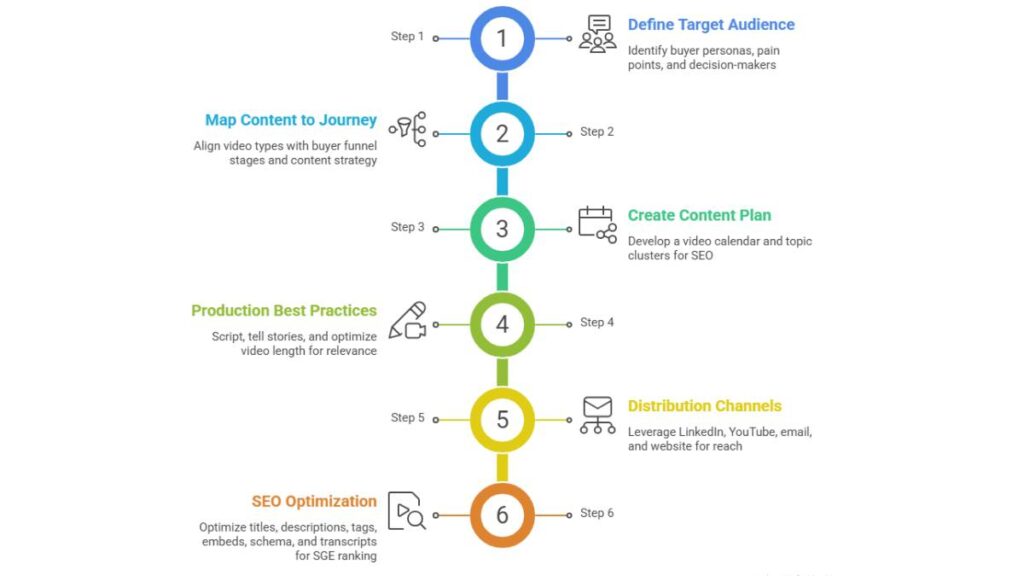
Step 1: Define B2B Target Audience & ICP
Everything starts here. And yet, this is where most video efforts quietly fall apart.
B2B audiences aren’t a single group. They’re layered: decision-makers, influencers, users, sometimes all in the same deal. Each one cares about different things. A CFO looks for efficiency and cost. A marketing lead wants performance. An end user just wants the product not to slow them down.
So defining the Ideal Customer Profile (ICP) isn’t just about industry or company size. It’s about understanding who’s involved in the decision and what each person needs to feel confident moving forward.
That means digging into:
- What problem actually triggered the search
- What alternatives have they already considered
- What objections tend to show up late in the process
- What “success” looks like from their point of view
Video becomes far more effective when it speaks to these specifics. Not broad messaging, but targeted clarity. One video doesn’t need to do everything; it just needs to land with the right person at the right moment.
Step 2: Map Video Content to Buyer Journey
A common mistake is creating video content in isolation. A demo here, a testimonial there… but no real connection between them.
In reality, video works best when it’s mapped to the buyer journey. Each stage needs a different kind of conversation.
At the early stage, content should open interest. Short explainers, thought-led videos, quick insights; things that help buyers understand the problem better than they did before.
As they move forward, the content needs to shift. Now it’s about evaluation. Product walkthroughs, comparisons, deeper dives. This is where clarity starts turning into preference.
And toward the end, it becomes more specific. Case studies, ROI-focused videos, personalized walkthroughs. These don’t introduce new ideas; they remove the last bits of hesitation.
When this mapping is done well, the content feels connected. One piece leads to the next. The buyer doesn’t have to search for answers; they naturally find them.
Step 3: Create a B2B Video Content Plan
Without a plan, video tends to become reactive. One-off ideas, inconsistent publishing, no real direction. It shows.
A content plan doesn’t need to be complicated, but it does need to be intentional.
Start by identifying a few core themes: problems your audience consistently faces, questions that come up often, and areas where confusion is common. These become your foundation.
From there, build around them. Not just single videos, but clusters. For example, one core topic can turn into:
- A short awareness video
- A deeper explainer
- A product-focused walkthrough
- A supporting case study
This approach does two things. It keeps content consistent, and it makes sure you’re not repeating the same message in slightly different ways.
A simple calendar helps, but flexibility matters too. Some of the best-performing videos come from reacting to what’s happening right now: industry shifts, new challenges, changing buyer behavior.
Structure is useful. Rigidity usually isn’t.
Step 4: Video Production Best Practices
There’s a tendency to overcomplicate production. Fancy visuals, heavy editing, trying to make everything look perfect.
But in B2B, clarity almost always beats polish.
Scriptwriting is a good place to start. Not in a rigid, word-for-word way, but as a way to structure thinking. What’s the one idea this video needs to communicate? What’s the simplest way to explain it? If that’s not clear, no amount of editing will fix it.
Storytelling matters too, even in technical content. Not dramatic storytelling, just logical flow. Problem → context → solution → outcome. When that flow is missing, videos feel scattered.
Length is another area where teams often get stuck. There’s no universal “right” length. A short video works well for awareness. A longer one can work just as well deeper in the funnel. What matters is whether the content justifies the time.
One thing that’s become clear: shorter, focused videos tend to perform better in most cases. Not because attention spans are shrinking, but because clarity improves when you remove the unnecessary parts.
And sometimes, a slightly less polished video feels more real. More direct. Easier to trust.
Step 5: Distribution Channels for B2B Video
Creating the video is only part of the job. Distribution is where most of the impact actually happens.
Different platforms serve different purposes, and treating them the same rarely works.
LinkedIn has become a natural space for B2B video. Especially for short-form and thought-led content. It’s where professionals already spend time, so content fits more naturally into their day.
YouTube plays a different role. It’s more intent-driven. People go there to learn, compare, and explore. Longer-form content, demos, and educational videos tend to perform better here.
Email is often underused when it comes to video. Adding a video element, whether it’s a thumbnail or embedded content, can noticeably improve engagement. Especially when it’s tied to a specific action or stage in the journey.
Then there’s your own website. Landing pages, product pages, blog content. The video here doesn’t need to attract attention; it needs to support decisions. A well-placed demo or testimonial can make a measurable difference.
The key is not to rely on a single channel. Distribution works best when it’s layered. One piece of content, adapted and placed where it makes the most sense.
Step 6: Video SEO Optimization (Critical for SGE Ranking)
A strong video that no one finds doesn’t do much.
Optimization isn’t about chasing algorithms; it’s about making content easier to discover and easier to understand.
Titles and descriptions should be clear, not clever. If someone is searching for a solution, the video should match that intent directly. Overcomplicating language usually reduces visibility.
Embedding videos within relevant content also helps. A video placed inside a blog or landing page adds context. It gives viewers a reason to stay longer and explore further.
Transcripts and captions are often overlooked, but they matter more than they seem. They make content accessible, and they also add another layer of clarity for both users and search systems.
Structured data, tagging, metadata… all of these support discoverability, but they only work when the content itself is aligned with what people are actually looking for.
At the end of the day, optimization isn’t separate from strategy. It’s part of making sure the right people find the right content at the right time.

Enroll Now: Product Marketing Course
B2B Video Marketing Examples
Looking at examples usually clears things up faster than any framework. Not the polished case studies; the actual stuff teams are putting out and what it ends up doing.
Take a typical SaaS product demo. On paper, it’s just a walkthrough. But the ones that work don’t feel like tours. They feel closer to… “here’s how this solves something specific.” A user logs in, does one task, and reaches a clear outcome. That’s it. No need to cover every feature. In fact, trying to do that usually makes the whole thing harder to follow.
There’s a small shift there, but it matters. Showing use beats explaining capability almost every time.
Testimonial videos are a different story. They either land really well… or feel completely flat. And the difference is usually obvious. When someone speaks in their own words, slightly uneven, maybe not perfectly structured, it feels real. When it’s too polished, too rehearsed, it starts sounding like marketing again.
The best ones tend to focus on simple things:
- What wasn’t working before
- What changed after
- What that change actually meant in day-to-day work
No need for big claims. Specifics do the heavy lifting.
Then there’s thought leadership content. This one’s interesting because it doesn’t look like “marketing” at all. A short video explaining a shift in the industry, a quick breakdown of something people are getting wrong… it builds familiarity over time. People start recognizing the voice behind it. And later, when that same brand shows up with a product message, it doesn’t feel cold.
Webinars sit somewhere in the middle. Live sessions bring in attention, sure. But the real value tends to show up later. The recording gets reused, clipped, and shared in follow-ups. One session turns into multiple touchpoints without much extra effort.
And that’s kind of the pattern across all of this. No single video does everything. The impact builds when these pieces connect; when someone can move from one to the next without feeling like they’ve hit a dead end.
Latest B2B Video Marketing Trends
AI-Powered Video Personalization
Personalization has been around for a while, but video is where it’s starting to feel… more noticeable.
Not in a flashy way. More in the small details.
A video that references a use case relevant to a specific industry. Or speaks to a role without being generic. These aren’t massive changes, but they shift how the content feels. Less like a broadcast, more like something intended for a particular audience.
And that’s enough, in most cases. It doesn’t need to be overengineered. Just aligned.
Interactive & Shoppable Videos
Video used to be pretty linear. You hit play, watched, and that was it.
That’s changing a bit.
Now there’s more control on the viewer’s side. Clicking into sections, jumping to parts that matter, exploring features without sitting through everything else. It’s subtle, but it changes how people engage.
In B2B, this shows up most clearly in product videos. Someone doesn’t care about the entire platform; they care about one feature, one workflow. Letting them get there quickly reduces friction. And less friction usually means more engagement.
Short-form & Mobile-First Video Content
Short-form video has settled into B2B, but not in the same way it works in other spaces.
It’s not about going viral. It’s more about staying visible.
Quick clips: 30 to 60 seconds; sharing a single idea, a small insight, or a reaction to something current. These pieces don’t try to do too much. They just create a moment. Something that makes a viewer pause for a second.
From there, if the interest is there, they’ll go deeper.
Mobile plays a role in shaping this. Vertical formats, tighter edits, less buildup. People are watching between tasks, not sitting down for it. So the content adapts.
AR/VR and Immersive Video Experiences
This one hasn’t fully gone mainstream, but it’s finding its place in specific industries.
Where products are hard to visualize or too complex to explain, immersive experiences help. Virtual walkthroughs, simulated environments, and things that let a buyer “see” how something works without being there physically.
It’s not something every business needs. But where it fits, it cuts down a lot of explanation.
Data-Driven Video Marketing
There’s more attention now on what happens after a video is published.
Not just views, but behavior. Where do people stop watching? Which parts get replayed? Which videos actually lead to conversations, not just clicks?
Over time, patterns start showing up.
Some topics consistently hold attention. Some formats lose people halfway through. Some videos quietly outperform everything else without being obvious about it.
That feedback loop changes how content gets created next. Less guessing, more adjusting.
And honestly, that’s where a lot of improvement comes from; not big changes, just small corrections based on what’s already happening.
Best Practices for B2B Video Marketing
There’s a lot of advice floating around on video, but a few things tend to hold up no matter the industry.
First, structure matters more than production quality. A video with a clear flow (problem, context, solution) will usually outperform something that looks great but feels scattered. People need to follow the idea without effort.
Second, keep it tight. Trying to cover too much in one video almost always backfires. It feels heavy, and viewers drop off. It’s better to break things into smaller, focused pieces. Let each video do one job properly.
Captions… these aren’t optional anymore. A lot of people watch without sound, especially on social platforms. If the message depends entirely on audio, it gets lost.
CTAs should be there, but they don’t need to be aggressive. Not every video needs to push for a demo or sign-up. Sometimes a softer next step works better; watch another video, explore a page, learn something more.
Consistency matters, but not in the way most people think. It’s not about posting every day. It’s about showing up regularly with something useful. That builds familiarity over time.
And one thing that doesn’t get said enough: perfection isn’t the goal.
In B2B, overly polished videos can sometimes create distance. They feel… too produced. A slightly rough edge, a more direct tone, that can actually make the content easier to trust.
At the end of the day, the job of video isn’t to impress. It’s to make something clearer than it was before. If that’s happening, the rest usually follows.
Common B2B Video Marketing Mistakes to Avoid
A lot of B2B video content doesn’t fail because of budget or tools. It usually comes down to a few predictable missteps; things that seem small but quietly hurt performance.
1. Creating overly long videos
There’s a tendency to “cover everything” in one go. It feels efficient. In reality, it overwhelms the viewer. Most people are looking for one clear answer, not a full product tour. Shorter, focused videos almost always hold attention better.
2. Ignoring SEO optimization
A well-made video that no one finds… doesn’t do much. Titles, descriptions, transcripts; these aren’t extras. They’re what help the content show up in the first place. Skipping this step limits reach, even if the video itself is solid.
3. Lack of distribution strategy
Publishing a video and hoping it gets traction rarely works. Where is it going? LinkedIn, email, landing pages, sales conversations? Good videos need placement. Otherwise, they just sit there.
4. Not aligning with the sales funnel
Some videos try to speak to everyone at once: new visitors, warm leads, ready-to-buy prospects. That usually dilutes the message. A top-of-funnel video should feel very different from something meant for closing a deal.
5. Overly salesy content
This one shows up a lot. Heavy product pushing, too early, too direct. Most B2B buyers need context before they need a pitch. If the video jumps straight to “buy this,” it creates resistance instead of interest.
There’s no need to get everything perfect. But avoiding these mistakes alone puts most teams ahead of the curve.
How to Measure B2B Video Marketing Success (KPIs & Metrics)
Measuring video performance isn’t just about views. In fact, views on their own don’t tell much. What matters is what people do after watching, and how they engage along the way.
Key Video Marketing Metrics
View count and watch time
Views give a rough idea of reach. Watch time tells a more useful story. If people drop off early, something’s not working; either the hook, the pacing, or the relevance.
Engagement rate
Likes, comments, shares… these are signals. Not perfect ones, but they help. Especially on platforms like LinkedIn, where engagement can extend reach beyond the initial audience.
Click-through rate (CTR)
If a video includes a next step, visit a page, sign up, or explore more, CTR shows whether people are actually taking it. A strong video with a weak CTA often shows up here.
Conversion rate
This is where things get real. How many viewers turn into leads, sign-ups, or actual opportunities? It’s not always immediate, but over time, patterns become clear.
ROI of B2B Video Marketing
ROI in B2B video isn’t always instant. It builds gradually, across multiple touchpoints.
Lead generation tracking
Forms, demo requests, webinar sign-ups; these can often be traced back to video interactions, especially when videos are embedded in landing pages or emails.
Pipeline contribution
Some videos don’t generate leads directly, but influence deals later. Product demos, case studies, and follow-up videos; these help move prospects forward, even if they weren’t the first touch.
Revenue attribution
This part takes a bit more setup. Connecting video views to closed deals isn’t always straightforward. But when tracked properly, it becomes clear which content is actually contributing to revenue, not just attention.
A simple way to think about it: a good video doesn’t just get watched, it moves people closer to a decision.
Tools for B2B Video Marketing
Tools matter, but not as much as people think. A strong idea with basic execution will usually outperform a weak idea with expensive production. Still, having the right setup makes things smoother.
Video creation tools
Used for editing, adding captions, trimming clips, and basic production work. These don’t need to be complex; just reliable enough to get content out consistently.
Video hosting platforms
Where the videos live. Some are built for public discovery, others are better for embedding on websites or sharing in sales conversations. Choosing the right one depends on how the video is being used.
Video analytics tools
These help track performance beyond surface-level metrics. Things like watch time, drop-off points, and viewer behavior. Over time, this data becomes more valuable than the video itself; it tells you what to improve next.
AI video tools
These are starting to play a bigger role, especially in speeding up production. Generating captions, editing clips, and even creating basic videos from text. Useful, but only when guided properly. Left unchecked, they tend to produce content that feels generic. As AI video workflows evolve, creators can explore advanced video generation models like Seedance 2.5 through invideo Agent to produce visuals that better align with their creative goals.
At the end of the day, tools should support the process, not drive it. The focus stays on clarity, relevance, and making something worth watching.
Future of B2B Video Marketing
Things are shifting, but not in a dramatic, overnight way. It’s more of a steady change in how video gets created, distributed, and actually used inside the buying process.
AI-generated video content
Video creation is getting faster. What used to take weeks can now be done in days, or even hours. But speed isn’t the real story here. The bigger shift is volume and variation.
Instead of producing one “perfect” video, teams are starting to create multiple versions of the same idea: slightly different angles, different messaging, different audiences. More testing, less guesswork.
That said, faster production comes with a trade-off. When everything looks polished and generated, it starts to feel… interchangeable. The brands that stand out will be the ones that keep some level of personality in their content.
Automation in video production
A lot of the repetitive work is slowly getting removed. Editing, captioning, and formatting for different platforms; these things are becoming easier to handle at scale.
Which changes where the effort goes.
Less time spent on execution, more time on thinking through what the video should actually say. The strategy side becomes more important than the production side. That’s already starting to show.
Hyper-personalization at scale
Personalization won’t just be a “nice addition” anymore. It’s moving toward being expected.
Different industries, roles, and company sizes; each group sees a version of the content that feels relevant to them. Not completely custom, but tailored enough to make sense in their context.
In B2B, where buying decisions involve multiple stakeholders, this matters even more. One generic message rarely works for everyone involved.
Integration with sales workflows
Video is becoming part of the sales process itself, not just marketing.
Sales teams are using videos in outreach, follow-ups, and even during deal stages. A quick walkthrough, a personalized explanation, a recap after a call; these things reduce back-and-forth and keep momentum going.
Over time, the line between marketing content and sales content gets thinner. It all starts working together instead of sitting in separate buckets.
The overall direction is pretty clear. More video, more personalization, and closer alignment with how buyers actually make decisions. Not necessarily more complicated; just more connected.
Conclusion
B2B video marketing has moved well past the experimental phase. It’s not something to “try out” anymore; it’s becoming part of how companies communicate, explain, and sell.
The reason is simple. B2B products and services are often complex. Video shortens the gap between confusion and clarity. It helps people see how something works, not just read about it.
Across the funnel, the role changes:
- At the top, it builds awareness and familiarity
- In the middle, it answers questions and builds trust
- At the bottom, it helps decisions happen faster
And when it’s done right, it doesn’t feel like marketing. It feels useful.
The key isn’t to produce more videos. It’s to produce the right ones, aligned with what the buyer needs at each stage. A clear message, a focused approach, and consistent execution tend to go further than high production alone.
Looking ahead, video will only become more integrated into everyday workflows: marketing, sales, and even customer success. The teams that adapt early won’t just get more views, they’ll have smoother conversations and shorter sales cycles.
That’s really what this comes down to. Making things easier to understand… and easier to act on.
FAQs: B2B Video Marketing
What is B2B video marketing?
At its simplest, it’s using video to explain, educate, and move business buyers closer to a decision. Not just “watch this product,” but more like, here’s how this actually solves something. It shows up in demos, testimonials, webinars… different formats, same intent. Make complex things easier to understand.
Why is video important in B2B marketing?
Because most B2B offerings aren’t easy to grasp at a glance. Video cuts through that. Instead of reading through pages, a buyer can see how something works in a few minutes. It also feels more human, which matters when trust is part of the decision. People engage longer, too, quietly, which makes a difference.
What types of videos work best for B2B?
Depends on where the buyer is. Early on, explainer-style videos do well. When interest builds, demos and walkthroughs start making more sense. Closer to decisions, testimonials or case studies carry weight. There’s no one format that wins everywhere. Matching the video to the moment; that’s usually what works.
How long should B2B videos be?
Shorter is safer, especially at the start. Somewhere around 30–90 seconds for awareness works well. But once someone is interested, longer videos aren’t a problem if they stay relevant. A 5-minute demo can hold attention. A 2-minute unfocused video won’t. Length matters less than how quickly value shows up.
How to create a B2B video marketing strategy?
It usually begins with clarity around the audience. Who’s watching, what they care about, what stage they’re in. From there, videos get mapped to those stages. Then comes planning: what to create, where it goes, how it’s measured. Without that structure, videos end up scattered. And scattered rarely performs well.
Which platform is best for B2B video marketing?
There isn’t a single answer here. LinkedIn works well for visibility and industry conversations. YouTube helps with discovery and deeper content. Email and websites handle nurturing and conversions. The stronger setups usually combine a few. Each platform plays a role instead of trying to do everything in one place.
How does B2B video marketing generate leads?
The video itself usually isn’t the lead generator; it’s what it leads into. A clear next step matters. That could be a demo, a signup, or a deeper resource. When video removes confusion, people are more likely to take that step. It’s less about pushing, more about making the decision easier.
What is the best platform for B2B video marketing in 2026?
LinkedIn still stands out for B2B conversations, no surprise there. YouTube remains strong for search and longer content. But relying on one platform isn’t ideal. The better approach is to match the platform with the goal: reach, engagement, or conversion; rather than trying to force everything into one channel.
How much does B2B video marketing cost?
It can be minimal or quite high; it really varies. But cost isn’t the deciding factor most of the time. A simple, clear video can outperform something expensive but unfocused. The message does most of the work. Spending more helps only when the fundamentals are already in place.
What is the ideal length of a B2B marketing video?
There’s no fixed number that works everywhere. Short videos grab attention faster, especially on social. Longer ones work when the viewer already cares. A detailed demo can run several minutes without losing interest. The key is pacing;if it feels slow or stretched, people drop off. Pretty quickly, actually.
How do you create a high-converting B2B video?
It usually starts with a clear problem. Then moves straight into how it’s solved, without too much buildup. The best ones feel easy to follow, almost obvious by the end. No over-explaining, no heavy selling. Just enough clarity that the next step feels natural instead of forced.
What are the best tools for B2B video marketing?
There’s no perfect stack. Some tools help with editing, others with hosting or tracking. What matters more is consistency. If the setup helps produce and publish regularly, it’s doing its job. Overcomplicating things tends to slow teams down. Simple setups, used well, usually go further.
How to optimize B2B videos for SEO?
It comes down to making the video easy to find and understand. Clear titles, relevant descriptions, and proper tagging help. Transcripts and captions add context. Embedding videos within useful content also improves visibility. It’s not complicated, but skipping these basics limits how far the video can reach.
What types of B2B videos drive the most conversions?
Videos closer to the decision stage tend to convert better. Product demos, case studies, testimonials; anything that shows real outcomes. These answers specific questions and reduce uncertainty. Instead of telling, they show. And that shift, from claims to proof, usually makes the difference.
Is video marketing effective for small B2B businesses?
Yes, and in many cases, it levels things out. Smaller teams don’t need large budgets to compete. A clear message, delivered well, can go a long way. In fact, slightly less polished videos sometimes feel more real, which can work in their favor. It’s more about relevance than scale.
How often should B2B companies post video content?
Consistency tends to matter more than frequency. Posting once or twice a week, regularly, builds familiarity over time. Sudden bursts of content followed by silence don’t do much. It’s better to find a pace that’s sustainable and stick with it. That steady presence adds up.
What is the ROI of B2B video marketing?
It doesn’t always show up immediately. Some videos generate leads directly, others influence decisions later. Over time, patterns become clearer: better engagement, higher conversions, shorter sales cycles. The impact builds gradually. It’s less about one video performing, more about the system working together.
How to use video marketing in B2B email campaigns?
Video fits well into an email when it adds clarity. A short demo, a quick explanation, something that moves the conversation forward. It tends to increase clicks when it feels relevant. The key is keeping it focused; no long introductions, just straight to what matters.
What are common challenges in B2B video marketing?
A lot of teams struggle with unclear messaging or inconsistent output. Sometimes videos are created without a clear role in the funnel. Distribution is another gap; good content that doesn’t reach the right audience. Often, the issue isn’t production quality. It’s a lack of direction.
How is AI changing B2B video marketing?
It’s making production faster, no doubt. But speed isn’t the main shift. The bigger change is in personalization, creating variations for different audiences without starting from scratch each time. Still, tools can only do so much. If the core message isn’t strong, the output won’t be either.