

Most SEO teams spent 2025 chasing rankings while a bigger shift happened quietly underneath them. Google AI Overviews now show up in roughly 45% of searches, and a growing share of those searches never end in a click at all. If your content isn’t structured to get picked up and quoted by an AI system, it doesn’t matter how well it ranks on page one.
That’s the gap Claude SEO skills are built to close. Instead of manually auditing every page for AI extractability, you hand Claude a packaged skill file that tells it exactly how AI search engines select, structure, and cite content, then let it do the audit, the rewrite, and the monitoring plan for you. By the end of this guide, you’ll know what these skills are, how the most widely used one actually works, and how to set it up for your own content this week.
Table of Contents
What Are Claude Skills, and Why Do They Matter for SEO?
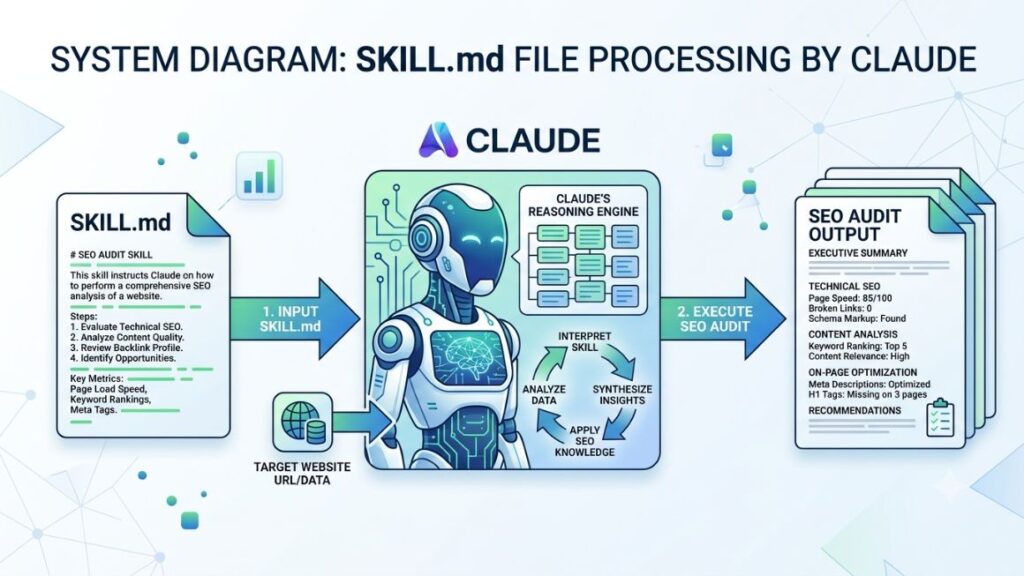
Claude skills are modular instruction packages, each built around a single file called SKILL.md, that give Claude domain-specific expertise it doesn’t have by default. Anthropic describes them as reusable, filesystem-based resources: workflows, context, and best practices that turn a general-purpose model into a specialist for one job. Instead of re-explaining your process every single conversation, you load the skill once and Claude applies it automatically whenever the task matches.
Here’s the part that matters for marketers. Skills aren’t limited to coding. They work the same way across Claude.ai, Claude Code, and the Claude API, which means a skill built for SEO audits behaves identically whether you’re running it in a chat window or inside an automated content pipeline. Anthropic’s own skills documentation confirms this: a skill is discovered by its description, loaded into context only when relevant, and then executed step by step.
The reason this matters for search right now is timing. According to Similarweb’s 2024 usage data referenced across multiple SEO research reports, AI Overviews and chat-based answer engines have cut click-through rates to websites by as much as 58% for informational queries. Traditional audits can’t keep pace with three or four AI platforms, each with different citation logic. A packaged skill can, because it encodes that logic once and reuses it every time.
Honestly, most teams still treat this as a “nice to have” experiment. It shows. The brands already running structured content through an SEO-focused skill are the ones showing up when you ask ChatGPT or Perplexity a category question, and the ones that aren’t are watching competitors get cited in their place.
How the Claude AI SEO Skill Actually Works
The most complete open-source example right now comes from Infrasity Labs, whose dev-gtm-claude-skills repository includes an ai-seo skill built specifically for developer-focused go-to-market teams. It’s a useful reference point because it’s public, well-documented, and built around the same core logic every serious AI SEO effort needs.
The skill opens by gathering context before it does anything else: your current AI visibility, what content types you publish, your competitive landscape, and your goals. That sequence matters. Skipping straight to “optimize this page” without knowing whether you’re already being cited somewhere else wastes effort on the wrong priority.
Once context is established, the skill walks through what it calls an AI visibility audit. This is where a well-built skill earns its keep over a manual process. The skill tests your top 10 to 20 priority queries across Google AI Overviews, ChatGPT, and Perplexity, checks whether your competitors are cited where you aren’t, and inspects your content for the structural signals AI engines look for: a clear definition in the opening paragraph, self-contained answer blocks, cited statistics, comparison tables, and an FAQ section.
It also checks something most manual audits skip entirely: your robots.txt file. If GPTBot, PerplexityBot, ClaudeBot, or Google-Extended are disallowed, those platforms literally cannot cite your content, no matter how well-structured it is. That’s a one-line technical fix that gets missed constantly because it lives outside the content team’s usual checklist.
A Claude AI SEO skill runs a structured visibility audit across Google AI Overviews, ChatGPT, and Perplexity, checking both content extractability and technical access signals like robots.txt bot permissions before recommending any changes. This sequencing, audit first, changes second, is what separates a skill-driven process from a generic rewrite.
AI Search vs Traditional SEO: What Changed by 2026
Traditional SEO gets you ranked. AI search gets you cited, and those are not the same outcome anymore.
In classic search, you needed to land on page one to get meaningful traffic. In AI search, a page ranking third or fourth can still get pulled into an AI Overview or a ChatGPT answer if it’s structured well enough to extract cleanly. Rank position still correlates with citation, especially for Google’s AI features, but it’s no longer the only variable.
Google has been explicit about its own stance here. Its AI features optimization guide states plainly that the best practices for SEO remain relevant because its generative AI features are rooted in core Search ranking and quality systems. Google’s guidance also warns against writing separate content specifically for AI, since that risks triggering its scaled content abuse policy. In other words: don’t fragment your page into bite-sized AI bait. Write for people, organize clearly, and both audiences win.
Where it gets more interesting is the platforms outside Google’s index. ChatGPT, Perplexity, and Copilot behave differently. They actively reward extractable structure, things like 40 to 60 word answer blocks, FAQ sections, and comparison tables, and they lean heavily on third-party sources. Brands are roughly 6.5 times more likely to be cited through third-party mentions on Wikipedia, Reddit, or review platforms than through their own domain, based on citation pattern analysis published across multiple AI SEO research reports in 2024 and 2025.
There’s also a structural shift happening inside Google itself called query fan-out. When someone asks “how to fix lawns,” Google’s AI doesn’t just answer that one query. It quietly generates related queries about herbicides, chemical-free removal, and prevention, then synthesizes across all of them. A single narrow page targeting one keyword is weaker in this world than a page that comprehensively covers a topic cluster. That’s a genuine departure from a decade of one-keyword-per-page thinking, and it’s why content strategy is shifting toward topical depth over keyword lists.
The Three Pillars of AI-Powered SEO
Every well-built AI optimization workflow organizes its recommendations around three pillars: structure, authority, and presence. Skip one and the other two don’t compensate for it.
Structure: Make Content Extractable
AI systems extract passages, not entire pages, which means every key claim in your content needs to work as a standalone statement. That’s a different discipline than writing a flowing narrative article.
Practically, this means leading every section with a direct answer instead of building up to it, keeping key passages to 40 to 60 words for optimal extraction, using headings phrased the way people actually ask questions, and choosing tables over prose whenever you’re comparing options. A comparison table for “X vs Y” queries will get pulled far more often than the same information buried in three paragraphs.
Authority: Make Content Citable
This is where the data gets specific enough to act on. Research from Princeton, published at KDD 2024 and conducted across Perplexity’s citation behavior, ranked nine optimization methods by their impact on AI visibility. Citing sources produced a 40% visibility boost. Adding statistics added 37%. Quotations from named experts added 30%. Writing in an authoritative, demonstrated-expertise tone added 25%.
The same research found something worth sitting with: keyword stuffing actively hurt visibility by 10%. That’s not neutral, it’s a penalty. The old SEO instinct to repeat a keyword until it feels safe works directly against you in AI search.
Princeton’s KDD 2024 GEO study found that citing sources boosts AI visibility by roughly 40%, adding statistics adds 37%, and expert quotations add 30%, while keyword stuffing actively reduces visibility by 10%. The strongest combination researchers found was pairing clear, fluent writing with specific statistics, which produced the largest citation gains of any tested method.
Presence: Be Where AI Looks
AI engines don’t only cite your website. They cite wherever you show up. Wikipedia mentions account for roughly 7.8% of all ChatGPT citations, and Reddit discussions account for another 1.8%, based on citation-share data circulating in AI SEO research through 2025. That means a genuinely helpful Reddit answer in your category can outperform a polished blog post for AI citation purposes.
For B2B brands, review platforms like G2 and Capterra carry real weight too. An Indian D2C example makes this concrete: a brand like Nykaa benefits from citation not just through its own product pages but through beauty forums, YouTube reviews, and comparison roundups that AI engines pull from when someone asks “best foundation for oily skin in India.”
Step-by-Step: Setting Up the Skill for Your Content
Here’s how to actually put this kind of skill to work, whether you’re using Claude.ai, Claude Code, or the API.
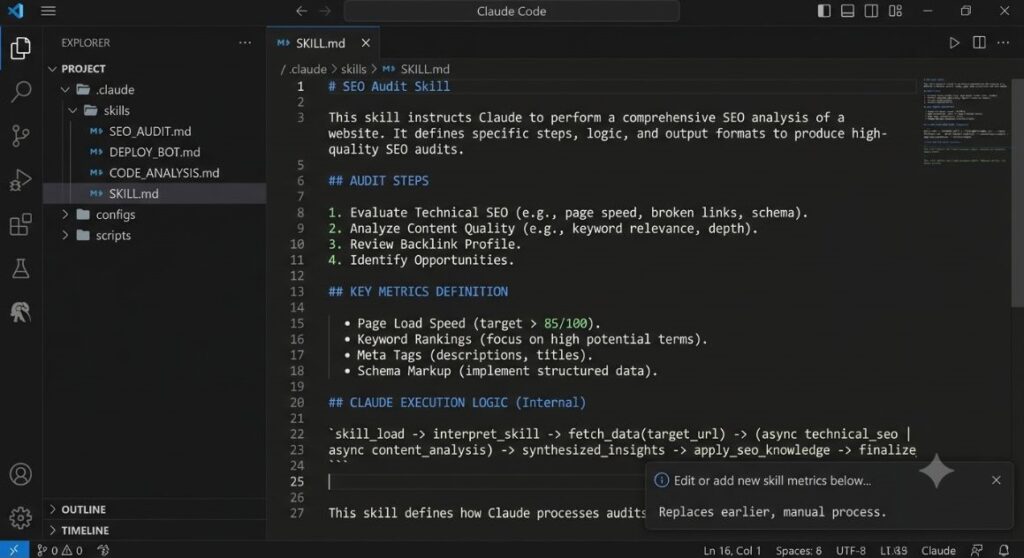
- Create or source the SKILL.md file. Use an existing open-source skill like Infrasity Labs’
ai-seoskill, or write your own following the standard format: YAML frontmatter with a name and description, followed by clear instructions Claude can follow. - Place it in the right directory. For Claude Code, that’s
.claude/skills/at the project or personal level. For Claude.ai, you upload the skill directly through the interface. For the API, you specify the skill ID in the container parameter alongside the code execution tool. - Feed Claude your current content and context. Share your top-performing pages, your current robots.txt, and the 10 to 20 queries that matter most to your business.
- Let it run the AI visibility audit. Claude checks each query across the platforms you care about and flags where competitors are cited and you aren’t.
- Review the extractability checklist. This covers definitions, answer blocks, statistics, comparison tables, FAQs, and schema markup, all scored pass or fail per page.
- Fix technical access issues first. Confirm GPTBot, PerplexityBot, ClaudeBot, and Google-Extended aren’t blocked before touching a single sentence of content.
- Rewrite flagged pages using the structural patterns. Direct answer blocks, named entities instead of vague references, and cited statistics with sources and dates.
- Set a monthly recheck cadence. AI citation patterns shift faster than traditional rankings, so quarterly reviews are too slow for competitive categories.
Content Types That Get Cited Most by AI Engines
Not every content format has equal odds of getting pulled into an AI answer. Comparison articles lead the pack, accounting for roughly 33% of AI citations based on content-type analysis published across GEO research in 2024 and 2025, because they’re already structured, balanced, and high-intent by nature.
Definitive guides follow at around 15%, largely because comprehensiveness signals authority to both readers and AI systems. Original research and proprietary data sit at roughly 12%, which makes sense: AI engines can’t cite a stat that doesn’t exist anywhere else. Best-of listicles and product pages each account for roughly 10%, and how-to guides trail at around 8%, mostly because their step structure is easy to extract but the content itself is narrower in scope.
The clear underperformers are worth naming directly: generic blog posts without structure, thin product pages padded with marketing language, gated content an AI crawler simply can’t access, anything missing a publish date or author name, and PDF-only resources that are harder for most AI systems to parse cleanly.
A practical example: when Swiggy or Zomato-style food delivery brands get cited in AI answers about “best food delivery app for late-night orders in Bangalore,” it’s rarely their homepage doing the citing. It’s a comparison piece, a Reddit thread, or a review roundup that structured the comparison clearly enough for the AI to lift.
Common Mistakes Teams Make With Claude Skills for SEO
The single biggest mistake is treating AI SEO as a separate discipline from regular SEO. It isn’t. Good traditional SEO, clean indexing, solid E-E-A-T, genuine expertise, is the foundation everything else sits on. A well-built skill applied to your SEO process amplifies that foundation. It doesn’t replace it.
The second mistake is writing content that reads like it was built to game an algorithm rather than help a person. If your writing feels produced, AI systems are increasingly good at recognizing that pattern, and it won’t get cited or convert either way.
A few more that show up constantly:
- No freshness signals anywhere on the page, which matters because AI systems weight recency heavily when choosing between similar sources
- Gating your most authoritative content behind a form, which makes it invisible to the crawlers that would otherwise cite it
- Ignoring third-party presence entirely and assuming your own domain is the only place that counts
- Ignoring SEO skills and audits until a competitor visibly outranks you in an AI answer, at which point you’re playing catch-up instead of building a lead
- Blocking AI bots in robots.txt while simultaneously complaining that ChatGPT never mentions the brand
That last one happens more often than teams expect. Somebody blocks crawlers for a legitimate reason, usually to prevent AI training on proprietary content, without realizing the same block also prevents citation. The fix Anthropic and most GEO researchers recommend is blocking training-only crawlers like CCBot while explicitly allowing the search-and-cite bots.
Monitoring and Measuring AI Visibility After Deployment
You can’t improve what you don’t measure, and AI citation doesn’t show up in Google Search Console the way traditional rankings do. Google’s own documentation confirms there’s no AI-specific reporting inside Search Console. The standard Performance and Coverage reports are still what you use for Google’s core Search data, but they say nothing about whether ChatGPT or Perplexity mentioned you last week.
That gap is why third-party monitoring tools exist. Peec AI tracks visibility across ChatGPT, Gemini, Perplexity, Claude, and Copilot simultaneously, which makes it useful for teams tracking share of voice across every major platform at once. Otterly AI focuses on ChatGPT, Perplexity, and Google AI Overviews specifically, and ZipTie adds sentiment tracking on top of citation counts, which matters if you want to know not just whether you’re mentioned but how favorably.
If tooling budget isn’t there yet, a manual monthly check works too. Pick your top 20 queries, run each one through ChatGPT, Perplexity, and Google, and log whether you’re cited, who else is, and which specific page got pulled. Track it month over month in a shared spreadsheet. It’s not glamorous, but it beats not knowing at all, and it’s exactly the kind of grounded, repeatable habit that separates teams actually improving their AI visibility from teams just hoping their last content push worked.
Getting Started This Week
The pattern across every part of this guide is the same: structure earns extraction, authority earns citation, and presence earns reach. None of the three works alone, and skipping the audit step to jump straight to rewriting is the fastest way to waste a rewrite on the wrong page.
If you’re running this for the first time, start narrow. Pick your five highest-intent queries, run the visibility audit, fix any robots.txt blocks immediately since that’s a five-minute fix with outsized impact, then rebuild just those pages around direct answer blocks and cited statistics before expanding further.
If you want a structured way to build this into your actual content calendar rather than a one-off project, YUP’s SEO course walks through the full traditional-to-AI search transition with hands-on templates, or you can get monthly breakdowns like this one straight from the Crystal Clear newsletter.
The Claude AI SEO Skill discussed in this guide is available as an open-source project from Infrasity Labs. Because it’s built as a standard SKILL.md package, marketers can customize it for their own content workflows, automate recurring SEO audits, and extend it with additional AI optimization rules as search engines evolve.
You can also reference the SKILL.md file directly:
Claude AI SEO Skill (SKILL.md):
https://github.com/Infrasity-Labs/dev-gtm-claude-skills/blob/main/marketing-skills/ai-seo/SKILL.md
Frequently Asked Questions
What is a Claude skill built for SEO?
Claude SEO skills are packaged instruction files, structured as SKILL.md documents, that give Claude a repeatable process for auditing and optimizing content for AI search engines like ChatGPT, Perplexity, and Google AI Overviews. They cover visibility audits, content structure checks, and citation monitoring in one workflow instead of scattered manual steps.
How is AI SEO different from traditional SEO?
Traditional SEO focuses on ranking position in search results, while AI SEO focuses on getting your content cited directly inside an AI-generated answer. A page ranking third can still get cited in ChatGPT or an AI Overview if its structure, statistics, and clarity are strong enough, which makes structure matter more than rank position alone.
Do I need to write separate content for AI search engines?
No, and Google explicitly warns against it. Writing fragmented content specifically to feed AI systems risks triggering scaled content abuse penalties. The better approach is writing clear, well-organized content for people that happens to use the same structural patterns, direct answers, FAQs, comparison tables, that AI systems reward.
How do I check if I’m blocking AI crawlers?
Open your robots.txt file and look for Disallow rules targeting GPTBot, ChatGPT-User, PerplexityBot, ClaudeBot, anthropic-ai, or Google-Extended. If any of these are blocked, that specific platform cannot cite your content at all, regardless of how well-optimized the page is.
Is keyword stuffing still a problem for AI search?
Yes, and it’s arguably worse than it was for traditional SEO. Princeton’s KDD 2024 GEO research found keyword stuffing actively reduces AI visibility by around 10%, while techniques like citing sources and adding statistics increase it by 30 to 40%.
Which content types get cited most by AI engines?
Comparison articles lead at roughly 33% of citations, followed by definitive guides at around 15% and original research at around 12%. Product pages, best-of listicles, and how-to guides trail behind those three, mostly because they’re narrower in scope or less structurally distinct.
Can I use a Claude skill without any coding experience?
Yes. Skills built for Claude.ai can be uploaded directly through the interface without touching code, and Claude applies them automatically once loaded. The coding-heavy setup, placing files in a .claude/skills/ directory, is only necessary if you’re working inside Claude Code or building an automated pipeline through the API.
Do I still need Google Search Console if I’m tracking AI visibility?
Yes, for a different reason. Search Console still covers your traditional Search performance, since Google’s AI features are built on the same core ranking systems. It has no AI-specific reporting though, so you’ll need a separate tool like Peec AI or Otterly AI, or a manual monthly check, to track citations across ChatGPT and Perplexity.
Is it worth optimizing for AI search if my traffic still comes mostly from traditional clicks?
Probably, and sooner rather than later. AI Overviews already appear in around 45% of Google searches, and that share keeps growing. Waiting until AI-driven traffic becomes dominant means optimizing from behind competitors who started structuring their content for citation years earlier.
What’s the biggest mistake teams make when they start using an AI skill for SEO?
Treating it as a bolt-on experiment separate from their core SEO work. The teams that get real citation gains treat AI structure as an extension of solid traditional SEO and E-E-A-T, not a replacement for it, and they recheck their visibility monthly instead of setting it up once and forgetting it.