
Social media teams have never been under more pressure. More platforms, faster trend cycles, bigger community inboxes, and the same headcount that was there two years ago. The answer most teams reach for is more tools. Better scheduling, smarter analytics, faster content turnaround. But tools still need someone driving them.
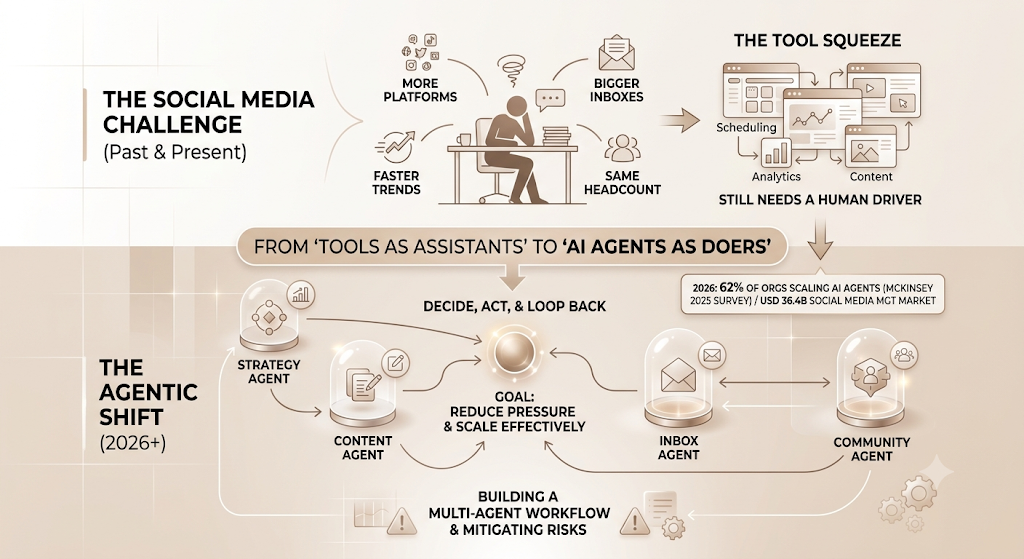
AI agents for social media marketing change that equation. They don’t just assist; they decide, act, and loop back on results without waiting for a human to prompt every step. In 2026, that shift has moved from pilot project to production reality: according to McKinsey’s 2025 State of AI survey, 62% of organizations are experimenting with or actively scaling AI agents, and the social media management market is projected to hit USD 36.4 billion this year alone.
This article breaks down exactly what AI agents are, how they work in a social media context, which tools actually qualify as agents (not just AI-assisted schedulers), and how to build a multi-agent workflow your team can actually run. It also covers the risks that most vendor guides skip.
Table of Contents
What Is an AI Agent for Social Media Marketing?
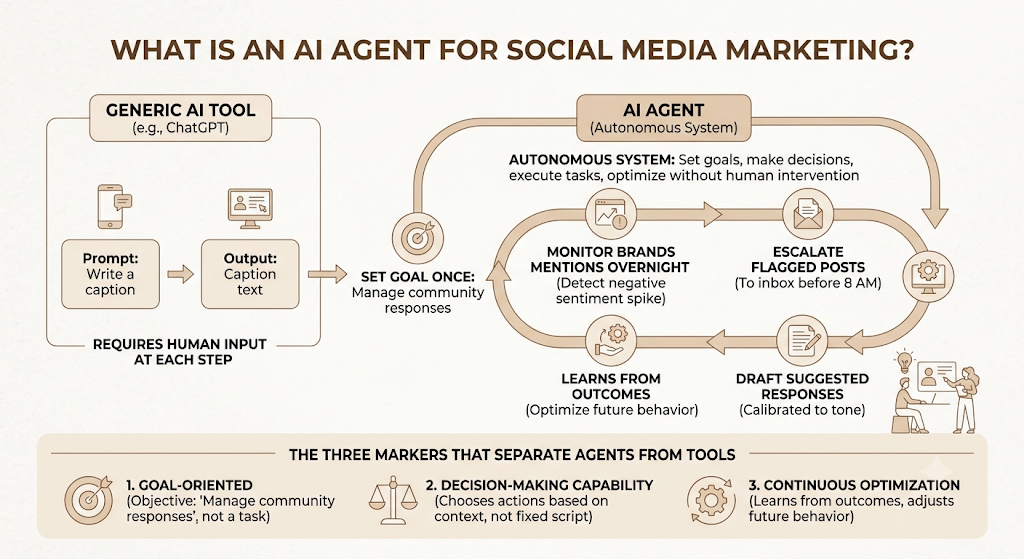
An AI agent for social media marketing is an autonomous software system that can set goals, make decisions, execute multi-step tasks, and optimize its own actions based on feedback -all without requiring human input at each step.
That definition sounds simple. The distinction from a regular AI tool is not.
When you use ChatGPT to write a caption, you’re using a generative AI tool. You prompted it, it responded, done. When Sprout Social’s Trellis agent monitors your brand mentions overnight, detects a spike in negative sentiment, escalates the flagged posts to your inbox before 8 AM, and drafts suggested responses calibrated to each post’s tone -that’s an AI agent. You didn’t ask it to do any of that. You set the goal once.
The three markers that separate agents from tools:
Goal-oriented: You give the system an objective, not a task. “Manage community responses under our new product launch posts” is a goal. “Write a response to this comment” is a task.
Decision-making capability: The agent chooses which action to take at each step based on context, not a fixed script.
Continuous optimization: It learns from outcomes and adjusts future behavior, rather than repeating the same output each time.
An AI agent for social media marketing is a goal-oriented system that independently monitors social platforms, creates content, publishes posts, manages community responses, and analyzes performance. Unlike traditional automation tools, agents make contextual decisions and adapt outputs based on real-time feedback rather than executing fixed, pre-programmed rules.
Why Traditional Social Media Automation Has Hit Its Ceiling
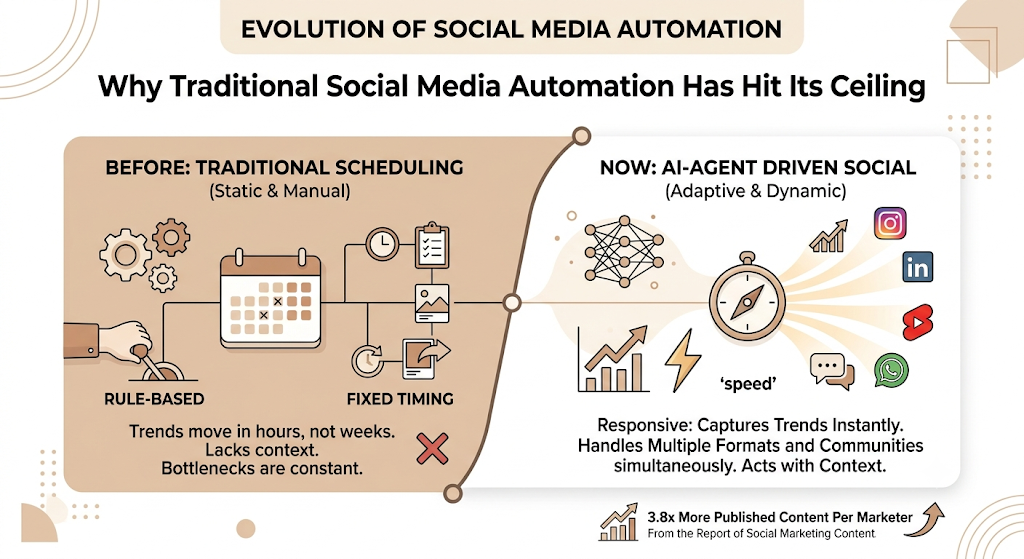
Scheduling tools were a real leap forward when they arrived. Being able to queue two weeks of posts on a Sunday afternoon changed how lean teams operated. But scheduling tools are fundamentally rule-based. They do what you tell them to do, at the time you tell them to do it, in the format you set up. That’s it.
The problem is that social media in 2026 doesn’t work on a schedule.
Trends move in hours, not weeks. A viral audio on Instagram Reels has a 48-hour window before it’s overexposed. A competitor’s product failure can generate a community moment that’s gone by the time your weekly content review happens. Community management inboxes for mid-sized brands can receive hundreds of DMs and comments daily. And the platforms themselves have multiplied.
Most Indian brands with a decent digital presence are now active across Instagram, LinkedIn, YouTube Shorts, and WhatsApp Broadcasts simultaneously. For a brand like Nykaa, that’s not content for four platforms. It’s four distinct audiences, four content formats, four sets of posting windows, and four community personalities to maintain. Doing all of that manually, even with a team, creates constant bottlenecks.
Rule-based automation doesn’t solve this because it lacks contextual judgment. If your scheduler is set to post at 9 AM Tuesday and a national tragedy occurred that morning, the tool posts anyway. If your chatbot is scripted to handle ten common questions and a new one comes in on the 11th variation, it fails. That gap between automation and intelligence is where AI agents operate.
According to HubSpot’s AI Trends 2026 report, teams using AI social media tools now produce 3.8 times more published content per marketer per month compared to pre-adoption baselines. But the bigger unlock isn’t volume. It’s responsiveness.
How AI Agents Work: The Five-Stage Social Media Loop
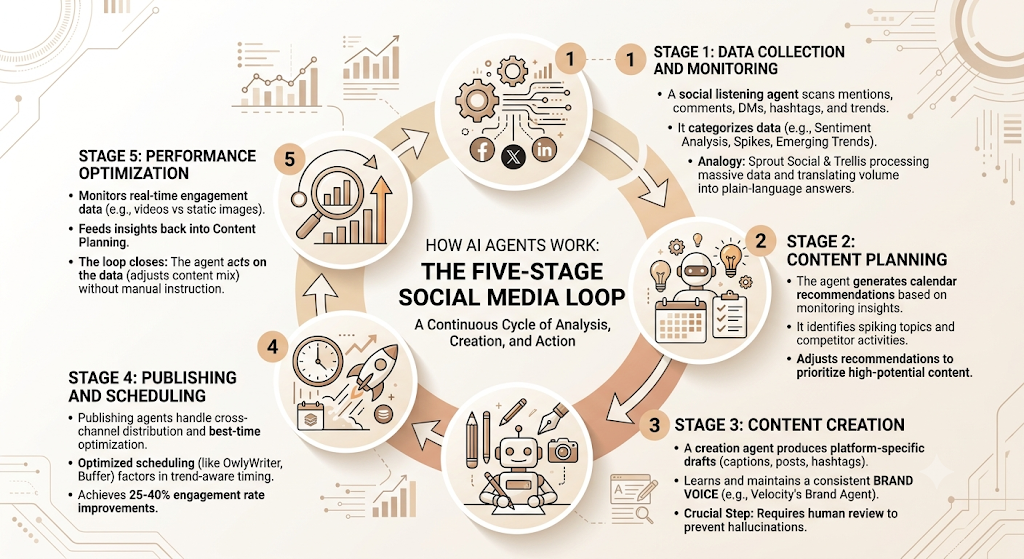
AI agents in social media don’t work the way most people picture them -a single bot doing everything. The better mental model is a cycle of five distinct stages, each of which can be handled by a specialized agent or by modules within a platform.
Stage 1: Data Collection and Monitoring
This is where agents start. A social listening agent scans mentions, comments, DMs, hashtag activity, competitor posts, and trending topics continuously. It’s not just logging data -it’s categorizing it. Positive sentiment here, negative spike there, emerging trend on LinkedIn that matches your content pillars.
Sprout Social’s AI-powered listening engine, for example, processes up to 50,000 posts per second across social platforms, news sites, and forums. The Trellis AI agent then translates that volume into plain-language answers to questions like “what is our audience saying about this campaign right now?”
Stage 2: Content Planning
Based on what the monitoring stage surfaces, a content-planning agent generates calendar recommendations. It might identify that a particular topic spiked in your audience segment on Thursday evenings and suggest a post for that slot. Or it might flag that a competitor just launched a product adjacent to your category and recommend a positioning response piece.
This is distinct from a content calendar template. The agent is reading live signals and adjusting recommendations. It doesn’t just fill slots; it prioritizes.
Stage 3: Content Creation
A content creation agent takes the brief (or generates its own based on Stage 2) and produces drafts: captions, post copy, hashtag sets, image direction notes, and platform-specific variants.
Here’s where brand voice becomes a real technical challenge. The best agents don’t just write in “professional” or “friendly” tones. Tools like Velocity’s Brand Agent learn your voice from your website and past posts, so outputs require editing rather than full rewrites. That’s the practical threshold for content agents that are worth deploying.
One caveat worth naming: content agents still hallucinate. A 2025 study found that even the best-performing models had roughly 0.7-0.8% hallucination rates. At scale, that’s not a rounding error. Every agent output that makes factual claims about your brand, products, or competitors needs a human review step.
Stage 4: Publishing and Scheduling
Publishing agents handle platform-specific posting, best-time optimization, and cross-channel distribution. Most major platforms now embed this: Hootsuite’s OwlyWriter AI drafts platform-optimized captions and factors in trend-aware timing. Buffer’s AI Assistant recommends when posts are most likely to connect based on historical engagement patterns. Early adopters of AI-optimized scheduling report 25-40% engagement rate improvements compared to fixed scheduling.
Stage 5: Performance Optimization
This is the stage most traditional tools skip entirely. A performance optimization agent monitors engagement data in real time, identifies which content formats and topics are driving results, and feeds those insights back into Stage 2. The loop closes.
This is also where the difference between an AI tool and an AI agent becomes clearest. A tool shows you the data. An agent acts on it. If your video posts are outperforming static images by 3x, an agent adjusts your content mix in the next planning cycle without you having to notice, interpret, and instruct.
AI agents for social media marketing operate through a five-stage loop: monitoring social conversations and trends, planning content based on live signals, creating platform-specific drafts, publishing at optimal times, and feeding performance data back into the planning stage. This closed-loop model replaces the manual review-and-briefing cycle that creates delays in traditional social workflows.
The Multi-Agent Social Media Team Model
The most sophisticated teams aren’t running one AI agent. They’re running a coordinated team of specialized agents, each owning a distinct function.
This is the model that most competitor articles don’t explain clearly, because it sounds complex. But it maps exactly to how a well-structured human social media team already works.
| Agent | What It Owns |
| Research Agent | Trend discovery, competitor monitoring, audience signals |
| Content Agent | Caption writing, post drafts, platform-specific variants |
| Design Agent | Visual brief generation, image prompt creation for tools like Midjourney |
| Publishing Agent | Scheduling, timing optimization, cross-channel distribution |
| Analytics Agent | Performance reporting, insight generation, and content recommendations |
| Community Agent | Comment prioritization, DM triage, response drafts |
The question is how these agents communicate. In a well-built multi-agent system, the Research Agent’s output becomes the input brief for the Content Agent. The Analytics Agent’s performance findings get routed back to the Research Agent’s prioritization logic. The Community Agent flags escalations that exceed its confidence threshold to a human reviewer.
Frameworks like CrewAI make this kind of team structure buildable without needing to write complex orchestration code from scratch. You define each agent’s role, goal, and the tasks it handles. CrewAI manages the handoffs. LangChain’s social media agent, open-sourced by the LangChain team on GitHub, takes it further: it connects to a Slack channel where your team drops relevant URLs, and the agent turns those into platform-ready posts autonomously, publishing on a cron schedule once per day.
Brands like Swiggy and boAt, which manage high-velocity content across multiple platforms simultaneously, are precisely the kind of operations where this model delivers results. High frequency, distinct platform voices, community engagement at scale -those are the conditions multi-agent systems are designed for.
Best AI Agent Tools for Social Media Marketing in 2026
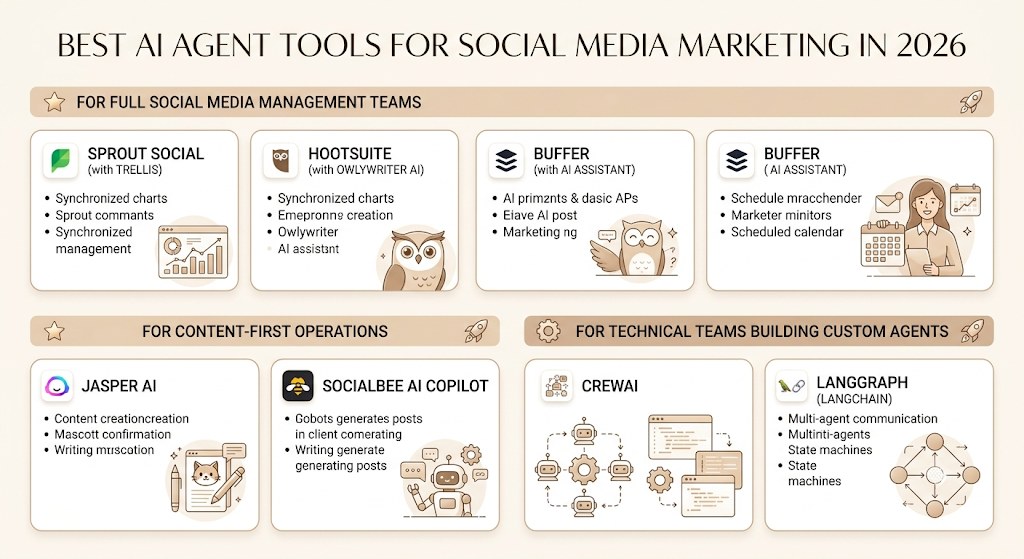
A quick note before the list: the word “AI” appears on every pricing page in 2026. Not every “AI-powered” social tool is actually running an agent. Below are the platforms that genuinely qualify, ranked by use case.
For Full Social Media Management Teams
Sprout Social with Trellis Sprout Social is the strongest overall pick for enterprise teams that need social management connected to business outcomes. The Trellis AI agent handles routine community engagement autonomously, runs sentiment analysis, and routes complex interactions to human reviewers. Its listening engine processes 50,000 posts per second. The trade-off: starting at $199 per user per month for five profiles, it’s priced out of small team reach.
Hootsuite with OwlyWriter AI and OwlyGPT Hootsuite’s AI stack is the right choice for teams that already have established social operations and need AI woven in rather than rebuilt. OwlyWriter AI generates platform-specific captions that factor in trending topics from Hootsuite’s Talkwalker integration. OwlyGPT adds conversational ideation inside the workflow. For teams that need governance, compliance controls, and a content approval structure, Hootsuite remains the most mature option.
Buffer AI Assistant Buffer is the clearest entry point for small teams and solo marketers. The AI Assistant is included on the free plan, covers scheduling and caption drafting across multiple platforms, and doesn’t require enterprise overhead to set up. It doesn’t run autonomous workflows the way Sprout or Hootsuite do, but if your bottleneck is distributing content you already have, Buffer does that job well.
For Content-First Operations
Jasper AI stays relevant because its brand voice controls are more sophisticated than most platforms. You train it on your existing content, and it maintains that voice across long-form and short-form social outputs. For teams that produce high-volume content across multiple brand accounts, Jasper’s brand voice feature reduces the editing burden more than most tools.
SocialBee AI Copilot: At $29 per month, SocialBee’s AI Copilot blurs the line between scheduler and AI-first tool. It includes DALL-E 3 image generation, over 1,000 content prompts, and strategy-based content categorization. The value-to-cost ratio is hard to beat for teams that want AI content generation and scheduling in one place without enterprise pricing.
For Technical Teams Building Custom Agents
CrewAI is the fastest way to get a functional multi-agent social media workflow running. Its role-based model maps directly to how social teams think: define a Research Agent, a Content Agent, a Community Agent. CrewAI handles coordination and handoffs. It had 45,900+ GitHub stars as of early 2026 and supports OpenAI, Anthropic, and local models via Ollama.
LangGraph (LangChain). For teams that need production-grade agents with durable execution, checkpointing, and auditability, LangGraph is the stronger choice. It’s more code than CrewAI, but the state machine model gives you precise control over every transition. LangGraph surpassed CrewAI in GitHub stars in early 2026, driven by enterprise adoption. A common pattern: use CrewAI for rapid prototyping, migrate the critical workflows to LangGraph for production.
Benefits Worth Talking About (With Real Numbers)
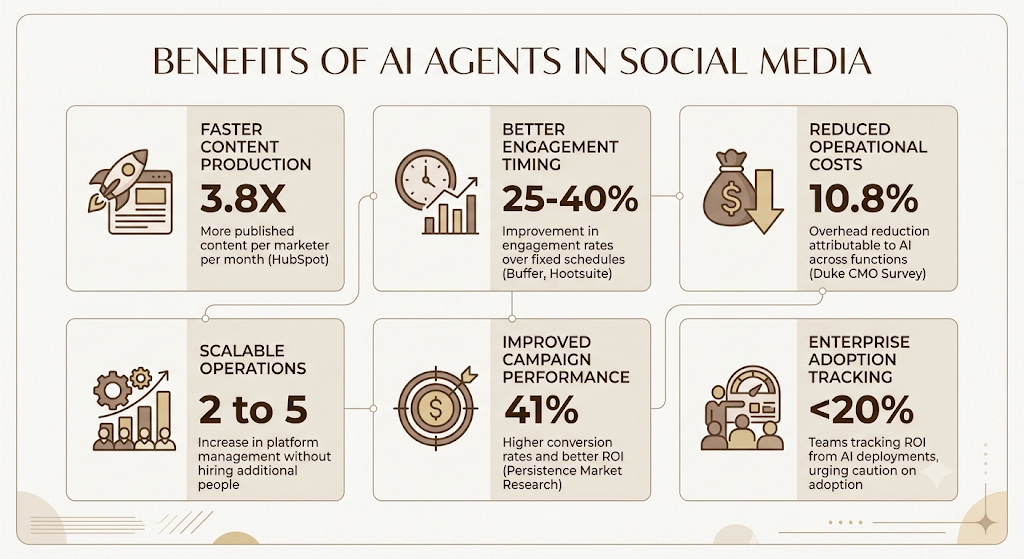
The benefits of deploying AI agents in social media are real, but some claims in vendor marketing are inflated. Here’s what the data actually says.
Faster content production. HubSpot’s AI Trends 2026 report found that social media teams using AI tools produce 3.8 times more published content per marketer per month versus pre-adoption baselines. That multiplier flattens at around months 12-15 as teams hit quality ceilings, not quantity ceilings.
Better engagement timing. Buffer, Hootsuite, and Sprout Social all report 25-40% engagement rate improvements when AI-optimized posting times replace fixed schedules. That’s meaningful for brands where organic reach is the primary distribution channel.
Reduced operational costs. The Duke University CMO Survey 2026 found a 10.8% overhead reduction attributable to AI across marketing functions. For social media specifically, the savings come primarily from reduced manual reporting time and community management hours.
Scalable operations without proportional headcount growth. This is the clearest long-term case. A social team managing two platforms can maintain quality across five with the right agent infrastructure, without hiring three additional people. For Indian D2C brands like Mamaearth or Zepto that are managing rapid category expansion, that matters.
Improved campaign performance. According to Persistence Market Research, campaigns created with AI deliver up to 41% higher conversion rates and improve ROI by nearly 40% compared to fully manual campaigns. That figure reflects platforms with mature AI targeting, not just content generation.
One thing worth noting: 34% of enterprise marketing teams now run at least one autonomous agent in production, according to a Digital Applied analysis of 2026 AI adoption data. But fewer than 20% are tracking ROI from their AI deployments. Adoption without measurement is just spending. If you’re deploying agents, set your measurement baseline before you start.
Risks and Limitations Nobody Wants to Tell You About
Most AI vendor content skips this section. That’s telling.
The Authenticity Problem Is Getting Worse
Consumers are getting better at detecting AI-generated social content, and their reactions are negative. Billion Dollar Boy’s research shows that only 26% of consumers now prefer AI-generated creator content to traditional creator content, down from 60% in 2023. That’s a massive drop in consumer acceptance in two years.
Research published in ScienceDirect found that brands adopting generative AI for social media content creation see measurable drops in follower reactions, mediated specifically by reduced brand authenticity perceptions. The mitigation isn’t to stop using AI. It’s to use AI to assist human creation rather than replace it entirely. Outputs drafted by an agent, then edited and signed off by a human, perform significantly better than fully autonomous outputs.
As Digiday noted in January 2026, audiences are increasingly seeking content that feels “messy” and human, precisely because AI content has flooded their feeds.
Hallucinations Are a Reputational Risk
The mean completion rate across major AI agent platforms is 74.8%, per First Page Sage’s Q1 2026 benchmark. That means 1 in 4 complex tasks contains an error. Even the best large language models hallucinate at roughly 0.7-0.8% of queries. A Canadian airline learned this expensively when its AI agent promised a refund policy that didn’t exist, and a court ruled the company was liable for the agent’s statement.
For brands, the risk is specific: an agent posting incorrect product specs, fabricated statistics, or culturally inappropriate content at 2 AM when no one is reviewing. The fix is human approval checkpoints, not better prompts alone.
Cultural Context Is Still a Weakness
AI systems trained primarily on English-language data perform significantly worse on non-English content. Stanford’s Human-Centered AI Institute found that non-English AI content is 12% less accurate on average than English. For Indian brands managing regional language content (Hindi, Tamil, Bengali) or pan-India campaigns that need to shift tone across Tier 1 and Tier 3 cities, autonomous agents need significantly more oversight.
Over-Automation Kills Community
The most followed accounts on every platform are accounts with personality. Automated responses to comments feel automated. Audiences notice. The brands that are winning community growth in 2026 are using agents to handle the inbox volume at the top (routine questions, spam filtering, sentiment categorization) and keeping human voices on the responses that matter.
A practical rule: any response that a follower might screenshot and share should have human review before it goes out.
Compliance and Privacy Risks
India’s Digital Personal Data Protection (DPDP) Act requires explicit user consent before using personal data for AI targeting. The EU AI Act, with high-risk AI obligations taking full effect from August 2026, adds further compliance burden for brands with European audiences. Social media agents that autonomously collect, process, and act on user data without clear governance frameworks are a legal exposure. Only 1 in 5 companies has a mature governance model for autonomous AI agents, per Deloitte’s 2026 report.
The primary risks of AI agents in social media marketing are: reduced brand authenticity when content is fully automated, factual errors and hallucinations in outputs, cultural and linguistic gaps in non-English markets, and compliance exposure under data protection regulations like India’s DPDP Act and the EU AI Act. Human review checkpoints and clear governance policies are the practical controls that reduce these risks without eliminating agent efficiency gains.
How to Implement AI Agents in Your Social Media Workflow
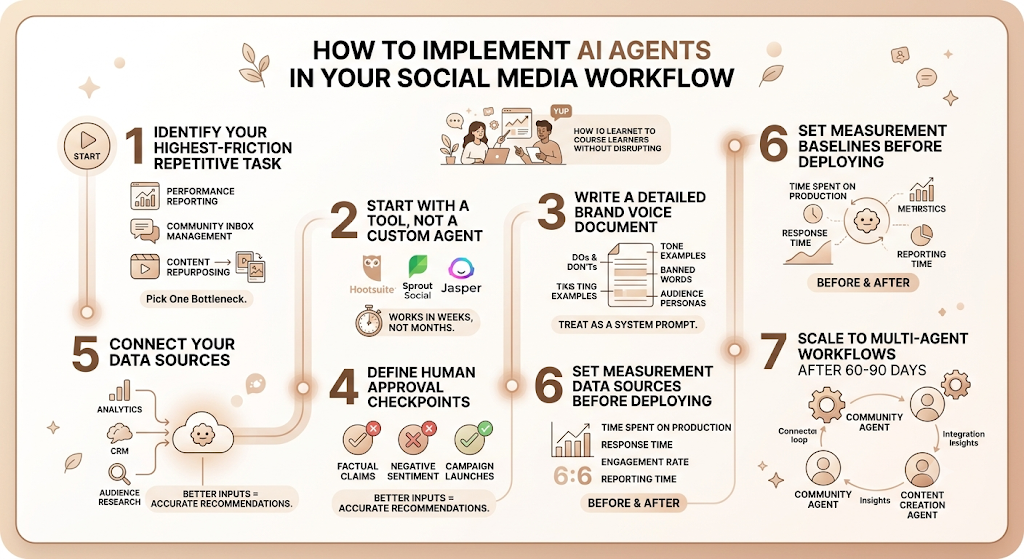
The teams that succeed with AI agents don’t start by replacing their entire workflow. They start with one bottleneck.
Step 1: Identify your highest-friction repetitive task. For most social teams, this is one of three things: performance reporting (pulling data, building slides), community inbox management (triaging comments and DMs), or content repurposing (turning a long-form video into ten social posts). Pick one.
Step 2: Start with a tool, not a custom agent. Before building with CrewAI or LangGraph, test whether an existing platform covers the need. Sprout Social’s Trellis for community management, Hootsuite’s OwlyWriter for caption generation, and Jasper for multi-brand content production. A paid tool that works in a week is more useful than a custom build that takes three months.
Step 3: Write a detailed brand voice document before you connect any agent. This is the step most teams skip, and it’s why their AI outputs sound generic. Write out your brand’s dos and don’ts, tone examples, banned words, audience persona descriptions, and platform-specific voice differences. The more specific this document is, the better every agent performs. Treat it as a system prompt you’ll update quarterly.
Step 4: Define human approval checkpoints before going live. Not every output needs approval. Routine comment replies on a product FAQ question probably don’t. But posts that make factual claims, responses to negative sentiment, and any content going out during a campaign launch absolutely do. Map these checkpoints before the agent is live, not after something goes wrong.
Step 5: Connect your data sources. An agent that can’t read your performance history is half-blind. Connect your social analytics, CRM data if relevant, and any audience research to the agent’s context. The better the data inputs, the more accurate the recommendations.
Step 6: Set measurement baselines before deploying. Track the metrics that matter for your specific goal: time spent on content production, average response time for community messages, engagement rate per post, and reporting time. You can’t assess agent impact without a before-and-after comparison.
Step 7: Scale to multi-agent workflows after 60-90 days. Once one agent is stable and delivering measurable results, add the adjacent function. If you started with a community management agent, add a content creation agent that draws on the insights the community agent surfaces. That’s the beginning of the multi-agent loop described earlier.
This isn’t a six-week project. From what we’ve seen with YUP course learners who’ve gone into marketing roles, the teams that get the most out of agent tools are the ones that treat implementation as a 90-day process, not a single sprint.
The Future of Autonomous Social Media Management
The direction is clear. But the pace is uneven.
Autonomous campaign management is close. Meta began testing agentic AI assistants across its apps in April 2026, enabling automated interactions and task execution without manual input. For social advertising, this means agents that can adjust creative, budgets, and audience targeting in real time without human intervention between check-ins.
AI-powered social listening will feed product decisions. Sprout Social’s Trellis already answers complex research questions in plain language. The next step is those answers routing directly into product roadmaps and positioning briefs, not just social strategy. Brands that wire their social listening agent to their product team’s tools will have a significant advantage in reading real-time market signals.
Human-AI collaborative teams will be the winning model. The brands that will lose are the ones fully automating their social presence and the ones ignoring agents entirely. The winners are running agents on operational work (publishing, reporting, inbox triage, repurposing) while human marketers own strategy, brand voice decisions, and community building moments. Gartner predicts 90% of all online content will be generated or edited with AI by 2027 -but the content that actually builds audiences will be the 10% that feels distinctly human.
India-specific agents will emerge. The gap between English-language agent performance and Hindi/regional language performance is a real market need. Expect specialized agent tools tuned for Indian market nuances, regional language competency, and UPI-integrated social commerce workflows to emerge from Indian SaaS players over the next 18-24 months.
The agent market itself is projected to grow from USD 15 billion in 2026 to USD 221 billion by 2035 (Roots Analysis). Social media is one of the fastest-moving applications. The teams building operational muscle with agents now will have a significant advantage as that infrastructure matures.
Agents Are the New Workflow -Not the New Employee
The frame that trips most teams up is thinking of AI agents as replacements. They’re not. What agents replace is the portion of a social media manager’s week that involves moving information, repeating tasks, and bridging gaps between disconnected tools. The work that requires judgment, relationships, and brand instinct stays human.
The practical starting point: pick one bottleneck, deploy one agent, and measure for 60 days. Don’t start with a six-agent multi-team orchestration. Start with the task that your team handles five times a week and wishes they didn’t have to. That’s where agents return value fastest.
The brands that build agent-enabled workflows in 2026 will have an operational advantage in 2027 that’s difficult to close. Not because AI is magic, but because the compounding effect of faster content cycles, better-informed posting decisions, and more responsive community management adds up faster than most people expect.
Frequently Asked Questions
What is an AI agent for social media marketing?
An AI agent for social media marketing is an autonomous system that can monitor social platforms, plan content, create posts, publish at optimal times, and optimize performance based on live data -all without requiring human instruction at each step. It differs from a regular AI tool in that it pursues goals across multiple steps, makes contextual decisions, and learns from outcomes.
What’s the difference between AI agents and traditional social media automation?
Traditional social media automation is rule-based: you set conditions, the tool executes them. If the rules don’t cover a situation, the tool fails or does nothing. AI agents make decisions. They can read context, adjust behavior based on new information, handle situations not explicitly programmed, and improve over time. An automated scheduler queues posts. An agent notices that your brand is trending and adjusts what posts go out.
Which AI agent tool is best for social media management in 2026?
It depends on your team size and primary use case. Sprout Social with Trellis is the strongest full-platform option for enterprise teams. Hootsuite OwlyWriter AI is best for teams needing governance and multi-account management. Buffer is the clearest choice for small teams and creators. For technical teams building custom multi-agent workflows, CrewAI handles rapid prototyping well, while LangGraph is better for production-grade systems.
Are AI agents replacing social media managers?
No. AI agents are replacing specific repetitive tasks within social media management: routine inbox responses, scheduled publishing, performance reports, and content repurposing. Strategic decisions, brand voice ownership, community-building moments, and creative judgment remain human work. According to Sprout Social’s 2025 Index, 54% of marketing leaders believe AI is what will let them grow their teams -meaning agents expand capacity, they don’t reduce headcount.
How do I prevent AI agents from posting off-brand content?
Three controls matter most: write a detailed brand voice document before connecting any agent (tone, banned words, example posts, platform-specific variations), add human approval gates for any content that makes factual claims or goes out during high-stakes moments, and run the agent in “draft mode” for the first 30 days so all outputs are reviewed before publishing. Don’t rely on good prompts alone.
Is it safe to use AI agents for community management in India?
Broadly yes, with caveats. India’s DPDP Act requires explicit consent before using personal data for AI-driven targeting. Community management agents that process user messages fall into a compliance grey area, so it’s worth checking your data handling agreements. The bigger practical risk is cultural context: agents trained on English-language data often miss regional tone and sentiment nuances in Hindi or Tamil interactions. Keep human review on sensitive community interactions.
What is a multi-agent social media system?
A multi-agent social media system is a coordinated team of specialized AI agents, each owning one function in the social media workflow. A research agent monitors trends, a content agent writes posts, a design agent generates image briefs, a publishing agent handles scheduling, an analytics agent produces reports, and a community agent manages the inbox. Each agent hands off outputs to the next, with the analytics agent feeding insights back to the research agent to close the loop.
How much does it cost to implement AI agents for social media?
Costs range from free (Buffer’s AI Assistant on its free plan) to enterprise-priced ($199 per user per month for Sprout Social or Hootsuite). For custom multi-agent builds using CrewAI or LangGraph, the main ongoing cost is API token consumption. The median mid-market marketing team spent $3,400 per month on AI tools in Q1 2026, per HubSpot’s AI Trends 2026 data. The ROI calculation should factor in time saved on content production, reporting, and community management alongside subscription costs.
What are the biggest risks of using AI agents for social media?
The main risks are: hallucinations (factual errors in AI outputs that go live without review), brand authenticity drop (consumers can detect and react negatively to fully automated content), cultural and language gaps, particularly in non-English markets, over-reliance on automation that removes human community building, and compliance exposure under data protection regulations. All of these are manageable with governance policies and human review checkpoints -they just need to be designed before deployment, not after.
What’s the difference between CrewAI and LangChain for social media agents?
CrewAI uses a role-based team model that maps naturally to how social media teams think. You define agents as roles (Researcher, Content Writer, Community Manager), and CrewAI handles task coordination. You can get a working prototype in under 30 minutes. LangChain (specifically LangGraph) gives you explicit control over every step in a state machine model: more code, but better error recovery, checkpointing for long-running workflows, and LangSmith for production monitoring. Most teams prototype on CrewAI and migrate to LangGraph when they need production reliability.