

Rule-based personalization breaks the moment a customer does something you didn’t plan for. A shopper may browse running shoes and leave the page. They open your email two days later and come back on a different device. Your rules see four unrelated events. Your segments still call this person a “new visitor.”
That’s the gap an AI agent for personalized marketing closes. It’s a system that reads customer signals, works out context, decides what to do next and takes the action itself. That happens within limits you set. Segments haven’t gone away and they shouldn’t. But individual, real-time signals are finally usable at scale in 2026. That changes what’s possible.
The momentum is real, even if the results lag behind it. Roughly 90% of CMOs are experimenting with AI according to McKinsey’s 2026 CMO research. Fewer than 10% have scaled it across marketing workflows. Most teams are playing. Few are operating.
This guide explains how these agents work, where they fit across the customer journey and what data they need. See how to implement one safely and how to measure whether it’s helping.
Table of Contents
What Is an AI Agent for Personalized Marketing?
An AI agent for personalized marketing is software that works toward a marketing goal. It does that by reading customer signals, interpreting context, choosing an action and carrying it out within approved limits. It then watches what happened and adjusts. A recommendation engine suggests. An agent acts.
The Simple Definition
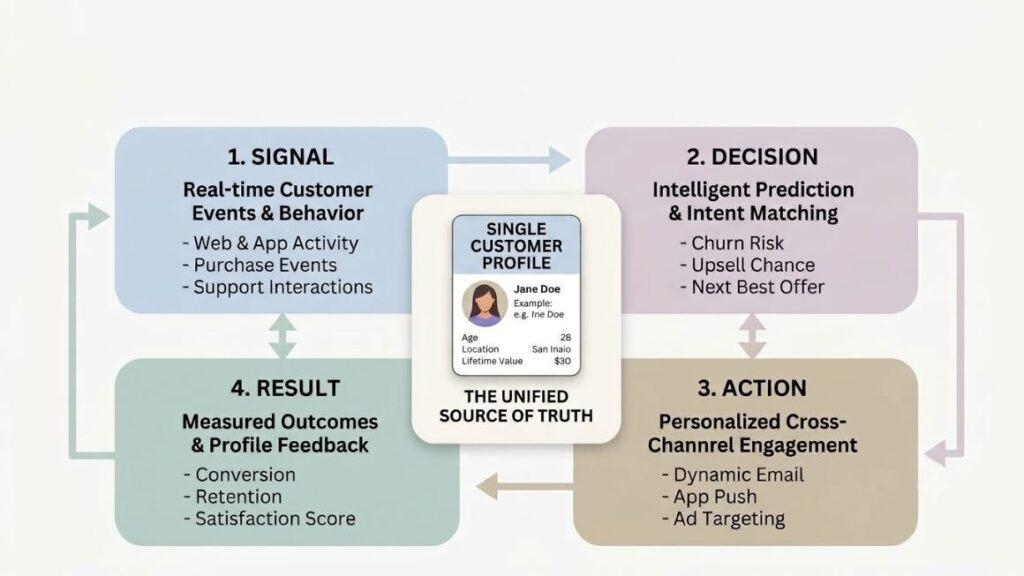
Think of it as a loop: Collect signals → Understand context → Decide → Act → Observe → Adjust.
Each pass makes the next decision a little better informed. That’s what separates an agent from a content generator or a recommendation widget. A generator writes the email. A recommender suggests the product. An agent is responsible for the outcome, whether that’s a completed purchase or a renewed subscription. It’s allowed to take approved steps toward it.
What Makes an AI Agent Different From a Normal AI Tool?
The difference shows up in: how each one is started. What it can see. What it’s allowed to do.
| Traditional AI Tool | AI Agent |
| Responds to prompts | Works toward a defined goal |
| Usually handles a specific task | Can coordinate multiple tasks |
| Limited context | Can use connected customer data |
| Requires human initiation | Can act when triggered |
| Generates recommendations or content | Can execute approved actions |
| Usually static | Can adapt to new signals |
A Simple Customer Example
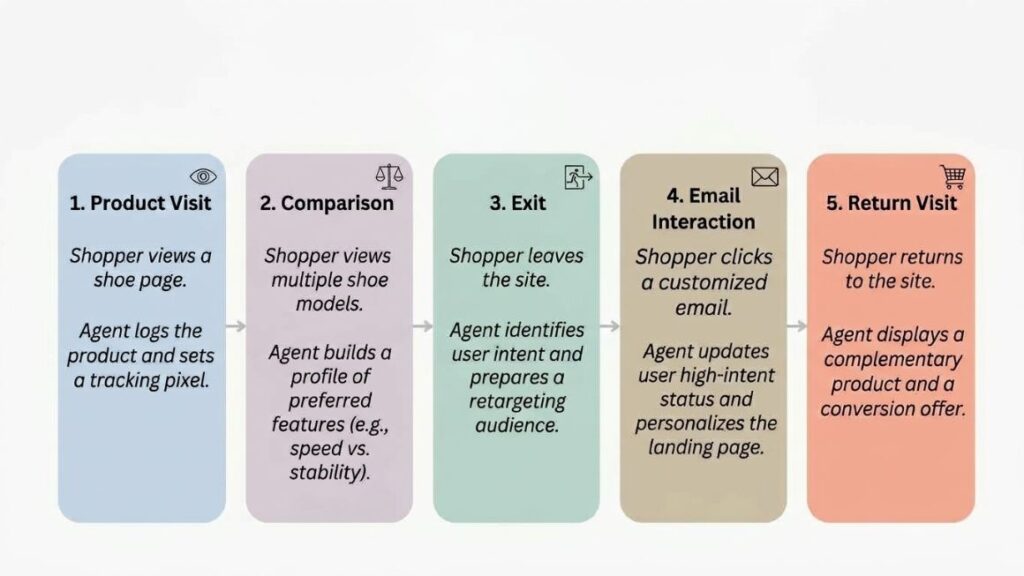
Take a shopper looking at running shoes. The path goes: product visit → comparison → exit → email interaction → return visit.
A segment-based setup files this person under “running shoe browsers” and sends the same weekly promotion as everyone else. An agent reads the sequence differently. The comparison says the shopper is weighing two models. The exit hints at doubt over price or fit. The email click shows interest is still alive.
On the return visit, the agent can surface a sizing guide and the comparison the shopper already started. Same customer. But treated as someone in motion, not a fixed label.
An AI agent for personalized marketing is software that reads customer signals, interprets context, chooses an action and executes it within approved limits. Unlike a content generator or recommendation tool, it works toward a defined goal and adjusts based on results.
How AI Agents Make Marketing More Personalized?
An AI agent for personalized marketing works through a repeating six step process. It collects signals. Builds real time context. Infers intent. Chooses the next action. Executes it across connected tools and learns from the result. The mechanism stays the same no matter if the channel is email, web or ads.
1. Collecting Customer Signals
Everything starts with what customers actually do. That covers website behavior, purchase history, CRM records, email engagement, product usage and past customer interactions. Alone, each says little. An agent’s advantage is reading them together. It’s also treating behavioral data as a live stream instead of a monthly export.
2. Building a Real-Time Customer Context
A historical profile tells you who someone was last quarter. It doesn’t tell you where they are today. Real time personalization depends on a context layer. That updates as signals arrive. It places the customer at a stage: Researching → Comparing → Ready to Buy → Post-Purchase → At Risk.
The same person can sit at different stages for different products at the same moment. That’s exactly why static profiles fall short.
3. Understanding Customer Intent
The old question was “Who is this customer?” The better one is “What is this customer trying to do right now?”
Two shoppers with completely different profiles can be comparing the same two models with identical intent. Demographics won’t show that. Session behavior will.
4. Choosing the Next-Best Action
Once the agent understands intent, it picks a move. It can recommend content, send a message, change what the customer sees on the site, recommend a product, delay communication or escalate to a human. Delay matters more than most teams expect. Sometimes the smartest next best action is to send nothing at all.
5. Executing the Action
A decision that never reaches the customer is a report. It’s not personalization. Agents act by connecting to your CRM, email platform, website, advertising accounts, commerce system and support desk. This is usually through a customer data platform (CDP) that unifies the profile. That connection list is also your risk list. Every system the agent can write to is a system it can get wrong.
6. Learning From the Outcome
The loop closes when results flow back in: Signal → Decision → Action → Result → New Signal.
Did the shopper buy, click, ignore or unsubscribe? Each answer feeds the next decision. That’s the mechanism. Where to apply it comes later.
AI agents personalize marketing by running a loop of six steps: collecting signals, building real-time context, inferring intent, choosing the next action, executing it through connected systems and learning from the result. The goal is to ask what a customer is trying to do right now, not only who they are.
AI Agent for Personalized Marketing vs Traditional Personalization
Traditional personalization follows fixed rules or shared segments. AI-powered personalization predicts what a customer is likely to want. An agent goes one step further. It weighs the customer’s current context against a business goal and then decides what to do.
Rule-Based Personalization
If X happens, do Y. A visitor views a pricing page. So a reminder email goes out. Rules are predictable and easy to audit. They’re also brittle. Someone has to anticipate every scenario in advance.
Segment-Based Personalization
Customers are grouped by shared characteristics or behavior. This could be plan type, purchase history or city. Each group gets its own message. Customer segmentation still earns its place especially for planning and reporting. It just treats everyone inside a group as identical.
AI-Powered Personalization
Models find patterns in past data, predict preferences. They estimate who’s likely to buy, churn or click. This is where predictive personalization lives. The model scores. A person or a fixed workflow still decides what happens with the score.
Agentic Personalization
An agent evaluates the customer’s current context against a business objective. It determines the next appropriate action and carries it out inside set boundaries. It doesn’t replace the layers below it. It uses them.
This approach is part of the wider shift toward agentic marketing platforms, where agents can plan, execute and optimise work across multiple marketing systems.
| Rule-Based | Segment-Based | AI-Powered | Agentic | |
| Decision-making | Pre-written if/then logic | Group-level logic | Model predicts, workflow or human acts | Goal-driven, context-based decisions |
| Adaptability | Changes only when rules are rewritten | Changes when segments are rebuilt | Changes when models are retrained | Adjusts as new signals arrive |
| Level of automation | Fixed triggers | Automated sends per segment | Automated scoring, partial action | Decides and acts within permissions |
| Human involvement | Writes every rule | Defines segments and content | Reviews models, acts on scores | Sets goals and limits, approves high-impact actions |
Where AI Agents Can Personalize the Customer Journey
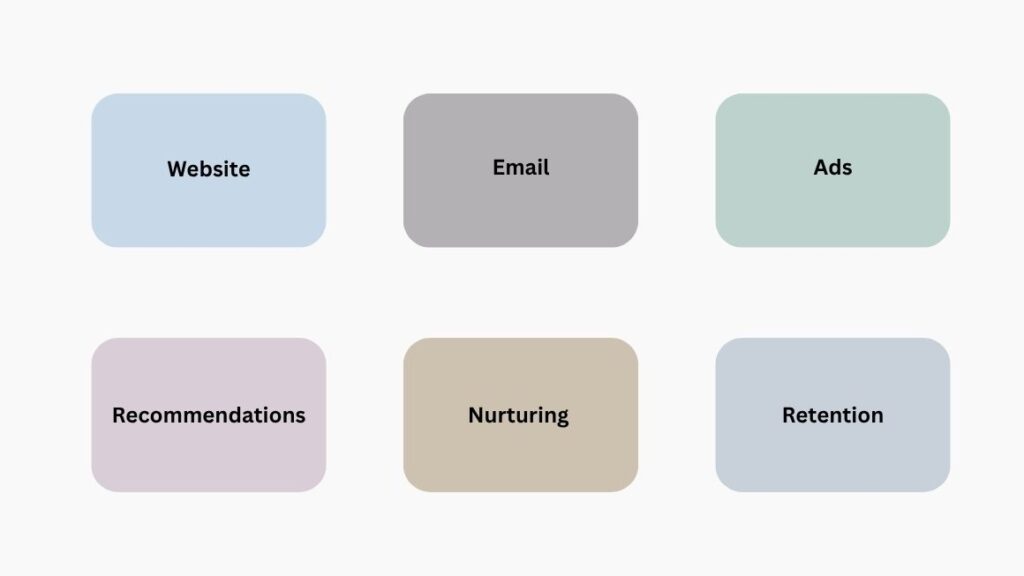
An AI agent for personalized marketing can personalize six touchpoints. Your website, email, advertising, product recommendations, lead nurturing and retention. The case for personalized customer journeys shows up in survey data.
HubSpot’s 2026 State of Marketing report is based on 1,500+ global marketers. It found that 93.2% say personalized or segmented experiences led to more leads and purchases. That’s self-reported. So read it as a signal instead of proof.
McKinsey’s 2025 analysis of AI-powered next best experience adds a bigger claim. Based on its own research, it estimates gains of 15 to 20% in customer satisfaction, 5 to 8% in revenue and 20 to 30% in lower cost to serve. Those are McKinsey’s estimates for well-built programs. Those aren’t outcomes you should expect by default.
Website Personalization
Your homepage doesn’t have to be the same page for everyone. Dynamic content personalization helps an agent can change the hero message, CTA and featured products. That’s done on the basis of what a visitor is trying to do. A returning visitor who read three pricing comparisons gets a “compare plans” prompt. A first time visitor from a how-to article gets something educational.
Personalized Email Marketing
Classic email flows fire on a timer whatever the customer does next. Things change with marketing automation with AI. An agent adjusts timing, message and follow-up as behavior changes. It might pause a cart reminder once the customer returns to the site. It may switch an onboarding email to a tutorial after a failed setup step. It may also hold a cross-sell until the first order arrives.
The same logic covers abandoned browse, abandoned cart, onboarding, product education, reactivation, upselling and cross-selling.
Personalized Advertising
Agents can suggest audience adjustments and flag creative that’s wearing out. They can shift campaign priorities toward high-value customers and tune retargeting windows. This is where AI marketing automation can quietly go wrong. Aim an agent at clicks and it will chase clicks. Aim it at business outcomes, like profitable first orders or qualified leads.
Personalized Product Recommendations
Good recommendations weigh browsing behavior, purchase history, product affinity, current intent, inventory and price sensitivity together. Hyperpersonalization at this level means you don’t push a premium model at someone who clicked discounted items.
Quick example: a shopper compared two trail shoes and left over price. The agent shows the one in stock in her size and lower-priced option, first.
Personalized Lead Nurturing
The agent’s real job is judging readiness for B2B and high consideration purchases. A lead who’s read two blog posts needs education. One who opened a case study twice may want a product comparison. One who viewed pricing three times may be ready for sales contact. Sometimes the right call is simply more time. AI-driven customer engagement works best when the agent knows when to wait. This is where AI agents for B2B marketing can help coordinate signals across a longer buying journey.
Personalized Customer Retention
Retention is where agents quietly earn their keep. Declining engagement, an unresolved support ticket and a renewal 30 days out tell a story no single metric does. The agent can flag the account, send a relevant help resource or route it to a person before the customer drifts further. A personalized customer experience at this stage often looks like fixing a problem, not offering a discount.
Real-World Examples of AI Agent Personalization
Salesforce, Adobe, HubSpot and Optimizely all sell agent-driven personalization now. It shows agentic marketing has moved from concept to product roadmaps. What follows is documented capability and vendor positioning, not independently verified results. Use it as evidence of direction. It is not proof of what any tool will deliver for you.
Salesforce
Salesforce Personalization is built on Data 360 and its customer data foundation. It is positioned to deliver real time and one to one experiences from unified profiles. Its Adaptive Websites feature adjusts layout, content and recommendations. Agentforce Marketing runs on the same data. It aims to turn static journeys into adaptive ones. These are Salesforce’s own descriptions.
Adobe
Adobe Experience Platform Agent Orchestrator was launched in 2025. It coordinates Adobe and third-party agents, with agents built into Real-Time CDP, Experience Manager and Journey Optimizer. The company introduced Adobe CX Enterprise at Adobe Summit in April 2026. That is described by analyst firm Constellation Research as an agentic system designed for customer experience orchestration. In practice, that puts customer journey orchestration at the center of Adobe’s pitch.
HubSpot
HubSpot’s Breeze personalization tool creates content variations using CRM data and contextual inputs, and its customer agent can be set up to access and update CRM data. A separate data agent monitors CRM data quality. HubSpot’s own 2026 survey found 48.57% of marketers cite using AI for personalized content as the top trend.
Optimizely
In June 2026, Optimizely announced limitless 1:1 personalization inside its Opal agent platform. It lets brands build a microsite for each target buyer, managed and optimized by AI agents. It also added contextual multi-armed bandits. These serve each individual the variation most likely to convert based on real-time attributes. The direction of the market is clear, even if outcomes vary by team.
A Hypothetical Example for a Smaller Marketing Team
This is a hypothetical, not a YUP case study. An online education company watches a learner move through: content visit → course-page visit → video engagement → schedule check → return visit.
An AI agent for personalized marketing could read the video engagement as real interest. It could also read a schedule check as a time concern. On the return visit, it shows flexible-batch details and a short learner story. It holds the discount email for a few days. If the learner enrolls, it switches to onboarding. If not, it tries a different angle, like a free sample session.
What Data Does an AI Agent Need for Personalization?
An AI agent for personalized marketing needs five kinds of data to personalize well. First party customer data, behavioral signals, transactional records, contextual signals and customer feedback. Quality matters more than volume. Data has to be accurate, current and connected across systems.
First-Party Customer Data
First-party data is information customers give you directly. Or they generate on your own properties. Those could be sign-ups, stated preferences and purchases. It’s the most dependable input because you know where it came from. Ccustomers expect you to use what they chose to share.
Behavioural Signals
Clicks, searches, page views, purchases, sessions and email interactions show what people do. That often differs from what they say. A search for “waterproof trail shoes” says more about today’s intent than a profile field ever will.
Transactional Data
Order value, purchase frequency, product categories and returns reveal buying patterns and price comfort. A customer who returns two of every three orders needs different handling from one who reorders monthly.
Contextual Signals
Device, time, current session, channel and customer lifecycle stage shape what’s relevant in the moment. Mention location only when it’s genuinely useful and was collected appropriately.
Customer Feedback and Conversations
Surveys, reviews, support conversations and chat interactions carry the reasons behind the numbers. They’re also the easiest data to overlook because they’re messy.
Why Bad Data Creates Bad Personalization
Bad data → Wrong context → Wrong decision → Poor customer experience.
Having data isn’t enough. It needs to be accessible, reliable and sufficiently current. It needs to be connected across systems. That takes basic governance: who owns each source. What customer consent covers. How often records are refreshed.
Gartner’s 2026 CMO Spend Survey shows why this matters. Only 30% of CMOs reported mature AI readiness. Gartner warned that many are investing in tools faster than they build the data foundations, processes and governance to support them.
How to Implement an AI Agent for Personalized Marketing?
Start with one customer journey to implement an AI agent for personalized marketing. Define a measurable outcome. Map your signals. Set the agent’s decision limits. Connect the tools. Add human approval. Test against a control group. Seven steps, in that order.
Step 1: Choose One Customer Journey
Pick one defined workflow: cart recovery, lead nurturing, onboarding, retention or recommendations. Choose the one where you already have decent data and a painful manual process.
Step 2: Define the Business Outcome
Possible objectives include increasing conversions, increasing repeat purchases, reducing churn, generating qualified leads or improving engagement. “Personalize everything” isn’t a goal. You can’t measure it. So you’ll never know whether it worked.
Step 3: Map Your Customer Signals
Mark each signal honestly. One that’s available but unreliable is a liability.
| Signal | What to check |
| Purchase history | Is it available, accurate and up to date? |
| Website behavior | Can you capture browsing and interaction data in real time? |
| Email engagement | Can you track opens, clicks and recent engagement reliably? |
| CRM data | Are customer profiles complete and consistent? |
| Support history | Can the agent access recent support interactions? |
Step 4: Define the Agent’s Decision Space
Answer three questions in writing. What can the agent decide? What can it do? What can it never do? The “never” list might include offering discounts above a set limit. Or it could be contacting customers who opted out.
Step 5: Connect the Required Tools
Link only what your chosen journey needs from your CRM, CDP, analytics, CMS, email platform, advertising accounts and commerce system. Every extra connection adds risk.
Step 6: Add Human Approval
- Auto-execute: Low-risk actions. These include adjusting send time or picking a content block.
- Review first: Medium-risk actions. These include a new discount offer or a new audience.
- Human-only: High-impact or sensitive decisions. These include pricing changes or complaint handling.
Step 7: Test Before Scaling
Run one audience + one journey + one channel + one measurable outcome. Compare agent-assisted performance against your existing process or a control group before you expand.
Also Read: How to Automate Digital Marketing Workflows with AI
How to Measure an AI-Personalized Marketing Strategy?
Measure an AI agent for personalized marketing at three levels: customer outcomes, marketing economics and agent behavior. Then prove the lift is incremental with controlled tests instead of assuming the agent caused every improvement.
Customer Metrics
Track conversion rate, engagement, repeat purchases, retention, churn and customer satisfaction. These show whether customers are actually better served.
Marketing Metrics
Watch revenue per customer, customer acquisition cost (CAC), return on ad spend (ROAS), email conversion and qualified leads. They show whether the economics hold up.
Agent Performance Metrics
An agent is a worker. So measure it like one: decision accuracy, action completion, human escalation rate, error rate, time saved and cost per automated action. A high escalation rate isn’t always bad. It can mean the guardrails are doing their job.
Measure Incremental Impact
Use A/B tests, holdout groups and incrementality testing. A holdout group is a slice of customers who don’t get the agent’s treatment. So you can see what would have happened anyway. HubSpot’s 2026 State of Marketing found 67.5% of marketers say they know how to measure AI impact. That’s up from 48% in 2025. Good progress. It still means a third don’t.
Risks and Limitations of AI-Driven Personalization
Most of the main risks of an AI agent for personalized marketing are governance problems rather than technology problems.
Privacy and Consent
Collecting more customer data is automatically going to produce better personalization. Use what customers agreed to share. Do it for the purpose they agreed to. Check the rules in each market you serve. That includes India’s Digital Personal Data Protection Act, 2023.
When Personalization Becomes Creepy
An email that quotes a product someone viewed once late at night, feels like surveillance. So does inferring a life event or health concern from purchases and acting on it. Relevant is good. Unexpected specificity isn’t.
Poor-Quality Data
An outdated address, a wrong lifecycle stage or a missing return can send the agent down the wrong path. It’s like congratulating someone on a purchase they already sent back.
Bias and Unfair Treatment
Models reproduce problems in their data, rules and decision criteria. If past purchase patterns mean certain groups rarely saw premium offers, an agent may keep it that way. Audit outcomes across groups, not only averages.
Brand Voice and Factual Errors
Generated or selected content can be inaccurate, irrelevant or off-brand. A wrong price, an invented feature claim or a tone-deaf message reaches real customers at scale.
Too Much Autonomy
Autonomous marketing sounds efficient until an agent makes a sensitive call nobody reviewed. Certain decisions should stay with people.
Gartner’s January 2026 research is direct about this. Gartner’s Emily Weiss said marketers must put strong data governance in place to enable secure and ethical personalization at scale. A Gartner survey of 335 US consumers found 78% rate explicit labeling of AI-generated content as very important or the most important factor for trust.
The main risks of AI-driven personalization are privacy failures, over-targeting, poor data, bias, off-brand content and excessive autonomy. Gartner’s 2026 research points marketers toward strong data governance and transparency as the foundation for responsible deployment.
Best Practices for Using AI Agents in Personalized Marketing
The best practices for an AI agent for personalized marketing come down to one idea. Give the agent a narrow and well-defined job. Keep people in charge of the decisions that carry risk. Use this table as a quick check before launch.
| Do | Avoid |
| Start with customer value | Starting with the technology |
| Give the agent a clear objective | Vague automation goals |
| Use reliable customer data | Personalizing from weak signals |
| Set explicit permissions | Giving unlimited autonomy |
| Keep humans involved in high-impact decisions | Automating sensitive decisions |
| Make personalization explainable | Using unexplained decisions |
| Test against a control group | Assuming every uplift is causal |
| Monitor the agent continuously | Setting it and forgetting it |
| Protect brand consistency | Letting automation weaken the brand |
| Give customers appropriate control | Making personalization unavoidable |
Notice the pattern. Nearly every row is about restraint, not capability.
AI Personalization Trends Marketers Should Watch in 2026
Six shifts are shaping AI personalization this year. Each builds on the data and governance foundations covered above.
From Segmentation to Individual-Level Experiences
Gartner predicts that by 2028, 60% of brands will use agentic AI to facilitate streamlined one-to-one interactions (Gartner, January 2026). Read that as segmentation expanding, not disappearing. One-to-one personalization will sit on top of segments you still use for planning and reporting.
From Campaign Automation to Continuous Orchestration
McKinsey’s research on the future of marketing describes a move from campaign cycles to always-on orchestration, and names five capabilities shaping it: insights, creativity, personalization, agentic commerce and orchestration. McKinsey says properly configured orchestration can improve marketing ROI by 30 percent, a figure drawn from its own experience and not a guarantee.
Agents Connecting Multiple Data Sources
Useful personalization needs unified customer context. McKinsey notes that always-on orchestration requires a unified data and orchestration layer plus clear governance on how humans and machines make decisions. Disconnected data means a disconnected agent.
AI Agents Influencing Commerce and Recommendations
McKinsey also found that senior marketers rate agentic commerce, meaning influencing how AI systems recommend your product, as the area where their organizations are least ready. Personalization now includes being understood by other people’s agents.
AI-Mediated Customer Journeys
A Gartner survey of 365 US consumers, reported in January 2026, found 31% say AI summaries make them spend more time searching, versus 16% who spend less. AI is influencing discovery, evaluation and decisions. It isn’t shortcutting them.
Marketers Becoming Orchestrators
The role is shifting toward Strategy → Rules → Data → Agent Supervision → Experimentation → Growth. Marketers who learn to supervise AI marketing agents will do better than those who only prompt them.
Is an AI Agent Right for Your Marketing Team?
An AI agent for personalized marketing suits teams with usable data and a clear goal, and it’s a poor fit for teams still sorting out basics. Use this quick checklist.
You May Be Ready If
- You have usable customer data.
- Your team manages repetitive workflows.
- Multiple systems need coordination.
- Personalization is difficult to scale.
- You have a measurable business objective.
You May Need to Wait If
- Customer data is unreliable.
- Ownership is unclear.
- Goals are not defined.
- There is no governance process.
- You are trying to automate everything at once.
Conclusion
Every agent-led personalization system rests on the same framework: customer signals + context + decision-making + execution + feedback. You don’t need to automate every marketing activity to benefit from it. Start narrow instead: one customer problem + reliable data + a clear objective + defined boundaries. Get that working on a single journey, and the next one gets easier.
If you want to build these skills hands-on, YUP’s AI Marketing course is made for marketers who want to work with AI agents and automation in real campaign work.
FAQs: AI Agent for Personalized Marketing
What is an AI agent for personalized marketing?
It’s software that reads customer signals, interprets context, chooses an action and carries it out within approved limits to reach a marketing goal. Then it learns from the result.
How does an AI agent personalize marketing campaigns?
It collects behavior and CRM signals, builds real-time context, infers intent, selects the next action, executes it through connected tools and feeds the result back into its next decision.
What is the difference between AI personalization and agentic personalization?
AI personalization predicts what a customer may want. Agentic personalization weighs current context against a business goal, then decides and takes the next appropriate action within set boundaries.
What data does an AI agent need for personalized marketing?
Customer-provided details, behavioral signals, transaction history, contextual signals and customer feedback. It must be accurate, current and connected across systems, because weak data produces weak decisions.
Can AI agents personalize email and website experiences?
Yes. Agents can adjust email timing, content and follow-ups, and change website messaging, CTAs and recommendations based on a visitor’s current behavior and stage.
How much human oversight does an AI marketing agent need?
It depends on risk. Low-risk actions can run automatically, medium-risk ones need review first, and high-impact or sensitive decisions should stay with people.
How can a business start using AI agents for personalization?
Pick one journey, define one measurable outcome, check your data, set clear permissions, add human approval and test against a control group before scaling.