

Your media buyer checks five dashboards before lunch, adjusts three bids by hand, and still misses the moment a campaign starts bleeding budget at 2 a.m. That gap between what happens in your ad account and when a human notices it is where most wasted spend comes from. An AI Agent for Campaign Optimization closes that gap by watching performance data continuously and acting on it the moment a pattern breaks.
This isn’t about replacing your media buyer. It’s about giving them a system that never sleeps, never gets bored scanning spreadsheets, and never forgets to check the fourth ad set. In this article, you’ll learn how these agents read campaign data, what separates them from basic automation rules, which tools are actually worth your budget, and how to set one up without breaking a campaign that’s already working.
Table of Contents
What Is an AI Agent, and How Does It Optimize Campaigns?
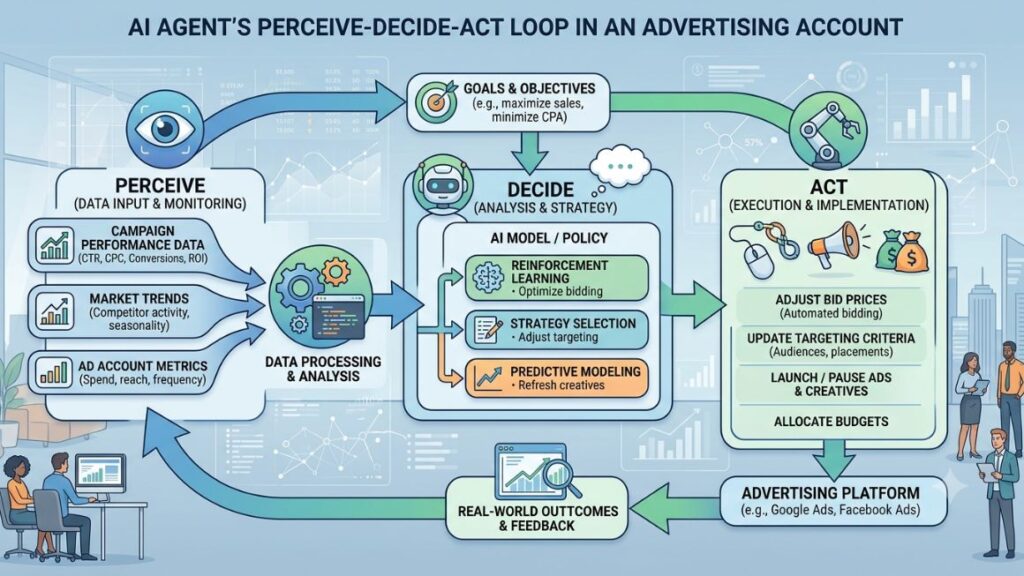
An AI Agent is a software system that can perceive data, make a decision based on that data, and execute an action without waiting for a human to click a button. Unlike a chatbot that just answers questions, it has permission to actually do something inside your ad accounts.
Campaign Optimization means continuously adjusting targeting, budgets, bids, and creative to get more results out of the same spend, or the same results out of less. Put the two together and you get a system that reads performance signals across your ad accounts, spots underperformance or opportunity, and reallocates budget or pauses creative on its own.
This kind of agent combines real-time data monitoring with the authority to act, pausing weak ad sets, shifting budget toward winners, and adjusting bids without waiting for a scheduled review. That distinguishes it from a dashboard, which only reports what happened after the fact.
Most marketers have used automation rules in Google Ads or Meta Ads Manager. Those rules follow a fixed if-this-then-that logic. An agent is different because it weighs multiple variables at once, including seasonality, audience fatigue, and cross-channel performance, before deciding what to change.
How AI Agents Analyze Campaign Data Before Taking Action
Good decisions start with good inputs. Before an agent touches your budget, it pulls data from every connected source and normalizes it into a format it can actually compare.
Data sources an agent typically pulls from:
- Platform APIs (Google Ads, Meta Ads Manager, Microsoft Ads, TikTok Ads Manager)
- First-party analytics (GA4, server-side conversion tracking)
- CRM and revenue data, when connected via tools like HubSpot or Salesforce
- Creative performance metrics, including thumb-stop rate and hook rate on video
That last point matters more than people think. Honestly, this metric gets misused more than almost any other benchmark in the industry. A campaign can have a strong click-through rate and still lose money if the traffic never converts downstream, which is why agents that only look at platform-reported metrics without revenue data tend to optimize toward the wrong outcome.
Once the data is pulled, the agent applies statistical models, usually a mix of regression analysis and machine learning classifiers, to separate genuine performance shifts from normal daily noise. A 15% drop in conversions on a Tuesday might be nothing. The same drop across three consecutive days, paired with a rising cost per click, is a signal worth acting on.
According to Zebracat AI’s 2026 research, AI-driven PPC bid management can reduce wasted ad spend by around 37% and increase ad ROI by roughly 50% compared with manual bidding. That gap exists because a human reviewing performance weekly simply cannot catch what a system monitoring hourly can.
From Insight to Execution: How Automated Campaign Optimization Actually Works
Automated campaign optimization removes the lag between insight and action. The agent doesn’t just flag a problem in a report; it makes the change and logs why.
Here’s what that decision loop generally looks like in practice:
- Ingest performance data from every connected ad account at a set interval, often hourly.
- Compare current performance against a rolling baseline, not a single fixed target.
- Flag anomalies that cross a statistical threshold, such as CPA rising 20% above the seven-day average.
- Simulate the outcome of a possible fix, like shifting 15% of budget from Ad Set A to Ad Set B.
- Execute the change automatically, or route it to a human for approval if it exceeds a set risk threshold.
- Log the action with a timestamp and reasoning, so the marketer can audit it later.
That last step is the one most teams skip when they build automation in-house, and it’s usually the reason trust in the system breaks down. If a budget shifts overnight and nobody can explain why, marketers stop trusting the agent and start manually overriding it, which defeats the purpose.
Automated campaign optimization works through a repeatable loop of ingest, compare, flag, simulate, execute, and log. The log step is what separates a trustworthy agent from a black box, since it lets marketers audit every automated decision after the fact.
For most D2C brands running paid social and search together, this loop runs across channels at once, which is where things get genuinely useful. A pure Google Ads automation rule can’t see that a TikTok campaign is quietly stealing conversions it deserves credit for. A cross-channel agent can.
The Best AI Campaign Management Tools, Explained in Detail
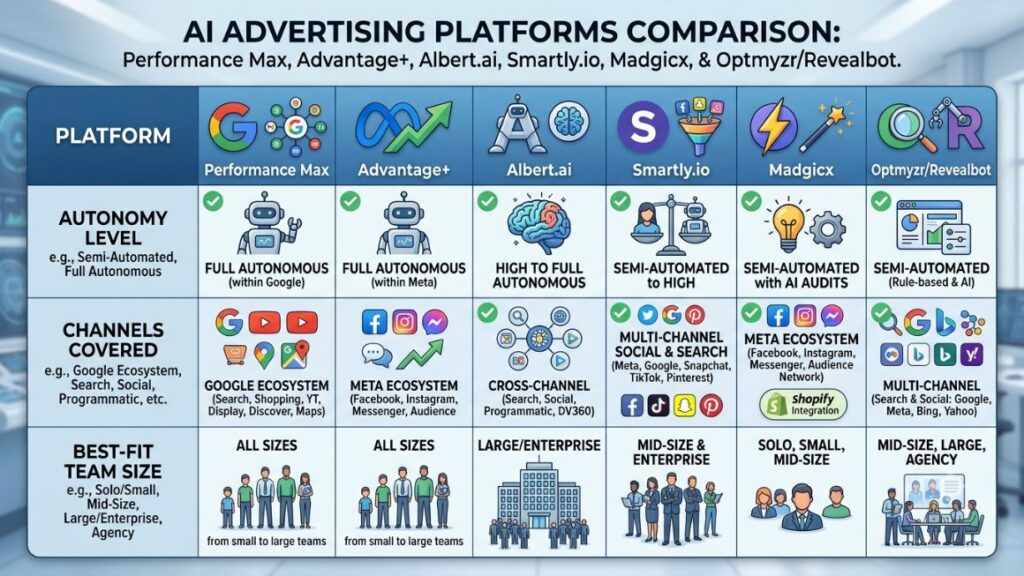
The best AI campaign management tools generally fall into three buckets: platform-native automation built by Google and Meta themselves, cross-channel AI agents built by independent vendors, and creative-focused tools that optimize the assets feeding those campaigns. Here’s what each one actually does.
Google Performance Max
Performance Max is Google’s fully automated campaign type that runs across Search, Display, YouTube, Gmail, Discover, and Maps from a single campaign. You feed it creative assets, audience signals, and a conversion goal, and Google’s machine learning handles bidding and placement across every surface at once.
According to SQ Magazine’s 2025 report, 58% of paid search campaign optimization in 2025 was driven by Google Performance Max. That’s a significant share of the market running on an algorithm most advertisers can’t fully see inside, which is the trade-off with Performance Max: strong results, limited visibility into why a specific decision was made.
Meta Advantage+ Shopping Campaigns
Advantage+ automates audience targeting, placement, and budget allocation across Facebook and Instagram, and it’s grown fast. Meta’s Advantage+ AI ad campaigns have reportedly crossed a $20 billion annual revenue run rate, with roughly 4 million advertisers now using Meta’s generative AI ad tools in some form.
The strength here is scale and access to Meta’s own signal data. The limitation is that it works best when you feed it a wide creative pool, since the system tests combinations you’d never have time to test manually.
Albert.ai
What makes Albert different from Performance Max or Advantage+ is that it’s platform-agnostic. It doesn’t just optimize inside Google’s or Meta’s walled garden; it moves budget between them based on where performance is actually strongest.
Albert is one of the earliest true AI marketing agents, built to run and optimize paid campaigns autonomously across Google, Meta, and programmatic channels without a human setting every rule. Fashion retailer Cosabella publicly credited Albert with driving a significant lift in return on ad spend after handing over campaign execution to the platform, an early and widely cited case in the shift toward AI-run advertising.
Smartly.io
Smartly.io combines creative automation with budget and bid management across Meta, TikTok, Snapchat, and Pinterest. It’s built for teams running high-volume creative testing, letting you generate dozens of ad variations and automatically shift spend toward the combinations that perform.
Enterprise retail and D2C teams tend to reach for Smartly.io when creative fatigue, not targeting, is their biggest bottleneck.
Madgicx
Madgicx positions itself as an AI-powered campaign optimization layer that sits on top of Meta and Google accounts, offering automated rules, audience insights, and a unified dashboard for tracking true profitability rather than just platform-reported ROAS. Its Marketing Intelligence feature pulls revenue data directly from Shopify or WooCommerce so budget decisions reflect actual profit, not just clicks.
Optmyzr and Revealbot
These two deserve a joint mention because they solve a similar problem from opposite ends. Optmyzr focuses on rule-based PPC automation for Google and Microsoft Ads, with granular controls for agencies managing dozens of accounts. Revealbot does the same job but leans harder into cross-platform automation, covering Meta, Google, TikTok, and Snapchat from one interface.
Neither is a fully autonomous agent in the way Albert is. Think of them as a powerful, customizable rules engine rather than a system making independent judgment calls, which is exactly what smaller teams often want, since it keeps a human in the loop on every major decision.
How to Set Up an AI Marketing Agent for Your Campaigns
Setting one up isn’t complicated, but skipping a step here is exactly how teams end up with a system nobody trusts. Follow this order.
- Audit your existing tracking. Confirm conversion tracking, GA4 events, and any server-side setup are accurate before connecting an agent. An agent trained on bad data will optimize toward the wrong outcome with total confidence.
- Define your optimization goal explicitly. Decide whether the agent should optimize for CPA, ROAS, revenue, or a blended metric like MER. Vague goals produce vague results.
- Connect your ad accounts and data sources. Link Google Ads, Meta Ads Manager, and your analytics or CRM platform through the tool’s native integrations.
- Set guardrails before turning on full automation. Cap daily budget shifts at a fixed percentage, and require human approval for changes above a set dollar threshold.
- Run it in recommendation mode first. Most AI campaign management tools let you review suggested changes before they go live for the first two to four weeks.
- Switch to automated execution gradually. Start with lower-risk actions like bid adjustments, then expand to budget reallocation and creative pausing once you trust the output.
- Review the decision log weekly. Check what the agent changed and why, at least until you’ve built confidence in its judgment.
That said, this may not apply to every setup. Brands with long B2B sales cycles and few weekly conversions won’t give an agent enough data volume to learn from quickly, and forcing automation there usually backfires.
AI Agents vs Traditional Campaign Management: What Actually Changes
Traditional campaign management is reactive by design. A media buyer checks performance on a schedule, usually daily or weekly, and makes changes based on what already happened. AI marketing agents shift that model to continuous monitoring and same-hour response.
The real difference isn’t speed alone. It’s scale. A human managing 40 ad sets across three platforms can maybe review each one twice a week in real depth. An agent reviews all 40, every hour, without fatigue.
That doesn’t mean the human role disappears. It moves upstream, toward strategy, creative direction, and setting the guardrails the agent operates inside. From what we’ve seen with YUP learners running performance accounts, the marketers getting the most out of automation are the ones spending their freed-up time on creative testing and offer strategy, not on manually double-checking every bid the algorithm made.
Common Mistakes Marketers Make When Automating Campaigns
Most failures with campaign automation come down to trust issues, not technology issues.
Turning on full automation before tracking is clean. If your conversion data is inaccurate, the agent will optimize confidently toward the wrong goal, and you won’t notice until spend is already wasted.
Setting no guardrails at all. Letting an agent move unlimited budget without a daily cap is how a single bad signal turns into a five-figure mistake overnight.
Expecting it to fix a weak offer. No agent can optimize its way around a product-market fit problem or creative that doesn’t resonate. It can only make a working campaign more efficient, not save a broken one.
Ignoring the decision log. Teams that never review why changes were made lose the ability to catch a mistake early, and they lose the institutional knowledge of what worked and why.
That sounds obvious. It almost never happens in practice, because most teams treat the setup phase as a one-time task instead of an ongoing habit.
Where AI-Powered Campaign Optimization Is Headed Next
The direction is clear even if the exact tools change: agents are getting more autonomous, and the boundary between platforms is dissolving. According to IAB’s State of Data 2025 report, roughly 30% of media agencies and brands have already integrated AI into their campaign lifecycles, and that number is rising fast as platform-native tools like Performance Max and Advantage+ become the default rather than the exception.
The next shift is agents that don’t just optimize existing creative but generate and test new creative variations on their own, closing the loop between AI for marketing campaigns and AI-generated production. Tools like AdCreative.ai are already moving in this direction, scoring and generating ad creative based on predicted performance before a single dollar is spent.
The next stage of marketing campaign automation isn’t just smarter bidding. It’s agents that generate, test, and optimize creative in the same continuous loop they use for budget, collapsing the line between the media team and the creative team.
This won’t replace strategic thinking. It will keep raising the floor on execution quality, which means the marketers who stay ahead will be the ones who understand what the agent is optimizing for, not just the ones who turned it on.
Getting Started With AI Agents in Your Own Campaigns
The tools covered here range from fully autonomous platforms like Albert to controllable rules engines like Optmyzr, and the right starting point depends on how much of the decision-making you’re ready to hand over. Start small, keep your guardrails tight, and expand automation as the decision log earns your trust.
If you want to actually build and deploy these workflows instead of just reading about them, Hotskill walks you through setting up AI-driven campaign management step by step, tool by tool, with real ad accounts. It’s the fastest way to go from understanding the concept to running it yourself.
Frequently Asked Questions
What does an AI campaign optimization agent actually do?
An AI Agent for Campaign Optimization is a software system that monitors your ad campaign data continuously and takes action, like shifting budget or pausing weak ads, without needing a human to approve every change. It differs from a reporting dashboard because it can actually execute decisions, not just display them.
How is an AI marketing agent different from automation rules in Google Ads?
Standard automation rules follow fixed if-this-then-that logic, such as pausing an ad if CPA exceeds a set number. An AI agent weighs multiple variables together, including seasonality and cross-channel performance, before making a more nuanced call.
Do I need a large ad budget to use AI campaign management tools?
No. Many tools, including Google Performance Max and Meta Advantage+, are built into platforms most advertisers already use, so there’s no minimum spend requirement. That said, agents generally need enough conversion volume to learn from, so very small accounts may see slower results.
Which AI campaign management tool is best for a small team?
Start with the automation already built into Google Ads and Meta Ads Manager, since they’re free and require no new integration. If you outgrow that, tools like Revealbot or Madgicx offer more control without the enterprise price tag of Smartly.io.
Is automated campaign optimization safe for a limited budget?
Yes, as long as you set daily spend caps and require human approval above a certain threshold. Running the tool in recommendation mode for the first few weeks before switching to full automation is the safest way to build trust in the system.
Can an AI agent replace a media buyer?
No, and treating it that way usually backfires. It replaces the repetitive, hour-by-hour monitoring work, but strategy, offer positioning, and creative direction still need a person who understands the business.
How long does it take to see results from AI-powered campaign optimization?
Most tools need two to four weeks of data before their recommendations stabilize, since the underlying models need enough conversion volume to separate real signal from noise. Accounts with low weekly conversion counts will take longer.
What’s the biggest risk of using AI for marketing campaigns?
Optimizing confidently toward the wrong goal because of inaccurate tracking. If your conversion data is broken, the agent won’t know it, and it will keep making changes based on bad information until someone catches it.
Does marketing campaign automation work for B2B with long sales cycles?
It’s harder. B2B accounts often have low weekly conversion volume, which gives the agent’s models less data to learn from. It still helps with top-of-funnel bid and budget efficiency, just expect a longer ramp-up before it’s making strong independent calls.
Are AI agents and AI campaign management tools the same thing?
Not exactly. AI campaign management tools is the broader category, covering everything from simple rule engines to fully autonomous agents. An AI agent is the more advanced end of that category, one that can reason across variables and act independently rather than just following preset rules.