

Open Google Ads, Meta Ads Manager, your email platform and Google Analytics 4 on the same Monday morning. Each one will tell you it won last week’s sales. Add them up and the total can exceed what the business actually recorded.
That’s the attribution problem in one picture. Every platform grades its own homework. None of them sees the whole customer journey. Connecting campaign activity to real revenue means pulling data from five or six places, cleaning it and then arguing about what it means.
An AI agent for marketing attribution is built to take on that grind. It reads your connected data, investigates why numbers disagree, summarizes what it finds and suggests what to check or test next. This guide explains how it works, where it helps and where it doesn’t. Also learn how to set one up without handing it the keys to your budget.
Table of Contents
What Is an AI Agent for Marketing Attribution?
An AI agent for marketing attribution is a software system that connects to your marketing and sales data, analyzes how campaigns relate to conversions and revenue, and reports back with findings and suggested next steps. It works toward a goal you set, such as explaining a drop in return on ad spend. This doesn’t answer one isolated question at a time.
Understanding the concept in simple terms
An agent is a system that uses connected data and tools to pursue a goal through a sequence of actions. Ask it why last week’s results slipped. It might pull a channel report, notice an odd cost spike, pull a second report to check and then write up what it found.
Compare that with asking a general chatbot the same question. You’ll get a sensible list: creative fatigue, seasonality, audience overlap. Handy as a checklist. But the chatbot isn’t looking at your account, so it can’t tell you which of those actually happened. An agent with access to your campaign data can.
Capabilities vary a lot by setup. Some agents only read reports. Others run approved workflows, like refreshing a weekly summary. A few can act, for example by changing a budget. Most teams should start at the read-only end.
How it differs from traditional marketing analytics
Four tools often get lumped together here, and they do different jobs.
| Approach | What it does | Where it stops |
| Dashboard | Shows predefined metrics | Won’t explain why a number moved |
| Rules-based automation | Runs when a set trigger fires, such as pausing an ad above a cost limit | Can’t handle a situation nobody wrote a rule for |
| Conversational AI | Explains information you give it | Doesn’t see your data unless you paste it in |
| Data-connected agent | Retrieves reports, compares results, investigates anomalies, proposes a response | Only as good as the data and permissions behind it |
Why attribution matters to business decisions
Clicks and leads are easy to count, and that’s the trouble. A campaign can bring plenty of both while losing money once refunds, discounts and acquisition costs are counted. So revenue, customer acquisition cost (CAC, the total spent to win a customer divided by customers won), profit and incremental impact all belong in the picture.
The stakes are real. In the Haus 2026 Marketing Decision Confidence Index, a survey of 500 senior US decision-makers run in January 2026 and reported by EMARKETER, 78% said they believe at least 10% of their marketing spend is wasted because measurement falls short. Haus sells incrementality testing, so read that with its angle in mind. The direction still matches what most marketers feel.
One point deserves a plain statement. Attribution distributes credit. It doesn’t automatically prove a campaign caused a sale.
Key takeaway: The useful question isn’t whether AI is involved. It’s whether the system can reach trustworthy data, do meaningful analysis and give recommendations you can verify.
An AI agent for marketing attribution is software that connects to a company’s marketing and sales data, investigates how campaigns relate to conversions and revenue, and recommends next steps. Its value depends on data quality, transparent calculations and verifiable recommendations. Attribution assigns credit to touchpoints; it does not on its own prove that a campaign caused a sale.
How an AI Attribution Agent Works
An AI attribution agent works in five stages: it collects data, links touchpoints to conversions, analyzes patterns, explains findings with a recommendation, and tracks what happens afterward. Each stage depends on the one before it. Weak data at the start weakens everything downstream.
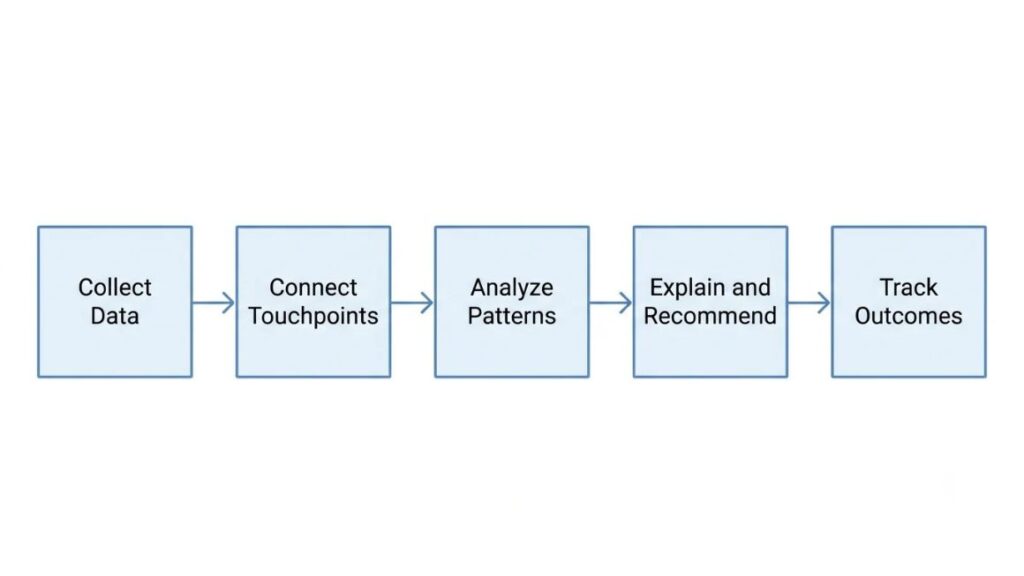
Step 1. Collect data from marketing and sales platforms
The agent starts by reading from advertising accounts such as Google Ads and Meta Ads Manager, web analytics like Google Analytics 4, CRM records in tools such as HubSpot or Salesforce, ecommerce transactions from a store like Shopify, and offline conversions (phone orders, in-store sales) where you have them.
Then comes the unglamorous part. Campaign names need a consistent format. A “lead” has to mean the same thing everywhere. Timestamps, time zones and currency must match, and duplicate conversions need removing. Google’s own documentation warns that when a Google Ads account and a Google Analytics property use different time zones, reporting discrepancies can appear.
Step 2. Connect customer touchpoints to conversions
Next, the agent rebuilds customer journeys. It uses campaign parameters (UTM tags), click identifiers, event data, login IDs and approved matching methods to tie ad clicks, site visits and form fills to a sale. Where several touchpoints exist, multi-touch attribution splits the credit across them instead of handing it all to one.
Visibility has limits, and they matter. Missing consent, people switching between phone and laptop, browser tracking restrictions and systems that don’t talk to each other all leave gaps. Google’s consent mode documentation says that when users deny consent, tags limit data collection and Google may use modeling to fill measurement gaps. So some numbers you see are estimates, not observations.
Step 3. Analyze performance and identify patterns
With joined-up data, the agent can do the comparison work a person would do on a good day. It compares channels, checks which conversion rates changed and when, flags unusual cost increases and looks at where platform-reported results differ from business-reported ones. Cross-channel attribution, which means judging channels together instead of one platform at a time, is the whole point of this step.
It also surfaces the questions worth asking. Why does Meta report more purchases than the store recorded? Which campaign started costing more per conversion once a sale ended?
Step 4. Explain findings and recommend action
Here’s an illustrative scenario, not a documented customer result. A campaign’s reported revenue rises, but its profit falls because acquisition costs and refunds climb. The agent flags the mismatch and identifies the affected period. It recommends reviewing campaign quality and net revenue before anyone increases spend.
Notice what it didn’t do. It didn’t pause the campaign or move budget. It showed the evidence and proposed a check.
Step 5. Track outcomes and improve decisions
A good setup records whether each recommendation was accepted, what changed, and what happened next. Better still, it helps design a controlled experiment around bigger moves, so you can review the result properly.
Be careful here. An agent shouldn’t conclude that its advice caused an improvement just because numbers moved afterward. Performance changes for plenty of reasons, and a before-and-after comparison can’t separate them.
An AI attribution agent works in five stages: collecting data, connecting touchpoints to conversions, analyzing patterns, explaining findings with a recommendation and tracking outcomes. Gaps from missing consent, cross-device behavior and disconnected systems limit what it can see. Improvements after a recommendation should be confirmed with controlled tests, not assumed.
Key Benefits for Marketing Teams
The main benefit of an AI agent for marketing attribution is less time spent assembling reports and more time deciding what to do about them. Beyond that, a connected agent gives a shared view across channels and catches problems earlier. And it lets non-analysts ask questions in plain language. None of it works without clean data underneath.
Faster reporting and less manual analysis
Pulling the same numbers from four platforms every week is repetitive work. Agents are good at repetitive work. An agent can retrieve existing reports and summarize them quickly, which cuts the manual effort. How much time you’ll save depends on your setup, so treat any promised percentage with suspicion.
Marketers are already moving this way. A July 2025 EMARKETER and TransUnion survey of 196 US marketing professionals found that 50% of brand and agency marketers are adopting AI and machine learning for automated marketing reporting.
Better visibility across channels
When Google Ads, Meta Ads and email each claim the same sale, nobody trusts any report. A shared view of spend, conversions and revenue gives everyone one set of numbers to argue about instead of four.
Earlier detection of performance problems
An agent can watch for sudden shifts in conversion rate, tracking failures, spending anomalies and gaps between ad-platform revenue and store revenue. A broken checkout tag found on Tuesday beats one found at month-end.
More informed budget allocation
Recommendations can show where to investigate and which budget experiments to run first. That supports marketing budget optimization without handing the decision over. Major spending changes should still go through a person who can ask, “does this make sense?”
Easier access to marketing insights
Not everyone on a team can build a custom report. With an agent, a marketer can ask in everyday language. Google’s documentation for its Analytics MCP server lists sample questions such as how many users visited yesterday and what the top-selling products were. That shift is what AI-powered marketing analytics looks like in practice: the analysis stays rigorous, but the interface gets easier.
Questions a marketing team could put to its agent:
- Which channels have declining profitability?
- What changed in conversion performance this week?
- Which campaigns need a tracking audit?
- Which budget change should we test next?
Real-World Use Cases Across Different Businesses
Here’s how an AI agent for marketing attribution could work in four kinds of business. The pattern repeats: the agent connects ad, site and revenue data, spots a gap and proposes a check. Examples here are hypothetical unless stated otherwise. They show how an agent could work, and they aren’t customer results.
Ecommerce: Understanding campaign profitability
A retailer can combine ad spend, order revenue, discounts, refunds and margin data to see which campaigns bring commercially valuable customers, not just orders.
Hypothetical example, with illustrative numbers only. A skincare store on Shopify assumes a 50% gross margin and compares two months of one campaign.
| Metric | Last month | This month |
| Ad spend | ₹2,00,000 | ₹3,50,000 |
| Platform-reported revenue | ₹8,00,000 | ₹10,50,000 |
| Reported return on ad spend | 4.0 | 3.0 |
| Refunds | ₹40,000 (5%) | ₹1,50,000 (14.3%) |
| Net revenue after refunds | ₹7,60,000 | ₹9,00,000 |
| Gross profit at 50% margin | ₹3,80,000 | ₹4,50,000 |
| Profit after ad spend | ₹1,80,000 | ₹1,00,000 |
Reported revenue went up 31%. Profit after ad spend dropped from ₹1,80,000 to ₹1,00,000. A dashboard headline would call that a win. An agent that looks at refunds and margin would flag it.
B2B marketing: Connecting leads to closed revenue
A B2B sale can take months. An agent can link ad campaigns and content visits to CRM stages: lead, qualified lead, opportunity, closed deal. That matters because judging a campaign only on form submissions rewards cheap, low-quality leads. The campaign that looks expensive per lead might produce the deals that close.
Marketing agencies: Reporting across client accounts
Agencies repeat the same reporting job across many accounts. An agent can standardize report formats, flag anomalies in a client account, and draft explanations for a strategist to review. The condition: each client’s data stays isolated, and permissions limit who and what can see which account.
Performance marketing: Investigating changes before reallocating spend
Say return on ad spend (ROAS, revenue divided by ad spend) falls. Pausing campaigns is the reflex. A better agent first separates measurement problems, like a broken conversion tag, from plausible campaign changes, like rising auction costs. Then it recommends a controlled test, such as a holdout group, before anyone pauses anything. Google Ads offers Conversion Lift studies for this, though Google notes they aren’t available for every account.
Also Read: AI Agent for Marketing Campaigns: How to Plan, Launch, and Scale Campaigns Autonomously

Tools and Technology to Consider
AI marketing attribution isn’t one product category. It’s a combination of measurement data, a way to connect an AI system to that data, and rules for what the agent may do. Most teams already own part of it. The work is deciding which parts to keep, buy or build.
Existing analytics and attribution platforms
Google Analytics 4 is the usual starting point. It offers three attribution models in its reports: data-driven attribution, paid and organic last click, and Google paid channels last click. Google removed first click, linear, time decay and position-based models in November 2023.
Marketing attribution software from dedicated vendors, such as Triple Whale, Northbeam and Rockerbox, goes further on journey tracking and ecommerce data. CRM reporting, such as HubSpot’s attribution reports, ties marketing activity to deals. The right choice depends on your data sources, attribution model, sales cycle and reporting needs.
Connecting an agent to marketing data
Before an AI agent for marketing attribution can answer anything, it has to reach your data. That happens through integrations and APIs, ideally with read-only connections. The Model Context Protocol (MCP) is an open-source standard for connecting AI applications to external systems such as data sources and tools. Google has published an experimental open-source MCP server for Google Analytics, announced on July 22, 2025, and Google’s documentation states it handles read requests only and can’t edit your settings. Google also open-sourced a Google Ads API MCP server on October 7, 2025, which began as read-only for reporting and diagnostics.
Some platforms are building the agent inside the product. Google announced Ask Advisor on May 20, 2026, a Gemini-powered agent that spans Google Ads, Google Analytics, Merchant Center and Google Marketing Platform, and said it was in beta for English-language accounts.
Also Read: AI Tools for Marketing: 150+ Tools to Build Your Stack in 2026
Choosing between an existing platform and a custom solution
No universal winner exists. A rough comparison:
| Factor | Existing platform | Custom build |
| Implementation effort | Lower; connectors are prebuilt | Higher; you design the data pipeline |
| Flexibility | Limited to what the vendor supports | High; you define metrics and logic |
| Governance | Vendor controls many safeguards | You own the permissions and audit trail |
| Maintenance | Vendor handles updates | Your team handles changes and breakages |
| Cost | Predictable subscription | Lower license cost, higher people cost |
What to evaluate before choosing a tool
- Supported data sources and export options
- Attribution models and configurable lookback windows
- Data freshness and reconciliation with your source numbers
- Access controls and audit logs
- Transparency of calculations and recommendations
- Pricing, implementation and ongoing maintenance
Prices and features change often, so check current details on each vendor’s official documentation before deciding.
How to Implement an AI Agent for Marketing Attribution?
Implementing an AI agent for marketing attribution takes seven steps: define one business question, audit tracking, choose data sources and an attribution approach, set permissions, test outputs against known reports, pilot, and expand gradually. Skipping the audit is a common reason projects stumble.
Step 1. Define the business question
Pick one problem. Unexplained swings in acquisition cost, or revenue that never matches across platforms, are good candidates. “Fix our attribution” isn’t a question an agent can answer.
Step 2. Audit tracking and conversion definitions
Check campaign parameters, conversion events, duplicate records, offline conversion imports, revenue values and tracking consent. Honestly, this step does more for accuracy than any model choice that follows.
Step 3. Choose the data sources and attribution approach
Decide which platform reports, CRM records and financial data the agent needs. Document the attribution model you picked and what it can’t tell you. In GA4, check the key event lookback window too: Google’s default is 90 days for most key events, with 30 and 60 days as options.
Step 4. Set up the agent’s permissions
Start read-only wherever possible. Restrict access by account and role, and decide which actions need explicit human approval.
Step 5. Test outputs against known reports
Compare the agent’s answers with the underlying reports. Verify key calculations yourself. If it can’t reproduce a number you already trust, you’ve found a problem early.
Step 6. Pilot the workflow and measure success
Run a small pilot. Record time saved, check the accuracy of findings, and track whether the recommendations led to useful results.
Step 7. Expand gradually
Add automated budget changes or other consequential actions only after validation, monitoring and approval controls are in place.
A starter checklist:
- One business question written down
- Conversion definitions agreed across teams
- Campaign naming and UTM rules documented
- Read-only access set up and tested
- Five known reports chosen for comparison
- A named person who approves recommendations
A sample prompt to try during the pilot:
Compare last month’s performance across Google Ads, Meta Ads and email using our CRM revenue. Identify gaps between platform-reported and CRM-reported conversions. Explain the evidence you used, state what data is missing or uncertain, and propose one test to run next. Do not recommend budget changes without showing your calculations.
Also Read: AI Agent for Marketing Automation: Benefits, Use Cases, Tools & How to Get Started in 2026
Limitations, Privacy, and Best Practices
An AI agent for marketing attribution can mislead you when data is incomplete, when credit gets mistaken for causation, when customer data is handled carelessly, or when no human reviews consequential decisions. Each risk has a practical fix.
Incomplete data can produce misleading answers
Missing conversions, duplicated events, reporting delays and inconsistent CRM records all undermine conclusions. The agent won’t always know. It may deliver a confident summary built on a broken tag. That’s why the pilot comparison against known reports matters.
Attribution is not the same as causation
Assigning credit to a campaign doesn’t prove it generated extra sales. Google’s own Conversion Lift documentation separates the two: standard attributed conversions are what Google Ads reports, while incremental conversions measure the causal impact of ads, calculated as treatment-group conversions minus control-group conversions. When causal impact is the real question, incremental lift measurement through controlled experiments is the right tool. Aggregate methods such as marketing mix modeling (MMM), which analyzes historical spend and sales patterns across channels, can add another angle.
Also Read: Attribution vs Incrementality vs MMM: When Each One Lies to You
Attribution assigns credit to touchpoints, while incrementality measures the additional conversions caused by advertising. Google’s Conversion Lift documentation defines incremental conversions as treatment conversions minus control conversions. Use attribution for day-to-day optimization and controlled experiments when the question is whether spend actually worked.
Protect customer information
Customer data in a marketing agent brings legal and security duties. Collect consent where required, use the minimum data needed, restrict access by role, set retention limits and check vendor security. For Indian businesses, the Digital Personal Data Protection (DPDP) Rules were notified in November 2025. The core obligations for data fiduciaries are due 18 months later, in May 2027, though MeitY floated a shorter timeline in January 2026. Check the current status before you finalize your plan.
Keep humans responsible for consequential decisions
Require approval for major budget changes. Make the agent show its evidence, flag its confidence, and say what it couldn’t see. And have a rollback plan, so a bad change can be reversed quickly.
Emerging Trends to Watch
Three shifts are worth tracking if you plan to run an AI agent for marketing attribution for the long term. Each comes with a caution about what’s available now versus what’s only announced.
From static reports to interactive analysis
Agents that pull actual business metrics and answer follow-up questions are arriving inside platforms. Google’s Ask Advisor is one example, announced in May 2026 and in beta at the time. In August 2026, trade coverage reported prompt-driven dashboards live in Google Ads, with a Google Analytics version listed as coming soon. Treat announcements as direction, not guarantees.
Combining different measurement methods
Attribution, aggregate modeling and experiments complement each other. No single one of them is a perfect measurement solution. Google’s modern measurement playbook describes using incrementality experiments, MMM and attribution together. In May 2026, Google announced plans to bring Meridian, its open-source marketing mix model, into Google Analytics 360.
More privacy-aware measurement
Expect more weight on first-party marketing data, consent-aware tracking and modeled conversions. Modeled numbers are estimates, so interpret them carefully, and keep your own records of what’s observed versus modeled.
Conclusion
Connecting an AI agent for marketing attribution to your campaign data saves time and clears up the Monday-morning confusion. The result depends on three things: clean data, a clear measurement goal and controlled testing for any claim about cause. Skip those, and the agent just produces confident mistakes faster.
Don’t automate the whole operation at once. Pick one high-value question, like why acquisition cost jumped last quarter. Your next step: audit your current tracking, then choose a measurable pilot you can finish in a few weeks.
Learning to build this skill set is easier with guided practice. YUP’s AI Marketing course covers how to work with AI agents on real marketing data, from connecting sources to checking outputs. If you want structure and feedback while you build your first workflow, start there. [CTA: link to YUP AI Marketing course]
Frequently Asked Questions (FAQs)
What is an AI agent for marketing attribution?
It’s software connected to your real marketing data that analyzes how campaigns link to conversions and revenue. It explains performance, flags problems and proposes actions. Some agents only read reports, while others run approved tasks.
How does an AI agent improve marketing attribution?
It speeds up analysis, compares channels side by side, spots anomalies and supports better-informed decisions. Results still depend on data quality. Bad inputs get you fast, confident, wrong answers.
Can an AI agent replace attribution software?
Usually not. Most agents need a reliable measurement platform or data setup to supply the underlying numbers. Think of the agent as a layer that reads and explains, not a replacement for the measurement itself.
Is AI-driven attribution accurate?
An AI agent for marketing attribution is only as accurate as its data completeness, model assumptions, identity matching and validation. AI doesn’t remove measurement uncertainty. Check its outputs against known reports and use experiments for causal questions.
How do you measure the ROI of an AI attribution agent?
The ROI of an AI agent for marketing attribution shows up in time saved, reporting accuracy, investigation speed and the incremental business impact of recommendations you tested. Time saved alone is a weak measure. Better decisions are the real return.
Is an AI attribution agent suitable for small businesses?
Yes, an AI agent for marketing attribution can suit a small business, provided tracking is reliable. A smaller team can start with a limited data connection and a single reporting workflow. Small accounts with few conversions may struggle to detect small effects in experiments, so keep expectations realistic.