
Most food delivery apps compete on discounts. Zomato competes on culture.
Table of Contents
That difference is why the Zomato case study still gets studied, not just for what worked in food delivery, but for what it shows about building a brand that people feel something about. You don’t see users sharing Swiggy memes on Twitter at 2 AM. You see them sharing Zomato’s.
But here’s what most Zomato case study breakdowns miss: the marketing is only part of the story. The bigger shift happened when Zomato stopped being a food delivery app and started building a full-stack commerce company. In March 2025, the parent company rebranded to Eternal Limited. Blinkit’s Net Order Value (NOV) crossed food delivery’s NOV for the first time in Q1 FY26. A restaurant listing website from 2008 is now a multi-vertical commerce platform valued at over ₹2.87 lakh crore.
This case study covers both: the marketing that made Zomato’s brand what it is, and the business model decisions that turned it into what it’s becoming.
How Zomato Started and What It Got Right Early
Zomato wasn’t built to deliver food. It was built to digitise restaurant menus.
Deepinder Goyal and Pankaj Chaddah launched it in 2008 under the name Foodiebay, originally as a platform where you could browse restaurant menus without calling ahead. By 2010, they renamed it Zomato and started expanding across Indian metros. The delivery business came much later, after 2015, when the market made it impossible to stay just a discovery platform.
That origin matters because it explains Zomato’s early advantage: a massive content library of restaurant data, reviews, and user-generated ratings before any competitor thought to build one. By the time delivery became the battleground, Zomato already had the trust layer that takes years to build.
The early product decisions compounded over time. Restaurant discovery meant Zomato had to care about search, local SEO, and content quality from day one. These aren’t things food delivery apps prioritise. Zomato did, and it’s a big reason organic traffic now accounts for 48% of total sessions, up from 40% in 2023, according to data reported by industry trackers in 2025.
What Does Zomato Believe In?
Zomato’s mission is pretty simple: better food for more people.
But it’s not just about the food. The team has always been very experimental, bold, and kind of quirky. You can feel it in their social media posts, their app copy, even their email subject lines.
They’ve built a culture that doesn’t sound like a stiff corporate voice. They sound like that funny, slightly sarcastic friend who sends you memes at midnight. That’s part of what makes them special.
Zomato’s Growth Story: From Startup to Super App
Zomato didn’t become a household name overnight. It took years, a bunch of smart decisions, and some solid risks. Let’s walk through how it all played out.
Quick Timeline
- 2008 – Foodiebay is launched. Just menus. No delivery yet.
- 2010 – Name changes to Zomato
- 2011–2013 – They start expanding to other countries like the UAE, UK, and South Africa
- 2015 – They add food delivery (huge step)
- 2018 – Zomato Gold is introduced
- 2020 – They buy Uber Eats India
- 2021 – Zomato goes public (yep, stock market)
- 2023–2026 – Add groceries, intercity delivery, more experiments
How Did It Start Getting Popular?
In the beginning, it was all about helping people find good restaurants. They nailed that.
Back then, most of us didn’t have easy access to menus or reviews. Zomato solved that, and people loved it. So they told their friends, who told their friends, and boom, it started spreading.
When food delivery came in around 2015, things really blew up. Suddenly, Zomato wasn’t just for planning dinner, it was for ordering it. That changed everything.
And then, when COVID hit, delivery became essential. Zomato adapted fast, and that helped them grow even more.
The Different Stages of Growth
- Menu Discovery (2008–2012): Just showing menus and restaurant info
- Global Expansion (2013–2015): Moved into other countries
- Delivery Phase (2015–2020): Food delivery becomes core
- Full Ecosystem (2020–now): Grocery, B2B supply, events, subscriptions
They’ve tried a lot over the years. Some things worked, some didn’t, but they never stopped moving.
Zomato’s Business Model: How It Actually Makes Money
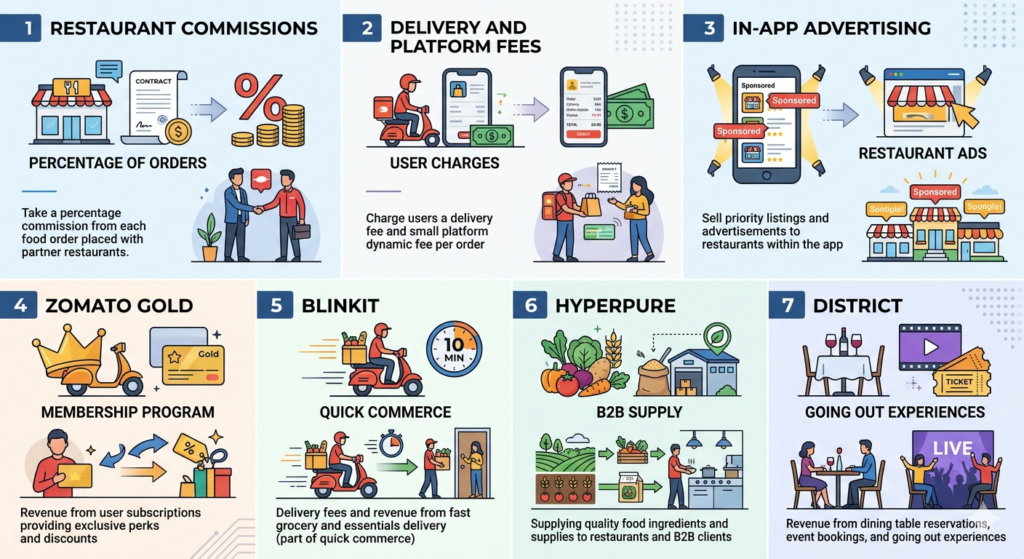
Zomato’s business model is more layered than most people realise. There are seven distinct revenue streams, and the balance between them has shifted significantly over the last three years.
Restaurant commissions are the core. Zomato charges 18 to 30% on every food delivery order. This is the original business and still the most profitable per unit.
Delivery and platform fees are charged to customers. These are small individually but add up across hundreds of millions of annual orders.
In-app advertising is where restaurants pay for promoted placement in search results and category pages. As the platform’s user base grows, ad inventory becomes more valuable.
Zomato Gold is the subscription model, a paid membership that gives users free delivery, discounts at partner restaurants, and priority service. Gold renewals increased 27% in 2024, according to industry reporting, which signals real retention value, not just promotional sign-ups.
Blinkit is quick commerce: grocery and essentials delivered in under 15 minutes through a network of dark stores. Revenues come from product markups, delivery fees, and brand ad slots inside the app. In FY25, Blinkit revenue crossed ₹5,206 crore, and it grew approximately 126% year-on-year.
Hyperpure is the B2B arm, supplying fresh ingredients and kitchen staples to restaurants and Blinkit’s dark stores. It operates in 10+ cities and serves over 30,000 restaurants. Hyperpure’s revenue grew 93% year-on-year in Q4 FY25.
District handles event ticketing and table reservations, built after Zomato acquired Paytm’s entertainment ticketing business in 2024. It’s the smallest vertical today but expands the brand’s surface area into lifestyle commerce.
Zomato (now operating under parent company Eternal Limited) runs seven revenue streams: restaurant commissions, platform fees, in-app advertising, Zomato Gold subscriptions, Blinkit quick commerce, Hyperpure B2B supply, and District event ticketing. In FY25, Eternal’s consolidated revenue reached ₹20,243 crore, a 67% year-on-year increase, with Blinkit growing 126% in the same period.
Also Read: Netflix Case Study
Who Uses Zomato? (Target Audience)
Zomato has always been very clear about who they’re building for.
Typical Zomato Users:
- Urban professionals
- College students
- Working couples
- People living away from family
- Basically, anyone who doesn’t want to cook
Most of their users are between 18 to 35 years old. They’re tech-savvy, they live in cities, and they order food often, especially late at night, on weekends, or during office hours.
Also Read: AirBnb Customer Acquistion Case Study
What Zomato Knows About Their Users
They don’t just guess who their audience is. They study them closely.
- They know what time people usually order (hint: lunch and dinner, but also late-night snacks)
- They know which cuisines trend on weekends (Chinese, Mughlai, pizza)
- They even track which locations need more delivery partners
All this helps them send better push notifications, suggest smarter options, and improve delivery timing.
Also Read: Starbucks Case Study
The Competition: Zomato vs Swiggy (and Others)
Let’s talk about the elephant in the room, Swiggy.
Zomato and Swiggy have been going head-to-head for years now. They both do food delivery. They both have sleek apps. They both offer quick grocery services, too.
But they feel different, don’t they?
What Sets Them Apart?
| Feature | Zomato | Swiggy |
| App Personality | Witty, quirky, meme-driven | Straightforward, clean, utility-first |
| Social Media | Funny, casual, highly viral | Professional, less humorous |
| Other Services | Dining, Intercity, Zomato Gold | Instamart, Genie, Swiggy One |
| Content & Branding | Loud, colorful, full of personality | Calm, efficient, more reserved |
Zomato wins when it comes to brand recall and creativity. Swiggy focuses more on speed and service.
They both have loyal fans, and honestly, most people have both apps installed. It’s just about who gives the better deal at that moment.
Also Read: Amul Case Study
Zomato’s Digital Marketing Strategy (Deep Dive)
If there’s one thing Zomato does really, really well, it’s digital marketing. They don’t just run ads. They talk to their audience in a way that feels real. Fun. Even emotional sometimes.
Let’s break down how they do it:
1. SEO (Search Engine Optimization)
Zomato shows up at the top when you search for something like “best momos in Delhi” or “budget restaurants in Bandra.” That’s not an accident.
They’ve put in a lot of work into:
- Writing local food blogs
- Creating city-specific food lists
- Tagging restaurants with detailed keywords
They also have a Zomato blog, where they talk about food trends, lifestyle content, and sometimes even dating advice (yes, really). This content brings a lot of organic traffic from Google. Zomato also plays a big role in helping restaurants digitize their menus through Digital Menu integrations, making the dining and ordering experience smoother for both customers and partners.
2. Social Media: Memes, Relatability & Voice
This is where Zomato really shines.
They don’t post boring ads. They post:
- Food-related memes
- Funny one-liners
- Quirky tweets (sometimes with spelling mistakes on purpose)
- Replies to trending topics, movie releases, IPL matches, you name it
They talk like their users. They sound like a friend who’s hungry and dramatic at the same time. That’s what makes people want to follow them.
3. Push Notifications
We’ve all received those funny Zomato push messages, right?
They’re not just reminders. They’re full of personality. Examples:
- “Your crush might ignore you, but we won’t.”
- “Paneer is temporary. Biryani is forever.”
And it’s not random. They use your order history and location to time these messages perfectly.
4. Email & WhatsApp Marketing
Zomato also sends emails that don’t feel like emails. Their subject lines are clever and their content is usually short and playful. Same with WhatsApp updates, they send order tracking, promos, and even jokes sometimes.
5. YouTube Content
Zomato has tried various YouTube formats:
- Food challenges
- Collaborations with influencers
- Behind-the-scenes delivery stories
Some hit, some didn’t. But they keep experimenting.
6. Paid Ads (Performance Marketing)
When you search for “best pizza near me” or “order food online,” you’ll often see a Zomato ad at the top. That’s part of their Google Ads strategy.
They also run Facebook and Instagram ads, usually for discounts, special offers, or promoting Gold/Pro memberships.
What’s different? Their creatives don’t look like typical ads. They look like memes or tweets, and that gets clicks.
Enroll Now: Live Advanced Digital Marketing Course
The Marketing Strategy Behind Zomato’s Brand
Open Zomato’s Twitter (now X) account and you’ll find something rare: a brand that seems to have a personality.
That’s not an accident. And it’s not just social media management. Zomato’s marketing strategy is built on a few decisions made early that compound over time.
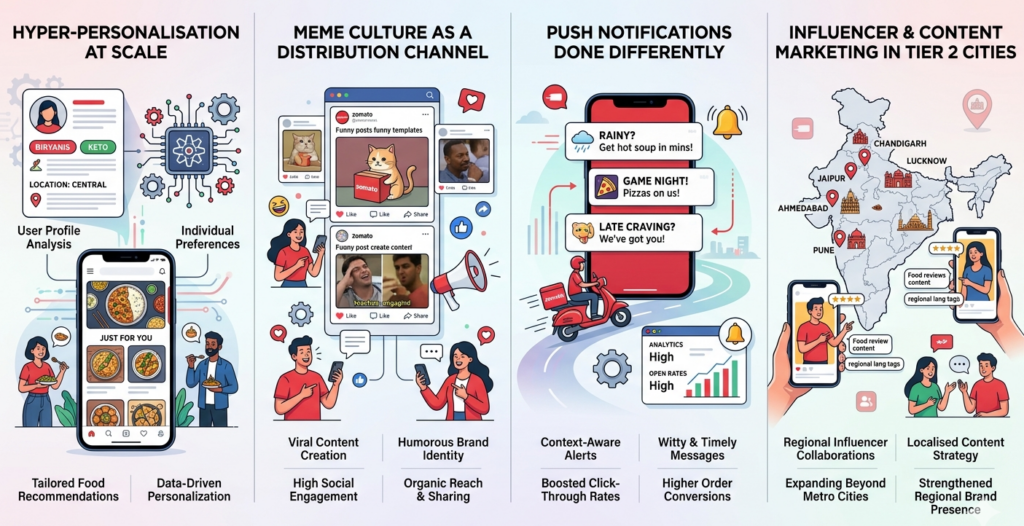
Hyper-personalisation at scale
Zomato collects and acts on user data in ways most apps don’t. Order history, time of day, weather, past ratings, location: all of it feeds into what you see when you open the app. The homepage looks different for someone who orders biryani every Friday versus someone who orders salads at noon on weekdays.
This matters because personalisation reduces the cost of re-engagement. You don’t need as many discount offers if the recommendations feel like they’re reading your mind. It’s a real driver behind the 36% increase in repeat orders reported in 2024.
Meme culture as a distribution channel
Zomato was one of the first Indian brands to treat its social media accounts as creative properties rather than broadcast channels. The tone is witty, self-aware, and occasionally a little reckless, which is exactly why it works.
The #ZomatoMemes campaign generated 120 million impressions, 2 million shares, and 300,000 user-generated posts in a single month, according to 2025 industry data. That’s earned media you can’t buy with a performance budget.
Most marketers look at this and think “we should do memes too.” The harder truth is that meme marketing only works when you have brand consistency underneath it. Zomato’s social content is funny because the brand’s values are clear. Irreverence isn’t the strategy. It’s the expression.
Push notifications done differently
Push notifications are the most abused channel in app marketing. Most brands use them to blast promotions. Zomato uses them to be useful and occasionally delightful.
Weather-based nudges (“Rainy day? Perfect excuse to stay in”), late-night messages timed to when specific users typically order, meal reminders calibrated to individual order patterns. The personalisation here is the point. A notification that feels like it knows you is a very different experience from a coupon code at 7 PM.
Influencer and content marketing in Tier 2 cities
Zomato’s Tier 2 and Tier 3 city expansion has relied heavily on local influencer partnerships rather than national campaigns. Food bloggers and local creators have better credibility with regional audiences than celebrity endorsements. The approach has driven meaningful growth outside the five metros, which now account for a significantly smaller share of total orders than they did three years ago.
Zomato’s digital marketing strategy combines hyper-personalised in-app experiences, social media content built around humour and cultural relevance, and data-driven push notifications. Its #ZomatoMemes campaign generated 120 million impressions in a single month in 2024. The company ranked in the top 3 positions for over 3,500 food and delivery-related keywords as of 2025.
Gamification & Loyalty: Zomato Gold
Zomato Gold wasn’t just about discounts. It was about making users feel like part of an exclusive club.
Here’s how they used gamification:
- Limited invites at first (created hype)
- “Unlock Gold” messages after multiple orders
- Special badges, milestones, and member-only deals
This created FOMO (fear of missing out), which drove more people to subscribe. It also boosted repeat orders, because people felt they were getting better value.
They later switched the program a few times based on feedback. Some versions were better than others. But the core idea, reward loyal users, stayed.
Also Read: McDonald’s Case Study
Personalization, Localisation & UX Magic
Zomato’s app experience is one of the smoothest out there. But behind that simplicity is a lot of smart tech and data use.
Personalization
- The app recommends restaurants based on your past orders
- Suggests “repeat orders” with one tap
- Shows offers based on your city and budget
Even the homepage changes based on what time you open the app. Breakfast options in the morning. Snacks in the evening.
Regional & Local Campaigns
Zomato doesn’t do one-size-fits-all marketing. They use local languages, festivals, and even slang.
Examples:
- During Onam in Kerala, they post Sadhya meal jokes
- In Delhi winters, they push hot soup orders
- In Mumbai, they reference local train culture
This makes users feel seen. And it makes the brand feel closer to home.
UX That Just Works
The app is super intuitive:
- Clean layout
- Easy filters (by cuisine, rating, delivery time)
- Quick order tracking
- Helpful visuals and icons
It’s designed for people who are hungry and impatient. And it works.
Also Read: Amazon Case Study
Blinkit: The Acquisition That Changed Everything
In August 2022, Zomato paid $568 million to acquire Blinkit. At the time, the reaction was mostly negative. Analysts called it expensive. Critics said quick commerce was a fad. The acquisition looked like a distraction.
Three years later, it looks like one of the smartest moves in Indian tech history.
In Q1 FY26, Blinkit’s NOV hit ₹9,203 crore, surpassing the food delivery segment’s ₹8,967 crore for the first time. Blinkit’s NOV grew 127% year-on-year in that quarter. Food delivery grew 13%.
Blinkit is now the growth engine. Zomato food delivery is the cash generator. That’s a complete structural reversal from what the business looked like in 2022.
What made it work wasn’t just timing. Zomato had three things Blinkit needed: an existing delivery fleet and infrastructure, a massive consumer app with established trust, and the capital to fund dark store expansion at scale. Blinkit is on track to operate 2,000 dark stores by December 2025. That density is a logistics moat that pure-play quick commerce competitors like Zepto and Instamart have to build from scratch.
Blinkit is also moving from a marketplace model to inventory ownership, which increases revenue recognition but also accountability. Under FSSAI’s licensing rules, Blinkit will be liable for product quality and consumer complaints at a higher level than before. The business is maturing.
Zomato acquired Blinkit for $568 million in 2022 in a widely criticised deal. By Q1 FY26, Blinkit’s Net Order Value of ₹9,203 crore had surpassed Zomato’s food delivery NOV of ₹8,967 crore, growing 127% year-on-year. Blinkit is now Eternal Limited’s primary growth driver.
What the Numbers Say About Zomato’s Growth
The numbers behind the Zomato case study tell a clearer story than most commentary does.
Eternal Limited’s FY25 consolidated revenue reached ₹20,243 crore, up 67% year-on-year. Net profit for the full year was ₹527 crore, up from ₹351 crore in FY24. Adjusted EBITDA grew to ₹1,079 crore from ₹372 crore, which reflects improving unit economics in food delivery even as Blinkit continues to invest in scale.
On the user side, Zomato crossed 80 million monthly active app users in 2025. Blinkit’s average monthly transacting customers doubled year-on-year to 10.2 million in FY25.
The marketing numbers are equally interesting. Zomato was named one of India’s Top 10 Most-Trusted Brands in 2025 by ET Brand Equity. It holds top-3 rankings for over 3,500 food and delivery-related search keywords. Social media followers grew 17% in 2024.
That said, the FY25 picture isn’t uniformly positive. Q4 FY25 net profit fell 77% to ₹39 crore, driven by heavy investment spending and rising delivery costs (up 46% year-on-year to ₹5,728 crore). Zomato’s parent Eternal is clearly in build mode, not harvest mode. Food delivery growth at around 15% is slower than what the market expected, and the company has acknowledged it. The bet is that Blinkit’s scale and the eventual profitability of quick commerce justifies the spending now.
Whether that bet pays off is the story of the next five years.
What Marketers Can Take From the Zomato Playbook
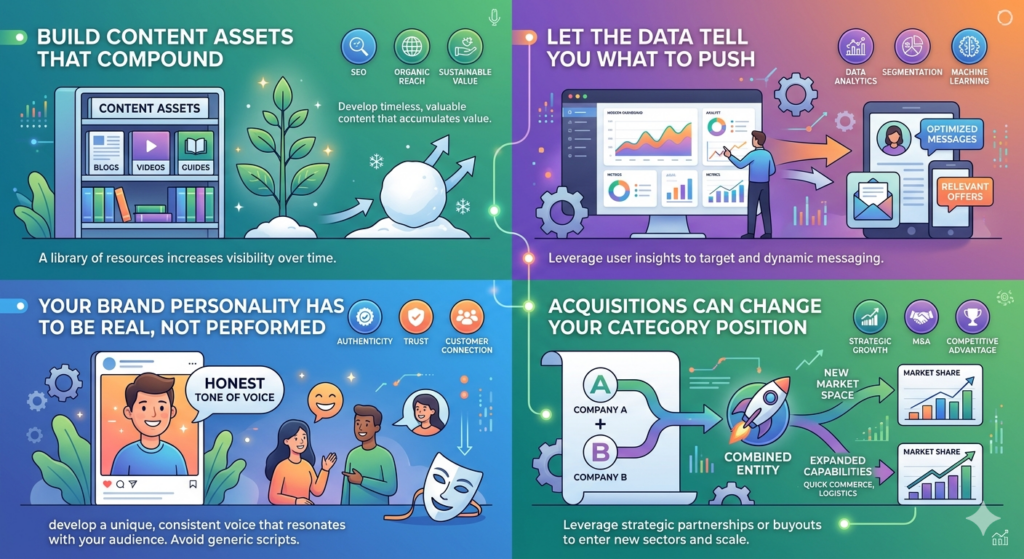
The Zomato case study gets referenced in a lot of marketing conversations because the surface lessons are easy to take away: be funny on social media, personalise your notifications, build a loyalty programme. Those are real tactics, but they’re the output, not the input.
The more useful lessons are structural.
Build content assets that compound. Zomato’s restaurant data and review infrastructure created an SEO advantage that’s hard to replicate. Organic traffic at 48% of sessions doesn’t happen without years of content investment. Whatever the equivalent is in your category, start building it now.
Let the data tell you what to push. Zomato’s personalisation isn’t clever guesswork. It’s behavioural data fed into recommendation systems. The principle scales down: even basic segmentation (what did someone buy last time, when do they typically engage) produces better results than one-size campaigns.
Your brand personality has to be real, not performed. Zomato’s social media works because the company’s culture matches the tone. Brands that try to bolt on a witty persona without backing it up internally get called out fast. The marketing is downstream of the culture.
Acquisitions can change your category position. Blinkit turned Zomato from a food delivery platform into a commerce infrastructure company. Most marketers don’t think about M&A as a marketing decision, but brand positioning and product strategy are the same thing at a certain scale.
From what we’ve seen with YUP learners who work in D2C and consumer tech, the Zomato playbook is most useful for teams thinking about retention over acquisition. The company doesn’t win by being cheapest. It wins by being most embedded in the customer’s daily habit.
Challenges Faced by Zomato
Of course, not everything was smooth sailing. Zomato had its fair share of problems.
1. Delivery Partner Protests
Some delivery partners have protested about long working hours, low pay, and safety concerns. Zomato responded by tweaking pay models and offering insurance, but it’s still a challenge.
2. Regulatory Issues
There have been rules around food quality, tax collection, and delivery hygiene. Zomato has had to deal with a lot of government scrutiny, especially around restaurant listings and fake reviews.
3. Campaign Backlash
Not all campaigns were hits. Sometimes, people felt Zomato crossed the line, especially with jokes that touched sensitive topics. They’ve had to take posts down and apologize.
4. Profitability Pressure
For a long time, Zomato was burning a lot of cash to grow fast. Investors and the stock market have pushed them to show profits. That’s why they’ve started focusing more on unit economics and core services lately.
Also Read: Coca-Cola Case Study
Lessons for Marketers & Startups
There’s so much to learn from Zomato’s journey. Here are a few takeaways:
- Be Bold with Your Brand Voice
Don’t sound like a robot. Be human. Be fun. Zomato’s casual tone helped it build a huge fan base. - Content is a Growth Channel
Zomato’s SEO blogs, witty social media, and funny push notifications all helped them grow without spending a bomb. - Timing is Everything
Whether it’s memes, notifications, or campaigns, posting at the right moment makes all the difference. - Adapt Fast
The market changes quickly. Zomato failed fast, learned faster, and kept experimenting. - Loyalty is More Than Points
Real loyalty comes from how you make users feel. Gold, Pro, repeat-order nudges, all of these made people come back.
What Makes Zomato’s Case Study Special?
You’ll find many startups in India. Many delivery apps. But Zomato stands out because it mixes technology, design, data, and content like very few others do.
They made food delivery fun. Emotional. Viral.
They didn’t just deliver meals, they built a community. A brand you actually want to follow on social media.
That’s rare.
Conclusion
Zomato’s journey shows how a simple idea can become a big brand with the right mix of timing, bold thinking, and smart marketing. They understood what people needed, spoke their language, and kept things fun, even when just talking about food.
From listing menus to delivering meals and making people laugh on social media, Zomato stayed close to its users. They failed at times, but never stopped learning or improving.
For anyone trying to build something today, whether it’s a startup, a blog, or a brand, Zomato’s story is full of useful lessons. It’s proof that with good content, a strong voice, and quick action, you can build something people love.
FAQs: Zomato Case Study
Q1. What is Zomato’s business model, and how does it generate revenue?
Zomato earns money mainly through food delivery commissions, restaurant ads, subscription plans like Gold/Pro, B2B services like Hyperpure, and dining deals.
Q2. Who are Zomato’s main competitors in India?
Zomato’s biggest competitor is Swiggy. Others include Dunzo for groceries and new quick-delivery apps trying to enter the food space.
Q3. How does Zomato use digital marketing to grow?
They use SEO, funny social media posts, push notifications, YouTube, and paid ads. Their tone is casual and relatable, which makes people connect easily.
Q4. What was the idea behind Zomato Gold and how did it impact growth?
Zomato Gold made people feel special with extra benefits. It helped increase loyalty and made users order more often from partner restaurants.
Q5. What made Zomato’s marketing campaigns go viral?
They use humor, local language, and perfect timing. Their posts are funny, real, and made for today’s internet audience. That’s why people share them.
Q6. What can startups learn from the Zomato case study?
Startups can learn to build trust, speak like humans, adapt quickly, and keep the user at the center. Content and brand voice matter a lot.