

Zero-Party Data is starting to show up more in real marketing conversations, not just theory. This blog takes a closer look at what it actually means and where it fits. Not in a textbook way, but in how teams are using it day to day. It covers how zero-party data is collected, where it tends to work best, and what usually goes wrong along the way. There’s also a practical angle, how to turn those inputs into something useful, not just store them. And toward the end, it touches on where things are heading. Because this shift isn’t temporary. It’s slowly becoming the default.
Table of Contents
What is Zero-Party Data?
Zero-party data gets talked about a lot, but the simplest way to look at it is this: it’s information customers choose to give you on purpose.
Not tracked. Not guessed. Not stitched together from behavior patterns.
They tell you.
That’s why the commonly used definition, “data intentionally and proactively shared by customers”, actually matters. The intent part is doing most of the work here. Without it, you’re just back to first-party data.
And this is where things start to shift a bit.
Most marketing data lives in the world of inference. Someone clicks on three product pages, spends time comparing pricing, maybe adds something to the cart, and you assume interest. Sometimes you’re right. Sometimes… not really.
Zero-party data removes that guesswork. A user says, “This is what I want,” or “this is what I care about.” No decoding needed.
That’s also why it’s called zero-party. It sits even before first-party data. First-party still needs interpretation. Zero-party doesn’t.
It’s clean. Direct. Almost uncomfortable in how clear it is, especially if you’re used to working with messy datasets.
Simple Explanation of Zero-Party Data (Beginner-Friendly)
Think about the last time a website asked a few questions before showing results.
Not in a pushy way. More like:
- “What are you looking for today?”
- “What’s your biggest concern?”
- “How often do you want to hear from us?”
That’s zero-party data in action.
A skincare quiz where someone selects “dry skin” and “sensitivity.”
A streaming app where a user picks genres they like.
An email preference center where someone says, “Send fewer updates.”
It’s all the same idea.
Instead of quietly watching what people do and trying to reverse-engineer intent, you just… ask. And more importantly, you give them a reason to answer.
That last part tends to get overlooked. People don’t share information just because a form exists. There’s usually a trade happening, better recommendations, more relevant content, and less noise.
When that trade feels fair, responses come naturally. When it doesn’t, the form sits there collecting nothing.
Examples of Zero-Party Data in Marketing
Zero-party data isn’t limited to surveys, even though that’s where most teams start.
It shows up in small, everyday interactions, often quietly.
- Quizzes and guided flows that help users find the right product
- Preference centers where people control what they see and how often
- Customization inputs like size, style, dietary choices, or goals
- Feedback forms where users share opinions, not just ratings
Even something as simple as asking, “What are you shopping for today?”, that counts.
The common thread is consent and clarity. The user knows what they’re sharing, and why.
And when it’s done well, it doesn’t feel like data collection at all. It just feels like part of the experience.
Why Zero-Party Data is Important in a Privacy-First World
Death of Third-Party Cookies and Data Privacy Shift
For a long time, marketing ran on tracking. Quietly, mostly in the background.
Third-party cookies filled in the gaps, who users were, what they browsed, and what they might want next. It worked. Until it didn’t.
Now, between browser changes, stricter regulations, and general user awareness, that system is breaking down. Not all at once, but enough to feel it.
- Data signals are weaker
- Attribution is messier
- Targeting isn’t as precise as it used to be
And then there’s the compliance side. Regulations like GDPR and CCPA didn’t just add rules; they changed expectations. Consent isn’t optional anymore. Transparency isn’t a bonus.
So the question becomes: how do you still personalize without overstepping?
Zero-party data fits naturally here. It doesn’t try to work around the rules. It works with them.
Why Marketers Are Moving to Zero-Party Data
Part of this shift is forced. Part of it is… overdue.
When tracking becomes less reliable, teams start looking for stronger signals. And it turns out, the strongest signal is often the one users give directly.
There’s also a trust angle that’s hard to ignore now.
People notice when they’re being tracked. They notice irrelevant ads. They definitely notice when brands get something wrong. It adds up.
Zero-party data changes that dynamic a bit. It’s more transparent, which makes it easier to justify. You’re not guessing what someone wants; you’re responding to what they’ve already said.
And from a performance standpoint, that clarity helps.
Less wasted spend. Fewer mismatched messages. Better alignment between what users expect and what they see.
Not perfect, of course. It still needs thoughtful execution. But it’s a cleaner starting point.
Benefits of Zero-Party Data for Businesses
From the business side, the biggest win is precision.
When users tell you exactly what they’re looking for, personalization stops feeling generic. Messages land better. Recommendations make more sense. Journeys feel… connected.
There’s also less friction internally. Teams don’t have to debate what a certain behavior might mean. The intent is already there.
A few things tend to improve when zero-party data is used properly:
- Campaign targeting becomes sharper
- Conversion paths get shorter
- Content feels more relevant without trying too hard
Another point that often gets missed, it reduces dependency on unstable data sources. When third-party signals drop, or attribution gets fuzzy, zero-party data stays consistent because it’s coming straight from the user.
And over time, that consistency adds up.
Benefits of Zero-Party Data for Customers
From the user’s perspective, this is less about data and more about control.
Instead of being analyzed in the background, they get to shape what they see. That alone makes the experience feel different.
Content becomes more relevant, yes, but also more predictable. Fewer surprises. Less “why am I seeing this?”
There’s also a subtle shift in trust.
When people know what they’re sharing and how it’s used, they’re usually more comfortable engaging. Not always immediately, but it builds.
And when brands actually use that data well, better recommendations, fewer irrelevant emails, it reinforces the behavior.
It’s a simple loop:
- User shares something
- Brand responds correctly
- User shares a bit more next time
Not complicated. Just rarely executed properly.
Zero-Party Data vs First-Party Data vs Third-Party Data
What is First-Party Data?
First-party data is what most teams are already familiar with.
It comes from user interactions, things like page visits, clicks, purchases, and session time. All useful signals. In many cases, essential.
But here’s the catch: it tells you what happened, not necessarily why.
Someone visits a pricing page three times. That could mean strong intent… or confusion… or comparison shopping. You don’t really know without context.
So teams interpret. They build segments. They make educated guesses.
Sometimes those guesses are accurate. Sometimes they’re just close enough to work.
That’s the nature of behavioral data. It’s valuable, but it’s not always clear.
What is Third-Party Data?
Third-party data comes from outside your ecosystem.
Aggregated, packaged, and sold for targeting, usually at scale. It’s been a big part of digital advertising for years.
The appeal is obvious: reach more people, fill in gaps, expand audiences quickly.
But the downsides have become harder to ignore:
- Accuracy isn’t always reliable
- Source transparency is limited
- Compliance risks are higher
And now, with cookie deprecation and platform restrictions, it’s simply less effective than it used to be.
Still useful in some cases, but no longer something you can build everything around.
Key Differences: Zero vs First vs Third-Party Data
At a high level, the difference comes down to how close the data is to actual user intent.
Zero-party data is direct. The user tells you what they want.
First-party data is observed. You watch behavior and interpret it.
Third-party data is external. You rely on someone else’s dataset to fill in the blanks.
That distance matters.
The further you move from direct input, the more assumptions you introduce. And with more assumptions comes more room for error.
That’s why zero-party data feels different in practice. It’s not just another data source; it changes how decisions get made.
Less guessing. More responding.
Comparison Table (Zero vs First vs Third-Party Data)
| Factor | Zero-Party Data | First-Party Data | Third-Party Data |
| Source | Directly from the user | User behavior on owned channels | External providers |
| Consent Level | Clear and explicit | Usually implied or accepted | Often unclear |
| Accuracy | High (declared intent) | Medium (interpreted behavior) | Varies widely |
| Use Cases | Personalization, preferences | Analytics, optimization | Broad targeting |
| Reliability | Stable | Context-dependent | Declining over time |
There’s no need to completely replace one with another. Most teams will use a mix.
But the balance is shifting.
Less reliance on guessing. More emphasis on what users actually say.
And that shift, slow as it may feel, is already changing how good marketing gets done.
How to Collect Zero-Party Data
Collecting zero-party data sounds straightforward on paper; just ask users what they want. In reality, that approach falls flat more often than it works.
People don’t wake up wanting to fill out forms. They share information when the experience feels useful, quick, and worth it. That’s the part that separates high-performing zero-party strategies from everything else.
It’s less about collecting data and more about designing moments where sharing feels natural.
A few patterns tend to work consistently:
- Keep the interaction lightweight
- Make the benefit obvious upfront
- Don’t ask everything at once
And maybe the most important one, use what you collect. Nothing kills participation faster than asking questions and then ignoring the answers.
Interactive Content for Zero-Party Data Collection
Interactive formats tend to outperform static forms for a simple reason: they feel less like a task.
Quizzes, short surveys, even quick polls… they create a bit of momentum. Users move from one step to the next without overthinking it. That’s where most of the data comes from.
A product recommendation quiz is a good example. Instead of showing a long catalog, you ask a few focused questions:
- What are you looking for?
- Any specific preferences?
- Budget range?
By the time users reach the result, they’ve already shared valuable inputs, and they feel like they’re getting something in return.
Same with polls or quick surveys. Short works better here. Three to five questions, max. Once it starts feeling like effort, drop-off increases sharply.
Gamified experiences can also help, but only when they’re done carefully. If it feels gimmicky, users disengage. If it feels useful with a bit of interaction layered in, it works.
There’s a balance there.
Using Preference Centers for Data Collection
Preference centers are often underused, or worse, treated as a compliance checkbox.
In practice, they’re one of the cleanest ways to collect zero-party data, because the intent is already there. Users are actively telling you how they want to engage.
Instead of a basic “unsubscribe or stay” setup, a more thoughtful preference center might let users:
- Choose content topics
- Set communication frequency
- Select specific product categories
The key is flexibility. When users can shape their own experience, they’re more likely to stay engaged.
Another small detail that makes a difference is to keep it accessible. Don’t hide it behind multiple steps. If someone wants to update preferences, it should take seconds, not minutes.
Over time, these inputs become incredibly valuable. They evolve with the user, which means your data stays relevant without constant re-collection.
Conversational Data Collection (Chatbots & Forms)
Not every user wants to fill out a form. Some prefer a more conversational flow.
That’s where chat-based interactions come in. Instead of presenting a list of fields, you guide users through a sequence of questions, almost like a back-and-forth.
It feels lighter. More human, even.
The advantage here is progression. You don’t ask everything up front. You collect data step by step:
- Start with a broad question
- Narrow it down based on the response
- Build context as the interaction continues
This is often called progressive profiling, though the label matters less than the approach.
Done well, it avoids overwhelming users. Done poorly, it feels slow and repetitive.
The difference usually comes down to pacing. Keep it moving. Don’t ask questions that don’t clearly lead somewhere.
Incentivized Data Collection Methods
Incentives work, but only when they feel proportional.
A discount, early access, or exclusive content can encourage users to share information. That part isn’t new. What matters is how it’s presented.
If the incentive feels disconnected from the questions being asked, users hesitate. If it aligns, the exchange feels fair.
For example:
- A style quiz paired with a personalized product recommendation and a small discount
- A short onboarding survey followed by tailored content or offers
The mistake here is overloading the form just because there’s an incentive attached. More questions don’t mean more value. Usually the opposite.
Keep the ask tight. Deliver the reward quickly.
That’s what builds trust in the exchange.
Website & App-Based Data Collection
Some of the best zero-party data doesn’t come from dedicated forms at all. It comes from how the experience is structured.
Onboarding flows are a strong example. When users sign up or start using a product, there’s a natural moment to ask a few questions:
- What are you trying to achieve?
- What matters most to you?
Because it’s part of the setup, it doesn’t feel intrusive.
Account setup flows can work the same way. Instead of collecting everything at once, you introduce small questions at the right moments.
Even simple UI choices can act as data collection points:
- Filters
- Toggles
- Preference selections
Every time a user makes a choice, they’re telling you something.
The difference is subtle; you’re not asking for data explicitly, but you’re still capturing intent in a structured way.
Real-World Examples of Zero-Party Data Collection
In practice, zero-party data shows up in ways that don’t always look like “data collection.”
Retail brands often use product quizzes to guide users to the right items. The user answers a few questions, gets a tailored recommendation, and the brand captures preferences in the process. It’s simple, but effective.
In financial services, surveys are often used to understand goals, not just demographics. Instead of asking who the user is, the focus shifts to what they’re trying to achieve. That changes how the data is used later.
Across industries, the pattern is similar:
- Start with a clear user need
- Build a short interaction around it
- Capture inputs along the way
No long forms. No unnecessary questions. Just a focused exchange.
And when that exchange is done right, users don’t feel like they’re giving away data.
They feel like they’re getting something useful.
How to Use Zero-Party Data for Personalization
Collecting zero-party data is only half the equation. The real leverage comes from how it’s used after that.
This is where a lot of teams quietly struggle. Data gets collected, stored somewhere… and then nothing really changes in the experience. Same emails, same website, same messaging. At that point, users start wondering why they were asked anything in the first place.
Using zero-party data properly means one thing: closing the loop.
If someone tells you what they want, the next interaction should reflect it. Not eventually. Ideally, immediately.
Personalizing Website Experiences
Website personalization tends to be the most visible use case, and also the easiest place to get it wrong.
It’s tempting to overcomplicate things: dynamic banners, multiple variations, layered logic. But in practice, simple changes based on clear inputs often work better.
If a user selects a specific category or preference, the site should adjust accordingly:
- Show relevant products first
- Highlight content that matches their interest
- Remove distractions that don’t apply
That’s it.
No need to redesign the entire experience. Just reduce the friction between what the user wants and what they see.
One small shift that works well is using zero-party inputs to prioritize rather than completely personalize. Instead of changing everything, you just bring the most relevant elements forward.
Subtle, but effective.
Email Marketing Personalization with Zero-Party Data
Email is where zero-party data really starts to compound.
Most email personalization still relies on behavior, opens, clicks, and past purchases. Useful, yes. But often reactive.
Zero-party data changes that dynamic. It allows segmentation based on stated preferences, not just past actions.
If someone says they’re interested in a specific topic or product category, you don’t need to wait for them to click around. You can start there.
That leads to:
- Cleaner segmentation
- More focused campaigns
- Less irrelevant messaging
And over time, better engagement.
Another detail that often gets missed is frequency preferences. Letting users choose how often they hear from you can reduce unsubscribes more than any subject line tweak.
It’s not flashy, but it works.
Product Recommendations Using Zero-Party Data
Recommendation engines have traditionally relied on patterns, “people who bought this also bought that.”
Sometimes it works. Sometimes it feels random.
Zero-party data adds context to those recommendations.
Instead of guessing based on behavior, you match products to declared needs. If someone has already told you what they’re looking for, there’s no reason to default to generic suggestions.
This becomes especially useful in categories where preferences matter:
- Skincare
- Apparel
- Financial products
- Subscriptions
The goal isn’t to predict what someone might like. It’s to reflect what they’ve already said they need.
And when that alignment is tight, conversion tends to follow.
Omnichannel Personalization Strategy
Zero-party data shouldn’t live in one channel.
If someone shares a preference on your website, that signal should carry into email, ads, mobile, wherever the interaction continues.
That’s where many strategies break down. Data gets collected in one place, but doesn’t flow across the system. The result is inconsistent experiences.
A more connected approach looks like this:
- User shares preferences once
- That input informs messaging across channels
- Each touchpoint feels consistent, not fragmented
It doesn’t have to be perfectly synchronized. But it should feel intentional.
When a user sees the same relevance across multiple channels, it reinforces that the data they shared is actually being used.
Real-Time Personalization with Zero-Party Data
There’s a big difference between using data eventually and using it immediately.
Real-time personalization is about responding in the moment, while the user is still engaged.
If someone completes a quiz, the results shouldn’t just sit in a database. They should shape what happens next:
- On the next page, they see
- The products recommended
- The content shown
That immediate response builds trust. It shows that the interaction had a purpose.
Delayed personalization still has value, especially in email or retargeting. But real-time adjustments tend to feel more meaningful because they’re directly tied to the action the user just took.
It’s a small detail, but it changes how the experience is perceived.
Zero-Party Data Strategy: Step-by-Step Framework
A lot of zero-party data efforts fail not because the idea is wrong, but because the execution is scattered.
Random quizzes here, a form there, maybe a preference center added later. No clear structure tying it all together.
A more deliberate approach helps. Not overly complex, just intentional.
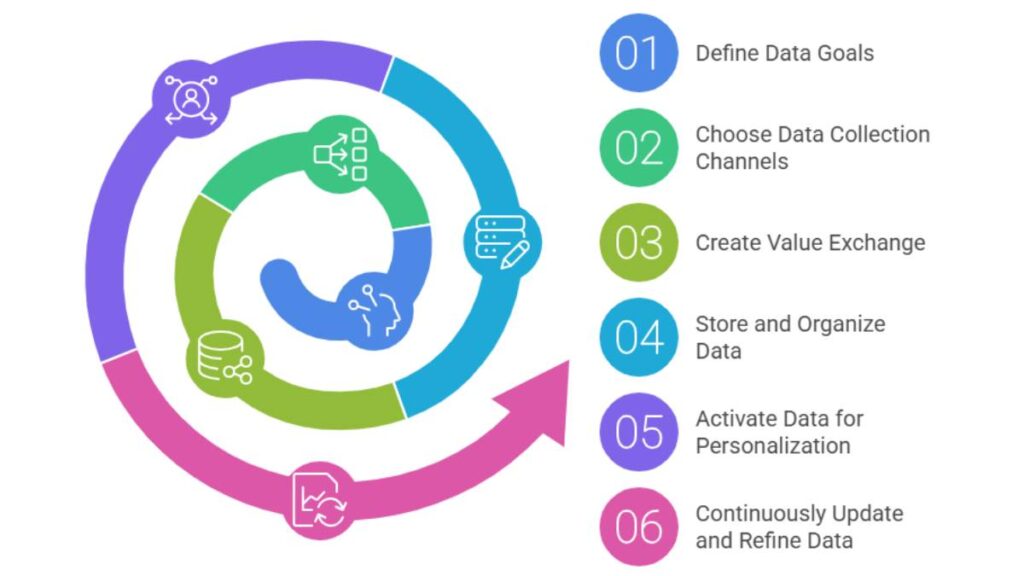
Step 1: Define Data Goals (What You Want to Learn)
Before collecting anything, there needs to be clarity on what actually matters.
Not every piece of data is useful. And asking too many questions too early usually backfires.
The better approach is to focus on a few key signals:
- What decisions are hard to make with current data?
- Where is personalization falling short?
- What would make the experience noticeably better?
Those answers usually point to the right questions to ask.
Without that clarity, data collection turns into noise.
Step 2: Choose Data Collection Channels
Once the goals are clear, the next step is figuring out where those questions should live.
Not every channel works for every type of data.
Some inputs fit naturally into:
- Onboarding flows
- Product discovery journeys
- Email preference centers
Others might work better in:
- Quizzes
- Surveys
- Interactive content
The placement matters more than the format. If the question shows up at the wrong moment, it feels intrusive. If it appears at the right time, it feels helpful.
That timing is often what determines participation.
Step 3: Create Value Exchange (Why Users Should Share Data)
This is where many strategies quietly fall apart.
Users don’t share information just because it’s asked. There has to be a clear benefit.
Sometimes it’s immediate, better recommendations, faster results.
Sometimes it’s longer-term, more relevant content, fewer irrelevant messages.
Either way, it needs to be obvious.
If the value isn’t clear, responses drop. If the value feels one-sided, trust drops.
A good rule here: if the benefit can’t be explained in one sentence, it’s probably not strong enough.
Step 4: Store and Organize Data Properly
Collecting data is one thing. Making it usable is another.
Zero-party data loses most of its value if it’s scattered or hard to access. It needs to be structured in a way that teams can actually use it:
- Clearly labeled fields
- Consistent formats
- Easy integration with existing systems
This isn’t the most exciting part, but it’s critical.
If marketing, product, and lifecycle teams can’t easily access and apply the data, it won’t get used consistently. And that breaks the entire loop.
Step 5: Activate Data for Personalization
This is where the strategy either proves itself or doesn’t.
Activation means taking the collected data and applying it across:
- Website experiences
- Email campaigns
- Product recommendations
- Customer journeys
It doesn’t have to be complex. In fact, simpler use cases often perform better at the start.
The important part is consistency. If users share preferences, those preferences should show up in multiple touchpoints, not just one isolated interaction.
Step 6: Continuously Update and Refine Data
Preferences change. Needs evolve.
What someone shares today might not be relevant six months from now.
That’s why zero-party data shouldn’t be treated as static. It needs to be updated over time:
- Light touchpoints to refresh preferences
- Occasional check-ins
- Opportunities to refine inputs
Not too often, that gets annoying. But enough to keep the data current.
Over time, this creates a more accurate and dynamic understanding of the user. And that’s where the real value builds.
Challenges of Zero-Party Data (And How to Overcome Them)
Zero-party data sounds clean in theory. In practice, there are a few friction points that show up quickly.
None of them is a deal-breaker. But ignoring them usually leads to underwhelming results.
Low User Participation
One of the most common issues, people simply don’t engage.
Forms get ignored. Quizzes don’t get completed. Preference centers sit untouched.
This usually isn’t about user reluctance. It’s about how the interaction is designed.
If the ask feels too long, too vague, or too early, participation drops.
A few things tend to help:
- Shorter interactions
- Clear benefits upfront
- Better timing within the journey
Sometimes it’s just about reducing friction. Fewer questions. Better placement. That alone can change response rates significantly.
Data Accuracy Issues (Self-Reported Bias)
Even when users do share information, it’s not always perfectly accurate.
People misjudge their preferences. They change their minds. Sometimes they just click through quickly to get to the result.
That’s the nature of self-reported data.
The way to handle this isn’t to distrust the data, but to validate it over time.
Look for patterns:
- Do behaviors align with stated preferences?
- Are certain inputs consistently leading to better outcomes?
Combining zero-party data with behavioral signals tends to balance things out. One provides intent, the other provides context.
Over-Collection vs Minimal Data Strategy
There’s a temptation to ask everything up front.
If users are willing to share, why not collect as much as possible?
Because it usually backfires.
Long forms increase drop-off. Too many questions create fatigue. And most of that data won’t even be used immediately.
A minimal approach works better:
- Start with the most important inputs
- Expand gradually over time
- Keep each interaction focused
It’s not about collecting less data overall. It’s about collecting it in a way that feels manageable.
Poor Execution of Personalization
This is the biggest risk, and the easiest to overlook.
Users share information, but nothing changes.
Same emails. Same recommendations. Same experience.
At that point, the data collection effort starts working against you. It signals that user input doesn’t matter.
Fixing this isn’t about adding more complexity. It’s about actually using what’s already there.
Even small changes can make a difference:
- Adjusting content based on preferences
- Tweaking messaging tone or focus
- Prioritizing relevant products
The goal is simple: if a user shares something, they should see the impact of it.
Otherwise, there’s no reason for them to share again.

Enroll Now: Advanced Digital Marketing Course
Zero-Party Data Best Practices for Marketers
Zero-party data works well when it’s handled with restraint. Not more questions, not more layers, just better judgment around what to ask and when.
There’s a tendency to over-engineer this. Add more fields, more flows, more logic. In reality, the strongest setups usually feel simple on the surface. Almost invisible.
Ask Only What You Need
This sounds obvious, but it’s where most implementations drift.
Once a team sees that users are willing to share information, the instinct is to expand the scope. Add a few more questions. Capture a few more attributes. It adds up quickly.
The problem is, not all data is equally useful.
If a piece of information doesn’t directly improve the experience or decision-making, it probably doesn’t need to be asked, at least not yet.
A tighter approach works better:
- Start with the 2–3 inputs that actually matter
- Use those to improve the experience
- Expand only when there’s a clear gap
Less friction. Higher completion. Better data quality.
Be Transparent About Data Usage
People are more comfortable sharing information when they understand how it will be used.
Not in a long legal disclaimer, that doesn’t help. Just a clear, simple explanation at the moment of interaction.
Something along the lines of:
- “Answer a few questions to get better recommendations.”
- “Tell us your preferences so we send fewer irrelevant emails.”
It doesn’t need to be clever. Just honest.
When that clarity is missing, hesitation creeps in. When it’s present, users move forward without overthinking.
Transparency isn’t just about compliance. It directly impacts participation.
Deliver Immediate Value
If someone shares information, the response should follow quickly.
Not hours later. Not buried in the next campaign.
Immediately.
That could be:
- Personalized results after a quiz
- A tailored product list
- A cleaner homepage experience
The exact format doesn’t matter as much as the timing. The faster the feedback loop, the stronger the connection between action and outcome.
Delay that response, and the interaction loses weight. It starts to feel like data collection again, not value exchange.
Keep UX Simple and Frictionless
Most drop-offs don’t happen because users refuse to share data. They happen because the experience gets in the way.
Too many steps. Too much text. Too many decisions at once.
A cleaner flow usually wins:
- Short interactions
- Clear progress
- Minimal cognitive load
Even small details matter here. Button labels, question phrasing, and layout spacing, all of it affects how easy it feels to move forward.
If the experience feels heavy, users leave. If it feels quick, they complete it without thinking twice.
Continuously Test and Optimize
What works once won’t always keep working.
User behavior shifts. Expectations change. Even small tweaks in design or messaging can impact how people respond.
That’s why zero-party data collection shouldn’t be static.
It needs regular refinement:
- Testing question formats
- Adjusting timing within the journey
- Simplifying flows where drop-off is high
Not constant overhauls. Just small, steady improvements.
Over time, those adjustments compound. Participation improves, data quality gets sharper, and the overall experience feels more aligned.
Tools and Platforms for Zero-Party Data Collection
The tooling side of zero-party data doesn’t need to be complicated, but it does need to be connected.
A lot of teams end up with fragmented setups, one tool for quizzes, another for email, something else for storing data. It works, but only up to a point.
The goal isn’t to stack more tools. It’s to make sure whatever you use actually supports the flow from collection to activation.
Survey & Quiz Tools
Survey and quiz tools are usually the starting point.
They’re easy to deploy, flexible in format, and familiar to users. Whether it’s a quick poll or a guided recommendation flow, they handle the front-end interaction well.
What matters more than the tool itself is how it’s structured:
- Are the questions focused?
- Does the flow feel natural?
- Is the output actually useful?
The tool enables the experience, but it doesn’t fix poor design. That part still needs to be intentional.
Customer Data Platforms (CDPs)
Once data starts coming in, it needs a place to live, and more importantly, a place where it can be used.
Customer Data Platforms help centralize that information. They bring together different data points, zero-party, first-party, and sometimes even external signals, into a unified profile.
That’s what allows teams to:
- Access user preferences easily
- Segment audiences more precisely
- Activate data across channels
Without some form of centralization, zero-party data tends to stay siloed. And when that happens, its impact drops significantly.
Personalization Engines
Personalization engines handle the next step, applying the data in real experiences.
Website content, recommendations, messaging variations, all of it can be adjusted based on what users have shared.
The key here is responsiveness.
If a user provides input, the system should be able to reflect that quickly. Not after multiple syncs or delays.
Even basic personalization layers can go a long way if they’re tied directly to user inputs. It doesn’t need to be complex to be effective.
CRM Integration
CRM systems often act as the backbone for customer data, especially on the lifecycle side.
Integrating zero-party data into the CRM ensures it’s not just used for immediate interactions, but also for:
- Ongoing communication
- Sales context
- Customer support insights
For example, knowing a user’s preferences can shape not just marketing emails, but also how conversations are handled later.
Without this integration, data stays isolated in marketing workflows. With it, the entire customer experience becomes more aligned.
Future of Zero-Party Data in AI and Search
The role of zero-party data is only getting stronger, not weaker.
Partly because of privacy shifts. Partly because of how digital experiences are evolving. But mostly because explicit intent is becoming more valuable than inferred behavior.
That shift is already visible in how platforms prioritize relevance.
Role of Zero-Party Data in AI Personalization
As personalization systems become more advanced, they still rely on one thing: signals.
Behavioral data provides patterns, but it doesn’t always explain intent. Zero-party data fills that gap.
When users state their preferences clearly, personalization becomes less about prediction and more about alignment.
That leads to:
- More accurate recommendations
- Less dependency on guesswork
- Faster adaptation to user needs
In other words, the system doesn’t need to “figure it out”; it already knows where to start.
Zero-Party Data and Google AI Overviews
Search experiences are shifting toward more direct answers and summarized outputs.
In that environment, content that reflects clear intent tends to perform better. Not just broad topics, but specific needs, preferences, and use cases.
Zero-party data plays into this indirectly.
When brands understand what users are explicitly looking for, they can:
- Create more targeted content
- Address specific queries more clearly
- Align messaging with real user language
It’s less about volume and more about precision.
That precision is what stands out when information gets condensed into shorter, more direct formats.
How Zero-Party Data Improves Content Visibility
Content visibility isn’t just about publishing more. It’s about matching what users actually care about.
Zero-party data gives a clearer view of that:
- What questions are users asking
- What problems they’re trying to solve
- What outcomes do they expect
With that clarity, content becomes more focused.
Not broader, sharper.
And when content aligns closely with user intent, engagement signals tend to follow. Higher relevance leads to better interaction, which reinforces visibility over time.
Predictive vs Declared Data in AI Search
There’s always going to be a role for predictive data. It helps fill gaps, identify patterns, and scale insights.
But declared data, what users explicitly say, carries a different weight.
It’s more stable. Less ambiguous.
In environments where accuracy matters, declared intent often wins over inferred signals.
That doesn’t mean prediction disappears. It just becomes secondary.
The balance is shifting toward:
- Asking instead of assuming
- Confirming instead of guessing
And zero-party data sits right at the center of that shift.
Quietly, but steadily, it’s becoming one of the most reliable inputs in an otherwise noisy data landscape.
Zero-Party Data Use Cases Across Industries
Zero-party data doesn’t really belong to one vertical. It adapts. Same principle, different shape depending on the business model.
What changes is context, what users are trying to do in that moment, and how comfortable they are sharing information. Get that wrong, and even the best strategy feels forced.
E-commerce (Product Recommendations)
In e-commerce, this usually shows up early, sometimes right on the homepage.
A quick question like “What are you shopping for today?” does more than it seems. It narrows the path. Instead of browsing endlessly, users get a starting point that actually makes sense for them.
The better setups don’t overwhelm users with options. They guide. Quietly.
And once preferences are captured, even in a small way, everything downstream becomes easier:
- Product sorting feels smarter
- Recommendations stop feeling random
- Users spend less time figuring things out
It’s not about being flashy. Just relevant enough that users don’t have to think too hard.
SaaS (Onboarding Personalization)
SaaS is a bit more sensitive. If onboarding feels generic, users notice almost immediately.
This is where zero-party data earns its place.
A few well-placed questions during signup, what they’re trying to achieve, how experienced they are can reshape the entire product experience. Not dramatically, just enough to feel like it “gets it.”
Without that input, onboarding tends to default to one-size-fits-all. Which usually fits no one particularly well.
With it, you can:
- Adjust the starting dashboard
- Highlight relevant features first
- reduce that initial confusion phase
And honestly, that early clarity often decides whether someone sticks around.
Healthcare (Preference-based communication)
Healthcare requires a lighter touch. There’s less room for guesswork, and even less tolerance for irrelevant communication.
Here, zero-party data isn’t about pushing recommendations. It’s more about respecting boundaries.
Some users want detailed updates. Others don’t. Some prefer email, others don’t want notifications at all unless it’s important.
Those preferences matter more than most teams assume.
When they’re respected, the experience feels thoughtful. When they’re ignored, it feels careless, even if the intent was good.
Finance (Goal-based personalization)
In finance, everything revolves around intent.
People aren’t casually browsing. They usually have something specific in mind, saving, investing, or managing debt. The challenge is understanding that intent early, before it gets buried under behavior patterns.
Zero-party data helps bring that forward.
Instead of inferring from transactions, you ask:
- What are you trying to achieve?
- What matters most right now?
The answers shape everything else, recommendations, content, and even how options are presented.
It’s a more direct route. Less elegant, maybe, but far more accurate.
Media & Publishing (Content personalization)
Content platforms deal with a different problem, too much choice.
Without guidance, users either skim or bounce. Rarely something in between.
Zero-party data helps trim that noise.
Letting users pick topics, formats, or frequency gives you a filter to work with. Not perfect, but enough to prioritize what matters to them.
And over time, that reduces fatigue. Instead of pushing everything, you surface what’s likely to land.
It’s a quieter kind of personalization. But it keeps people coming back.
Conclusion:
Why Zero-Party Data is the Future of Marketing
There’s a noticeable shift happening. Slow, but steady.
For years, marketing leaned heavily on tracking, collecting signals, building profiles, and trying to predict what people might want next. It worked, to a point.
But that model is getting harder to maintain. Less data, more restrictions, and honestly… less patience from users.
Zero-party data moves things in a different direction.
Instead of trying to figure users out behind the scenes, you bring them into the process. Ask directly. Listen. Then act on it.
Simple idea. Not always easy to execute.
Because it requires discipline. Asking fewer questions, not more. Actually using the answers. Keeping the experience consistent across touchpoints.
When it works, it doesn’t feel like data collection at all. It just feels… aligned.
Users get what they expect. Brands waste less effort trying to guess.
And somewhere in that middle ground, trust builds. Quietly. Over time.
That’s probably the real advantage here. Not just better personalization, but a better way of getting there.
FAQs: Zero-Party Data
What is zero-party data in simple terms?
Zero-party data is what people willingly tell a brand about themselves. Not guessed. Not stitched together from clicks. Just… shared. Preferences, needs, intentions, the things that actually matter. It tends to be clearer because there’s no interpretation layer. You’re not reading signals, you’re hearing them directly.
How is zero-party data collected?
Usually, through simple interactions, quizzes, short forms, onboarding questions, and preference settings. Nothing complicated. The important part is that users know what they’re sharing and why. When there’s a visible payoff, like better recommendations, people don’t mind answering a few questions. In fact, they expect something useful back.
What is the difference between zero-party and first-party data?
Zero-party data is stated. First-party data is observed. That’s the cleanest way to think about it. One comes from what users say, the other from what they do. Both have value, but they behave differently. Declared intent tends to be sharper, while behavioral data needs a bit of interpretation.
Why is zero-party data important for personalization?
Because it removes a lot of the guesswork. Instead of trying to infer what someone might want, you already have a starting point. That usually leads to fewer mismatches, fewer irrelevant emails, and fewer off-target recommendations. It doesn’t make personalization perfect, but it makes it feel more… aligned.
Is zero-party data privacy-compliant?
In most cases, yes. The data is shared intentionally, with awareness. That’s a big difference from passive tracking. As long as the exchange is transparent and expectations are clear, it fits well within modern privacy standards. Still, clarity matters; vague messaging tends to create hesitation.
What are examples of zero-party data?
Think of things users actively fill out, quiz answers, preference selections, survey responses, and even basic profile details. It doesn’t have to be complex. A simple “What are you looking for?” can count. The key is intent; the user knows they’re sharing it, and why.
How do companies use zero-party data?
Mostly to make experiences feel less generic. Website content, emails, and product suggestions can all be adjusted based on what users have said. It also helps with segmentation, since you’re grouping people by stated needs, not just behavior. That tends to be more stable over time.
What tools help collect zero-party data?
There are plenty of survey tools, quiz builders, and customer data platforms. But the tool isn’t the hard part. The design is. A well-structured question in a simple form often outperforms a complex setup. If the interaction feels natural, the tool almost fades into the background.
Can zero-party data replace third-party cookies?
Not entirely. They solve different problems. But as cookies lose reliability, zero-party data becomes more important. It’s cleaner, more transparent, and easier to trust. The trade-off is scale; you don’t get the same volume, but what you do get tends to be more usable.
Is zero-party data accurate?
Generally, yes, but it’s not static. People change their minds, preferences shift. So while it’s accurate in the moment, it still needs occasional updates. Pairing it with behavioral data helps fill in the gaps. One gives clarity, the other adds context.
How does zero-party data improve customer experience?
It cuts down the noise. When a brand actually reflects what someone has said they want, things feel smoother. Fewer irrelevant messages, fewer wrong turns. It’s not dramatic, just a series of small improvements that make the experience feel more considered.
What is the difference between zero-party data and declared data?
They’re closely related. Zero-party data is a type of declared data, but with a clearer emphasis on intent and transparency. It’s shared proactively, usually as part of a value exchange. Declared data can be broader, sometimes collected in less direct ways.
How can small businesses collect zero-party data effectively?
Start small. One or two meaningful questions can go a long way. A short quiz, a simple preference toggle, that’s enough to begin with. Trying to collect too much upfront usually backfires. It’s better to build gradually, as the relationship develops.
What are the best examples of zero-party data collection forms?
The ones that don’t feel like forms. Product quizzes, onboarding flows, quick preference selections, anything that blends into the experience. If it feels like a task, people hesitate. If it feels helpful, they move through it without much friction.
How do you incentivize users to share zero-party data?
Clarity helps more than incentives sometimes. If the benefit is obvious, better results, more relevant content, that’s often enough. Discounts or perks can work too, but they’re not always necessary. The exchange just needs to feel fair.
Can zero-party data be integrated with CRM systems?
Yes, and it should be. When it’s tied into a CRM, it becomes part of a broader view of the customer. That’s where it gets more useful, not just for marketing, but for sales and support as well. Otherwise, it risks sitting unused.
How often should zero-party data be updated?
Not constantly. That tends to annoy people. But leaving it untouched isn’t ideal either. Occasional check-ins or subtle prompts work better. Just enough to keep things current without making it feel repetitive.
What are common mistakes when collecting zero-party data?
Asking too much, too soon, is probably the biggest one. Another is collecting data and then not doing anything with it. That breaks trust quickly. If users don’t see the impact of what they shared, they’re less likely to engage again.
How does zero-party data impact conversion rates?
It shortens the decision path. When users see options that match what they’ve already said they want, there’s less friction. Less second-guessing. That alignment tends to lift conversions, even without aggressive tactics.
Is zero-party data useful for B2B marketing?
Very much so. In B2B, intent matters a lot, and it’s often harder to read from behavior alone. When prospects share their goals or challenges directly, it becomes easier to tailor messaging. Especially in longer sales cycles, that clarity makes a difference.