

Every SaaS homepage in your inbox right now says “agentic.” Your CRM says it. Your email tool says it. The ad platform you signed up for eighteen months ago probably added it to the pricing page overnight. So what is agentic marketing, actually, and how much of what’s being sold under that name even qualifies?
Here’s the stake for you as a marketer: Gartner estimates that of the thousands of vendors claiming agentic capability, only around 130 offer the real thing, according to a June 2025 Gartner press release. The rest are running standard automation with a new label glued on top, a pattern Gartner calls “agent washing.” If you buy into the wrong one, you don’t just waste budget. You hand a system decision-making power it was never built to hold, and you find out at the worst possible moment, mid-campaign, in front of a customer.
This piece breaks down the real definition, how these systems actually work, where the four criteria come from that separate agentic from automated, and exactly where most vendors cut corners. By the end you’ll have a working checklist to run before you sign anything.
Table of Contents
What Is Agentic Marketing, Actually?
The direct answer to what is agentic marketing looks like this: it’s an approach where autonomous AI agents plan, execute, and adjust marketing campaigns end to end, working from a goal you set rather than a task you assign. You define the outcome, say acquire 200 qualified accounts in the mid-market segment this quarter, and the system figures out the sequence, the content, the channel mix, and the timing on its own.
Standalone definition: An agentic system is software that can perceive its environment, plan a course of action, decide between options, and act, all without a human approving each individual step.
That last part is what separates this from every “AI-powered” tool you’ve used before. A generative tool writes an email when you ask it to. An agentic one decides which 4,000 people should get an email, writes 4,000 slightly different versions, sends them at the right time for each recipient’s timezone, and then rewrites next week’s batch based on who opened what. Nobody clicked “send” in the middle of that process.
The term picked up steam through 2024 and 2025 as large language models got good enough at multi-step reasoning and tool use to actually hold a plan together across many steps without falling apart. Before that, “AI” in a marketing tool usually meant a chatbot or a content generator bolted onto an existing dashboard. The shift is not cosmetic. According to Gartner’s January 2026 forecast, 40% of enterprise applications will feature task-specific AI agents by the end of 2026, up from under 5% in 2025.
An agentic system is software that perceives, plans, decides, and acts toward a goal without step-by-step human approval. In practice this means a marketer sets the objective and the guardrails, and the system handles execution across channels in real time. Gartner forecasts 40% of enterprise applications will include task-specific agents by the end of 2026, up from under 5% in 2025.
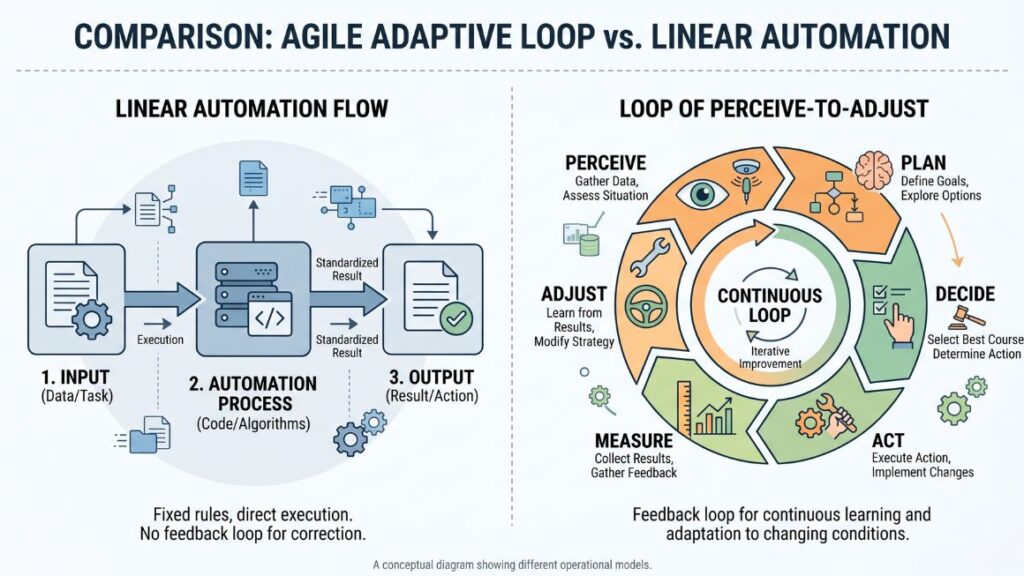
How Agentic Marketing Differs From Automation and AI-Assisted Tools
Marketers have heard “this changes everything” about martech before. Marketing automation made that claim in 2010. AI-assisted tools made it again in 2023. Here’s the honest distinction, because the difference actually matters this time.
Marketing automation runs rules you wrote. If a lead fills out a form, send email one. If they click the link, send email two. It’s fast and reliable, but it can’t handle anything you didn’t explicitly map out in advance. AI-assisted tools go one step further: they generate a draft, suggest a subject line, or flag a churn risk, and then a human decides what to do with that suggestion. The intelligence is there. The authority to act on it isn’t.
An autonomous system closes that gap. It doesn’t wait for you to approve the subject line or pick the send time. It observes the result of its last decision, whether an email opened, an ad converted, a lead replied, and adjusts the next action based on that outcome, continuously, without a human in the approval loop for every single move.
| Capability | Marketing Automation | AI-Assisted Tools | Agentic Systems |
|---|---|---|---|
| Follows pre-set rules | Yes | Sometimes | Rarely, sets its own path within guardrails |
| Generates content | No | Yes, on request | Yes, continuously and at scale |
| Decides without approval | No | No | Yes, within defined boundaries |
| Learns mid-campaign | No | Limited | Yes, closed-loop |
| Requires human for every step | Yes | Yes | No, only for objectives and review |
Honestly, this is the line most vendors blur on purpose. A rules engine with a chatbot slapped on the front looks identical to a real agent on a demo call. The tell shows up three weeks in, when the “agent” needs a human to manually adjust every campaign because it never actually learned anything.
The Four Things a System Needs Before It Can Be Called Agentic
Not every AI tool that touts autonomy deserves the label. A system needs to clear four bars before it qualifies, and most marketing tools on the market today only clear one or two.
It has to perceive. The system needs real, structured access to what’s happening, campaign performance, customer behavior, inventory, pricing, not a static export somebody uploads once a month. Without live data, it’s guessing dressed up as reasoning.
It has to plan. Given a goal, it needs to break that goal into steps on its own. “Increase repeat purchase rate 15%” has to become a sequence of specific actions, not a single generic output.
It has to decide. Faced with more than one viable path, it picks one and can explain why, based on the data it has, not a coin flip disguised as an algorithm.
It has to act, and then measure. It executes in the real environment, watches what happened, and feeds that result back into its next decision. This is the closed loop. Without it, you just have a smarter suggestion engine.
Adobe’s agent orchestration layer inside Experience Platform is aiming at this bar, letting agents coordinate across audience building and content generation. Salesforce’s Agentforce does something similar inside its CRM data and Salesforce Marketing Cloud, while Demandbase applies it to account-based orchestration for B2B teams, and smaller players like Tofu build agents specifically for campaign generation and testing. What separates these from a rebadged chatbot is that all four criteria show up together, not just one or two dressed up in a product update.
A system only qualifies as agentic if it clears four bars together: it perceives live data, plans a multi-step path toward a goal, decides between options and can justify the choice, and acts, then measures the outcome to inform its next move. Tools that hit one or two of these, usually perceive and act, without genuine planning or decision-making, are automation wearing an agentic label.
Why Most Vendors Get Agentic Marketing Wrong
Here’s the uncomfortable part. Anushree Verma, senior director analyst at Gartner, put it bluntly in the firm’s June 2025 research: most agentic AI projects right now are early-stage experiments driven by hype, and they’re often misapplied. That’s not a knock on the technology. It’s a knock on how it’s being sold and bought.
The most common failure is agent washing, taking an existing automation or chatbot product and rebranding it as agentic without adding the planning or decision layer underneath. Gartner’s estimate that only about 130 of thousands of self-described agentic vendors offer genuine capability tells you how widespread this is. Most marketers can’t tell the difference on a sales call, because the demo is scripted to hide exactly the gap that matters.
The second failure is scope. Vendors sell you “full campaign autonomy” when what they’ve actually built handles one narrow slice, say, subject line generation, and calls the rest “roadmap.” You find out the roadmap part never ships.
The third, and this is the one that costs the most money, is governance as an afterthought. A system gets deployed with real authority to send, bid, or publish before anyone has written down who owns the outcome when it goes wrong, what the rollback process looks like, or what data it’s actually allowed to touch. Gartner predicts that in 2026, one-third of companies will damage customer experience by deploying AI prematurely, eroding both acquisition and retention in the process.
That sounds obvious when you read it in a list. It almost never gets caught before signing, because the sales conversation is about upside, not failure modes. From what we’ve seen with marketers going through YUP’s AI courses, the ones who ask vendors to walk through their rollback process before the contract, not after, are the ones who avoid the worst outcomes.
Most agentic AI failures in marketing trace back to three causes: agent washing, where automation is rebranded without real planning or decision capability, oversold scope where one narrow function is marketed as full autonomy, and governance treated as an afterthought instead of a precondition. Gartner estimates only 130 of thousands of self-described agentic vendors have genuine capability, and predicts a third of companies will harm customer experience through premature AI deployment in 2026.
What Real Agentic Marketing Looks Like Right Now
So where is this actually working, past the sales deck? Three use cases show up consistently in production, not pilot, deployments.
Dynamic account targeting in B2B. Instead of a static list, an agent continuously re-scores which accounts show buying intent, adjusts ad spend toward them in real time, and generates account-specific messaging without a human rebuilding the list every week. Demandbase and Tofu both run versions of this today.
Real-time personalization at consumer scale. Quick commerce platforms like Zepto operate on windows of minutes, not days, so a human reviewing every personalization decision simply isn’t fast enough. An agent watching live browsing and order data can adjust offers and push notifications per user, continuously, in a way a marketing team physically cannot replicate by hand.
Closed-loop lifecycle campaigns. A churn-prevention sequence that underperforms on a Tuesday gets restructured by Wednesday morning, not by an analyst noticing a dashboard three weeks later, but by a system that detected the drop and adjusted the send cadence, offer, or channel on its own.
McKinsey’s 2025 research on marketing workflows suggests this kind of system could eventually power up to two-thirds of current marketing activity, cut campaign cycle times by 10 to 15 times, and lift hyperpersonalized revenue by 10 to 30 percent. Those numbers sound aggressive. They probably are, for most teams, in the next 12 months. But the direction of travel is not in question. A January 2026 study by RevSure and Ascend2 covering 306 B2B go-to-market leaders in the US and UK found that 76% of organizations are already deploying some form of this, with 41% in full implementation.
The Risks Nobody Puts in the Sales Deck
None of this is a free lunch, and the vendors who tell you otherwise are the ones to be most careful with.
The first risk is brand voice drift. An agent generating thousands of message variants at speed will occasionally produce something off-brand, and it will do so faster than a human reviewer can catch every instance. You need sampling and audit processes built in from day one, not added after an incident.
The second is compounding errors. A human making a bad call on one campaign affects one campaign. A system making a systematically bad call, say, misreading a data signal, applies that mistake across every account it touches, at scale, before anyone notices the pattern.
The third, and the one Gartner leans on hardest, is the cancellation risk itself. Gartner’s June 2025 prediction that over 40% of agentic AI projects will be canceled by the end of 2027 cites escalating costs, unclear business value, and inadequate risk controls as the top three reasons, not model failure. The tech usually works. The deployment plan around it usually doesn’t.
This may not apply to every setup, but in most cases, the fix isn’t more sophisticated AI. It’s answering three questions before you deploy anything with real authority: what is the written success metric and who agreed to it, what data and systems does the agent actually need access to, and when it fails, who notices and how fast can someone roll it back. If a vendor can’t answer all three clearly, that’s your signal.
The core risks are brand voice drift at scale, compounding errors that apply a single bad decision across every account simultaneously, and project cancellation driven by unclear governance rather than model failure. Gartner’s June 2025 research found escalating costs and inadequate risk controls, not technical limitations, are the leading causes behind projects being canceled.
How to Evaluate an Agentic Marketing Vendor Without Getting Fooled
Run this before you sign anything, not after.
- Ask the vendor to walk through all four capability criteria separately: perception, planning, decision-making, and action. If they jump straight to a demo of the output without explaining the reasoning layer, push back.
- Request a specific example of the system changing its own approach mid-campaign based on a result, not a human adjusting a setting.
- Ask who owns the outcome when the system makes a wrong call, in writing, before the contract is signed.
- Confirm what data the system needs live access to, and check whether your current stack can actually provide it in real time.
- Ask what the rollback process looks like and how long it takes to execute.
- Start with one contained use case, not a full campaign handover, and measure the closed loop working before expanding scope.
Getting This Right Without Betting the Budget on It
The honest takeaway about agentic marketing is that the technology is real and it’s moving fast, but the market selling it to you is running well ahead of what most vendors can actually deliver. The four-criteria test, perceive, plan, decide, act, is the fastest way to separate genuine capability from a relabeled chatbot on a sales call. And the projects that survive past 2027 won’t be the ones with the biggest model. They’ll be the ones where someone wrote down the success metric, the data access, and the rollback plan before a single agent touched a live campaign.
If you’re trying to figure out where your team fits into this shift, and which AI skills are actually worth building right now, that’s exactly what we cover inside the Hotskill app and YUP’s AI Marketing course, built for marketers who need to work with these systems, not just read about them.
Frequently Asked Questions
What is agentic marketing in one sentence?
It’s the use of autonomous AI agents to plan, execute, and adjust marketing campaigns toward a goal you set, without a human approving every individual step along the way.
Is agentic marketing the same as marketing automation?
No. Automation follows rules you wrote in advance and can’t deviate from them. An autonomous system plans its own path toward a goal and adjusts that path based on results, which automation was never built to do.
How is this different from just using ChatGPT or another AI writing tool?
A writing tool produces content when you prompt it and stops there. An autonomous system decides what to create, who receives it, when to send it, and how to adjust based on what happens next, all without a person approving each of those decisions individually.
Who should actually be using this today?
Teams with clean, real-time data access and at least one well-defined, contained use case are in the best position. Teams still working from spreadsheets and monthly data exports should fix that foundation first, because a system without live data is guessing, not reasoning.
Do I really need to deploy this now, or can it wait?
It depends on your category. In fast-moving verticals like quick commerce or paid social, the speed advantage compounds quickly. For longer B2B sales cycles, waiting a year while the tooling matures carries less risk than it does for consumer brands.
How do I know if a vendor is genuinely agentic or just rebranded automation?
Ask them to demonstrate the system changing its own approach mid-campaign based on a live result, not a preset rule firing. If they can’t show that, and can’t explain their planning and decision layer separately from their output, you’re likely looking at agent washing.
What’s the biggest reason these projects get canceled?
According to Gartner’s June 2025 research, escalating costs, unclear business value, and inadequate risk controls are the top three causes, not the underlying technology failing to work.
Does this replace the marketing team?
Not in any deployment happening today. Humans set the objective, the budget, the brand guardrails, and review outcomes. The work shifts from doing every task manually to supervising a system that executes at a speed no team can match by hand.
What should I do first if I want to try this?
Pick one narrow, contained use case, such as one lifecycle email sequence or one paid channel, confirm the system has live data access for it, and measure whether the closed loop of act, measure, adjust actually happens before you expand to anything broader.