

A container sits at a port for four extra days, and nobody at the company knows until a customer calls asking where their order is. That’s not a rare story. It’s Tuesday for most supply chain teams. According to the GEODIS Supply Chain Worldwide Survey, only 6% of companies report full end-to-end visibility into their supply chain. Everyone else is piecing it together from emails, spreadsheets, and phone calls to carriers.
That gap is exactly what supply chain visibility software is built to close. It pulls data from every system and partner touching a shipment, puts it on one screen, and tells you what’s about to go wrong before it does. This guide breaks down what supply chain visibility software actually does, the features that matter when you’re evaluating one, the best platforms on the market in 2026, and how to pick the right one for your business.
Table of Contents
What Is Supply Chain Visibility Software?
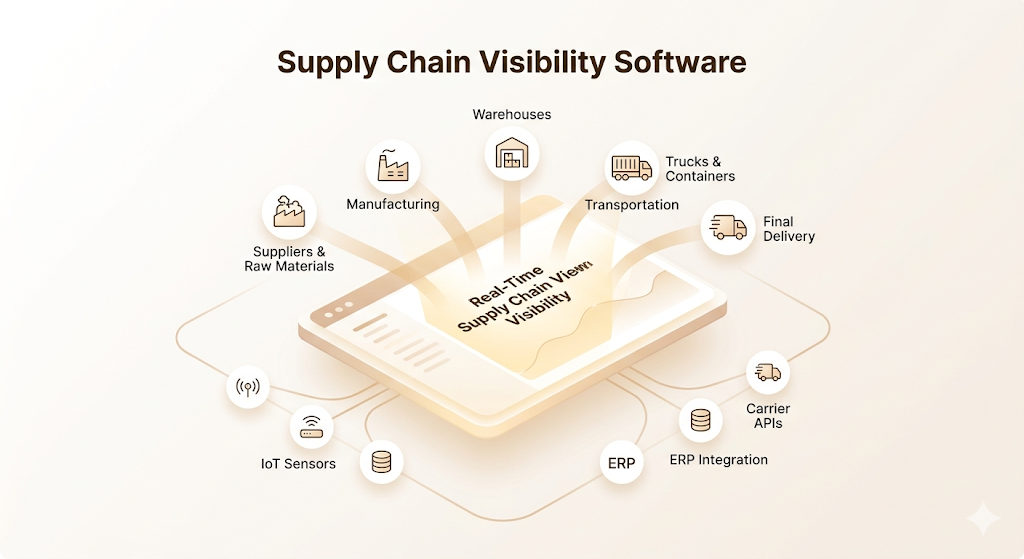
Supply chain visibility software is a platform that tracks goods, shipments, and inventory across every stage of the supply chain and presents that data in one place, in real time. That’s the whole job, stated plainly. Everything else is built on top of it.
Before this category existed, “visibility” meant calling your freight forwarder and hoping they picked up. Now it means an automated feed pulling location, status, and condition data from carriers, warehouses, and IoT sensors, then surfacing it the second something changes.
Why Supply Chain Visibility Matters
Here’s the problem it solves: supply chains today run across dozens of partners, countries, and systems that don’t talk to each other natively. A single order might touch a supplier’s ERP, a freight forwarder’s tracking system, a customs portal, and your own warehouse software. Without visibility software stitching that together, you’re the one doing the stitching manually, usually after something’s already gone wrong.
A logistics executive surveyed by Tradeverifyd in 2026 put it simply: 42% of executives cite a lack of real-time data as their main limitation when responding to a disruption. That’s not a small number. Nearly half the industry is flying blind at the exact moment they need to react fastest.
End-to-End Visibility vs. Transportation Visibility
These two terms get used interchangeably, but they’re not the same thing. Transportation visibility tracks a shipment from pickup to delivery -where the truck or container is right now. End-to-end supply chain visibility goes further. It covers the full journey from raw material sourcing through manufacturing, warehousing, transportation, and final delivery.
Think of transportation visibility as one chapter. End-to-end visibility is the whole book. Most businesses start with the former because it’s easier to implement, then expand toward the latter as they mature.
Supply Chain Visibility Software vs. Supply Chain Management (SCM) Software
This one trips people up constantly. SCM software is the broader category -it includes planning, procurement, demand forecasting, and execution across the entire supply chain. Visibility software is narrower. It’s focused specifically on tracking and surfacing real-time status, not running the planning process itself.
In practice, the line blurs. Big players like SAP and Oracle bundle visibility features into broader SCM suites. Specialist platforms like FourKites and project44 focus almost entirely on visibility and treat planning as someone else’s job. Neither approach is wrong. It depends on whether you need a single system of record or a best-in-class tracking layer sitting on top of systems you already have.
Supply chain visibility software tracks shipments and inventory in real time across every partner in the chain, while SCM software covers the broader work of planning, procurement, and execution. The two overlap but solve different problems -visibility tells you what’s happening now, SCM decides what should happen next.
How Does Supply Chain Visibility Software Work?
At a basic level, the software pulls data from every system touching your shipment, normalizes it into one format, and pushes updates to a dashboard the moment something changes. The “how” is where it gets interesting.
Data Collection From Multiple Sources
None of this works without data, and data comes from a lot of places at once. A typical visibility platform connects to:
- ERP systems -order and inventory data from the back office
- TMS (Transportation Management Systems) -carrier bookings, routing, and freight costs
- WMS (Warehouse Management Systems) -inbound and outbound warehouse movement
- IoT devices -temperature, humidity, and shock sensors on sensitive cargo
- GPS tracking -live truck, container, and vessel location
- Carrier APIs -direct status feeds from FedEx, Maersk, DHL, and similar carriers
- EDI (Electronic Data Interchange) -the older but still widely used data exchange standard between trading partners
Pulling from seven different sources sounds messy, and honestly, it is, behind the scenes. The platform’s job is to make that mess invisible to the person looking at the dashboard.
Real-Time Shipment Tracking
Real-time shipment tracking means you can see exactly where a shipment is, right now, without calling anyone. GPS and carrier API feeds update the platform continuously, so the location on your screen reflects what’s actually happening on the road, at sea, or in the air.
Shippeo, a Paris-based visibility platform, advertises 98% accurate ETAs across global shipments. That number matters more than it sounds. An ETA you can trust changes how you plan labor at the warehouse, how you communicate with customers, and how you negotiate detention fees with carriers.
AI-Powered Predictive Insights
This is where supply chain visibility software stopped being a glorified map and started being genuinely useful. Modern platforms use machine learning to predict delays before they happen, not just report them after the fact.
The model looks at historical patterns, weather data, port congestion, and carrier performance to flag a shipment that’s likely to miss its window, sometimes days in advance. That’s a real shift. The old question was “Where is my shipment?” The 2026 question, as one buyer’s guide from Nauta puts it, is “what’s the smartest action to take right now?”
Exception Management and Automated Alerts
An exception is anything that deviates from the plan -a delayed truck, a temperature breach, a missed customs deadline. Good visibility software doesn’t just log these. It alerts the right person automatically and, increasingly, suggests or triggers a fix.
McKinsey’s research on logistics automation found that platforms with this kind of automated exception handling can cut manual tracking and reporting work by up to 75%. That’s hours per week given back to people who were previously just chasing status updates.
What Is a Supply Chain Control Tower?
A supply chain control tower is a centralized hub that gives one team a complete, real-time view across multiple supply chain functions -transportation, inventory, and supplier performance -so they can make decisions without switching between five different systems.
Control towers aren’t a separate product category so much as the most mature version of a visibility platform. Once you’ve got real-time data flowing in from everywhere, the next logical step is one team owning the whole picture instead of five teams each owning a slice.
Why Businesses Need Supply Chain Visibility Software in 2026
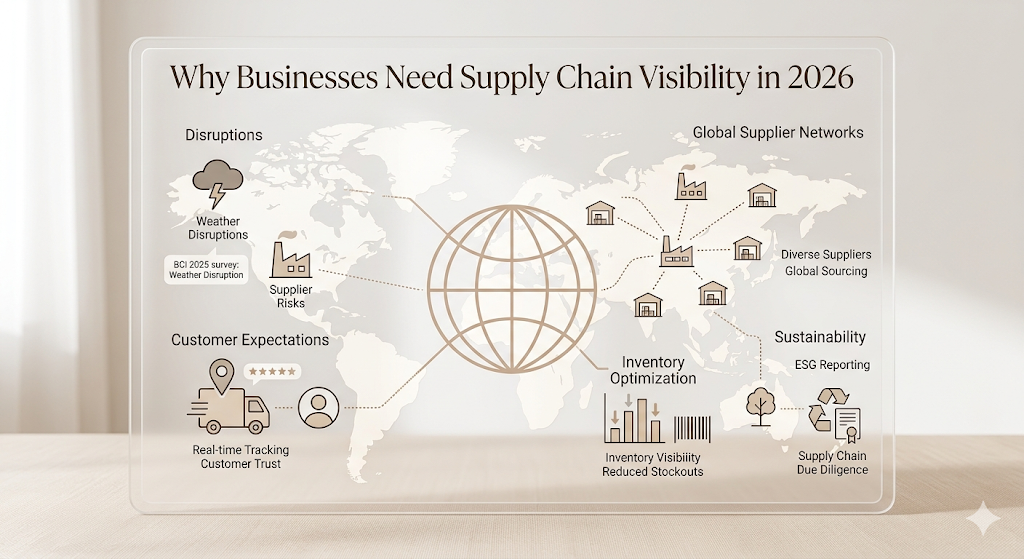
The honest answer is that the old way of running supply chains -phone calls, spreadsheets, and hoping -doesn’t hold up against how complex and disrupted global trade has become.
Increasing Supply Chain Disruptions
Disruption used to be the exception. Now it’s closer to a baseline condition. The Business Continuity Institute’s 2025 survey found that extreme weather became the single largest cause of supply chain disruption for the first time in nearly a decade, overtaking even cyber-related outages. Add geopolitical tensions, port congestion, and trade policy shifts, and “stable supply chain” starts to sound like a contradiction.
Rising Customer Expectations
Customers expect Amazon-level tracking from every brand they buy from, not just Amazon. Gartner reports that 83% of companies now place customer-experience enhancement at the center of their digital supply chain strategy. Visibility isn’t a backend operations tool anymore. It’s directly tied to whether customers trust you with their next order.
Global Supplier Networks
Most mid-size and large businesses don’t source from one factory in one country anymore. They source from a network spread across continents, each with different lead times, customs processes, and risk profiles. Tracking that manually was never realistic at scale, and it’s gotten harder every year as networks have spread out further.
Inventory Optimization
You can’t optimize inventory you can’t see. Without visibility into what’s in transit, what’s sitting in a warehouse, and what’s likely to arrive late, businesses either overstock to be safe (tying up cash) or understock and run out (losing sales). Neither is a strategy. Both are guesses.
Sustainability and Compliance Requirements
Regulators and customers both want proof, not promises, about where goods come from and how they got there. Visibility software increasingly doubles as the system that generates the audit trail for emissions reporting, ethical sourcing claims, and compliance with regulations like the EU’s deforestation and supply chain due diligence rules.
Supply chain disruption is no longer an occasional event -extreme weather, geopolitical shifts, and global sourcing have made it a constant variable. Gartner finds 83% of companies now build customer experience directly into their supply chain strategy, which means visibility has moved from an operations nice-to-have to a competitive requirement.
Key Features of Supply Chain Visibility Software
Not every platform does everything well. Here’s what actually separates a serious visibility platform from a glorified tracking page.
Real-time shipment tracking is the baseline. If a platform can’t show you accurate, live location data, nothing else matters.
Predictive ETA and delay forecasting is what turns tracking into planning. You’re not just watching a shipment move, you’re getting warned about problems before they hit.
End-to-end supply chain visibility means the platform covers your full journey, not just the trucking leg. Look for coverage across ocean, air, rail, and last mile, not one mode in isolation.
Exception management should be automatic, not something a person has to notice manually by staring at a dashboard all day.
Inventory visibility ties shipment data to stock levels, so a delayed container shows up as a future inventory gap, not just a late truck.
Carrier performance analytics tells you which carriers actually deliver on time and which ones quietly don’t, so renewal conversations are based on data instead of vibes.
Control tower dashboards, as covered above, bring everything into one screen for the team that owns the decisions.
Multi-modal transportation tracking matters if your goods move by more than one method, which most do.
AI-powered insights should go beyond a chatbot bolted onto an old dashboard. The real value is in pattern detection across thousands of past shipments.
ERP, TMS, and WMS integrations determine whether the platform fits into your existing tech stack or forces you to rebuild around it.
A collaboration portal for suppliers and logistics partners means fewer email chains and fewer “did you get my message” follow-ups.
Custom reporting and analytics let different stakeholders, from ops to finance to the C-suite, pull the view that matters to them without waiting on someone else to build it.
Benefits of Supply Chain Visibility Software
The features are nice. The benefits are why anyone pays for this.
Faster Decision-Making
When you can see a problem the moment it happens instead of three days later, your team makes the call faster. That sounds obvious. It almost never happens in practice without the right system feeding the right person at the right time.
Reduced Transportation Costs
Detention and demurrage fees, expedited shipping to fix avoidable delays, wasted fuel from inefficient routing -visibility software helps catch and prevent all of it before the cost lands on an invoice.
Better Inventory Management
Accurate, real-time data on what’s in transit means you can hold less safety stock without running the risk of stockouts. That’s working capital freed up, not just a nicer dashboard.
Improved On-Time Deliveries
This is the metric customers actually feel. FourKites, which tracks more than 3.2 million shipments daily across 230-plus countries, built its entire platform around improving this one number for its 1,500-plus enterprise clients.
Enhanced Customer Experience
Accurate ETAs mean fewer “where’s my order” support tickets and more customers who trust the next delivery date you give them. That trust compounds. It’s the difference between a one-time buyer and a repeat buyer.
Increased Operational Efficiency
Teams stop spending their day on manual status checks and start spending it on actual decisions. That 75% reduction in manual tracking work mentioned earlier isn’t a marketing number. It’s hours back in the calendar every single week.
Lower Supply Chain Risks
Seeing a problem early gives you options. Seeing it late gives you a crisis. Visibility software is, at its core, a risk management tool wearing a tracking dashboard’s clothes.
Improved Supplier Collaboration
Shared visibility means suppliers and logistics partners aren’t waiting on your team to relay status updates manually. Everyone’s looking at the same data, which cuts down on the finger-pointing that happens when a shipment goes wrong, and nobody can agree on whose fault it was.
Greater Supply Chain Resilience
McKinsey’s research found that real-time visibility dashboards helped 7 out of 10 global supply chain leaders build resilience and recover from past disruptions faster. That’s not a small win. Resilience is the difference between a disruption costing you a bad week and costing you a bad quarter.
Real-time visibility doesn’t just make supply chains faster; it makes them more resilient. McKinsey reports that logistic dashboards helped 7 out of 10 global supply chain leaders recover from disruptions more effectively, turning visibility from an efficiency tool into a risk management strategy.
What Happens Without Supply Chain Visibility
Without it, you’re managing by phone calls and hope. Shipment tracking depends on whoever remembered to send an update. Inventory counts drift out of sync with reality because nobody’s reconciling them in real time. Communication between teams and partners runs through scattered emails instead of a shared source of truth.
Deliveries slip because nobody catches the delay until the customer notices first. Customer satisfaction drops as a result, and it drops fastest with your highest-value, most demanding accounts. Operational costs creep up through expedited shipping, detention fees, and the sheer labor cost of people manually chasing information that should already be visible.
And underneath all of it sits the real problem: decision-making stays reactive instead of proactive. Every choice is a response to something that already went wrong, not a move to prevent it. That’s an expensive way to run a business, even when the costs don’t show up on a single line item.
Supply Chain Visibility Software Use Cases
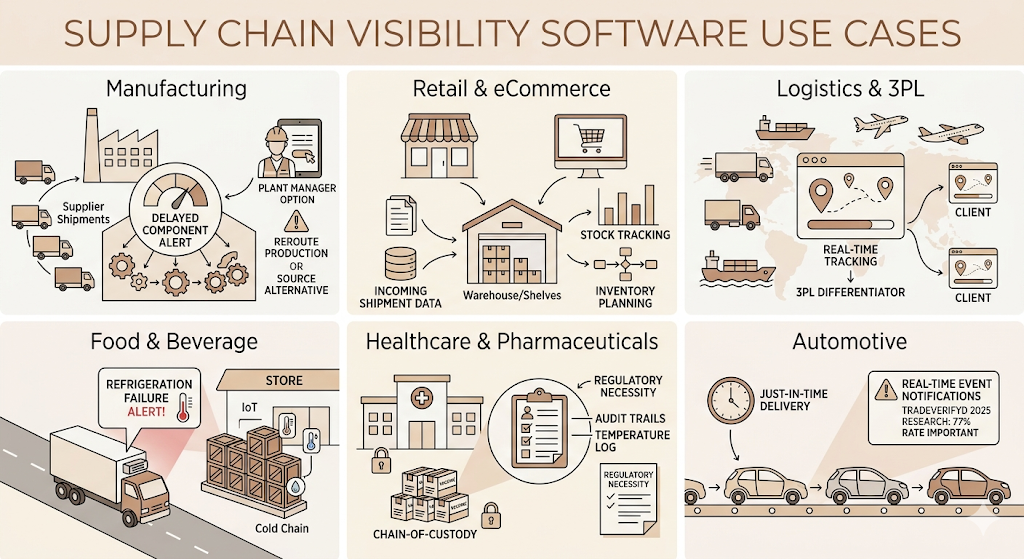
Manufacturing
Manufacturers use visibility software to track raw material shipments from multiple suppliers, so a delayed component doesn’t shut down a production line without warning. A missed part from one supplier can cascade into a full assembly delay, and the earlier that’s flagged, the more options a plant manager has to reroute production or source an alternative.
Retail & eCommerce
Retail and eCommerce businesses run on inventory timing. A platform like Blue Yonder, used by major retailers for AI-driven demand forecasting and execution, ties incoming shipment data directly to inventory planning so shelves and warehouses stay stocked without overordering.
Logistics & 3PL
Third-party logistics providers are, in a sense, selling visibility as part of their core service. A 3PL using a platform like project44 can offer its own clients real-time tracking as a differentiator, rather than relying on each individual carrier’s separate (and usually clunkier) tracking page.
Food & Beverage
Cold chain visibility is non-negotiable here. IoT sensors tracking temperature and humidity feed directly into the visibility platform, so a refrigeration failure mid-transit triggers an alert immediately instead of being discovered when the shipment arrives spoiled.
Healthcare & Pharmaceuticals
Pharmaceutical shipments often carry strict chain-of-custody and temperature requirements, sometimes for products that are extremely expensive to lose. Visibility software here isn’t just operational convenience; it’s a regulatory necessity, with audit trails required to prove a vaccine or biologic never left its required temperature range.
Automotive
Automotive supply chains run on just-in-time delivery models with very little room for error. Tradeverifyd’s 2025 research found that 77% of automotive suppliers consider real-time event notifications extremely or very important to their operations, which tells you how thin the margin for surprise delays really is in this industry.
Supply Chain Visibility KPIs You Should Track
A platform is only as useful as the metrics you actually watch. Here’s what matters:
- On-time delivery rate -the percentage of shipments arriving within the promised window
- Perfect order rate -orders delivered complete, accurate, undamaged, and on time, all at once
- Inventory accuracy -how closely your system’s stock count matches physical reality
- Order cycle time -total time from order placement to delivery
- Transit time -time spent specifically in transportation, separate from processing
- Carrier performance -on-time rate and reliability broken down by individual carrier
- Fill rate -the percentage of customer demand met from available stock, without backorders
- Exception resolution time -how fast a flagged problem actually gets fixed
- OTIF (On Time In Full) -orders delivered both on schedule and with the complete quantity ordered, considered the gold standard combined metric in logistics
OTIF is worth sitting with for a second, because it’s the metric that catches what the others miss individually. A shipment can be on time but short on quantity, or complete but late. OTIF only counts it as a win when both conditions are true at once, which is exactly the standard your customers are actually judging you against.
How to Choose the Best Supply Chain Visibility Software
Start with your business requirements, not the vendor’s feature list. What are you actually trying to fix? Late deliveries? Inventory blind spots? Supplier coordination chaos? The answer changes, which platform makes sense?
Deployment matters more than it sounds. Cloud-based platforms deploy faster and scale more easily. On-premise still shows up in industries with strict data residency rules, but it’s increasingly the exception rather than the norm.
Integration capabilities decide whether this becomes a tool your team actually uses or another tab nobody opens. Check explicitly for your existing ERP, TMS, and WMS before signing anything.
AI and predictive analytics separate the modern platforms from the ones still calling themselves “AI-powered” based on a single forecasting feature bolted on five years ago. Ask for a live demo of the predictive model, not a slide about it.
Carrier network coverage is non-negotiable if your shipments move through specific carriers or regions. A platform with 98% accurate ETAs in North America might have far weaker coverage in, say, Southeast Asia.
Scalability is easy to ignore when you’re small, and expensive to discover too late when you’ve grown past your platform’s limits.
Ease of implementation is underrated. A platform that takes nine months to deploy is solving next year’s problem, not this year’s.
Pricing models vary a lot, from per-shipment fees to enterprise licensing. Get the real number, including implementation and integration costs, not just the headline price.
Customer support quality shows up the moment something breaks during a live shipment crisis, not during the sales demo.
Security and compliance certifications matter more as visibility platforms start handling sensitive data tied to sourcing, customs, and increasingly, sustainability reporting.
Best Supply Chain Visibility Software in 2026
1. GoComet
Overview: GoComet is a visibility and freight procurement platform with a strong footprint among Indian and Asian exporters and manufacturers, alongside global clients. Key Features: Real-time ocean and air freight tracking, automated freight invoice audits, predictive ETA alerts. Pros: Strong fit for businesses managing freight procurement and visibility together; competitive for mid-size exporters. Cons: Less suited to businesses needing deep last-mile or ground transportation tracking. Best For: Mid-size to large exporters managing complex international freight.
2. FourKites
Overview: FourKites pioneered real-time transportation visibility in 2014 and now tracks more than 3.2 million shipments daily across 230-plus countries for over 1,500 global brands. Key Features: Multi-modal tracking, ML-powered ETAs, yard and warehouse visibility, emissions tracking. Pros: Massive carrier network, strong predictive accuracy, mature enterprise platform. Cons: Pricing and implementation complexity skew toward larger enterprises. Best For: Large enterprises with complex, multi-modal global shipping needs.
3. project44
Overview: project44 is a real-time transportation visibility platform with a strong presence in North American and European freight networks, often used by 3PLs and large shippers alike. Key Features: Predictive ETAs, automated exception alerts, and carrier performance scorecards. Pros: Deep carrier integrations, strong API ecosystem for developers. Cons: Some users report a learning curve in configuring advanced workflows. Best For: 3PLs and shippers wanting deep carrier-level data and developer flexibility.
4. Shippeo
Overview: Founded in 2014 and based in Paris, Shippeo focuses on real-time transportation visibility with a reported 98% ETA accuracy across global shipments. Key Features: Multimodal tracking, carrier collaboration tools, and CO2 emissions reporting. Pros: Strong European carrier coverage, high ETA accuracy claims. Cons: Smaller global footprint compared to FourKites or project44 outside Europe. Best For: European-centric shippers prioritizing ETA accuracy and sustainability reporting.
5. Descartes MacroPoint
Overview: Part of Descartes Systems Group, MacroPoint focuses on real-time freight visibility integrated into a broader logistics and customs compliance ecosystem. Key Features: Carrier tracking, automated check calls, integration with Descartes’ broader logistics suite. Pros: Strong fit for businesses already using other Descartes products. Cons: Less standalone appeal if you’re not already in the Descartes ecosystem. Best For: Businesses wanting visibility bundled with customs and trade compliance tools.
6. Overhaul
Overview: Overhaul combines supply chain visibility with cargo security and risk monitoring, popular in high-value and high-theft-risk freight categories. Key Features: Real-time tracking, theft and tamper alerts, risk intelligence. Pros: Strong differentiator for security-sensitive cargo, like electronics or pharmaceuticals. Cons: Narrower focus than general-purpose visibility platforms. Best For: Businesses moving high-value or high-risk cargo.
7. Oracle Fusion Cloud SCM
Overview: Oracle’s cloud-first SCM suite bundles visibility with planning, procurement, and execution, built for enterprises wanting one integrated backbone. Key Features: End-to-end visibility, AI-driven demand planning, automatic quarterly updates. Pros: Deep functionality, strong for businesses already on Oracle ERP. Cons: Heavier implementation than standalone visibility specialists. Best For: Large enterprises wanting a single cloud-first SCM and visibility backbone.
8. SAP Integrated Business Planning (SAP IBP)
Overview: SAP led the supply chain visibility software market with over 10% share in 2025, and IBP extends that strength into planning-integrated visibility. Key Features: Real-time analytics, demand and supply planning integration, control tower capabilities. Pros: Strong if you’re already an SAP ERP customer; deep planning integration. Cons: Best value is realized inside the broader SAP ecosystem, less so standalone. Best For: Enterprises already invested in SAP, looking to extend planning into visibility.
9. Infor Nexus
Overview: Infor Nexus is a cloud-based, multi-tier supply chain network connecting more than 80,000 trading partners for end-to-end visibility across buyers, suppliers, and logistics providers. Key Features: Multi-tier network visibility, predictive analytics, financial and order tracking alongside shipments. Pros: Massive partner network, strong multi-tier (not just first-tier supplier) visibility. Cons: Complexity can be high for businesses with simpler, single-tier supply chains. Best For: Enterprises with complex, multi-tier global supplier networks.
10. Blue Yonder
Overview: Blue Yonder delivers enterprise-grade visibility across multi-tier supply networks, with AI and machine learning used for event detection, predictive analytics, and root cause analysis. Key Features: AI-driven demand forecasting, execution management, and root cause analysis for disruptions. Pros: Strong AI maturity, deep ERP/TMS/WMS integration options. Cons: Enterprise pricing and scope may be more than smaller businesses need. Best For: Large enterprises needing integrated planning, execution, and visibility in one platform.
Supply Chain Visibility Software Comparison Table
| Software | Best For | Real-Time Tracking | AI Predictions | Integrations | Deployment |
| GoComet | Exporters managing freight procurement | Yes | Yes | ERP, TMS | Cloud |
| FourKites | Large multi-modal enterprises | Yes | Yes | ERP, TMS, WMS | Cloud |
| project44 | 3PLs and developer-led teams | Yes | Yes | API-first | Cloud |
| Shippeo | European shippers | Yes | Yes | TMS, ERP | Cloud |
| Descartes MacroPoint | Customs-compliance-focused shippers | Yes | Limited | Descartes suite | Cloud |
| Overhaul | High-value, security-sensitive cargo | Yes | Limited | TMS | Cloud |
| Oracle Fusion Cloud SCM | Enterprises on Oracle ERP | Yes | Yes | Oracle ecosystem | Cloud |
| SAP IBP | Enterprises on SAP ERP | Yes | Yes | SAP ecosystem | Cloud |
| Infor Nexus | Multi-tier global networks | Yes | Yes | ERP, TMS, WMS | Cloud |
| Blue Yonder | Integrated planning and execution | Yes | Yes | ERP, TMS, WMS | Cloud |
Best Practices for Successful Implementation
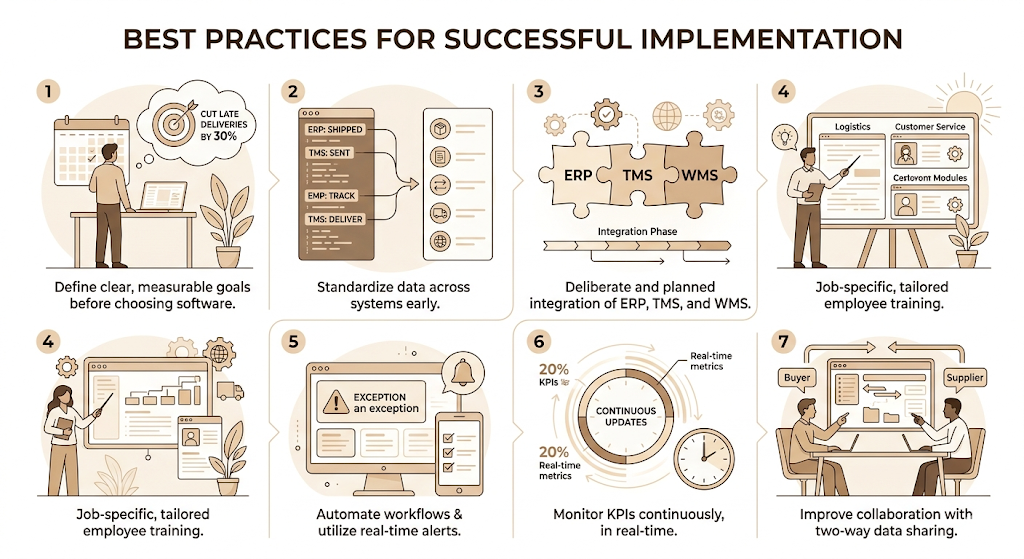
Define clear visibility goals before you shop for software, not after. “We want better visibility” isn’t a goal. “We want to cut late-delivery exceptions by 30% in six months.” is.
Standardize data across systems early. If your ERP, TMS, and WMS all label the same shipment status differently, the visibility platform inherits that mess instead of fixing it.
Integrate ERP, TMS, and WMS as a deliberate project phase, not an afterthought. Most failed visibility rollouts trace back to rushed integration work.
Train employees on the platform specifically, not just on “the new system” in general. Different teams use different parts of it, and generic training leaves gaps.
Automate workflows wherever the platform allows it. The value of exception alerts drops fast if a human still has to manually check the dashboard to catch them.
Monitor KPIs continuously, not quarterly. The whole point of real-time visibility is that the metrics should update in real time, too.
Improve supplier collaboration by actually giving suppliers access to relevant parts of the platform, not just consuming their data one-way.
Future Trends in Supply Chain Visibility Software
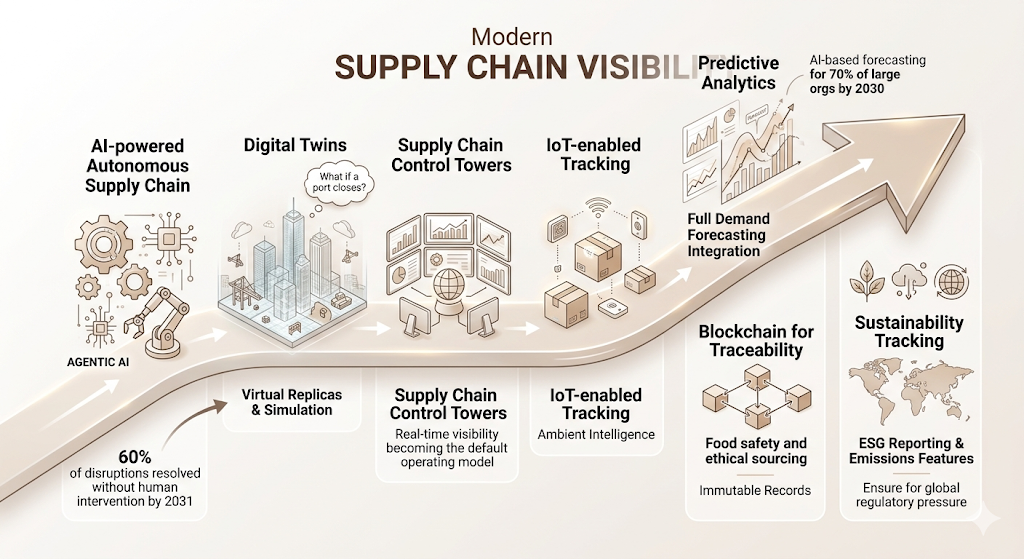
AI-powered autonomous supply chains are moving from pilot to production. Gartner predicts that 60% of supply chain disruptions will be resolved without human intervention by 2031, with agentic AI handling routine exception management end-to-end.
Digital twins -virtual replicas of physical supply chain networks -are increasingly used to simulate disruptions before they happen, testing “what if a port closes” scenarios in software instead of finding out the hard way.
Supply chain control towers are becoming the default operating model for large enterprises rather than a premium add-on, as the cost of building one drops.
IoT-enabled tracking keeps getting cheaper and smaller. Gartner’s 2025 trend report highlighted “ambient invisible intelligence,” low-cost smart tags and sensors that make large-scale tracking affordable even for goods that previously weren’t worth tagging.
Predictive analytics is shifting from delay forecasting to full demand forecasting integration, with Gartner projecting that 70% of large-scale organizations will adopt AI-based demand forecasting by 2030.
Blockchain for traceability continues to show up in specific niches, mainly food safety and ethical sourcing, where an immutable record matters more than the speed gains it offers elsewhere.
Sustainability tracking is no longer optional in many markets. Expect visibility platforms to keep expanding emissions and ESG reporting features as regulatory pressure increases globally.
The next phase of supply chain visibility software is less about seeing more and more about acting automatically. Gartner predicts 60% of disruptions will be resolved without human intervention by 2031, signaling a shift from dashboards that inform people to systems that make the call themselves.
Conclusion
Supply chain visibility software has moved from a nice-to-have to table stakes. The businesses still running on phone calls and spreadsheets aren’t just slower, they’re carrying risk they can’t even see coming. The ones investing in real-time tracking, predictive alerts, and integrated control towers are the ones turning disruption into a manageable variable instead of a crisis.
If you’re evaluating platforms, start with your specific bottleneck, not the longest feature list. A platform built for multi-tier global networks is wasted on a business with three suppliers and one warehouse, and vice versa. Match the tool to the actual problem, check the integrations against your existing stack, and you’ll save yourself a painful re-implementation a year from now.
Frequently Asked Questions
What is supply chain visibility software?
Supply chain visibility software is a platform that tracks shipments, inventory, and supplier activity in real time across the entire supply chain. It pulls data from systems like ERP, TMS, and WMS along with carrier APIs and IoT sensors, then displays it on a single dashboard.
Supply chain visibility software vs. SCM software -what’s the difference?
Supply chain visibility software focuses specifically on real-time tracking and status updates, while SCM software covers the broader work of planning, procurement, and execution. Many enterprise SCM suites now include visibility features, but standalone visibility platforms still exist for businesses that want a focused tracking layer.
How does supply chain visibility software work?
It connects to your ERP, TMS, WMS, and carrier systems through APIs and EDI feeds, then normalizes that data into a single, real-time view. AI models layered on top use historical and live data to predict delays and flag exceptions before they become full-blown problems.
Who should use supply chain visibility software?
Any business managing shipments across multiple partners, carriers, or countries benefits, but it matters most for manufacturers, retailers, 3PLs, and any company where late or inaccurate deliveries directly hurt revenue or customer trust.
Is supply chain visibility software actually worth the cost?
For most mid-size and large businesses, yes, especially given that McKinsey ties real-time visibility to measurably faster recovery from disruptions. For very small operations with one or two suppliers, simpler tracking tools might cover the need without the cost of a full platform.
What is a supply chain control tower?
A supply chain control tower is a centralized hub that brings transportation, inventory, and supplier data into one view, letting a single team make decisions without switching between separate systems for each function.
How much does supply chain visibility software cost?
Pricing varies widely by platform and scale, ranging from per-shipment fees for smaller operations to enterprise licensing running into six figures annually for global platforms like Oracle or SAP. Always ask for the total cost, including implementation and integration work, not just the subscription fee.
What industries use supply chain visibility software?
Manufacturing, retail and eCommerce, logistics and 3PL, food and beverage, healthcare and pharmaceuticals, and automotive are the heaviest users, though the underlying need (knowing where your goods are) applies to nearly any industry moving physical products.
Why isn’t my current visibility tool catching delays early enough?
This usually comes down to weak predictive analytics or incomplete data integration. If the platform only shows the current location without forecasting based on historical patterns, weather, and carrier performance, it’s tracking history, not predicting the future.
Which is the best supply chain visibility software in 2026?
There’s no single best platform; it depends on your scale and needs. FourKites and project44 lead for large multi-modal enterprises, GoComet stands out for exporters managing freight procurement alongside tracking, and Oracle, SAP, and Blue Yonder make sense if you want visibility bundled into a broader planning and execution suite.