

Performance marketing has changed a lot in the last few years. What used to work with manual optimizations and basic reporting now feels slow, sometimes painfully slow, especially once campaigns start running across five or six platforms at the same time. That’s where performance marketing automation starts becoming less of a “nice-to-have” and more of an operational necessity. This blog looks at how brands are automating paid campaigns, attribution, audience targeting, reporting, and creative testing without completely handing over control to algorithms. It also gets into the messy side of automation too, because honestly, not every automated system improves performance unless the strategy, data, and tracking underneath it are actually solid.
Table of Contents
Introduction
Performance marketing used to be manageable with spreadsheets, manual bid adjustments, weekly reporting calls, and a few dashboards open in separate tabs. Not anymore.
Marketers are managing campaigns across Google Ads, Meta, TikTok, LinkedIn, affiliate networks, programmatic platforms, retail media networks, and increasingly fragmented customer journeys. Attribution windows keep changing. Privacy regulations continue tightening. Creative fatigue happens faster than most teams can react to. And customer acquisition costs? They’ve climbed enough to make inefficient campaigns painfully obvious.
The reality is pretty simple: manual optimization can’t keep up with modern paid media anymore.
A campaign today generates thousands of data signals every hour. Audiences shift constantly. Competitors change bids in real time. Consumer behavior changes by device, platform, geography, even time of day. Trying to manage all of that manually is like attempting to control air traffic with sticky notes.
That’s exactly why performance marketing automation has become such a critical capability for modern growth teams.
Not just for enterprises, either.
Even smaller ecommerce brands and lean SaaS teams are leaning heavily into automated performance marketing because the economics almost force them to. You either automate intelligently or spend too much time reacting to problems after they’ve already hurt performance.
And honestly, a lot of marketers still misunderstand what automation actually means.
It’s not simply turning on Smart Bidding in Google Ads and hoping for the best. Real marketing automation for paid campaigns goes much deeper than that. It connects data, attribution, audience segmentation, creative testing, reporting, optimization logic, and AI-driven decision-making into one scalable system.
The biggest shift happening right now is the rise of AI performance marketing.
Platforms are no longer just automating repetitive tasks. They’re predicting outcomes.
AI systems now estimate conversion probability before users even click. They dynamically personalize creatives based on behavior patterns. They forecast campaign pacing issues before budgets get wasted. Some tools can even generate and test dozens of ad variations automatically without needing constant human input.
A few years ago, that sounded futuristic. Now it’s becoming standard operating procedure.
The interesting part is that automation isn’t replacing marketers. At least not the good ones.
It’s replacing manual operational work.
The marketers seeing the best results today are usually the ones spending less time exporting CSVs and more time thinking strategically about positioning, messaging, customer psychology, and creative direction. Automation handles the repetitive optimization layer while humans focus on growth strategy and decision-making.
When done properly, performance marketing automation can help brands:
- Improve ROAS across channels
- Reduce wasted ad spend
- Launch campaigns faster
- Scale audience targeting efficiently
- Improve attribution accuracy
- Personalize ads at scale
- Shorten optimization cycles
- Reduce reporting and operational workload
It also helps marketing teams move with more confidence because decisions are increasingly based on live performance data instead of delayed reporting.
In this guide, we’ll break down exactly how automated performance marketing works, where AI fits into the picture, what tools matter in 2026, and how brands are building scalable automation systems without losing strategic control.
We’ll also cover the mistakes companies make when they automate too aggressively. Because that happens more often than most people admit.
Automation can absolutely improve performance. But bad automation just helps brands lose money faster.
What Is Performance Marketing Automation?
Performance marketing automation refers to the use of software, AI systems, machine learning, workflows, and data-driven rules to automate and optimize paid marketing campaigns across digital channels.
At its core, performance marketing focuses on measurable business outcomes. Things like:
- Conversions
- Revenue
- ROAS
- Cost per acquisition
- Lead generation
- Customer lifetime value
Unlike traditional brand marketing, where results can sometimes feel harder to quantify, performance marketing is heavily tied to trackable actions and efficiency metrics.
Automation enters the picture because modern paid acquisition generates more complexity than humans can realistically manage manually at scale.
A single campaign can involve:
- Thousands of audience signals
- Dynamic bidding changes
- Cross-channel attribution data
- Creative testing variations
- Budget pacing decisions
- Device-level performance shifts
- Behavioral targeting updates
And all of that changes continuously.
Performance marketing automation essentially creates systems that respond to those changes automatically.
Sometimes the automation is rule-based. For example:
“If CPA rises above target, reduce bids by 15%.”
Other times it’s AI-driven and predictive:
“This audience segment has a high probability of converting within the next 48 hours, so increase budget allocation automatically.”
That’s the major difference between older automation systems and modern AI performance marketing platforms.
Traditional automation mostly followed predefined workflows.
Modern automation increasingly learns and adapts.
How Performance Marketing Automation Works
Data Collection and Tracking
Everything starts with data.
Without clean, reliable data, automation systems become unreliable very quickly. Most automated ad optimization systems depend heavily on behavioral tracking and conversion feedback loops.
This includes:
- Website behavior tracking
- App event tracking
- CRM data synchronization
- Conversion tracking
- Attribution modeling
- Customer journey analysis
- Real-time campaign analytics
Platforms like Google Ads and Meta Ads constantly analyze user signals such as:
- Pages visited
- Purchase history
- Session duration
- Scroll behavior
- Cart actions
- Ad engagement patterns
- Device usage
- Geographic data
These signals feed machine learning models that help platforms determine which users are more likely to convert.
Attribution systems also play a huge role here.
Modern marketing attribution automation attempts to understand how different touchpoints contribute to conversions across channels. A user may click a TikTok ad, later search on Google, open an email sequence, and finally convert through a retargeting campaign.
Without automation, stitching those touchpoints together becomes messy very quickly.
And honestly, attribution is still imperfect even with advanced systems. But automation has made it significantly more accurate than last-click reporting models from a few years ago.
Automated Campaign Execution
Once data systems are in place, automation begins executing campaigns dynamically.
This is where most marketers first encounter paid media automation.
Common examples include:
- Automated bidding strategies
- Dynamic budget allocation
- Automated audience targeting
- Creative rotation
- Rule-based optimizations
- Real-time campaign adjustments
Google’s Smart Bidding is one of the clearest examples. Instead of manually setting keyword bids, advertisers allow machine learning systems to optimize bids based on conversion likelihood.
The platform evaluates massive amounts of contextual data in milliseconds:
- Device type
- Search intent
- Historical conversion patterns
- User behavior signals
- Time of day
- Browser data
- Location patterns
Humans simply can’t process that level of complexity in real time.
The same thing is happening across Meta Ads, TikTok Ads, LinkedIn Ads, and programmatic advertising platforms.
Creative automation is also becoming a major piece of the puzzle.
Dynamic creative optimization systems can automatically test combinations of:
- Headlines
- Images
- CTAs
- Product feeds
- Video variations
- Ad copy structures
Instead of manually building dozens of ads, marketers increasingly provide creative assets while AI systems determine which combinations perform best for specific audience segments.
This dramatically increases campaign velocity.
AI-Based Optimization
This is where performance marketing automation becomes significantly more advanced.
AI-driven systems are no longer just automating repetitive actions. They’re making predictive decisions.
Machine learning models analyze historical and real-time data to identify patterns humans would likely miss.
For example:
- Which audience segments are most likely to convert
- Which creative formats reduce CPA
- Which customers have higher projected lifetime value
- Which placements generate low-quality traffic
- Which bidding strategies maximize incremental conversions
Predictive analytics now influence almost every part of modern AI ad optimization.
Budget forecasting tools estimate future campaign performance based on historical trends. AI-powered targeting systems identify users who resemble high-value customers. Automated systems detect anomalies before campaigns overspend.
Some platforms even optimize toward profit margins instead of just conversions.
That’s an important evolution because not all conversions are equally valuable.
A campaign generating cheap leads sounds great until sales teams realize none of them convert into paying customers.
Advanced automated performance marketing systems increasingly optimize toward downstream business outcomes instead of vanity metrics.
Performance Marketing Automation vs Traditional Marketing Automation
A lot of marketers confuse these two categories because both involve automation. But they solve very different problems.
Traditional marketing automation is usually centered around lifecycle communication and customer nurturing.
Performance marketing automation focuses on paid acquisition and revenue optimization.
Here’s the practical distinction.
Traditional marketing automation typically includes:
- Email workflows
- CRM sequences
- Lead nurturing campaigns
- Customer onboarding flows
- Newsletter automation
- Retention campaigns
Meanwhile, performance marketing automation handles:
- Paid media optimization
- Ad targeting
- Automated bidding
- Budget allocation
- Cross-channel acquisition
- Conversion optimization
- Attribution modeling
One focuses primarily on owned channels.
The other focuses heavily on scalable paid acquisition.
Traditional marketing automation often follows scheduled workflows:
- Send email after signup
- Trigger onboarding sequence
- Notify sales team after demo request
Performance marketing automation is far more dynamic and real-time.
It continuously adjusts campaign behavior based on live data signals and machine learning analysis.
That distinction matters because many businesses mistakenly assume having email automation means they already have a sophisticated automation strategy.
Usually, they don’t.
True performance marketing automation requires integration across ad platforms, analytics systems, CRM infrastructure, attribution models, audience data, and optimization engines.
It’s operationally much more complex, but also significantly more impactful for growth.
Why Performance Marketing Automation Matters
Rising Customer Acquisition Costs (CAC)
Customer acquisition costs have been rising for years, but in 2026 the pressure feels different.
It’s not just that ads are more expensive. The entire acquisition environment has become more competitive, fragmented, and algorithmically driven.
More brands are competing for the same audiences across nearly every major platform. At the same time, privacy restrictions have reduced tracking visibility, which makes optimization harder if your systems aren’t sophisticated enough.
Manual campaign management simply struggles in this environment.
A marketer manually adjusting bids once or twice per day cannot compete with automated systems making thousands of micro-optimizations in real time.
That’s the uncomfortable truth.
Platforms themselves are increasingly designed around automation-first advertising. Google pushes advertisers toward Performance Max campaigns. Meta continues expanding Advantage+ automation features. TikTok’s algorithmic optimization systems are becoming more aggressive every year.
The platforms want advertisers to feed machine learning systems with data because it improves platform efficiency and usually increases ad spend velocity too.
For brands, though, the economics matter more than the platform narrative.
If CAC continues rising while teams remain operationally slow, margins eventually get squeezed hard enough to limit growth.
That’s why automated campaign optimization is no longer optional for serious growth-focused businesses.
It’s becoming infrastructure.
The Explosion of Multi-Channel Marketing
Consumers no longer move through neat, linear funnels.
Someone might discover a product on TikTok, research it on Google, see retargeting ads on Instagram, read reviews on Reddit, click an affiliate article, and finally convert through branded search.
Modern customer journeys are messy.
Which means marketers are now managing campaigns across:
- Google Ads
- Meta Ads
- TikTok Ads
- LinkedIn Ads
- YouTube
- Programmatic advertising platforms
- Affiliate marketing networks
- Retail media channels
- Connected TV platforms
Each platform has its own:
- Attribution model
- Optimization system
- Audience structure
- Reporting framework
- Creative requirements
- Learning phases
- Budget pacing logic
Trying to coordinate all of this manually becomes operationally exhausting very quickly.
This is where performance marketing automation becomes incredibly valuable.
Automation systems can centralize campaign management, normalize reporting data, automate audience syncing, adjust budgets across channels, and detect performance anomalies without requiring constant manual intervention.
Cross-channel paid media automation is especially important for brands scaling internationally or managing high monthly ad spend.
At scale, operational inefficiency becomes expensive surprisingly fast.
The Shift Toward AI-Driven Advertising
AI is fundamentally reshaping how digital advertising works.
Not theoretically. Operationally.
Ad platforms increasingly rely on machine learning models to make decisions that humans used to control manually.
This includes:
- Smart bidding
- Predictive audience targeting
- Automated creative testing
- Dynamic personalization
- Budget forecasting
- Conversion probability modeling
And honestly, some of these systems now outperform experienced media buyers in specific optimization tasks.
That doesn’t mean human marketers are becoming irrelevant.
It means the role is changing.
The best marketers today spend less time adjusting keyword bids manually and more time improving strategic inputs:
- Better positioning
- Better offers
- Better creative direction
- Better first-party data
- Better attribution structures
- Better conversion experiences
AI handles optimization speed. Humans still shape strategic advantage.
Generative AI is also accelerating creative production dramatically.
Brands can now generate multiple ad copy variations, landing page adaptations, video scripts, product descriptions, and creative concepts at a pace that simply wasn’t feasible before.
Of course, volume alone doesn’t guarantee performance. Plenty of AI-generated ads still feel generic and forgettable.
But when a strong creative strategy is combined with AI-assisted production and automated optimization, campaign scalability increases significantly.
Benefits of Performance Marketing Automation
Faster Campaign Optimization
Automation drastically shortens optimization cycles.
Instead of waiting days to analyze campaign data manually, systems can identify underperforming segments in real time and make adjustments immediately.
That responsiveness matters because paid media environments shift constantly.
A winning audience this week may fatigue next week.
Automation helps brands react faster.
Improved ROAS
One of the biggest advantages of automated performance marketing is efficiency improvement.
AI systems process more data signals than humans can realistically analyze manually. That often leads to:
- Better audience targeting
- More efficient bidding
- Improved creative matching
- Smarter budget allocation
- Reduced wasted spend
When configured properly, automation tends to improve return on ad spend over time because optimization becomes continuous instead of periodic.
Better Attribution Accuracy
Modern customer journeys involve multiple touchpoints across channels and devices.
Marketing attribution automation helps brands understand which campaigns actually influence conversions instead of relying on simplistic last-click models.
That leads to smarter budget decisions.
And honestly, many brands still massively underinvest in channels that contribute earlier in the funnel because their attribution systems are weak.
Automation helps surface those hidden influences more effectively.
Reduced Manual Work
This benefit sounds obvious, but it’s more important than many teams realize.
Performance marketers often spend enormous amounts of time on repetitive operational work:
- Reporting
- Bid updates
- Budget adjustments
- Audience exclusions
- Spreadsheet management
- Data exports
- Campaign duplication
Automation removes a large percentage of that workload.
That allows teams to focus on higher-value activities like:
- Creative strategy
- Funnel optimization
- Customer research
- Offer development
- Experimentation
- Incrementality analysis
The strategic layer becomes more important as operational tasks become automated.
Real-Time Decision Making
Modern advertising moves too fast for delayed optimization cycles.
Automation systems continuously monitor campaign performance and react instantly to changes.
For example:
- Increasing bids during high-converting periods
- Pausing inefficient placements automatically
- Reallocating budgets to stronger channels
- Detecting sudden CPA spikes
- Scaling successful audience segments
Real-time optimization helps campaigns remain efficient even in volatile auction environments.
Scalable Campaign Management
This is probably the biggest reason brands invest heavily in performance marketing automation.
Scale.
Without automation, campaign complexity eventually overwhelms teams.
With automation, brands can manage:
- More campaigns
- More creative variations
- More audience segments
- More geographic markets
- More products
- More channels
…without increasing operational workload proportionally.
That operational leverage becomes a major competitive advantage over time.
Core Components of a Performance Marketing Automation System
A lot of companies think performance marketing automation starts and ends with automated bidding.
It doesn’t.
Automated bidding is just one layer. A real performance marketing automation system is more like an interconnected engine where data, audiences, creatives, analytics, attribution, and optimization workflows continuously feed into one another.
When the system is built properly, campaigns become faster, smarter, and far more scalable. When it’s stitched together poorly, automation creates chaos at scale.
That distinction matters.
Most mature automated performance marketing systems usually include six core components working together simultaneously.
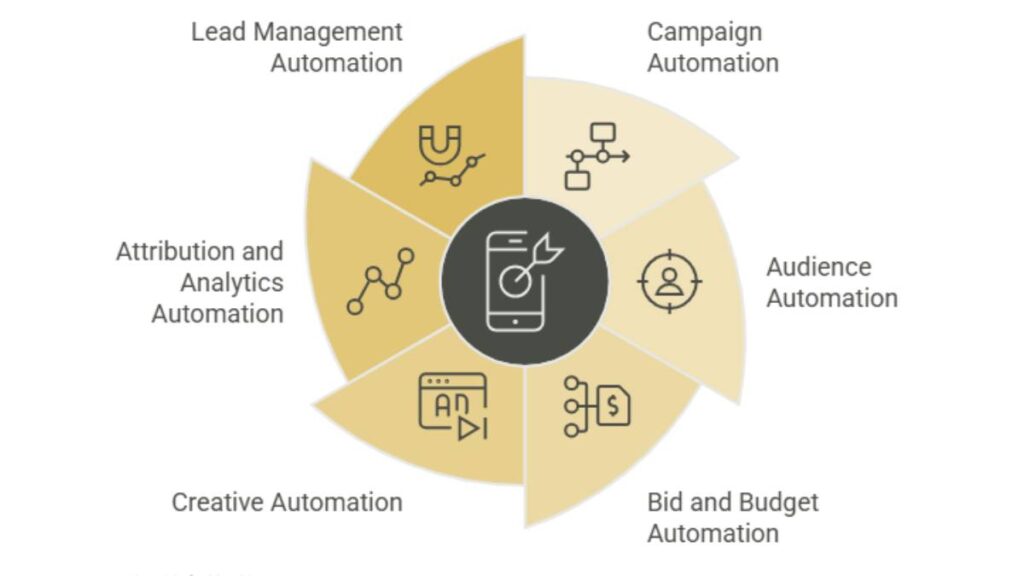
Campaign Automation
Campaign automation is the operational backbone of modern paid media systems.
This is where repetitive campaign management tasks get automated so marketers can focus less on execution and more on strategic growth decisions.
Automated Campaign Launches
Launching campaigns manually across multiple platforms used to consume massive amounts of time.
Teams had to duplicate campaigns, upload creatives, set budgets, configure targeting, build UTMs, apply exclusions, sync conversion tracking, and QA everything manually.
Now, much of that process can be automated.
Brands increasingly use templates, API integrations, feed-based campaign structures, and workflow automation systems to launch campaigns dynamically across channels.
For ecommerce brands, especially, campaign automation has become essential because inventory changes constantly. Products go out of stock, prices fluctuate, new SKUs launch daily, and promotions change quickly.
Automated systems can respond to those updates instantly without needing manual intervention.
That operational speed creates a pretty meaningful competitive advantage.
Rule-Based Optimization
Rule-based automation is still one of the most underrated parts of paid media automation.
Not everything needs advanced AI.
Sometimes simple logic works incredibly well.
For example:
- Pause ads if CPA exceeds the target threshold
- Increase the budget when ROAS remains stable for 3 consecutive days
- Reduce spend on low-converting placements
- Send alerts when conversion rates drop suddenly
- Pause campaigns with broken landing pages
These rules help teams react faster to performance shifts without constantly monitoring dashboards.
And honestly, many brands still underuse rule-based systems because they assume automation only means machine learning.
In reality, operational efficiency often comes from relatively simple automated workflows.
Trigger-Based Campaign Actions
Trigger-based automation allows campaigns to react dynamically to user behavior or business events.
For example:
- Launch retargeting ads after cart abandonment
- Increase bids during flash sales
- Trigger upsell campaigns after purchase
- Activate geo-targeted promotions during live events
- Pause campaigns automatically when inventory runs low
This type of automation makes campaigns feel much more responsive and behavior-driven rather than static.
Modern consumers move quickly. Campaign systems increasingly need to move with them.
Audience Automation
Audience targeting has become dramatically more sophisticated over the last few years.
Static targeting models are slowly fading.
Modern audience automation systems continuously evolve based on behavioral signals, conversion patterns, CRM data, and predictive modeling.
Automated Audience Segmentation
Audience segmentation used to rely heavily on demographic assumptions.
Age groups. Interests. Broad behavioral categories.
Now segmentation is becoming much more intent-driven.
Automation systems analyze:
- Purchase history
- Browsing behavior
- Engagement patterns
- Session frequency
- Product affinity
- Lifetime value potential
- Funnel stage positioning
This allows marketers to create highly dynamic audience groups that update automatically in real time.
For example, users who repeatedly view pricing pages but haven’t converted may automatically enter high-intent retargeting campaigns.
Users with low engagement signals may receive softer awareness messaging instead.
The segmentation becomes adaptive rather than fixed.
Lookalike Audience Generation
Lookalike modeling remains one of the most powerful forms of automated targeting, although platforms are evolving beyond traditional lookalikes into predictive audience systems.
The basic concept still matters though.
Automation systems analyze high-value customer attributes and identify users with similar behavioral characteristics across massive datasets.
This helps brands scale customer acquisition more efficiently without manually identifying targeting patterns.
The quality of these audiences usually depends heavily on input data quality.
Bad source audiences create weak lookalikes.
Strong first-party customer data creates significantly better targeting outcomes.
Retargeting Automation
Retargeting automation has evolved far beyond showing the same ad repeatedly to every website visitor.
Modern retargeting systems adjust messaging dynamically based on:
- Funnel stage
- Product interactions
- Time since last visit
- Purchase probability
- Previous ad engagement
- Cart behavior
- Cross-device activity
A user abandoning a cart today should not receive the same messaging as someone who abandoned 30 days ago.
Automation helps personalize those experiences at scale.
And personalization matters more now because consumers are exposed to enormous amounts of advertising daily. Generic retargeting campaigns often get ignored almost instantly.
Bid and Budget Automation
Bid and budget management used to consume huge portions of media buyers’ time.
Now, most serious advertisers rely heavily on automated bidding systems because manual optimization simply cannot react quickly enough to auction-level volatility.
Automated Bid Strategies
Automated bid strategies use machine learning to optimize bids based on campaign goals.
Instead of setting static bids manually, platforms dynamically adjust bids based on conversion probability.
Signals commonly analyzed include:
- Device type
- Search intent
- User behavior
- Historical conversion data
- Geographic performance
- Time-of-day trends
- Audience quality
- Placement performance
Google’s Smart Bidding systems are one of the clearest examples of this shift.
The platform evaluates millions of contextual signals in real time to determine bid values dynamically.
That level of optimization simply isn’t possible manually at scale.
Of course, automated bidding isn’t perfect either.
Poor conversion tracking or weak attribution can cause optimization systems to chase the wrong outcomes. That’s where human oversight still becomes critical.
Budget Pacing Automation
Budget pacing sounds operationally boring, but it becomes extremely important at scale.
Overspending early in the month can damage campaign efficiency. Underspending can limit growth opportunities.
Budget pacing automation helps distribute spend intelligently across campaign lifecycles while maintaining performance stability.
Some systems automatically slow spending when efficiency drops and accelerate spending during stronger conversion windows.
Others forecast pacing risks before overspending happens.
For large advertisers managing multiple channels, this becomes essential operational infrastructure.
Cross-Channel Budget Allocation
Cross-channel automation is becoming increasingly important because customer journeys rarely happen on one platform anymore.
A platform operating in isolation may appear inefficient even when it contributes meaningfully to overall acquisition performance.
Automation systems now attempt to allocate budgets dynamically across channels based on incremental performance contribution rather than isolated attribution metrics.
This is still an evolving area, honestly.
Cross-channel attribution remains imperfect.
But brands moving toward unified budget optimization generally make better long-term acquisition decisions than brands optimizing every channel independently.
Creative Automation
Creative has become one of the biggest performance differentiators in modern advertising.
Automation now plays a massive role in scaling creative production and optimization.
Dynamic Creative Optimization (DCO)
Dynamic Creative Optimization allows platforms to automatically test combinations of creative assets in real time.
Instead of building one static ad, marketers upload multiple:
- Headlines
- Images
- Videos
- CTAs
- Descriptions
- Product feeds
The platform then assembles and tests combinations dynamically based on audience behavior and predicted performance.
This dramatically increases creative testing velocity.
And honestly, velocity matters because creative fatigue happens much faster than it used to.
Audiences burn out quickly when repeatedly exposed to identical messaging.
AI Ad Copy Generation
AI-generated ad copy has become increasingly common across paid media workflows.
Modern systems can generate:
- Multiple headline variations
- CTA alternatives
- Product descriptions
- Ad body copy
- Retargeting sequences
- Dynamic text personalization
The quality varies, obviously.
Strong positioning and creative strategy still matter enormously.
But AI-assisted copy generation helps marketers test more creative angles much faster than manual workflows alone.
That increased experimentation often improves campaign performance over time.
Automated Creative Testing
Creative testing used to move painfully slowly.
Teams would test one or two variations every few weeks and wait for statistically significant data manually.
Now automation systems continuously rotate, test, pause, and prioritize creatives automatically.
Some platforms identify fatigue patterns early. Others shift budget allocation toward high-performing creative combinations dynamically.
The brands winning in paid acquisition today usually operate with extremely fast creative testing cycles.
Automation makes that possible operationally.
Attribution and Analytics Automation
Attribution has become one of the hardest problems in performance marketing.
Privacy changes, fragmented journeys, and cross-device behavior make clean attribution increasingly difficult.
Automation helps simplify some of that complexity.
Multi-Touch Attribution
Modern attribution automation attempts to measure how multiple touchpoints contribute to conversions across the customer journey.
Instead of assigning all credit to the final click, multi-touch systems distribute attribution across earlier interactions.
For example:
- A TikTok ad may generate awareness
- A Google search ad may drive research
- An email sequence may reinforce consideration
- A retargeting ad may close the conversion
Without attribution automation, many upper-funnel channels appear weaker than they actually are.
That often leads brands to overinvest in bottom-funnel tactics while underfunding discovery channels.
Conversion Path Analysis
Conversion path analysis helps marketers understand how users move across touchpoints before converting.
Automation systems identify:
- Common funnel paths
- High-converting sequences
- Drop-off points
- Time-to-conversion trends
- Assisted conversion channels
This helps teams optimize customer journeys more intelligently rather than viewing channels independently.
Automated Reporting Dashboards
Reporting automation is one of the biggest productivity gains in modern marketing operations.
Manual reporting wastes enormous amounts of time.
Automated dashboards consolidate:
- Ad platform data
- CRM metrics
- Attribution insights
- Revenue reporting
- Funnel performance
- LTV analysis
The best reporting systems also surface anomalies automatically instead of forcing teams to hunt through spreadsheets constantly.
Lead Management Automation
Performance marketing doesn’t stop at lead generation.
Lead handling matters just as much.
Poor lead management destroys acquisition efficiency surprisingly often.
Lead Scoring
Not all leads are equally valuable.
Lead scoring automation evaluates lead quality based on behavioral and demographic signals.
This helps sales teams prioritize higher-intent prospects while reducing wasted follow-up effort.
Modern lead scoring models increasingly use predictive analysis rather than simple static point systems.
CRM Integration
CRM integration is critical for effective performance marketing automation.
Without CRM synchronization, advertising systems lack downstream conversion visibility.
That creates optimization blind spots.
Integrated systems help marketers optimize toward actual revenue outcomes rather than shallow top-of-funnel metrics alone.
Automated Follow-Ups
Speed-to-lead matters enormously.
Automated follow-up systems trigger:
- Email sequences
- SMS reminders
- Demo scheduling
- Lead routing
- Sales notifications
- Nurture campaigns
Fast response times often improve conversion rates significantly, especially in competitive industries where prospects are evaluating multiple vendors simultaneously.

Enroll Now: AI-Powered Performance Marketing Course
How AI Powers Performance Marketing Automation
AI is no longer an experimental layer inside advertising platforms. It’s becoming the operational core of how modern performance marketing works.
Most marketers are already interacting with AI-driven systems daily, even if they don’t always realize how much decision-making has shifted toward machine learning.
Bidding systems use AI.
Audience targeting uses AI.
Creative optimization uses AI.
Attribution modeling increasingly uses AI.
The interesting thing is that performance marketing itself has become too data-heavy for manual optimization alone. There are simply too many variables changing simultaneously across campaigns, audiences, placements, devices, and behaviors.
That’s why AI performance marketing automation has accelerated so quickly over the last few years.
Not because automation sounds trendy, but because advertising complexity made it necessary.
The Role of Machine Learning in Performance Marketing
Machine learning sits at the center of modern advertising automation systems.
Unlike traditional software logic that follows static rules, machine learning systems continuously improve by analyzing performance data and identifying patterns over time.
That learning process allows campaigns to become increasingly adaptive.
Pattern recognition
One of AI’s biggest advantages in advertising is large-scale pattern recognition.
Humans are good at strategic thinking and creative direction, but terrible at processing millions of behavioral signals simultaneously.
Machine learning models can analyze enormous datasets to identify patterns like:
- Which audiences convert most profitably
- Which placements underperform consistently
- Which creatives fatigue fastest
- Which combinations of signals indicate purchase intent
- Which users are likely to churn
- Which traffic sources generate low-quality leads
Some of these patterns would be almost impossible to detect manually.
This is why AI advertising automation often improves efficiency over time as systems accumulate more conversion data.
Predictive bidding
Predictive bidding has changed how paid acquisition works across major ad platforms.
Instead of relying on static bids, AI systems estimate the likelihood that a user will complete a desired action.
That probability influences bid decisions in real time.
For example, if the system predicts a high probability of conversion from a particular user, it may increase the bid aggressively during the auction.
If the conversion probability appears low, the system reduces bidding automatically.
These adjustments happen instantly and continuously.
The scale is hard to fully appreciate sometimes. Platforms process millions of auction decisions every second.
Manual optimization simply cannot compete with that speed.
Conversion probability analysis
AI systems increasingly focus on conversion quality rather than just conversion volume.
That’s a really important shift.
Older optimization systems often prioritized cheap conversions regardless of downstream business value. Modern machine learning models are becoming better at predicting:
- Purchase likelihood
- Revenue potential
- Lifetime value
- Lead quality
- Repeat purchase probability
- Churn risk
This allows brands to optimize toward more meaningful business outcomes instead of surface-level metrics.
At least in theory.
The quality of these predictions still depends heavily on clean data infrastructure and accurate conversion tracking.
AI Use Cases in Performance Marketing Automation
AI is now embedded across nearly every stage of the paid media workflow.
Some use cases are already mature. Others are evolving rapidly.
AI-Powered Bid Management
Bid management was one of the earliest areas where AI dramatically changed performance marketing.
Platforms now use machine learning systems to optimize bids dynamically based on contextual signals like:
- Search intent
- User behavior
- Device type
- Geographic patterns
- Historical performance
- Audience engagement
- Time-of-day trends
This allows campaigns to adapt much faster than traditional manual bidding models.
The biggest advantage is responsiveness.
AI systems can react instantly to auction volatility, seasonal shifts, competitor activity, and conversion trends without waiting for manual adjustments.
Predictive Audience Targeting
Predictive targeting uses machine learning to identify users most likely to convert based on behavioral similarities and intent signals.
Traditional targeting often relied heavily on demographics or broad interest categories.
Predictive systems go much deeper.
They analyze behavioral relationships across enormous datasets to identify subtle patterns associated with high-value customers.
For example:
- Content consumption behavior
- Purchase sequencing
- Browsing intensity
- Product engagement patterns
- Cross-device interactions
This improves targeting efficiency because campaigns become more intent-focused instead of purely demographic-focused.
AI Creative Testing
Creative testing used to move slowly because production cycles were expensive, and manual analysis took time.
AI has accelerated both sides of the equation.
Modern systems can automatically:
- Rotate creatives dynamically
- Detect fatigue signals
- Prioritize stronger-performing assets
- Analyze engagement trends
- Recommend creative variations
- Predict likely creative winners
Some platforms now evaluate visual composition patterns, text structures, pacing, and engagement behavior to estimate creative effectiveness before campaigns fully scale.
Creative strategy still matters enormously, though.
AI can optimize execution, but weak messaging usually remains weak messaging.
Automated Ad Personalization
Personalization at scale used to be operationally unrealistic.
Now automation systems dynamically adjust messaging based on audience behavior and contextual signals.
This may include:
- Product recommendations
- Dynamic headlines
- Personalized CTAs
- Geographic customization
- Behavioral messaging sequences
- Dynamic product feeds
The goal is relevance.
Consumers respond better to ads that feel contextually aligned with their interests and behaviors.
AI helps make that level of personalization scalable across massive audience pools.
AI-Powered Budget Forecasting
Budget forecasting is becoming increasingly predictive rather than reactive.
AI systems now estimate:
- Future campaign performance
- Seasonal demand shifts
- Expected conversion trends
- Budget pacing risks
- Revenue projections
- Incremental scaling potential
This helps marketers make smarter allocation decisions earlier instead of reacting after inefficiencies appear.
Forecasting still isn’t perfect, obviously.
Consumer behavior can change unpredictably.
But predictive budget modeling has improved substantially over the last few years.
Generative AI in Performance Marketing
Generative AI is probably the fastest-moving layer of performance marketing automation right now.
It’s changing how marketers produce creative assets, landing pages, copy variations, and personalized experiences.
The operational speed increase is significant.
AI Ad Copy Generation
AI-generated ad copy allows marketers to test messaging variations much faster than traditional workflows.
Systems can now generate:
- Headlines
- Product descriptions
- Meta descriptions
- CTAs
- Retargeting sequences
- Promotional messaging
- Dynamic search ad copy
The biggest advantage isn’t necessarily perfect copy generation.
It’s testing velocity.
More variations allow brands to identify stronger messaging angles faster.
That said, generic AI-generated copy often performs poorly without strategic direction. Human oversight still matters heavily when it comes to positioning and emotional resonance.
AI Landing Page Personalization
Landing pages are increasingly becoming dynamic instead of static.
AI systems can personalize landing page experiences based on:
- Traffic source
- User intent
- Geography
- Device type
- Funnel stage
- Previous interactions
- Audience segment
For example, users arriving from different ad campaigns may automatically see different messaging hierarchies or product recommendations.
This improves message continuity between ads and destination pages.
And continuity matters more than many brands realize.
AI Video Ad Creation
Video production used to be one of the biggest bottlenecks in creative scaling.
Generative AI tools are helping reduce that friction by automating portions of:
- Script generation
- Caption creation
- Scene sequencing
- Voiceovers
- Localization
- Short-form adaptation
Short-form video especially benefits from rapid iteration because creative fatigue happens incredibly fast on platforms like TikTok and Instagram Reels.
The ability to generate and test multiple variations quickly has become operationally valuable.
Risks and Limitations of AI Automation
AI performance marketing automation is powerful, but it’s definitely not flawless.
Over-automation creates real risks when marketers blindly trust platform systems without strategic oversight.
Over-Reliance on Platform Algorithms
One of the biggest risks is becoming too dependent on black-box platform algorithms.
Platforms optimize based on the signals they can measure, but those signals don’t always align perfectly with actual business value.
For example, campaigns optimized purely for low-cost conversions may attract low-quality customers.
Platforms also prioritize their own ecosystem incentives sometimes. Marketers still need independent validation through incrementality testing and business-level analysis.
Blind trust in automation usually becomes expensive eventually.
Data Privacy Challenges
Privacy regulations continue reshaping performance marketing infrastructure.
Cookie deprecation, iOS tracking limitations, GDPR compliance requirements, and broader privacy expectations have reduced visibility across many attribution systems.
AI systems depend heavily on data quality.
When tracking weakens, optimization accuracy often declines too.
This is one reason first-party data strategies have become increasingly important for modern advertisers.
Poor Input Data Problems
AI systems are only as strong as the data feeding them.
Bad conversion tracking creates bad optimization.
Weak attribution creates distorted learning signals.
Incomplete CRM integrations create blind spots.
Many automation failures actually originate from poor infrastructure rather than poor algorithms.
Garbage in, garbage out still applies very heavily in automated advertising.
Creative Fatigue Risks
Automation can scale creative delivery extremely quickly.
That creates another problem: audiences burn out faster.
When campaigns aggressively scale winning creatives without sufficient refresh cycles, performance often declines rapidly.
AI can help detect fatigue patterns, but a human creative strategy still matters enormously.
The brands performing best right now usually combine aggressive automation with equally aggressive creative iteration.
Performance Marketing Automation Channels
Performance marketing automation now extends across almost every major acquisition channel.
This is important because customer journeys no longer happen in isolated environments. Consumers move fluidly between search, social, video, affiliate content, email, and programmatic media before converting.
Modern automation systems need to operate across that entire ecosystem.
And honestly, each channel behaves differently.
Search automation relies heavily on intent signals.
Social automation depends more on audience behavior and creative performance.
Programmatic advertising focuses heavily on real-time bidding infrastructure.
Affiliate automation revolves around tracking and partner management.
Understanding those differences matters because automation strategies should align with channel behavior rather than forcing every platform into the same optimization framework.
Paid Search Automation
Paid search remains one of the most mature automation environments in digital advertising.
Search platforms have spent years training machine learning systems on enormous volumes of intent-based data.
The result is that automated paid search systems have become extremely sophisticated.
Google Ads Automation
Google Ads is probably the clearest example of how deeply AI now influences advertising operations.
Automation touches almost every layer of the platform.
Smart bidding
Smart bidding uses machine learning to optimize bids based on the likelihood of conversion or conversion value.
Instead of manually managing keyword-level bids, advertisers increasingly rely on automated strategies like:
- Target CPA
- Target ROAS
- Maximize conversions
- Maximize conversion value
The system evaluates contextual signals in real time including:
- Search intent
- User behavior
- Device type
- Location
- Historical conversion data
- Audience quality
- Browser behavior
The scale of these calculations is impossible to replicate manually.
That’s why manual bidding strategies have become far less effective for large-scale campaigns.
Performance Max campaigns
Performance Max campaigns represent Google’s push toward heavily automated campaign structures.
Rather than separating campaigns by inventory type, Performance Max uses machine learning to distribute ads across:
- Search
- YouTube
- Display
- Discover
- Gmail
- Maps
- Shopping inventory
The platform automates:
- Audience targeting
- Bid optimization
- Creative assembly
- Placement allocation
- Budget pacing
Performance Max can work extremely well when fed strong creative assets and clean conversion data.
But it also reduces transparency significantly, which frustrates many experienced marketers.
That tension between automation and control is becoming one of the defining themes in modern advertising.
Automated keyword optimization
Keyword automation has evolved substantially beyond simple bid adjustments.
Modern systems now automate:
- Match type expansion
- Negative keyword management
- Query pattern analysis
- Dynamic keyword insertion
- Search term prioritization
Some campaigns increasingly optimize around intent clusters rather than tightly controlled keyword structures.
That’s a major shift from older search advertising models.
Microsoft Ads Automation
Microsoft Ads automation works similarly to Google Ads in many ways, although the ecosystem operates at a smaller scale.
Automation features include:
- Automated bidding
- Audience targeting
- Dynamic search ads
- AI-powered optimization
- Conversion-focused bidding strategies
Many B2B advertisers still find Microsoft Ads valuable because of lower competition and different audience demographics.
Automation helps simplify campaign management across both ecosystems simultaneously.
Social Media Advertising Automation
Social platforms have become heavily algorithm-driven.
Audience targeting, delivery optimization, and creative distribution increasingly rely on machine learning systems rather than manual advertiser controls.
Meta Ads Automation
Meta’s advertising ecosystem now relies deeply on automation infrastructure.
Features like Advantage+ campaigns automate:
- Audience expansion
- Placement optimization
- Budget allocation
- Creative testing
- Delivery pacing
Meta’s systems are particularly strong at behavioral targeting because of the platform’s enormous engagement dataset.
The platform increasingly encourages advertisers to provide broader targeting inputs while allowing algorithms to optimize delivery automatically.
This works well in many cases, although weak creative still limits performance heavily.
Creative quality remains the biggest variable on Meta platforms.
TikTok Ads Automation
TikTok’s advertising ecosystem moves incredibly fast.
Creative fatigue happens faster there than on almost any other major platform.
Automation plays a huge role in helping brands manage that pace.
TikTok automation systems optimize:
- Audience targeting
- Video delivery
- Engagement prediction
- Creative rotation
- Conversion optimization
The platform’s algorithm relies heavily on behavioral engagement patterns rather than static demographic targeting.
That creates opportunities for rapid scale when the creative resonates properly.
But it also means campaigns can deteriorate quickly when engagement signals weaken.
LinkedIn Ads Automation
LinkedIn automation focuses more heavily on professional targeting and B2B optimization.
Automation features include:
- Predictive audience expansion
- Automated bidding
- Lead form optimization
- Campaign pacing
- Dynamic audience syncing
B2B campaigns typically involve longer conversion cycles and higher-value leads, so LinkedIn optimization often prioritizes lead quality over pure volume.
CRM integration becomes especially important in these environments.
Affiliate Marketing Automation
Affiliate marketing has become far more automated over the last decade.
Managing affiliate programs manually at scale becomes operationally overwhelming very quickly.
Automation systems help streamline:
- Partner onboarding
- Tracking infrastructure
- Commission management
- Fraud detection
- Performance monitoring
- Attribution validation
Partner tracking
Affiliate tracking automation ensures conversions are accurately attributed across publishers and referral partners.
This includes:
- Click tracking
- Attribution windows
- Cross-device validation
- Revenue reconciliation
- Multi-touch contribution analysis
Accurate tracking matters heavily because affiliate ecosystems can become vulnerable to attribution disputes and fraud.
Commission automation
Commission systems now automate payouts dynamically based on predefined rules and performance thresholds.
For example:
- Tiered commissions
- Revenue-based payouts
- Recurring subscription commissions
- Bonus incentives
- Hybrid CPA structures
Automation reduces operational friction significantly for larger affiliate programs.
Fraud detection
Affiliate fraud remains a serious issue in performance marketing.
Automation systems increasingly use AI to detect suspicious behaviors like:
- Click spam
- Fake conversions
- Cookie stuffing
- Traffic laundering
- Bot activity
Without automated fraud detection, affiliate programs can lose significant budget efficiency.
Email and Lifecycle Automation for Performance Marketers
Email automation still plays a huge role in performance marketing ecosystems, especially when integrated with paid acquisition campaigns.
Paid media drives acquisition.
Lifecycle automation improves conversion efficiency and retention.
Lead nurturing workflows
Lead nurturing automation helps move users through the funnel after initial acquisition.
This may include:
- Educational sequences
- Product onboarding
- Demo reminders
- Trial activation workflows
- Retargeting email campaigns
Strong nurture systems often improve paid acquisition economics substantially because more leads eventually convert.
Retargeting email sequences
Retargeting automation increasingly combines paid media and email workflows together.
For example:
- Cart abandonment emails
- Browse abandonment sequences
- Post-click follow-ups
- Offer reminder campaigns
- Dynamic product recommendations
Cross-channel coordination matters because users rarely convert from one touchpoint alone.
Conversion recovery automation
Conversion recovery systems attempt to recapture lost opportunities automatically.
This includes workflows like:
- Failed checkout reminders
- Subscription renewal prompts
- Payment failure sequences
- Re-engagement campaigns
These systems often generate surprisingly efficient incremental revenue because the acquisition cost has already been paid.
Programmatic Advertising Automation
Programmatic advertising is essentially automation-driven by design.
The entire ecosystem revolves around real-time automated media buying.
Real-time bidding (RTB)
RTB systems buy ad inventory automatically through live auctions that happen in milliseconds.
Algorithms evaluate:
- Audience relevance
- Contextual signals
- Conversion probability
- Placement quality
- Historical performance
Then bid accordingly in real time.
Humans define strategy and constraints, but the execution layer is heavily automated.
Automated audience buying
Programmatic systems use audience automation to purchase impressions across massive inventory pools dynamically.
This allows advertisers to scale targeting beyond individual platforms while optimizing toward specific audience behaviors and outcomes.
AI-powered media buying
AI-powered programmatic systems increasingly optimize toward:
- Incremental conversions
- Viewability quality
- Brand safety
- Attention metrics
- Conversion efficiency
- Revenue impact
As programmatic infrastructure evolves, automation is becoming more predictive and outcome-focused rather than simply impression-focused.
Best Performance Marketing Automation Tools
The performance marketing automation landscape has become crowded very quickly.
A few years ago, most teams relied on native platform automation inside Google Ads or Meta Ads, and maybe one reporting dashboard layered on top. Now the ecosystem includes AI optimization platforms, attribution systems, creative automation tools, audience intelligence platforms, workflow automation software, and predictive analytics engines, all competing for attention.
That sounds exciting until you realize many companies end up building overly complicated stacks that create more operational confusion than efficiency.
The best automation setup is usually not the most complex one.
It’s the one that connects cleanly to your data, aligns with your acquisition model, and removes meaningful operational friction.
A fast-growing ecommerce brand has very different automation needs compared to a B2B SaaS company or a performance marketing agency managing dozens of client accounts.
That’s why tool selection matters more than marketers sometimes expect.
What to Look for in a Performance Marketing Automation Platform
Before comparing platforms, it helps to understand what actually matters inside a performance marketing automation system.
A lot of software looks impressive in demos. The real test is whether the platform improves decision-making, campaign efficiency, and operational scalability once integrated into actual workflows.
Automation Capabilities
Automation depth is usually the first thing marketers evaluate.
Some platforms only automate reporting. Others handle bidding, audience management, campaign launches, creative optimization, and cross-channel budget allocation.
The key question is whether the automation genuinely reduces repetitive work or simply adds another layer of management complexity.
Strong performance marketing software should help automate:
- Bid management
- Budget pacing
- Campaign deployment
- Audience syncing
- Reporting workflows
- Creative testing
- Attribution analysis
- Lead routing
Ideally, the automation should remain flexible enough to support strategic oversight rather than forcing marketers into rigid workflows.
AI Features
AI functionality has become a major differentiator in modern AI marketing automation platforms.
That said, not every “AI-powered” feature actually creates meaningful value.
The strongest platforms usually focus AI around practical use cases like:
- Predictive bidding
- Audience modeling
- Creative performance analysis
- Budget forecasting
- Conversion probability scoring
- Automated anomaly detection
- Dynamic personalization
Good AI should improve operational efficiency and optimization quality.
Bad AI just creates black-box decisions with limited transparency.
Marketers still need visibility into why systems are making optimization choices.
Attribution and Reporting
Attribution remains one of the hardest problems in digital marketing.
Because customer journeys span multiple channels, devices, and touchpoints, brands need automation systems capable of consolidating fragmented performance data into usable insights.
Strong attribution and reporting features should include:
- Multi-touch attribution
- Cross-channel tracking
- Revenue analysis
- LTV reporting
- Funnel visualization
- Conversion path analysis
- Real-time dashboards
Without a reliable attribution infrastructure, automation systems often optimize toward incomplete or misleading data.
That becomes dangerous at scale.
Integrations
Performance marketing automation works best when data flows cleanly between systems.
Disconnected platforms create blind spots.
A strong automation stack should integrate with:
- CRM systems
- Ecommerce platforms
- Analytics tools
- Ad platforms
- Customer data platforms
- Email systems
- Attribution software
- Data warehouses
Integration quality matters heavily because fragmented systems reduce optimization accuracy.
Many automation failures happen because tools operate independently instead of sharing clean data.
Scalability
Some automation platforms work well for small campaigns but struggle under enterprise-level complexity.
Scalability becomes critical when managing:
- Multiple ad accounts
- Large creative libraries
- International campaigns
- Multi-brand portfolios
- High monthly spend
- Large audience datasets
The best performance marketing platforms scale operationally without becoming difficult to manage.
That balance is harder to achieve than it sounds.
Pricing
Automation software pricing has become increasingly aggressive.
Enterprise platforms can become extremely expensive once spend-based pricing models kick in.
Marketers need to evaluate not just subscription costs, but also:
- Implementation costs
- Integration costs
- Operational complexity
- Training requirements
- Incremental efficiency gains
Sometimes a lightweight automation stack outperforms a bloated enterprise setup simply because teams actually use it consistently.
Best Performance Marketing Automation Software
The automation software market now covers everything from enterprise orchestration systems to lightweight workflow tools for smaller teams.
Some platforms specialize in attribution. Others focus on media buying, reporting, or creative optimization.
HubSpot Marketing Hub
HubSpot Marketing Hub has evolved into a strong automation platform for businesses combining paid acquisition with CRM-driven lifecycle marketing.
Its biggest strength is integration between marketing automation and customer data.
Marketers can automate:
- Lead nurturing
- CRM workflows
- Audience syncing
- Email sequences
- Attribution reporting
- Lead scoring
- Funnel tracking
For B2B companies especially, the ability to connect paid campaigns directly to downstream sales outcomes is extremely valuable.
Salesforce Marketing Cloud
Salesforce Marketing Cloud remains one of the largest enterprise-grade marketing automation ecosystems.
It’s powerful, although operationally heavy.
Large organizations use it for:
- Omnichannel personalization
- Customer journey orchestration
- Enterprise segmentation
- Predictive analytics
- CRM-driven advertising
- Cross-channel automation
The platform works best for enterprises with large customer datasets and mature internal infrastructure.
Smaller teams often find it unnecessarily complex.
Zapier for Marketing Automation
Zapier plays a very different role compared to full-scale advertising platforms.
It acts more like workflow glue between systems.
Marketers use Zapier to automate repetitive operational tasks like:
- Lead syncing
- Slack alerts
- Reporting triggers
- CRM updates
- Audience uploads
- Form routing
- Spreadsheet automation
Simple workflow automation often creates huge efficiency gains without requiring expensive enterprise systems.
AdRoll
AdRoll focuses heavily on ecommerce retargeting and cross-channel advertising automation.
The platform combines:
- Dynamic retargeting
- Audience segmentation
- Product recommendations
- Cross-channel campaign management
- Conversion tracking
It’s especially useful for ecommerce brands trying to improve retargeting efficiency without building overly complicated infrastructure.
Smartly.io
Smartly.io has become a major player in social media advertising automation.
The platform is heavily focused on:
- Creative automation
- Media buying
- Campaign scaling
- Dynamic creative optimization
- Workflow efficiency
Large advertisers managing massive creative volumes often benefit significantly from Smartly’s automation capabilities.
Creative production speed is one of its biggest advantages.
Marin Software
Marin Software focuses on cross-channel bid management and media optimization.
It helps advertisers manage campaigns across multiple ad platforms from centralized systems.
Core capabilities include:
- Bid optimization
- Budget management
- Performance forecasting
- Cross-channel reporting
- Audience management
For enterprise advertisers managing substantial paid search and social budgets, centralized optimization becomes increasingly important.
Revealbot
Revealbot is popular among performance marketers because it simplifies rule-based advertising automation.
Marketers can build automated rules around:
- Budget scaling
- CPA thresholds
- ROAS targets
- Campaign pausing
- Creative testing
- Performance alerts
Sometimes lightweight automation tools like Revealbot create more immediate operational value than large enterprise systems.
Google Ads Automation
Google Ads itself has become deeply automated.
Features like:
- Smart bidding
- Performance Max
- Automated targeting
- Dynamic search ads
- Responsive search ads
…all rely heavily on machine learning infrastructure.
Many advertisers now operate hybrid models where native platform automation handles bidding while external tools manage reporting, attribution, and workflow orchestration.
Meta Advantage+
Meta Advantage+ reflects Meta’s broader shift toward automation-first advertising.
The system automates:
- Audience expansion
- Creative optimization
- Budget allocation
- Placement selection
- Delivery pacing
Meta increasingly encourages advertisers to focus on creative inputs and business objectives while algorithms manage delivery mechanics.
Affise
Affise specializes in affiliate marketing automation.
The platform helps automate:
- Partner tracking
- Commission management
- Fraud detection
- Performance analytics
- Payout workflows
Affiliate ecosystems become difficult to manage manually at scale, so automation infrastructure matters heavily here.
Triple Whale
Triple Whale has become especially popular among ecommerce brands focused on attribution and profitability analysis.
The platform centralizes:
- Ad platform reporting
- Attribution modeling
- Profit tracking
- Customer journey analysis
- Creative analytics
As attribution complexity grows, tools like Triple Whale become increasingly valuable for ecommerce operators.
Hyros
Hyros focuses heavily on attribution accuracy and conversion tracking.
The platform attempts to improve visibility into customer acquisition journeys by consolidating fragmented tracking signals across platforms.
Brands spending heavily on paid acquisition often prioritize better attribution visibility because poor tracking creates expensive optimization blind spots.
Comparison Table of Top Performance Marketing Automation Platforms
| Tool | Best For | Key Features | AI Features |
| HubSpot Marketing Hub | B2B and lifecycle marketing | CRM automation, attribution, lead nurturing | Predictive lead scoring |
| Salesforce Marketing Cloud | Enterprise omnichannel marketing | Journey orchestration, segmentation, personalization | AI-driven customer insights |
| Zapier | Workflow automation | Integrations, triggers, task automation | Limited AI workflow support |
| AdRoll | Ecommerce retargeting | Dynamic ads, retargeting, audience automation | Predictive retargeting |
| Smartly.io | Social ad automation | Creative automation, media buying | AI creative optimization |
| Marin Software | Cross-channel optimization | Bid management, forecasting | Predictive bidding |
| Revealbot | Rule-based ad automation | Budget rules, campaign automation | Automated optimization rules |
| Google Ads Automation | Search and shopping campaigns | Smart bidding, Performance Max | Machine learning optimization |
| Meta Advantage+ | Social media automation | Audience expansion, creative delivery | AI-driven ad delivery |
| Affise | Affiliate marketing | Partner tracking, fraud prevention | Fraud detection AI |
| Triple Whale | Ecommerce attribution | Profit tracking, attribution dashboards | Predictive analytics |
| Hyros | Attribution tracking | Conversion visibility, attribution analysis | AI attribution modeling |
Enterprise vs SMB Performance Marketing Automation Tools
The automation needs of an enterprise brand look completely different from those of a startup.
Trying to copy enterprise infrastructure too early usually creates unnecessary complexity.
Enterprise Solutions
Enterprise automation systems prioritize:
- Cross-channel orchestration
- Massive data integration
- Global campaign management
- Advanced attribution modeling
- Governance controls
- Multi-team collaboration
Large organizations often require highly customizable infrastructure because of operational scale and internal complexity.
But implementation timelines can become long and resource-intensive.
Startup-Friendly Tools
Smaller businesses typically benefit more from simplicity and operational speed.
Startup-friendly automation tools usually focus on:
- Easy integrations
- Lightweight workflows
- Fast implementation
- Lower operational overhead
- Affordable pricing
For many startups, automating reporting, retargeting, and basic campaign optimization already creates meaningful leverage.
E-commerce-Focused Automation Platforms
Ecommerce brands often need specialized automation systems built around:
- Product feeds
- Dynamic inventory
- Cart recovery
- SKU-level reporting
- Profitability tracking
- Customer retention
That’s why ecommerce automation stacks often combine:
- Attribution software
- Dynamic ad platforms
- Email automation
- Retention workflows
- Creative testing tools
The complexity increases quickly once brands scale across multiple acquisition channels.
How to Build a Performance Marketing Automation Strategy
A lot of companies adopt automation backward.
They start by buying tools before defining a strategy.
That usually creates fragmented systems, disconnected workflows, and automation that optimizes the wrong things.
Technology alone doesn’t fix a weak acquisition strategy.
Performance marketing automation works best when it supports clear business objectives rather than replacing strategic thinking altogether.
The strongest automation systems are usually surprisingly focused. They prioritize operational efficiency, clean data infrastructure, and measurable business outcomes instead of automating everything blindly.
That distinction matters more because platforms increasingly push automation aggressively by default.
The real advantage comes from controlling the system thoughtfully.
Step 1: Define Clear Performance KPIs
Before automating anything, marketers need clarity around what success actually means.
That sounds obvious, but many automation failures happen because optimization systems chase shallow metrics that don’t align with business outcomes.
A campaign generating cheap leads may still hurt profitability if lead quality is poor.
A low CPA campaign can still destroy margins if customer lifetime value remains poor.
Automation systems optimize toward the signals they receive. If the signals are flawed, the optimization becomes flawed too.
CAC
Customer acquisition cost remains one of the most important performance metrics inside automated advertising systems.
CAC helps marketers understand how efficiently campaigns acquire customers across channels.
But CAC should rarely be evaluated in isolation.
Different acquisition channels often generate customers with very different retention patterns and revenue potential.
ROAS
ROAS remains central to most automated performance marketing systems because platforms can optimize toward revenue efficiency relatively quickly.
Still, ROAS can sometimes become misleading if brands focus too heavily on short-term attribution windows.
For example, retargeting campaigns often show very high ROAS because they capture existing demand, while upper-funnel campaigns may appear weaker despite contributing significantly to eventual conversions.
That’s why attribution strategy matters heavily alongside automation.
CPA
Cost per acquisition or cost per action metrics help automation systems optimize toward conversion efficiency.
CPA optimization works especially well for lead generation campaigns where downstream revenue tracking may take longer to mature.
The challenge is ensuring conversion quality remains strong rather than optimizing purely for volume.
LTV
Lifetime value is becoming increasingly important in AI performance marketing systems.
The most sophisticated brands now optimize toward long-term customer profitability instead of immediate conversion metrics alone.
This changes acquisition behavior significantly.
Some customer segments may have higher acquisition costs initially but generate far stronger retention and repeat purchase rates over time.
Automation systems become smarter when connected to downstream LTV data.
Conversion Rate
Conversion rate optimization remains critical because automation amplifies existing funnel performance.
Poor landing pages limit automated campaign efficiency regardless of how advanced the acquisition system becomes.
The best automation strategies treat acquisition and conversion optimization as interconnected systems rather than separate functions.
Step 2: Centralize Your Marketing Data
Data fragmentation is one of the biggest obstacles in performance marketing automation.
Most brands operate across multiple platforms simultaneously:
- Google Ads
- Meta Ads
- CRM systems
- Analytics platforms
- Ecommerce systems
- Affiliate networks
- Email platforms
When those systems remain disconnected, attribution weakens and optimization accuracy suffers.
Centralized data infrastructure becomes increasingly important as automation expands.
CRM integration
CRM integration allows advertising systems to optimize toward actual business outcomes rather than surface-level conversion events.
This is especially important for:
- B2B lead generation
- High-ticket sales
- Subscription businesses
- Long sales cycles
Without CRM visibility, platforms may optimize toward low-quality leads simply because they convert cheaply.
Analytics integration
Analytics integration helps unify customer behavior data across acquisition channels and owned platforms.
This creates stronger visibility into:
- Funnel drop-offs
- Assisted conversions
- Customer journeys
- Revenue attribution
- Incrementality patterns
Good analytics infrastructure improves automation quality significantly because optimization systems receive cleaner behavioral feedback.
Cross-channel tracking
Cross-channel tracking has become increasingly difficult because of privacy restrictions and fragmented attribution environments.
Still, brands need as much visibility as possible into how channels interact.
For example:
- Social ads may generate demand
- Search campaigns may capture intent
- Email may reinforce consideration
- Retargeting may close conversions
Without cross-channel tracking, automation systems often over-prioritize bottom-funnel channels unfairly.
Step 3: Automate Repetitive Tasks
Not every workflow requires advanced machine learning.
Sometimes operational automation creates the biggest efficiency gains.
The goal here is to remove repetitive manual work so teams can focus more on strategic optimization and experimentation.
Bid adjustments
Bid automation remains one of the most common forms of paid media automation.
Platforms can automatically adjust bids based on:
- Conversion probability
- Audience quality
- Device behavior
- Geographic performance
- Historical trends
Manual bidding becomes increasingly impractical as campaign complexity scales.
Reporting
Reporting automation is one of the fastest operational wins for most teams.
Manual reporting consumes enormous amounts of time across agencies and in-house marketing teams alike.
Automated dashboards help consolidate:
- Campaign performance
- Attribution analysis
- Revenue tracking
- Funnel reporting
- Creative performance
The best reporting systems also surface anomalies proactively rather than forcing teams to hunt through dashboards constantly.
Audience exclusions
Audience management becomes surprisingly messy at scale.
Automation helps maintain cleaner targeting by automatically excluding:
- Existing customers
- Low-quality leads
- Recent converters
- Duplicate audiences
- Inactive users
This improves acquisition efficiency while reducing wasted spend.
Creative rotation
Creative fatigue happens much faster than most brands expect.
Automation systems can rotate creatives dynamically based on:
- Engagement decline
- Frequency thresholds
- Performance deterioration
- Audience saturation
This helps maintain campaign freshness without requiring constant manual intervention.
Step 4: Use AI for Optimization
Once foundational automation infrastructure is stable, AI-driven optimization becomes much more effective.
Many companies try skipping straight to AI without fixing data quality first. That usually backfires.
AI systems are only as good as the infrastructure supporting them.
Predictive targeting
Predictive targeting helps identify high-intent users based on behavioral patterns and conversion probability.
Modern targeting systems increasingly prioritize behavioral signals over static demographics alone.
This improves efficiency because campaigns adapt dynamically to audience intent changes.
Budget optimization
AI-driven budget optimization allows systems to allocate spend dynamically across:
- Channels
- Campaigns
- Audience segments
- Placements
- Creative variations
This becomes especially valuable for brands managing large multi-channel acquisition programs.
Manual allocation models often react too slowly to changing performance conditions.
Conversion forecasting
Forecasting systems use historical data and predictive modeling to estimate future performance outcomes.
This helps teams make more informed decisions around:
- Budget scaling
- Seasonal planning
- Inventory alignment
- Campaign pacing
- Revenue projections
Forecasting is never perfect, obviously. Consumer behavior still shifts unpredictably.
But predictive models improve planning accuracy significantly compared to purely reactive management.
Step 5: Create Automated Reporting Systems
Automation without visibility becomes dangerous very quickly.
Marketers still need operational awareness even when systems handle optimization automatically.
That’s why reporting infrastructure matters so much.
Real-time dashboards
Real-time dashboards provide continuous visibility into campaign health across channels.
Strong dashboards should surface:
- Spend pacing
- ROAS trends
- CPA shifts
- Attribution insights
- Funnel performance
- Creative fatigue indicators
The faster teams detect issues, the faster they can intervene strategically.
Automated alerts
Automated alerts help teams respond quickly to performance anomalies.
For example:
- Sudden CPA spikes
- Tracking failures
- Budget overspending
- Conversion drops
- Landing page outages
- Attribution inconsistencies
This reduces the need for constant manual monitoring.
Executive reporting
Leadership teams usually care less about platform metrics and more about business impact.
Automated executive reporting should focus on:
- Revenue contribution
- Customer acquisition trends
- Profitability
- LTV growth
- Incremental efficiency
- Scaling opportunities
The reporting layer should simplify decision-making rather than overwhelm stakeholders with raw platform data.
Step 6: Continuously Test and Optimize
One of the biggest mistakes in marketing automation is assuming optimization eventually becomes “finished.”
It doesn’t.
Consumer behavior changes constantly.
Platforms evolve constantly.
Creative fatigue appears constantly.
Automation systems require continuous experimentation and refinement.
A/B testing automation
Automated testing systems help brands scale experimentation much faster.
This includes testing:
- Headlines
- Landing pages
- CTAs
- Creative formats
- Audience segments
- Offer positioning
Fast testing velocity often creates stronger long-term acquisition advantages than isolated tactical optimizations.
Incrementality testing
Attribution alone doesn’t always measure true impact accurately.
Incrementality testing helps determine whether campaigns are generating genuinely incremental conversions or simply capturing existing demand.
This becomes increasingly important as automation systems optimize aggressively toward attributed conversions.
Without incrementality analysis, brands sometimes overinvest in channels that appear efficient but contribute limited incremental growth.
Creative experimentation
Creative remains one of the biggest performance variables in modern advertising.
The brands scaling most effectively today usually operate extremely aggressive creative testing systems.
Automation helps accelerate testing velocity, but human strategic insight still drives the strongest creative concepts.
That balance between automation and creative direction matters a lot.
Performance Marketing Automation Workflows
Performance marketing automation becomes much easier to understand when viewed through actual workflows instead of abstract concepts.
Because in practice, automation is really about systems reacting dynamically to customer behavior, performance signals, and business conditions without requiring constant manual intervention.
The strongest workflows usually combine:
- Data collection
- Trigger-based actions
- Audience segmentation
- Messaging personalization
- Automated optimization
- Reporting feedback loops
Different business models require different automation structures, though.
An ecommerce brand optimizing for repeat purchases operates differently from a SaaS company focused on demo bookings or an agency managing dozens of client accounts.
That’s why workflow design matters so much.
Ecommerce Automation Workflow
Ecommerce businesses often benefit the most from performance marketing automation because of the sheer volume of customer interactions happening daily.
Inventory changes constantly.
Customer behavior shifts constantly.
Product demand fluctuates constantly.
Without automation, scaling ecommerce acquisition becomes operationally exhausting.
Cart abandonment retargeting
Cart abandonment automation is one of the highest-impact workflows in ecommerce marketing.
A user adds products to the cart but leaves before completing checkout.
The automation system then triggers coordinated follow-ups across channels like:
- Retargeting ads
- Email reminders
- SMS notifications
- Dynamic product recommendations
- Time-sensitive offers
Modern workflows personalize these sequences based on:
- Cart value
- Product category
- Customer history
- Time since abandonment
- Purchase probability
The timing matters heavily here.
A reminder sent one hour later behaves differently from one sent three days later.
Good automation systems adapt sequencing dynamically rather than treating every abandoned cart identically.
Dynamic product ads
Dynamic product advertising automates personalized ad delivery using real-time product feeds and behavioral data.
For example, users who browse specific products automatically receive ads featuring those exact items or related recommendations.
The system continuously updates:
- Pricing
- Inventory status
- Product availability
- Promotional messaging
- Cross-sell recommendations
This creates highly relevant advertising experiences without requiring manual creative production for every SKU.
For large ecommerce catalogs, dynamic automation becomes almost mandatory operationally.
Automated upsell campaigns
Automation also plays a huge role after the initial conversion.
Post-purchase workflows can automatically trigger:
- Upsell recommendations
- Replenishment reminders
- Subscription offers
- Loyalty incentives
- Cross-sell promotions
The best ecommerce brands increasingly focus on maximizing customer lifetime value rather than purely optimizing first-purchase acquisition costs.
That shift changes how automation systems prioritize audiences and retention strategies.
SaaS Lead Generation Workflow
SaaS acquisition funnels tend to involve longer customer journeys and more education-heavy buying decisions.
Automation helps maintain momentum throughout that process.
Lead capture automation
Lead capture workflows automatically collect and route prospect information across channels and systems.
For example:
- Paid ad forms sync directly into CRM systems
- Webinar registrations trigger nurture sequences
- High-intent content downloads activate retargeting audiences
- Trial signups initiate onboarding workflows
The goal is to reduce friction while maintaining consistent lead tracking visibility.
Fast data synchronization matters heavily in competitive SaaS environments.
Lead scoring
Lead scoring automation helps prioritize sales outreach based on conversion probability and engagement behavior.
Systems evaluate signals like:
- Demo requests
- Pricing page visits
- Product usage behavior
- Email engagement
- Company size
- Funnel progression
This helps sales teams focus attention on higher-quality opportunities instead of treating every lead equally.
The scoring models become increasingly predictive over time as more conversion data accumulates.
Demo booking automation
Demo scheduling automation reduces operational delays between lead generation and sales conversations.
Workflows may automatically:
- Route leads to appropriate sales reps
- Trigger scheduling links
- Send reminder sequences
- Sync calendars
- Qualify prospects dynamically
Speed-to-response matters enormously in B2B acquisition.
The faster prospects engage with sales teams, the higher the conversion probability usually becomes.
Agency Performance Marketing Workflow
Agencies face a different type of operational complexity.
Instead of scaling one acquisition system, they manage multiple clients, campaigns, reporting structures, and optimization requirements simultaneously.
Automation becomes critical for operational efficiency.
Client reporting automation
Manual client reporting consumes massive amounts of agency time.
Automation platforms help consolidate:
- Ad platform metrics
- Attribution data
- Revenue reporting
- Creative performance
- Funnel analysis
Automated reporting reduces operational workload while improving reporting consistency and transparency.
The best agency dashboards also simplify communication for non-technical stakeholders.
Budget pacing alerts
Agencies managing large client budgets often use automated pacing systems to detect overspending or underspending risks early.
Alerts may trigger when:
- Campaigns exceed spend thresholds
- CPA rises unexpectedly
- ROAS declines sharply
- Budget delivery slows
- Tracking errors appear
This helps account managers react quickly before performance issues escalate.
Multi-account optimization
Managing optimization manually across dozens of client accounts becomes operationally difficult very quickly.
Automation helps agencies standardize:
- Bid rules
- Reporting workflows
- Audience exclusions
- Creative testing
- Budget scaling logic
The goal isn’t eliminating strategic oversight.
It’s reducing repetitive execution work so teams can focus more on growth strategy and client performance analysis.
Affiliate Marketing Automation Workflow
Affiliate marketing ecosystems involve large amounts of partner coordination, attribution tracking, and payout management.
Automation simplifies much of that operational complexity.
Partner onboarding
Affiliate onboarding workflows automate:
- Application approvals
- Contract distribution
- Tracking setup
- Resource sharing
- Commission configuration
This allows affiliate programs to scale partner recruitment without overwhelming internal teams.
Commission payouts
Commission automation helps calculate and distribute payouts dynamically based on predefined attribution rules.
Systems can handle:
- Tiered commission structures
- Recurring subscription payouts
- Revenue-share agreements
- Bonus incentives
- Performance thresholds
Manual payout management becomes extremely difficult once affiliate programs scale.
Fraud prevention automation
Affiliate ecosystems remain vulnerable to fraudulent activity like:
- Fake conversions
- Click spam
- Cookie stuffing
- Bot traffic
- Attribution manipulation
Automation systems increasingly use AI and behavioral analysis to detect suspicious patterns automatically.
Without fraud prevention infrastructure, affiliate programs can lose significant efficiency very quickly.
Common Challenges in Performance Marketing Automation
Performance marketing automation can scale campaigns incredibly fast. That’s the upside.
The downside is that automation also scales inefficiencies, bad data, weak creative, and flawed strategy just as quickly.
A lot of brands assume automation automatically creates better performance. In reality, automation amplifies the quality of the system behind it. Strong inputs usually lead to strong outcomes. Weak inputs become expensive problems.
And honestly, many companies still underestimate how operationally complex automated performance marketing has become in 2026.
You’re managing fragmented attribution systems, privacy limitations, machine learning models, creative fatigue, cross-platform inconsistencies, and constantly changing customer behavior all at the same time.
Automation helps. But it also introduces a completely new layer of complexity.
Data Silos and Attribution Problems
One of the biggest issues in performance marketing automation is fragmented data.
Most brands collect customer information across multiple systems:
- CRM platforms
- Ecommerce platforms
- Ad networks
- Analytics tools
- Email systems
- Affiliate platforms
- Offline sales systems
The problem is that these systems often don’t communicate properly with one another.
As a result, attribution becomes messy very quickly.
A customer may discover a brand through TikTok, search on Google later, click a retargeting ad on Instagram, open an email sequence, and finally convert through branded search. Which platform gets credit?
Different systems will report different answers.
That creates optimization problems because automated advertising systems depend heavily on conversion signals and attribution feedback loops.
If attribution data becomes inconsistent, automation systems start optimizing toward incomplete information.
Automation Without Strategy
This is probably one of the most common mistakes in modern automated performance marketing.
Brands automate execution before defining strategy clearly.
They launch smart bidding, automated audiences, AI-generated creatives, dynamic campaigns, and cross-channel workflows without fully understanding:
- Customer psychology
- Buying behavior
- Funnel economics
- Margins
- LTV dynamics
- Incrementality
Automation cannot replace strategic clarity.
In fact, the more automation expands, the more important strategic thinking becomes.
Because eventually every advertiser gains access to similar machine learning systems and automation features. The competitive advantage shifts toward positioning, messaging, creative direction, audience understanding, and first-party data quality.
Automation is infrastructure.
Strategy still drives growth.
Over-Automation Risks
There’s also a point where too much automation starts creating operational blindness.
Some brands automate nearly every optimization layer:
- Bidding
- Creative delivery
- Budget allocation
- Audience expansion
- Placements
- Reporting
- Messaging
- Lead qualification
At first this sounds efficient.
But excessive automation can reduce visibility into what’s actually driving performance changes.
Marketers stop understanding:
- Why campaigns are improving
- Which creatives truly work
- Which audiences convert best
- Where incremental lift comes from
- How funnel behavior changes over time
Over-automation creates dependency on platform algorithms without enough strategic oversight.
And when performance suddenly declines, teams struggle to diagnose the problem because the optimization logic became too opaque.
Lack of Human Creative Oversight
Creative still matters enormously in performance marketing.
Maybe more than ever.
Algorithms can optimize delivery efficiently, but they still depend on strong creative inputs to generate demand and engagement.
One of the biggest mistakes brands make is assuming automation reduces the need for a creative strategy.
Actually, the opposite is happening.
As targeting becomes more automated and audience systems become more similar across advertisers, creative quality increasingly becomes the differentiator.
Without human creative oversight, automated campaigns often become repetitive very quickly.
Common problems include:
- Ad fatigue
- Generic messaging
- Recycled visual formats
- Weak emotional positioning
- Excessive personalization without relevance
Performance marketing automation works best when creative experimentation remains active and intentional.
Privacy and Tracking Changes
Privacy changes continue to reshape the entire advertising ecosystem.
And honestly, most marketers are still adapting.
Third-party cookies are disappearing, mobile tracking visibility has declined, and consent requirements continue expanding globally.
That directly impacts automated advertising systems because machine learning models depend heavily on user data signals.
Impact of:
Cookie deprecation
Cookie deprecation reduces cross-site tracking visibility.
This makes attribution harder, especially for multi-touch customer journeys spanning multiple devices and channels.
Retargeting accuracy also becomes weaker without persistent behavioral tracking.
As a result, advertisers increasingly rely on:
- First-party data
- Modeled conversions
- Server-side tracking
- CRM integrations
- Probabilistic attribution
The transition is still ongoing, and many brands haven’t fully adapted yet.
GDPR
Regulations like GDPR continue to increase pressure around consent management and data collection practices.
Brands now need stronger governance around:
- User permissions
- Data storage
- Audience targeting
- Tracking transparency
- Customer privacy controls
Poor compliance practices create legal and reputational risks in addition to operational limitations.
iOS privacy changes
Apple’s privacy updates significantly disrupted mobile attribution and audience tracking.
Platforms lost large amounts of deterministic conversion data almost overnight.
That forced advertisers to rethink:
- Attribution models
- Measurement frameworks
- Optimization windows
- Audience segmentation
- Conversion tracking systems
The broader impact is that performance marketing automation now operates in a less deterministic environment than it did several years ago.
Modeled data and predictive analytics are becoming increasingly important because direct tracking visibility continues to shrink.
Measuring Incrementality Correctly
One of the hardest challenges in automated advertising is separating attributed conversions from truly incremental conversions.
This distinction matters a lot.
Some campaigns appear highly efficient because attribution systems give them credit for conversions that may have happened anyway.
Retargeting campaigns are a common example.
A user already planning to purchase may click a retargeting ad shortly before converting. The platform claims attribution, but the ad may not have created meaningful incremental lift.
Automation systems often optimize aggressively toward attributed performance metrics.
Without incrementality testing, brands risk overinvesting in channels that look efficient on dashboards but contribute limited actual growth.
That’s why sophisticated advertisers increasingly combine:
- Attribution modeling
- Holdout testing
- Geo experiments
- Lift studies
- MMM frameworks
- First-party analytics
Attribution alone no longer tells the full story.
Performance Marketing Automation Best Practices
The companies getting the best results from performance marketing automation usually follow a similar pattern.
They automate operational complexity aggressively while keeping strategic decision-making highly intentional.
That balance matters.
Because automation works best when paired with strong fundamentals:
- Clean data
- Clear positioning
- Consistent creative testing
- Reliable attribution
- Thoughtful experimentation
A lot of automation failures happen because brands expect platforms to solve deeper marketing problems automatically.
But no amount of machine learning fixes weak messaging or unclear offers.
The fundamentals still matter. Maybe even more now.
Combine AI Automation With Human Strategy
AI performance marketing systems are becoming incredibly sophisticated.
Platforms can now optimize:
- Bids
- Audiences
- Placements
- Creative combinations
- Budget allocation
- Conversion prediction
But strategic direction still requires human judgment.
Automation systems don’t fully understand:
- Brand positioning
- Customer emotion
- Competitive context
- Cultural relevance
- Long-term market perception
That’s why the strongest advertisers use automation to enhance strategic execution rather than replace marketing thinking entirely.
The human role is shifting toward:
- Creative direction
- Offer development
- Positioning strategy
- Experimentation design
- Customer insight analysis
- Data interpretation
Automation handles speed and scale.
Humans still shape meaning and differentiation.
Use First-Party Data Wherever Possible
First-party data is becoming one of the most valuable assets in automated advertising.
As third-party tracking weakens, brands with strong first-party data infrastructure gain major advantages in:
- Audience targeting
- Retention marketing
- Personalization
- Attribution modeling
- LTV optimization
First-party data sources include:
- CRM systems
- Purchase history
- Website behavior
- Email engagement
- Loyalty programs
- Subscription data
- Customer surveys
The strongest automation systems increasingly rely on proprietary customer signals rather than rented platform audiences alone.
That trend will likely accelerate further.
Build Cross-Channel Attribution Models
Modern customer journeys rarely happen inside one platform.
Consumers move across channels constantly.
They may:
- Discover products through TikTok
- Research through YouTube
- Compare through Google Search
- Convert through email
- Repurchase through SMS campaigns
Single-platform attribution creates distorted optimization decisions because it ignores the broader customer journey.
Cross-channel attribution models help marketers understand how channels support one another collectively.
This improves:
- Budget allocation
- Funnel planning
- Incrementality analysis
- Creative sequencing
- Retargeting efficiency
Perfect attribution probably doesn’t exist anymore. Maybe it never really did.
But broader visibility still improves decision-making significantly.
Continuously Refresh Ad Creatives
Creative fatigue is one of the fastest-growing challenges in automated advertising systems.
Algorithms scale winning creatives aggressively, but audience saturation happens quickly.
Performance declines often have less to do with targeting and more to do with creative exhaustion.
Brands running aggressive creative refresh cycles usually outperform those relying on a few long-running assets.
Strong creative automation systems should support:
- High testing velocity
- Rapid iteration
- Multiple creative angles
- Dynamic asset variation
- Audience-specific messaging
The goal is maintaining novelty without losing strategic consistency.
Automate Reporting, Not Decision Quality
Automated reporting is valuable because it removes repetitive operational work.
But marketers should avoid becoming passive consumers of dashboard outputs.
Dashboards summarize information.
They don’t replace strategic analysis.
One of the risks of highly automated reporting environments is that teams start optimizing purely around visible metrics without questioning:
- Attribution quality
- Incrementality
- Customer quality
- Margin impact
- Retention patterns
Good automation improves visibility.
It shouldn’t reduce critical thinking.
Start Small Before Scaling Automation
Many companies overcomplicate automation too early.
They try implementing enterprise-level systems before establishing stable acquisition fundamentals.
That often creates unnecessary operational chaos.
A better approach is usually incremental:
- Automate reporting
- Automate repetitive workflows
- Improve attribution
- Introduce predictive optimization
- Expand cross-channel orchestration
- Layer advanced AI systems gradually
Smaller automation systems are easier to monitor, diagnose, and improve.
Complexity should grow alongside operational maturity.
Monitor Automation Rules Regularly
Automation systems are not “set and forget.”
Markets change.
Customer behavior shifts.
Platforms evolve.
Creative performance fluctuates.
What worked six months ago may stop working suddenly.
That’s why automation governance matters.
Teams should regularly audit:
- Bid strategies
- Audience exclusions
- Attribution models
- Reporting logic
- Creative rotation rules
- Budget thresholds
- Conversion tracking integrity
Otherwise, small automation issues can compound quietly over time.
And because automated systems operate at scale, minor mistakes can become expensive very quickly.
The Future of Performance Marketing Automation
Performance marketing automation is moving toward a much more autonomous future.
We’re already seeing the shift happen across major advertising platforms.
Campaign setup is becoming simpler.
Manual targeting is shrinking.
Creative generation is accelerating.
Optimization systems are becoming increasingly predictive instead of reactive.
The broader direction is clear: platforms want marketers focusing less on operational execution and more on strategic inputs.
That doesn’t mean human marketers become irrelevant.
But the nature of performance marketing work is definitely changing.
Predictive and Autonomous Advertising
Traditional campaign management relied heavily on manual optimization.
Marketers adjusted bids manually, segmented audiences manually, tested creatives manually, and analyzed reports manually.
Modern automation systems now perform many of those tasks continuously in real time.
The next evolution is fully predictive advertising systems capable of:
- Forecasting conversion probability
- Predicting customer intent
- Allocating spend dynamically
- Adjusting creatives automatically
- Identifying churn risk
- Sequencing messaging autonomously
Campaigns increasingly become adaptive systems rather than static media buys.
The marketers who succeed will probably be the ones who understand how to guide automation strategically instead of fighting against it.
AI Agents Managing Campaigns
AI agents are becoming one of the biggest emerging trends in automated performance marketing.
Instead of isolated automation features, AI agents operate more like autonomous assistants capable of handling interconnected workflows.
Future AI agents may manage:
- Campaign launches
- Budget pacing
- Audience expansion
- Creative testing
- Reporting analysis
- Attribution interpretation
- Optimization recommendations
Potentially across multiple platforms simultaneously.
That could dramatically reduce operational workload for performance teams.
At the same time, it also raises important questions around transparency, governance, and strategic oversight.
Because autonomous optimization without visibility can become risky.
Hyper-Personalized Advertising at Scale
Personalization is evolving far beyond basic demographic targeting.
Modern automation systems increasingly personalize experiences based on:
- Behavioral intent
- Purchase history
- Contextual signals
- Real-time interactions
- Product affinity
- Lifecycle stage
In the future, ad experiences may dynamically adapt in real time for individual users across channels.
Creative, messaging, offers, and landing pages could all adjust automatically based on predictive customer models.
That creates enormous performance potential.
But it also increases pressure around privacy, consent, and ethical data usage.
Cookieless Performance Marketing
Cookieless advertising is no longer a future trend.
It’s already happening.
The industry is shifting toward environments where deterministic tracking becomes more limited and first-party data becomes more valuable.
That transition is changing how automation systems operate.
Future performance marketing automation will likely rely more heavily on:
- First-party data ecosystems
- Server-side tracking
- Modeled attribution
- Contextual targeting
- Probabilistic identity systems
- AI-driven predictive analytics
Brands with strong customer data infrastructure will likely have major advantages in this environment.
Real-Time Customer Journey Automation
Customer journeys are becoming increasingly dynamic.
Users move between channels constantly, often within minutes.
Future automation systems will likely orchestrate customer interactions in real time across:
- Paid ads
- SMS
- Websites
- Mobile apps
- Conversational interfaces
- Customer support systems
For example, a user abandoning checkout may instantly trigger:
- Personalized retargeting
- Dynamic email sequences
- Product recommendations
- Time-sensitive incentives
- Customer support prompts
All coordinated automatically based on predicted conversion likelihood.
The speed and responsiveness of these systems will continue improving rapidly.
Unified Omnichannel Automation
Right now, many advertising systems still operate somewhat independently.
Search campaigns sit in one platform.
Social campaigns live elsewhere.
CRM data lives separately.
Analytics reporting becomes fragmented.
The future is moving toward unified omnichannel automation where acquisition systems coordinate more intelligently across the entire customer journey.
This includes:
- Shared attribution models
- Centralized customer profiles
- Cross-platform optimization
- Unified budget allocation
- Coordinated creative sequencing
Brands increasingly want one connected acquisition ecosystem instead of isolated channel management.
Emerging Trends
Several trends are shaping the next phase of performance marketing automation.
AI agents in marketing
AI agents will likely evolve from recommendation systems into execution systems.
Instead of simply suggesting optimizations, they may actively manage campaign operations autonomously within predefined strategic boundaries.
That changes the role of marketers significantly.
Execution becomes more automated.
Strategic orchestration becomes more valuable.
autonomous media buying
Media buying is steadily becoming more algorithmic.
Platforms increasingly automate:
- Inventory selection
- Audience targeting
- Bid adjustments
- Creative matching
- Placement optimization
Manual media buying will probably continue shrinking except in specialized strategic environments.
conversational commerce automation
Conversational interfaces are becoming integrated into acquisition and conversion workflows.
Brands increasingly automate customer interactions through:
- AI chat systems
- Messaging flows
- Conversational retargeting
- Interactive shopping experiences
The line between advertising, customer support, and commerce is starting to blur.
predictive customer acquisition
Future acquisition systems will likely prioritize predictive customer quality over immediate conversion signals.
Instead of optimizing only for short-term purchases, automation systems may increasingly optimize toward:
- Long-term LTV
- Retention probability
- Repeat purchase likelihood
- Churn risk
- Brand affinity
That creates smarter growth models over time.
Conclusion
Performance marketing automation is no longer optional for brands trying to scale efficiently.
The complexity of modern advertising ecosystems has simply outgrown purely manual campaign management.
There are too many channels, too many customer touchpoints, too many optimization variables, and too much real-time data for human teams to manage alone at scale.
That’s why automated performance marketing systems are becoming foundational infrastructure across paid acquisition.
But automation itself is not the strategy.
That part is important.
The companies seeing the strongest results are usually the ones combining automation with:
- Strong creative direction
- Reliable first-party data
- Thoughtful attribution models
- Continuous experimentation
- Clear business objectives
- Human strategic oversight
AI performance marketing systems can improve speed, efficiency, targeting, and optimization quality dramatically.
Still, human judgment remains essential for understanding customers, building differentiated messaging, and making strategic decisions in uncertain environments.
The future of marketing automation for paid campaigns will likely become even more predictive, autonomous, and personalized.
Campaigns will increasingly optimize themselves.
Customer journeys will become more dynamic.
Cross-channel orchestration will become more unified.
And performance teams will spend less time on manual execution and more time shaping strategy, creative systems, and growth experimentation.
The brands that adapt early to this shift while maintaining strong marketing fundamentals will likely scale faster, operate more efficiently, and compete more effectively in increasingly automated advertising ecosystems.
FAQs
What is performance marketing automation?
Performance marketing automation is basically what happens when paid advertising becomes too large, too fast-moving, and honestly, too messy to manage manually anymore. Instead of someone sitting inside ad accounts adjusting bids every few hours, automation handles a lot of those repetitive decisions in the background. Budgets shift automatically. Audiences update. Campaigns react to live data. That’s really the core idea. Less manual maintenance, more adaptive systems.
How does AI improve performance marketing?
Mostly through speed and pattern recognition. Large campaigns generate ridiculous amounts of data now, especially across multiple platforms. No team can realistically process all of that manually every day. AI systems help identify trends earlier, adjust bids faster, and spot audience behavior shifts before performance drops too hard. Though, to be fair, automation still depends heavily on good inputs. Weak creative usually stays weak.
What are the best performance marketing automation tools?
Depends who’s using them. An ecommerce brand scaling Meta and Google Ads has very different needs compared to a B2B SaaS company running lead generation campaigns. Some tools are stronger for attribution, some for workflow automation, and others for creative testing or reporting. Platforms like Smartly.io, Triple Whale, HubSpot, Revealbot, and Marin Software show up often, but the setup behind the tools matters just as much.
Is marketing automation useful for small businesses?
Yes, probably more than most small businesses expect at first. Smaller teams usually hit operational bottlenecks quickly because too much work depends on manual execution. Even simple automations, things like lead routing, retargeting flows, or scheduled reporting, can remove a surprising amount of daily friction. Doesn’t need to be overly advanced either. In fact, simpler systems tend to break less often. That helps.
What is the difference between CRM automation and performance marketing automation?
CRM automation focuses more on customer relationships after somebody enters the funnel. Email sequences, onboarding, retention workflows, lead nurturing, those kinds of things. Performance marketing automation sits earlier in the journey. It’s more about acquisition. Paid traffic optimization, bidding systems, audience targeting, attribution, and budget allocation. The two overlap sometimes, sure, but they solve different operational problems underneath everything.
Can performance marketing automation improve ROAS?
Usually yes, but not automatically. That’s the important nuance. Automation improves efficiency when campaigns already have strong fundamentals in place. Good offers, solid tracking, decent creative, clear conversion goals. Once those pieces exist, automated systems can optimize faster than manual workflows typically can. But weak campaigns don’t magically become profitable because automation gets layered on top. Sometimes bad campaigns just scale faster instead.
How do you automate Google Ads campaigns?
Most advertisers start with Smart Bidding because manual bid management becomes difficult pretty quickly once campaigns scale. From there, automation usually expands into audience exclusions, reporting workflows, keyword optimization, Performance Max campaigns, and creative testing. Good conversion tracking matters a lot here. Probably more than people realize initially. If conversion signals are inconsistent, Google’s automation systems tend to optimize toward the wrong behaviors over time.
What are the risks of automated advertising?
One big risk is losing visibility into what’s actually driving results. Automation creates efficiency, yes, but it can also hide problems for a while. Weak attribution models, poor-quality leads, creative fatigue, and overspending can all of that can sit underneath strong-looking dashboard metrics. Some teams become too dependent on platform recommendations and stop questioning the outputs regularly. That usually catches up eventually. Sometimes slowly.
How does performance marketing automation reduce customer acquisition costs (CAC)?
Mostly through efficiency gains that compound over time. Automated systems adjust bids faster, reduce wasted spend earlier, improve audience targeting continuously, and react to conversion data in real time. Small improvements stack together across thousands of decisions happening daily inside campaigns. It also frees marketing teams from repetitive manual work, which creates more room for strategic optimization instead of constant account maintenance.
Which channels can be automated in performance marketing campaigns?
Almost every major channel supports automation now in some form. Google Ads, Meta, TikTok, LinkedIn, affiliate platforms, email systems, programmatic advertising, even ecommerce retention campaigns. Bidding, targeting, reporting, retargeting, segmentation, and creative testing, most of it can be automated. The harder part usually isn’t automation itself anymore. It’s keeping data consistent across systems so optimization decisions actually make sense collectively.
What is the best AI tool for performance marketing automation?
There really isn’t one universal answer anymore. Different tools solve different bottlenecks. Some platforms focus heavily on attribution, others handle media buying better, while some specialize in reporting automation or creative optimization. Strong performance marketing setups usually combine multiple systems together. And honestly, strong strategic thinking still matters more than the software choice alone. Good tools help. They don’t replace fundamentals.
How do automated bidding strategies work in Google Ads?
Automated bidding systems evaluate auction signals in real time and predict how likely a click is to convert. Things like search intent, device behavior, historical conversion patterns, audience signals, location, all of it feeds into the model. Then bids adjust dynamically based on expected outcomes. Strategies like Target CPA and Target ROAS work well when enough conversion data exists. Without that data, performance becomes inconsistent pretty fast.
Can small businesses use performance marketing automation effectively?
Absolutely. Smaller businesses often see operational benefits quickly because lean teams can’t realistically monitor campaigns manually all day. Automating repetitive work like reporting, bid adjustments, lead follow-ups, or retargeting reduces workload almost immediately. The mistake is trying to automate everything too early. Better to start small. Stable systems scale more cleanly later than overly complicated setups built too soon.
What metrics should be tracked in automated performance marketing campaigns?
ROAS, CAC, CPA, conversion rate, and customer lifetime value are still core metrics worth paying attention to. But context matters too. Some campaigns look efficient inside ad platforms while generating weak customer quality underneath. Incrementality, retention, and profitability matter just as much eventually. Dashboard metrics alone can become misleading if teams stop looking at broader business outcomes connected to the campaigns.
How does performance marketing automation improve attribution accuracy?
Mostly by connecting fragmented data sources together more effectively. CRM systems, analytics tools, ad platforms, and ecommerce systems all share conversion signals inside more centralized reporting environments. That improves visibility into customer journeys across channels. Modern attribution also relies more heavily on modeled data now because privacy changes have reduced direct tracking visibility pretty significantly. Nobody really has perfect attribution anymore. Not consistently anyway.
What is the difference between programmatic advertising and performance marketing automation?
Programmatic advertising mainly refers to automated media buying through real-time bidding systems. Performance marketing automation is broader than that. It includes attribution, campaign optimization, reporting workflows, audience segmentation, creative testing, and cross-channel orchestration. Programmatic fits inside the larger automation ecosystem. The terms get blended together constantly, but technically, they’re describing different layers of digital advertising infrastructure.
How do you automate lead generation campaigns across multiple channels?
Usually, through CRM integrations, automated follow-up systems, lead scoring, audience syncing, retargeting workflows, and centralized conversion tracking across channels like Google, LinkedIn, Meta, webinars, and landing pages. Speed matters a lot in lead generation. Delayed responses still kill conversion rates surprisingly often. Good automation helps maintain consistency there, especially when lead volume starts increasing quickly across multiple acquisition sources.
What are the biggest mistakes brands make with marketing automation?
Probably automating before the foundation is ready. Weak tracking, poor messaging, unclear KPIs, and fragmented attribution all of those problems become bigger problems once automation scales campaigns aggressively. Another issue is over-relying on platform algorithms without enough human oversight. Automation should support strategic thinking, not replace it completely. Campaigns still need monitoring, creative refreshes, and regular reality checks. Otherwise, performance drifts over time.
How does first-party data impact performance marketing automation?
First-party data has become much more valuable because third-party tracking keeps getting weaker across platforms and devices. Brands with strong CRM systems and customer data infrastructure usually have better targeting accuracy, stronger personalization, and more reliable attribution visibility. Purchase history, behavioral signals, email engagement, and retention data all of it improves optimization quality. Without first-party data, automation systems operate with far less context overall.
Can performance marketing automation help improve conversion rates?
Yes, especially when automation improves timing and relevance throughout the customer journey. Dynamic retargeting, personalized messaging, audience segmentation, and automated testing can all improve conversion efficiency steadily over time. Though strong fundamentals still matter a lot. Weak offers, confusing landing pages, or poor user experience will still hurt performance regardless of how sophisticated the automation layer becomes underneath.
What integrations are essential for a performance marketing automation stack?
Most strong automation setups connect CRM systems, analytics platforms, ad networks, ecommerce tools, attribution software, and reporting dashboards together into one ecosystem. Data consistency matters more than people expect initially. Without proper integrations, reporting becomes fragmented and optimization quality starts slipping quietly in the background. A lot of scaling problems actually come from disconnected systems rather than bad advertising strategy itself.
How do AI-powered ad creatives work in automated campaigns?
AI-powered creative systems analyze engagement signals, audience behavior, conversion data, and historical campaign performance to generate or optimize ad variations dynamically. Headlines, visuals, messaging combinations, and even product recommendations can shift automatically based on predicted outcomes. But creative direction still needs human input. Automation improves testing velocity, sure, though differentiated messaging still comes from understanding customers deeply. Algorithms alone can’t fully replicate that.
What is the future of AI-driven performance marketing automation?
The industry is clearly moving toward more autonomous campaign systems across channels. Media buying, reporting, optimization, audience management, and even parts of creative testing will become increasingly automated over time. But human roles probably shift rather than disappear. More emphasis goes toward strategy, experimentation, customer psychology, and creative direction, while repetitive operational execution keeps shrinking gradually in the background.