

Every few weeks, a new “sell AI prompts for passive income” guide does the rounds. Sign up on PromptBase, list a few prompts, watch the money roll in. It sounds simple because the guides make it sound simple. The actual numbers tell a different story, and the honest starting point is this: most prompts fail not because the marketplace is broken, but because the prompt itself was never built to be sold in the first place.
This piece covers both halves of the problem. First, the six-part framework that separates a prompt someone will actually pay for from a one-line instruction that just sits on a listing page unsold. Then, how to take prompts built on that framework and organize them into an actual product using a prompt vault template, with a free starter version you can copy and fill in yourself.
Table of Contents
Why Most AI Prompts Don’t Sell
Most AI prompts don’t sell because they’re generic, priced into a saturated market, and indistinguishable from the free version ChatGPT will hand you if you just ask nicely.
PromptBase, the largest dedicated prompt marketplace, now lists over 260,000 prompts across more than 425,000 registered users. That’s not an early market, it’s a crowded shelf. According to a 2026 analysis by implo.ai, sellers ranked in the top 40 on the platform earn somewhere between $200 and $400 a month after fees, not the five-figure numbers some guides throw around. There’s a trust problem too: a widely shared post described AI prompt selling as “the biggest scam on the internet,” written after someone bought over 1,500 prompts and found most of them unusable.
PromptBase hosts over 260,000 prompts across 425,000+ users as of 2026, and top-ranked sellers earn roughly $200-400 a month after fees, according to implo.ai’s 2026 analysis. The prompt marketplace is not an untapped opportunity; it’s a saturated one where generic listings compete purely on price.
None of this means prompt writing has no value. It means the value isn’t in the three words you typed. It’s in the structure behind them, and in what you do with your prompts once you’ve written a few good ones.
The 6 Parts of a Prompt Worth Paying For
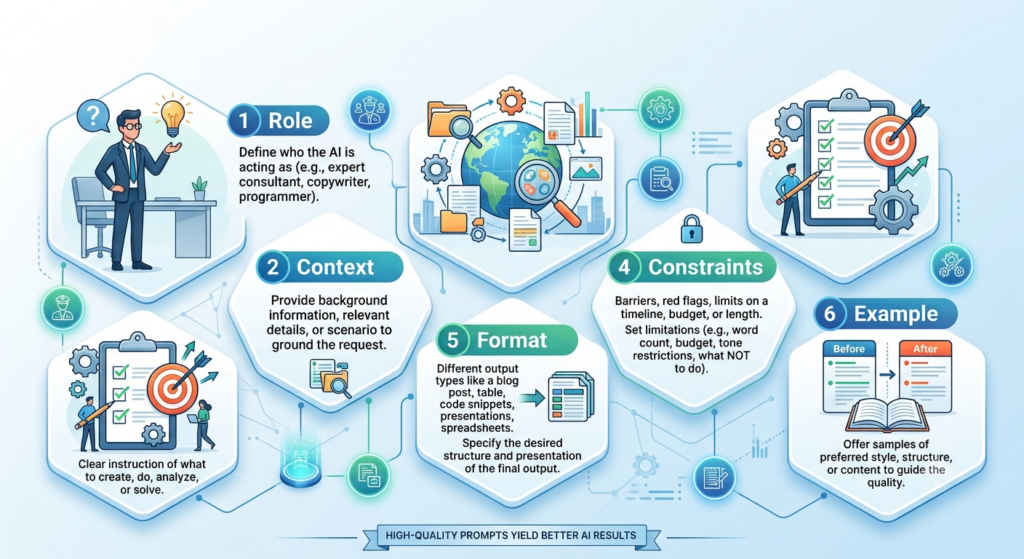
A prompt worth paying for isn’t a clever sentence. It’s a repeatable structure with six parts, and most free or low-quality prompts are missing at least three of them.
Role — tell the AI exactly who it’s pretending to be. “Write a product description” produces something generic. “You are a senior DTC copywriter who has written for skincare brands doing seven figures on Shopify” anchors the tone and judgment behind the output.
Context — the specific situation, not the general topic. “A ₹3,500 vitamin C serum aimed at women aged 28-45 who’ve tried and been disappointed by drugstore skincare” does more work than a paragraph of vague instructions.
Task — one clear instruction. If you catch yourself writing “and also,” that’s a second prompt, not an addition to the first.
Constraints — the part almost every free prompt skips. “No exclamation marks. Must mention the 72-hour hydration claim. Keep the reading level around grade 8.” Constraints are what stop an AI model from producing something technically correct but practically useless.
Format — how the answer should be structured, not just what it should say. “One opening line, three bullet points, one closing line with a soft call to action” hands the buyer a finished shape instead of a wall of text they still have to edit.
Example — one sample of the tone you want matched. Of the six parts, this single addition tends to improve output quality the most, because it gives the model something concrete to imitate instead of an abstract instruction to interpret.
Put together as one prompt: “You are a senior DTC copywriter who has written for skincare brands doing seven figures on Shopify. The product is a ₹3,500 vitamin C serum aimed at women aged 28-45 who’ve tried and been disappointed by drugstore skincare. Write a 150-word product description for the website’s main product page. Don’t use exclamation marks or the word ‘unlock.’ Mention the 72-hour hydration claim, and keep the reading level around grade 8. Structure the output as one short opening line, three bullet points on benefits, and one closing line with a soft call to action. Match this tone: confident, warm, no hard-sell language.”
That gap, between a usable first draft and a generic paragraph, is the entire product you’re selling. And once you’ve written a handful of prompts this way, you need somewhere for them to live that isn’t scattered across old chat threads. That’s what the rest of this guide covers.
What Is an AI Prompt Vault?
An AI prompt vault is a structured, categorized collection of tested prompts, organized so each one can be found, reused, and handed to someone else without extra explanation. That last part is what separates a vault from a personal notes document. A notes doc makes sense to you. A vault makes sense to anyone who opens it.
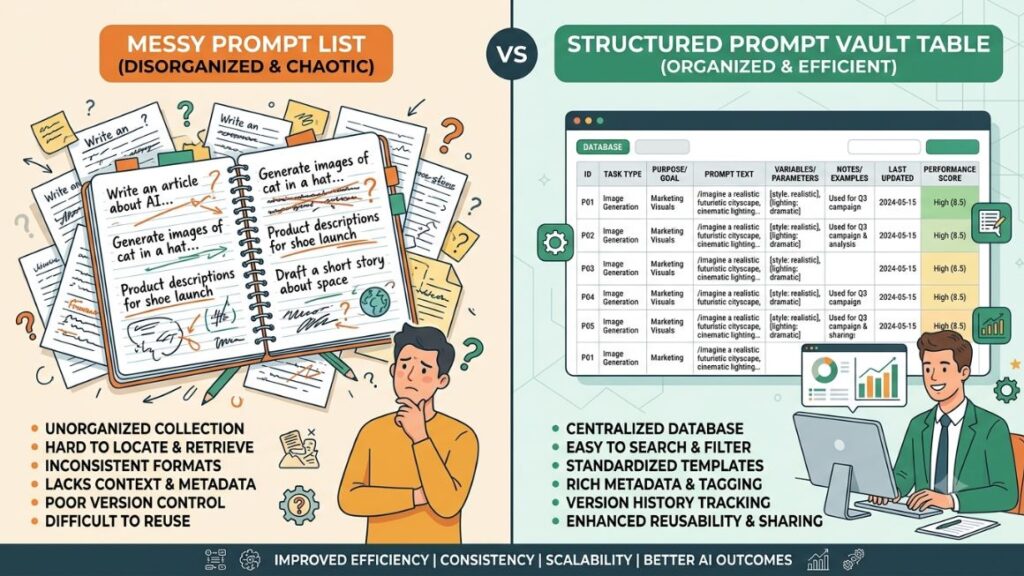
Most people already have something like a vault’s raw material, a messy list of prompts scattered across Notion pages, chat history, and sticky notes. What they don’t have is the structure that turns that raw material into something reusable, and eventually, something sellable. Think of it the way you’d think of a swipe file in copywriting or a component library in design. The individual pieces aren’t new inventions. The value comes from the fact that they’re organized, tested, and ready to use the moment you need them.
What Goes Into a Prompt Vault Template
A prompt vault template is only useful if every row answers the same questions. Skip a field, and you’ll end up with prompts you can’t actually use six months from now because you forgot which tool they were built for or what problem they solved.
Every row in a working template needs six fields:
- Number — a simple index so you can track how large your vault has grown.
- Category — the theme the prompt belongs to (marketing, career, image generation, and so on).
- Prompt title — written the way someone would search for it, not a generic label like “Prompt 3.”
- AI tool — the specific model the prompt is built for, since a prompt tuned for Midjourney rarely performs the same way in ChatGPT.
- Prompt text — the full instruction, built on the six-part framework above, so someone else could paste it in and get a usable result.
- Suggested price — even if you’re not selling yet, pricing each row forces you to think about how valuable it actually is.
A working prompt vault template needs six consistent fields per row: number, category, title, target AI tool, prompt text, and suggested price. Missing any one of these turns a vault into an unusable list within a few months.
Google Docs or Google Sheets both work fine for this. What matters isn’t the software, it’s that every prompt lives in one place with the same structure, instead of split across screenshots, notes apps, and old conversations.
How to Structure Your Vault by Category
Categories are what turn a long list into something a buyer, or even future-you, can actually navigate. Five categories cover most of what people search for when they’re starting out:
- Marketing and social media — captions, ad copy, content calendars. High demand because almost every small business needs this and doesn’t have time to write it.
- Business and productivity — emails, meeting summaries, SOPs. These sell well because they save time on tasks people do every single week.
- Image generation — Midjourney and Leonardo AI style prompts. This category rewards specificity: lighting, lens type, and mood matter more than the subject itself.
- Writing and content — blog outlines, scripts, product descriptions. Useful for solo creators and small teams without a dedicated writer.
- Career — resumes, cover letters, LinkedIn bios. Evergreen demand, since people need these regardless of what’s trending in AI tools that month.
You don’t need all five on day one. Pick the one or two categories closest to what you already know well, and expand once those are solid. A vault with fifteen strong prompts in one category is worth more to a buyer than fifty scattered prompts across five categories nobody fully committed to. That’s also the more specific bet, and specificity is what actually cuts through a marketplace as crowded as the one described earlier: a niche vault built for “product description prompts for Indian D2C skincare brands” competes on value, while a generic “50 marketing prompts” pack competes purely on price.
How to Fill In Your First 10 Rows
This is where most people either build momentum or quietly abandon the whole idea. The fix is treating it as a short, repeatable process instead of an open-ended task, using the six-part framework for every prompt you write.
- Pick one category and write down five real problems people in that category actually have.
- Draft a first version using the role, context, task, constraints, format, and example structure covered earlier.
- Run the prompt against at least two different inputs, not just the one example you had in mind.
- Check the output for consistency — does it hold its format and quality across different inputs, or does it fall apart the second you change something?
- Rewrite anything that fails, and only move a prompt into your vault once it passes step 4 twice in a row.
- Repeat until you have ten rows filled, then take a break before starting the next category.
Ten solid, tested rows in one category beat forty untested ones every time. A buyer, or a future client, can tell the difference between a prompt that was actually built on the full framework and one that was written once as a single line and never touched again.
How to Turn Your Vault Into a Priced Product
Once you’ve got a working vault, pricing turns it from a personal reference into an actual product. Start with ranges rather than guessing from zero:
- Single tested prompt: $2 to $6
- Bundle of 10-15 prompts in one category: $9 to $19
- Full vault spanning multiple categories: $19 to $49
- Ongoing access through a paid community: $9 to $29 a month
These aren’t fixed rules. According to a 2026 breakdown by Dodo Payments, developer-focused and business-use prompts command $20 to $99 per pack because the buyer is applying them to professional work with an immediate return, while generic art prompts top out closer to $5. Bundling matters more than most sellers assume, too: implo.ai’s 2026 research found that sellers who switch from individual prompts to themed bundles consistently report tripling to 10x their monthly income for the same amount of work.
Developer and business-focused prompt packs command $20-99 per pack, according to Dodo Payments’ 2026 guide, compared to roughly $5 for generic art prompts. Sellers who bundle prompts around a specific niche report income gains of 3x to 10x over selling individual prompts, per implo.ai’s 2026 analysis.
If a $15 bundle sells consistently, test $19 before assuming that’s the ceiling. If single prompts aren’t moving, that’s usually a signal to bundle rather than drop the price further. The vault itself becomes the product the moment you export it as a clean PDF or shareable doc, add a simple cover, and put a price on it.
Common Mistakes People Make With Their First Prompt Vault
A few patterns show up again and again in vaults that never turn into anything usable.
Untested prompts. Writing a prompt once, getting a decent result, and moving on without checking it against different inputs. It works for you in that one moment, then breaks the second someone else tries it with slightly different details.
Vague titles. Naming a row “Prompt 1” or “Good one for work” instead of something like “Weekly Status Update Email Generator.” Vague titles make a vault impossible to search once it grows past ten rows.
No categories. One long list with no grouping. This might feel fine at ten prompts. At fifty, it becomes unusable, and most people quietly stop adding to it around that point.
Treating it as a one-time task. Building ten rows in a single sitting and never returning to it. A vault that keeps growing, even by two or three rows a week, compounds into something genuinely valuable within a couple of months. One that’s abandoned after the first session never gets there.
Avoiding these four issues is mostly about discipline, not skill. The framework and the structure handle the hard part, showing up consistently is what’s left.
Where This Actually Works
The framework and the vault structure don’t care which platform you use, but the platforms carry real trade-offs worth knowing before you pick one.
PromptBase gives sellers an 80% revenue share and built-in buyer traffic, which matters if you have no audience yet. Gumroad charges a flatter 10% fee and gives you full control over pricing and bundling, but you’re responsible for bringing your own buyers. Platform risk is real either way: Etsy banned prompt bundles entirely, and PromptBase changed its payout terms in 2025, which is exactly why building a direct customer relationship, even just an email list, matters more than picking the “best” marketplace.
But this holds up beyond marketplaces entirely. If you work in marketing, content, or client services, the same six-part framework is what separates AI output your manager trusts from agentic AI output that gets quietly rewritten before it goes out. You don’t need to sell a single prompt for this to be worth learning. It’s a skill that shows up in your actual job first, and in a side income second, if it shows up there at all.
If you’d rather start from a working structure than build one from scratch, we’ve put together a free AI Prompt Vault starter template with the exact six-field structure covered above, plus a few example rows already filled in across marketing, image generation, and career categories. Comment “PROMPT” on our latest post and we’ll send it over.
Conclusion
The “sell AI prompts for passive income” pitch isn’t entirely wrong, it’s just incomplete. A one-line instruction was never going to be worth much in a market with over 260,000 competing listings. What actually holds value is the six-part structure behind the prompt, and the discipline of organizing tested prompts into a vault instead of leaving them scattered across old chat threads.
Start with one framework-built prompt, ten rows in one category, and a habit of testing before adding. Pricing, bundling, and expanding into new categories all get easier once that foundation is in place.
FAQ
What is a prompt in AI, exactly?
A prompt is the set of instructions you give an AI model, like ChatGPT or Midjourney, to produce a specific output. A well-built prompt includes context, constraints, and format instructions, not just a single-line request.
Is selling AI prompts still worth it in 2026?
It depends on what you’re selling. Generic, single-line prompts in flooded categories rarely make meaningful money. Niche, constraint-heavy prompt packs built around a specific buyer and problem perform noticeably better, though even strong sellers rarely describe it as passive income.
What is an AI prompt vault template?
It’s a structured document, usually a table, that organizes AI prompts by category, target tool, and use case, so each one can be found and reused without extra explanation. It’s different from a personal notes file because it’s built to make sense to anyone who opens it, not just the person who wrote it.
PromptBase vs Gumroad, which is better for selling prompts?
PromptBase gives you built-in buyer traffic and an 80% revenue share, which helps if you’re starting from zero. Gumroad charges a lower flat fee and gives you more pricing control, but you have to drive your own traffic. Many sellers use PromptBase for discovery and Gumroad for their own storefront.
How do I write a prompt that people will actually pay for?
Build it around six parts: role, context, task, constraints, format, and an example of the tone you want. The constraints and format sections are usually what separate a prompt worth paying for from a free one-liner.
Do I need a paid tool to build a prompt vault?
No. Google Docs or Google Sheets handle this fine. What matters is consistent structure across every row, not the specific software you use to build it.
How many prompts do I need before it counts as a real vault?
There’s no fixed number, but ten to fifteen tested prompts in one clear category, built on the six-part framework, is usually enough to feel like a real, usable collection rather than a scattered list.
Is prompt selling actually a scam?
Not inherently, but the category has a real trust problem after widely shared stories of low-quality, overpriced prompt packs. That’s exactly why specificity and proof, showing your prompts producing the exact result you’re promising, matters more here than in most digital product categories.
What’s the most common mistake people make when writing prompts to sell?
Staying generic. A one-line, broadly worded prompt in an already flooded category is competing purely on price against hundreds of thousands of similar listings, and it’s also the prompt most likely to sit untested in a badly organized vault.
Should I organize my vault by AI tool or by category?
Category first, tool second. Buyers and users typically know the problem they’re solving before they know which tool they’ll use to solve it, so category-first organization is easier to navigate.
Can this framework and template be used for client work, not just selling?
Yes. The same six-part framework and six-field vault structure work just as well for organizing client-facing prompt work as they do for a product you plan to sell directly.