

Most marketers who go looking for content ideas from podcasts end up with the same result: a notes app full of screenshots, half-typed quotes, and timestamps that made sense at 11 PM and mean nothing by morning. The insight was real. It just never became a post.
That’s not a discipline problem. It’s a process problem. Spotting something worth writing about and actually shipping content from it are two different skills, and most people only ever practice the first one. According to PwC’s 2024 report, India is now the third-largest podcast market globally, with more than 100 million monthly users, which means there’s more raw material sitting in podcast episodes right now than any single marketer could ever manually sort through.
This piece isn’t about where to find good podcasts or how to listen more efficiently. It’s the five-step system for what happens after you hear something worth using, so an insight has an actual path to becoming content instead of dying in a drafts folder.
Table of Contents
Why Most Podcast-Sourced Content Ideas Never Get Published
The gap isn’t awareness. It’s that most people treat “I heard something interesting” as the finish line instead of the starting point. An insight without a process attached to it is just trivia you’ll forget by Thursday.
Think about how most marketing teams actually consume podcasts. Someone listens to an episode of Lenny’s Podcast or The Ranveer Show on their commute, hears a founder say something sharp, and thinks “I should write about that.” Then the commute ends, Slack opens, and the thought is gone. Nothing was captured, so nothing can be filtered, matched to a format, or tested. The idea simply had nowhere to go.
Most podcast-sourced content ideas fail not because the insight was weak, but because there was no repeatable process to move it from “I heard something interesting” to a published piece of content. Capturing, scoring, and format-matching an insight the moment you hear it is what separates a note that gets used from one that gets forgotten.
Here’s the thing. This isn’t really about podcasts specifically. It’s about what happens to any raw insight that arrives without a system waiting to catch it. Podcasts just happen to be one of the richest, least-mined sources available right now, precisely because so few marketers have a process for what comes next.
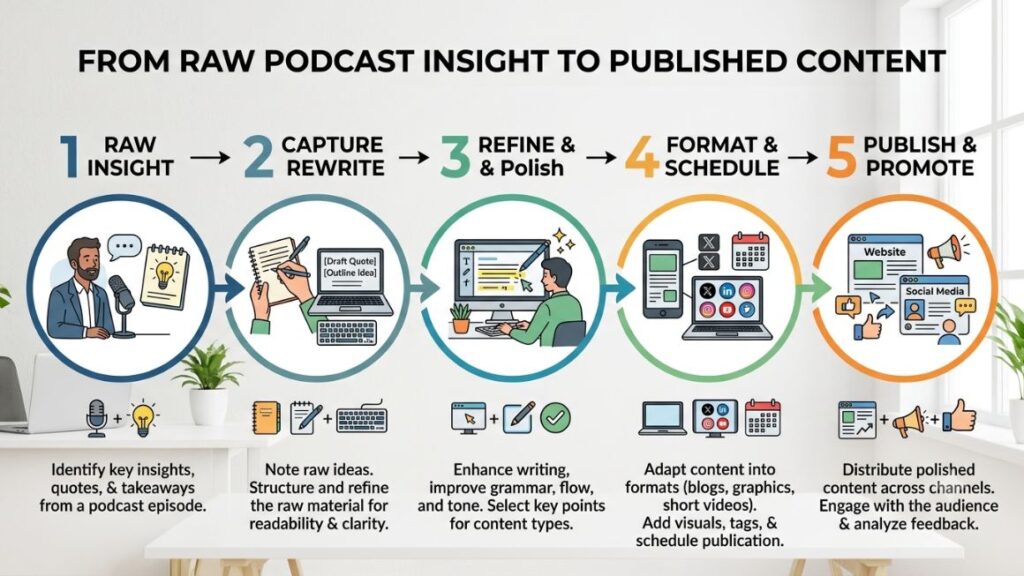
Step 1: Capture the Insight Before It Evaporates
A content capture log is a structured record you fill in the moment you hear an insight worth keeping, so it’s searchable and usable weeks later instead of forgotten by the next episode. Use five fields every single time, no exceptions:
- Insight — the claim, stat, or phrase, written in one sentence in your own words
- Source — podcast name, episode, guest, and rough timestamp
- Type — trend, disagreement, vocabulary shift, guest pattern, or prediction
- Date logged — so you can track how the idea ages
- Gut reaction — one honest line on why it stopped you mid-scroll
That fifth field is the one people skip, and it’s the one that matters most. If you can’t articulate why something grabbed you, it probably wasn’t an insight. It was just information passing through.
This doesn’t need to be complicated. A spreadsheet, a Notion table, or even a dedicated note works fine. What matters is consistency. Log every insight the same way, every time, so six months from now you have an actual searchable archive instead of forty screenshots you’ll never open again.
Brands that do this well tend to run it as a team habit, not an individual one. A content team tracking creator economy trends might log something from Nikhil Kamath’s WTF podcast the same afternoon it airs, rather than waiting for it to surface later on Twitter once three other brands have already written about it.
Step 2: Filter What’s Actually Worth Building Content Around
Not every logged insight deserves content, and that’s fine. The R.A.T.E. score is a four-part filter, scored one to five on each criterion, that tells you whether an insight is worth the time it takes to build content around it.
- Relevance — does your specific audience actually care about this?
- Actionability — can someone do something differently after reading it?
- Timeliness — is this genuinely early, or has it already been said everywhere?
- Emotional charge — will it make someone nod hard, or argue back?
Score honestly. A score of 16 to 20 out of 20 means build content now, it’s a priority. Between 11 and 15 means bank it and revisit once you’ve collected two or three related insights on the same theme. Ten or below means it was interesting to hear, not useful to write about. Archive it and move on.
This step is where most of the wasted content hours get saved. It’s tempting to write about everything that felt smart in the moment. Most of it, honestly, wasn’t as sharp as it felt at 11 PM.
The R.A.T.E. score, scoring an insight on relevance, actionability, timeliness, and emotional charge, gives marketers a fast way to decide whether a podcast-sourced idea deserves content investment. A combined score of 16 or higher across the four criteria signals the insight is worth prioritizing immediately, rather than added to a growing backlog of ideas that never ship.
Step 3: Match the Insight Type to the Right Content Format
Forcing every insight into a carousel or a LinkedIn text post is a big reason so much repurposed content feels flat. Different insight types carry different kinds of proof, and matching the format to the proof is what makes the content convincing instead of generic.
| Insight type | Best-fit format | Why it works |
| Trend velocity | Data-led carousel or chart post | The proof is the acceleration, so show it visually |
| Cross-pollination between shows | “Called it early” post, published now | Timestamps your call before bigger shows catch up |
| Mapped disagreement | Debate-style post or response video | Conflict format matches conflict content |
| Vocabulary drift | Short thought-leadership article | Needs room to explain what the shift signals |
| Guest overlap | “Who’s shaping this conversation” post | Named patterns reward a listicle structure |
| Logged prediction | Revisit series months later | Only works once time has actually passed |
A stat about how fast a term is spreading across podcasts needs a chart, not a paragraph. A disagreement between two founders needs a format built for tension, not a tidy summary. If you’re pulling a vocabulary shift, such as guests moving from calling something “AI tools” to “AI agents” over a few months, that’s a slower-burn insight that suits a proper article far better than a quick post.
This is often where marketing teams at D2C brands lose the thread. A team at a quick-commerce brand like Zepto might spot a genuine trend in three separate founder podcasts and then try to squeeze it into a two-line Instagram caption, when the actual proof, the acceleration over time, needed a chart to land.
Step 4: Multiply One Insight Into Multiple Content Angles
Most people stop after generating one piece of content per insight. That’s leaving output on the table. Run every scored insight through four distinct angles before moving to the next one, and you’ll get up to four genuinely different pieces of content from a single source.
- Build — agree with the insight, then add your own data or example on top of it
- Challenge — take the opposite position, respectfully, and explain your reasoning
- Translate — restate what this specifically means for your niche or audience
- Personalize — tie it to a real moment from your own work and turn it into a story
You won’t use all four every time. That’s not the point. The point of checking each one is that it stops you from defaulting to the laziest angle purely out of habit, which is usually “build,” because it’s the easiest to write and the least interesting to read.
If you genuinely can’t produce a draft you’d be excited to publish from any of the four angles, that’s useful signal too. It probably means the insight scored higher on R.A.T.E. than it deserved, and the honest move is to archive it rather than force a mediocre post out of it.
Step 5: Test Small Before You Scale the Content
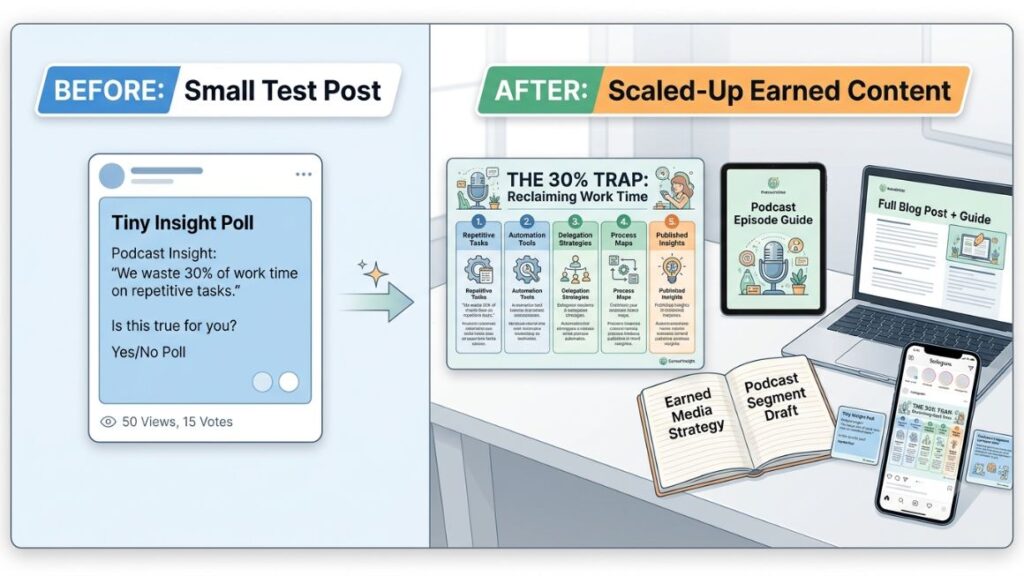
Don’t build your most expensive content format around an insight you haven’t validated yet. Publish the cheapest version first, a single post or a short caption, and read the engagement signal over 48 hours before committing more production time to it.
Watch for three things specifically. Saves and shares outperforming likes signal the idea has enough depth that people want to come back to it. Detailed disagreement in the comments signals the insight touched a real nerve, which is usually worth a follow-up piece. Questions in the comments signal there’s a bigger piece hiding inside the smaller one you already published.
From there, the decision is straightforward. A strong signal earns the bigger format, whether that’s a full carousel, a video, or a newsletter deep-dive. A flat signal means archive it and move on without further investment. A mixed signal is worth one more attempt through a different angle from Step 4 before you give up on it entirely.
How to Know an Insight Is Ready to Publish
Before anything goes live, run it through this quickly:
- It’s logged with source, type, date, and an honest gut reaction
- It scored 16 or higher on R.A.T.E., or it’s grouped with related insights building toward that score
- It’s matched to the format its type actually suits, not the format that’s easiest to produce
- It’s been run through at least two of the four angles, not just the obvious one
- It’s going out as a small test first, not the full production version
- There’s a date on the calendar to check the 48-hour engagement signal before scaling it
Skip any of these and you’re back to guessing, which is exactly the habit this whole process exists to break.
Conclusion
Finding content ideas from podcasts was never really the hard part. The hard part is building a process that turns a fleeting insight into something you actually publish, and then knowing which of those published pieces deserve a bigger push.
Capture consistently, filter honestly with R.A.T.E., match the format to the type of proof the insight carries, multiply it across angles before moving on, and let real engagement decide what earns the scaled-up version. Do this for a month and you’ll notice something simple: good ideas stop disappearing.
If content strategy and repurposing frameworks like this one are something you want to get systematic about, YUP’s Content Marketing course walks through exactly this kind of process, from sourcing raw material to building a content calendar that doesn’t run dry.
FAQ
What are the best podcasts to find content ideas from?
It depends more on your audience’s actual world than on subscriber counts. Lenny’s Podcast works well for product and growth marketers, The Ranveer Show and WTF with Nikhil Kamath cover Indian business and creator-economy conversations, and My First Million is strong for consumer trend spotting. Smaller, emerging shows in your specific niche are often more valuable than the biggest names, since ideas surface there weeks before they hit mainstream shows.
How often should I mine podcasts for content ideas?
Weekly is realistic for most teams without turning it into a full-time job. Log insights as you listen throughout the week, then run the R.A.T.E. filter and format-matching steps in one focused session, rather than trying to do the whole process in real time while you’re still listening.
Do I need special tools to track podcast insights?
No. A spreadsheet or a Notion table with the five capture fields covers it completely. The tool matters far less than the consistency of using the same five fields every single time you log something.
Is repurposing podcast content the same as content curation?
Not quite. Curation usually means sharing or summarizing what someone else said. This framework goes further: it filters insights for relevance, matches them to a format suited to the proof they carry, and pushes you to generate your own angle rather than simply restating the source.
What if an insight scores low on R.A.T.E. but I still like it?
Archive it rather than force content around it. A low score usually means the idea won’t land the way it felt like it should when you first heard it, and publishing weak content to prove a point rarely pays off in engagement or in the time it costs you.
How long does it take to see results from this framework?
Most teams notice within two to three weeks that fewer good ideas are slipping through the cracks. The compounding benefit, a searchable archive of pre-scored insights sorted by format, tends to show up closer to the two-month mark, once you’ve logged enough volume for patterns to emerge.
Can this framework work for B2B marketing, not just consumer brands?
Yes, though the podcast sources will differ. B2B teams get more value from founder interviews, operator podcasts, and niche industry shows than from consumer trend content. Signal Hill’s research found that 83% of senior executives had listened to a podcast in the past week, which makes B2B podcast content a genuinely underused source for account-based marketing ideas.
What’s the biggest mistake marketers make with podcast-sourced content?
Skipping the capture step entirely and trying to remember insights later. By the time someone sits down to write, the specific phrasing, the source, and the reason it felt sharp in the first place have usually faded, leaving behind a generic idea that could have come from anywhere.