

Five years ago, running a marketing agency of one meant turning down clients the moment your calendar filled up. You could sell your time, and only your time. That ceiling is gone. A solo operator with the right AI stack can now research, write, design, schedule and report on a scale that used to need four or five hires.
This isn’t a story about replacing people with bots. It’s about what really happens when a single person stops doing all the mechanical parts of marketing by hand. According to the Economic Survey 2025-26, which was tabled in India’s Parliament on January 29, 2026, the gig workforce of the country grew 55%, from 7.7 million workers in FY21 to 12 million in FY25. The survey attributes this shift partly to smartphone penetration crossing 800 million users and UPI processing over 15 billion transactions a month. That’s the infrastructure. AI is what turned it into a viable business model for a one-person marketing agency.
Here’s what breaks when solo operators try to scale this manually: they hit a ceiling around 3-4 clients. They burn out on execution. They stop doing the strategic work that actually justifies premium pricing. This guide covers the tool stack, the workflow, what to charge and what AI genuinely cannot do for you yet.
Table of Contents
What Is a One-Person Marketing Agency, and Why Is It Working Now?
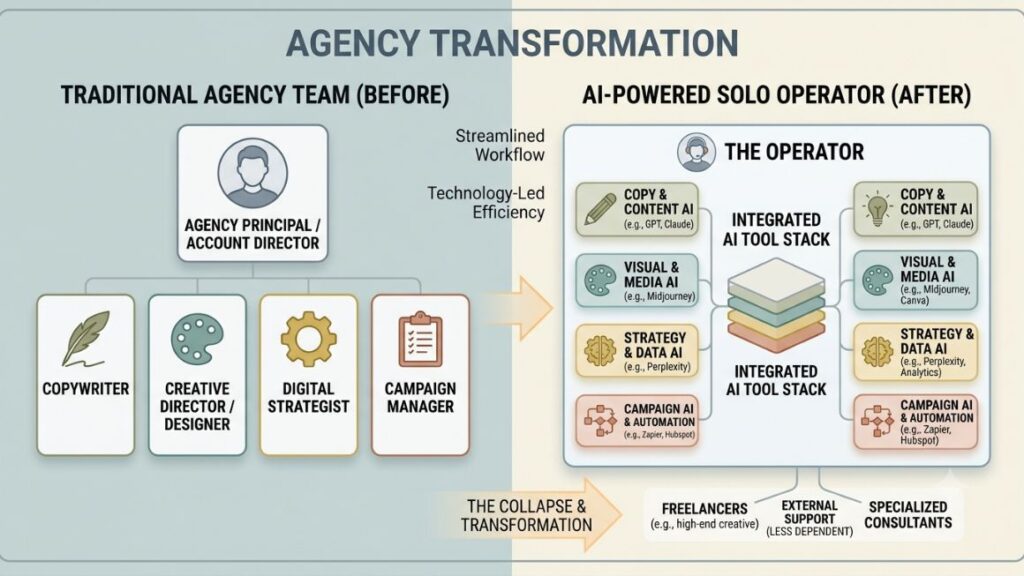
A one-person marketing agency is a single operator who plans, produces, and manages marketing campaigns for multiple paying clients at once. This involves the use of software and AI tools to cover the roles a traditional agency would split across strategists, copywriters, designers and account managers.
That definition hasn’t changed much since freelancing became common. What changed is the ratio of what one person can output. In 2023, a solo marketer running three retainers was already stretched thin. That same person can run six or seven in 2026, provided they’ve rebuilt their workflow around AI rather than bolted a chatbot onto their old process.
The adoption data backs this up. McKinsey’s 2025 State of AI survey found that 88% of respondents said their organizations use AI in at least one business function, compared with 20% in 2017. However, McKinsey notes that its definition of AI use has evolved over time. On the marketing side specifically, generative AI deployment across marketing activities jumped 116% year over year. It is now touching 15.1% of all marketing work, according to CMO Survey. That’s not a pilot program anymore. That’s infrastructure.
The honest part of this story is what it’s doing to junior roles. Gartner’s CMO research shows that AI is changing how marketing leaders think about agency spending and external creative work. In its 2025 survey, 39% of CMOs said they planned to cut agency budgets. 22% said GenAI had reduced their reliance on external agencies for creativity and strategy. The work that used to justify a junior hire, drafting first passes, formatting reports, building basic creative, is exactly the work AI handles now. That’s uncomfortable if you’re the junior hire. It’s an opening if you’re the strategist who knows how to direct the tools.
The Core AI Stack Every Solo Agency Owner Needs
A one-person marketing agency needs five categories of tools working together: a strategy and copy engine, a client management system, an SEO and content optimization layer, design and video production, and a research assistant. Miss one category and you end up doing that piece manually, which is usually where the time actually goes.
Strategy and Copy – Claude / ChatGPT
This is the layer that thinks. A large language model like Claude or ChatGPT drafts campaign briefs, writes ad copy, builds content calendars and rewrites client emails. But everything falls on the real context you feed it: brand voice guides, past-performing content and specifics about the client’s audience.
The tool isn’t the gap between marketers who get real value here and those who don’t. It’s the brief. Jasper’s 2026 survey of 1,400 marketers found that 91% now actively use AI. But fewer than a third use it for the high-value work, brand governance, hyper-personalization, full workflow automation, that actually moves the needle. Most people are still using a frontier model to write generic first drafts and calling it a day.
Client Management and Automation – CRM/Agent Platforms
Somewhere around your third client, spreadsheets and sticky notes stop working. This is where a CRM and automation platform like HighLevel, or a connector tool like Zapier or Make, takes over: tracking leads, triggering follow-ups, and moving approved content into scheduling without you touching it by hand.
HighLevel’s Starter plan, priced at $97 a month, now ships with three sub-accounts instead of one, which its 2026 product update specifically frames as a change for solo operators running a couple of client accounts. Bundled AI Employee tools handle voice, conversation, reviews, content, and funnel tasks out of the box, without custom setup.
SEO and Content Optimization – Surfer SEO, GEO/AEO Tools
Ranking on Google used to be the whole game. It isn’t anymore. GEO and AEO are emerging approaches that focus on making content easier for search engines and AI answer systems to understand, retrieve and potentially cite, not just so it ranks in a traditional search results page.
The stakes here are bigger than what most solo marketers realize. SparkToro’s 2026 research, which is built on Similarweb clickstream data, found that 68% of US Google searches in the first four months of the year ended without a single click, up from 60.45% in 2024. When Google answers the question on the results page, the win shifts from earning a click to being the source the AI names. Tools like Surfer SEO have adapted accordingly. Its 2026 AI Visibility Tracker monitors brand mentions across ChatGPT, Perplexity, Gemini, and Google’s AI Overviews, splitting its Content Score into a traditional SEO score and a separate AI Search Score.
Design and Video – Canva Pro, Veed
Visual production is the category solo marketers most often outsource, and the category AI has most completely absorbed. Canva Pro now handles branded social creative, presentation decks and basic video with AI-generated layouts baked in, at roughly $120 a year. Veed fills the gap for anything more video-heavy. Auto-subtitles. Translation. Short-form editing. All start around $12 a month on its Creator tier.
Neither tool replaces a dedicated designer for a brand’s flagship campaign. Both are more than enough for the weekly content volume a retainer client actually needs.
Research – Perplexity and Real-Time Data Tools
Strategy is only as good as the research underneath it, and this is where a lot of solo output quietly falls apart, stale stats, outdated competitor positioning, campaign ideas built on last year’s platform behavior. Perplexity Pro, at $20 a month, pairs unlimited search with a model picker across GPT, Claude, and Gemini, and returns cited sources rather than a single unverifiable answer.
A solo marketing agency’s AI stack typically spans five categories: a language model for strategy and copy, a CRM or automation platform for client management, an SEO/GEO tool for content optimization, a design tool for visual production, and a research assistant for real-time data. Most solo operators overinvest in the copy layer and underinvest in research and GEO, which is exactly where AI Overviews are reshaping visibility in 2026.
Read More: Agentic Marketing Platforms: The Complete Guide to AI Agents That Plan, Execute & Optimize Marketing
AI Tools vs AI Agents – Why the Difference Changes Your Workload
An AI tool responds when you prompt it. An AI marketing agent completes a multi-step task on its own. That said, it checks a calendar, qualifies a lead, updates a CRM record and reports back only when it’s done or stuck.
That difference matters more than it sounds. A tool still needs you in the loop for every step. An agent needs you to set it up once and review exceptions. HighLevel’s Agent Studio lets solo operators build custom voice and chat agents from a visual, no-code interface rather than writing logic by hand.
The adoption numbers show a real split forming. McKinsey found that 62% of organizations are at least experimenting with agents. But only 23% are actually scaling one anywhere in the enterprise. No more than 10% are scaling agents within any single business function as of late 2025.
For a one-person agency, the practical takeaway is this: agents earn their keep on repetitive, well-defined tasks (lead qualification, appointment booking, first-draft social replies) and lose money fast on ambiguous and judgment-heavy work. Start narrow.
Read More: Agentic AI vs AI Agents: Key Differences
How to Build Your One-Person Agency Workflow, Step by Step
A working one-person agency runs on a five-stage loop: onboarding, strategy, content production, approval and reporting. Skip a stage or try to do it all manually and the cracks show up fast. They come out as missed deadlines or content that doesn’t sound like the client’s brand.
- Onboard with a structured intake, not a conversation. Build a standard questionnaire covering brand voice, past-performing content, competitors and non-negotiables. Feed this directly into your AI tools as a standing reference document. Skipping this step is the single biggest reason AI output feels generic.
- Build the strategy layer before any content gets made. Use your research tool to pull current category data and competitor positioning. Use your language model to turn that research into a content calendar and campaign angles. But review every recommendation against the client’s actual goals before it moves forward.
- Produce content in batches, not one-offs. Draft a full week or month of copy, creative briefs, and design assets in one sitting. Batching lets you catch tone drift across a whole set of content, something you’d miss producing piece by piece.
- Run a single approval loop per client, on a fixed schedule. Send a consolidated batch for review rather than trickling pieces out as they’re finished. This is where CRM automation earns its cost, auto-routing approved content to scheduling and flagging anything overdue for review.
- Report with real numbers, not a narrative. Pull performance data automatically where your tools allow it, then add the interpretation yourself. Clients pay for the judgment on what the numbers mean, not the numbers themselves.
Read More: How to Create an AI Marketing Strategy: A Step-by-Step Guide
Pricing and Positioning When You’re a Team of One
Client retainer pricing for a solo operator sits in an odd spot. Charge like a freelancer and you’ll undercut the value AI now lets you deliver. Charge like a full agency and you’ll lose the deal to someone with a lower overhead pitch.
Indian freelance digital marketing retainers generally range from ₹25,000 to ₹3,00,000 or more a month, depending on experience and scope, according to 2026 market data compiled from Indian freelance rate guides. Freelance SEO consultants specifically average around ₹1,941 an hour in the domestic market. On the higher end, boutique full-service retainers in India start around ₹1.5 lakh and climb well past ₹6 lakh a month once media spend management is folded in, positioning that’s harder for a solo operator to hit without an agentic stack behind it.
The honest pricing conversation with a solo operator isn’t “AI makes you cheaper.” It’s the opposite. AI compresses your delivery time, which means you should be charging closer to what a small team would charge, not less. A retainer that used to require 40 hours of manual work might now take 15 with the right stack. The client isn’t paying for your hours anymore. They’re paying for the outcome and the judgment behind it.
Sceptic’s answer, upfront: is this actually profitable? For most solo operators, yes, once retainers cross 4-5 clients on a lean tool stack. The economics tighten below that, where AI subscription costs (often $150-$300 a month across a full stack) eat into thin early margins before volume kicks in.
Position against a traditional agency on speed and direct access to the person doing the work, not on being the cheaper option. Undercutting on price signals junior work, which is precisely the perception a solo operator needs to avoid.
Read More: How to Land Your First Freelance Client as a Marketer (Step-by-Step Guide)
What AI Still Can’t Do for a Solo Marketing Agency
AI cannot sit in a client’s boardroom and read the political tension between the CMO and the CFO over budget. It cannot build the trust that keeps a client renewing a retainer through a bad quarter. And it cannot originate a genuinely new strategic angle, it recombines patterns from what it’s seen, which is different from judgment built on watching a specific market move.
This isn’t a hedge to soften the pitch of this article. It’s the acknowledged limitation that makes the rest of the stack credible. AI-generated creative isn’t automatically disadvantaged just because AI is used. Platforms care more about relevance, originality, user experience, policy compliance and, in some cases, low-quality or repetitive AI-generated content. The practical risk for marketers is producing generic creative that performs poorly, not merely using AI to produce it. The tools that write and design fastest aren’t always the ones that convert best, and knowing where that line sits is a judgment call, not a prompt.
The honest limitation extends to relationships specifically. A retainer client renews because a person understood their business, not because a workflow ran smoothly in the background. From what we’ve seen among YUP’s own learners running solo operations, the ones who retain clients longest are the ones who show up for the strategy conversation personally, and let AI carry everything downstream of that conversation.
AI can compress the execution time of a marketing retainer from roughly 40 hours a month to 15. But it cannot replace the client relationship, boardroom judgment or genuinely original strategic thinking that justifies a solo operator’s premium pricing. The tools handle output. The operator still owns outcomes
Common Mistakes Solo Marketers Make When Automating Too Fast
The most common failure isn’t under-adopting AI. It’s over-adopting it without a system underneath.
Automating a broken process just makes the broken process faster. If your content approval workflow was chaotic on spreadsheets, wiring it into Zapier doesn’t fix the chaos. It just moves it somewhere you can’t see it as easily. Fix the workflow logic first and then automate it.
A second mistake is skipping the brand voice input entirely and expecting generic AI output to pass as client-specific work. This is precisely why content ends up sounding produced rather than written by someone who knows the account. Every AI tool in this stack needs a standing reference document, not a fresh prompt every time.
Third, and this one’s specific to agents: deploying an autonomous workflow before you’ve manually done the task enough times to know what “good” looks like. Agentic AI projects fail for a reason. Unclear ROI and escalating token costs are the two most cited drivers behind the roughly 40% of agentic AI projects industry analysts expect will be canceled by the end of 2027. Don’t hand an agent a task you haven’t mastered yourself.
Finally, solo operators chronically underprice the research and strategy layer relative to the production layer. Content is visible, so it gets valued. Strategy is invisible until it’s missing, and that’s exactly when a client notices.
Read More: The Marketing Skills That Actually Matter in 2026
How This Looks in the Indian Market
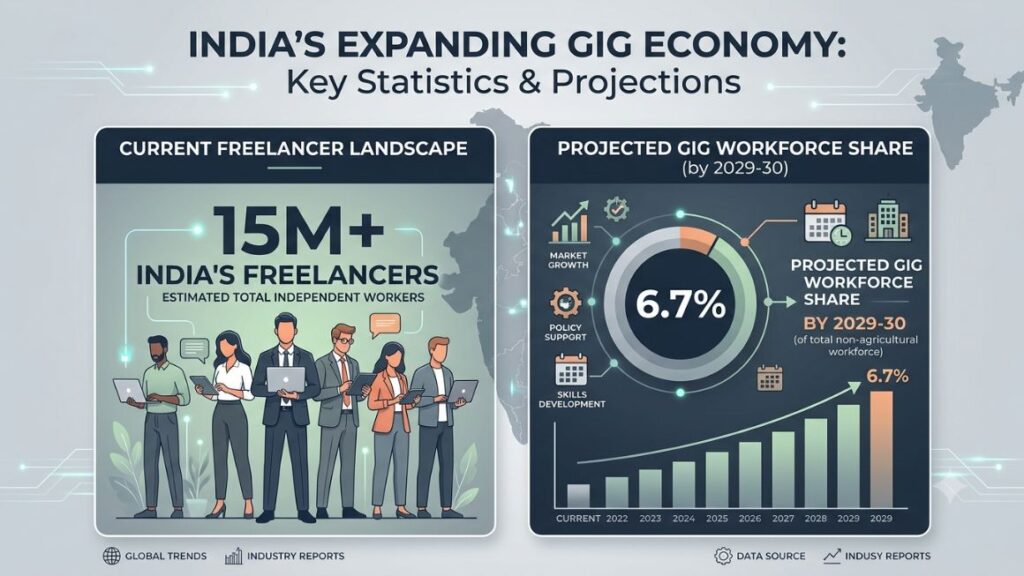
India’s independent and gig economy is expanding rapidly. The Economic Survey 2025 – 26 estimates that India’s gig workforce grew from 7.7 million in FY21 to 12 million in FY25. That is a scale combined with rock-bottom AI tool costs relative to Western markets. So, India is seen as one of the most favorable environments globally for a freelance marketing consultant to go solo.
The Economic Survey 2025-26’s broader gig data points in the same direction. Non-agricultural gig work is projected to reach 6.7% of India’s total workforce by 2029-30. All while it contributes ₹2.35 lakh crore to GDP. That’s structural growth, not a temporary trend tied to one hiring cycle.
Indian marketers are also shifting their AI use in a specific direction this year, according to industry coverage from Social Samosa: away from experimentation and toward solving concrete business problems, with growing attention to how AI adapts to India’s linguistic and cultural diversity. A solo operator serving Indian D2C brands, think the content demands of a boAt or a Mamaearth, benefits directly from this shift, since generic English-language AI output tends to miss the tone Indian audiences respond to. The operators winning here are pairing AI drafting with real fluency in regional context, not skipping that step.
The cost side favors solo operators too. A freelance SEO consultant in India, for instance, can run a full AI stack, a language model, HighLevel, Surfer SEO, and Perplexity Pro, for roughly ₹12,000 to ₹20,000 a month, a fraction of what the same stack costs a US-based operator relative to typical Indian retainer pricing.
Conclusion
Running a marketing agency alone used to mean picking between growth and burnout. That trade-off is looser now, not gone. The operators actually pulling this off aren’t the ones with the flashiest tool stack. They’re the ones who rebuilt their workflow around AI from the ground up, batched their production, and kept the judgment calls, the strategy, the client relationship, the honest read on what’s working, firmly in their own hands.
Start with one category of your stack this month. Fix the workflow underneath it before you automate the next one.
If you’re serious about building this out properly, YUP’s AI Marketing course walks through the exact stack and workflow covered here, tool by tool, with templates you can plug straight into your own client work. It’s built for marketers doing this for real, not for people collecting tool subscriptions.
FAQ
What is a one-person marketing agency?
A one-person marketing agency is a solo operator who handles strategy, content, design, and client management for multiple paying clients at once. That involves the use of AI tools and automation to cover work that traditionally needed a full team.
Is a one-person agency the same as freelancing?
Not quite. A freelancer typically sells hours or single deliverables to one client at a time. A one-person agency runs multiple retainer clients simultaneously, with a repeatable system and pricing that reflects ongoing account management, not just task completion.
How do I get my first client as a solo AI-powered agency?
Start with your existing network rather than cold outreach. Offer a scoped 90-day pilot instead of a long-term retainer. That lowers the client’s risk and gives you a fast case study to pitch the next client with.
Who should actually try building a one-person marketing agency?
This model fits marketers with 3+ years of hands-on experience who already know what good strategy and copy look like without AI. You need that judgment to direct the tools well. It’s a poor fit for someone brand new to marketing. You won’t recognize bad AI output when you see it.
Is running a one-person agency with AI actually profitable, or is this overhyped?
It’s profitable past a certain client threshold, generally 4-5 retainers, once your tool stack cost gets absorbed by volume. Below that, subscription costs across a full stack (often $150-$300 a month) can eat meaningfully into thin early margins.
Why does my AI-generated content still feel generic even with a good tool stack?
The tool isn’t the problem in most cases. Missing brand-voice context is. Feed your AI tools a standing reference document, past-performing content, tone guidelines, specific client language, rather than a fresh prompt for every piece. Review output against that document before it ships.
What’s the difference between an AI tool and an AI agent for marketing?
An AI tool responds to a prompt you give it each time. An AI agent completes a multi-step task on its own. It qualifies a lead or books a call and only reports back when it’s finished or stuck. Agents need more upfront setup but less ongoing hand-holding.
How much should I charge for AI-assisted marketing retainers in India?
Indian freelance digital marketing retainers generally run ₹25,000 to ₹3,00,000+ a month depending on scope and experience. Boutique full-service work starts around ₹1.5 lakh. Price closer to what a small team would charge, since AI compresses your delivery time, not your value.
Will AI eventually replace one-person marketing agencies entirely?
Unlikely in the near term. AI is displacing junior execution work, not the client relationships, boardroom judgment, and original strategic thinking that justify why a client hires a person rather than a tool subscription in the first place.