

Your reps are still spending four hours a day on data entry, list building, and follow-up emails that a script could write. That’s the gap AI sales automation tools exist to close, and in 2026 the gap has gotten expensive to ignore. According to a Gartner survey of 227 chief sales officers, organizations that give sellers AI-enabled next-best-action guidance are 2.6 times more likely to hit their commercial growth targets, and the same research found AI tools are already saving sellers close to five hours a week.
That’s not a small win. It’s the difference between a rep who prospects for twenty minutes and one who prospects for two hours, using the time AI freed up. This guide breaks down 20 tools that cover the full motion, from finding the right contact to booking the meeting to forecasting whether the deal actually closes. For each one, you’ll get what it does well, who it’s built for, and where it falls short, so you’re not stuck reading a vendor’s own comparison page.
Table of Contents
Why Sales Teams Are Turning to AI-Driven Automation in 2026
AI sales automation tools are software platforms that use machine learning and generative AI to handle prospecting, outreach, data entry, and deal analysis so reps spend more time actually selling. That’s the one-line version. The longer version is that sales has quietly turned into a data problem, and reps were never trained to be data analysts.
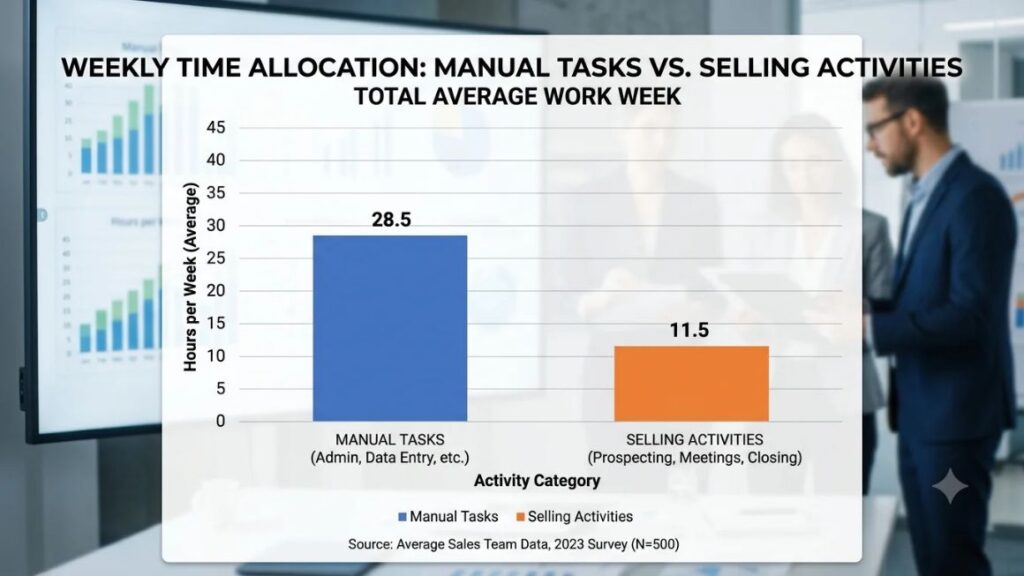
Buyers have changed too. A Gartner survey conducted between August and September 2025 found that 69% of B2B buyers now prefer to validate AI-generated insights with a human sales rep rather than trust the AI output alone. That’s an important nuance. Buyers aren’t rejecting AI, they’re using it themselves, then wanting a person to confirm it’s not nonsense.
Sellers who show up with sharper, AI-informed context win that conversation. Sellers who show up cold don’t.
This is where sales automation tools earn their budget. Not by replacing the rep, but by removing the thirty tabs a rep used to juggle before making one good call. Freshworks, the Chennai-headquartered SaaS company, built its own AI layer called Freddy directly into its CRM for exactly this reason: reps don’t read a wall of contact history before a call, so the software has to surface the two things that matter and skip the rest.
A Gartner survey of 227 chief sales officers found organizations giving reps AI-enabled next-best-action guidance are 2.6 times more likely to hit commercial growth targets. The same research found AI tools save sellers close to five hours a week on manual tasks. Buyers, meanwhile, still want a human to validate AI-generated insights before trusting them, according to a separate Gartner buyer survey.
What to Look for Before You Buy
Shopping for sales AI tools usually starts with the vendor everyone has heard of, not the one that actually fits your funnel. Not every sales automation platform solves the same problem, and buying the wrong one is worse than buying nothing. Before you sign a contract, check these five things.
- Where it fits your funnel. Some tools handle top-of-funnel prospecting, some handle mid-funnel outreach sequencing, and some handle late-stage forecasting. Buying a forecasting tool when your problem is empty pipeline won’t fix anything.
- Data quality behind the AI. Any AI-driven assistant is only as good as the contact data feeding it. Ask vendors directly about email verification rates and refresh frequency.
- Integration depth with your CRM. A tool that syncs one-way into Salesforce or HubSpot creates duplicate work. Look for two-way sync and field-level mapping.
- Time to first value. Some platforms take a quarter to configure. If your team needs results this month, that timeline matters more than a longer feature list.
- Actual seat-based pricing, not the “contact us” number. Vendors that hide pricing usually have per-seat costs that scale badly past 15 users. Push for a real number before the demo ends.
Honestly, most teams skip that last step. It shows up three months later as a renewal conversation nobody wants to have.
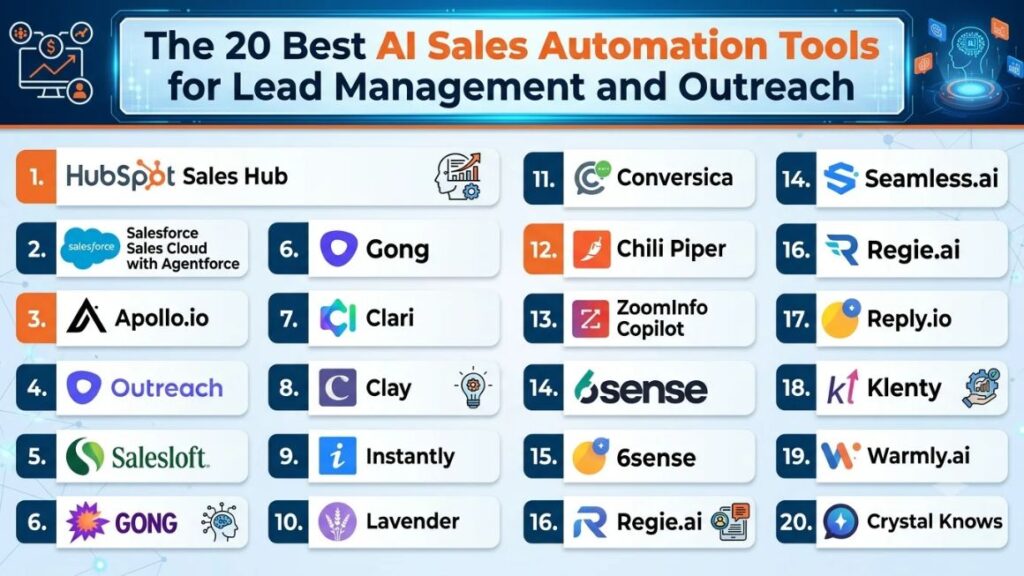
The 20 Best AI Sales Automation Tools for Lead Management and Outreach
Here’s the full list of AI sales software, grouped roughly by where each tool sits in the funnel. Prospecting and lead generation tools come first, followed by outreach and engagement platforms, then conversation intelligence and forecasting.
1. HubSpot Sales Hub
HubSpot Sales Hub pairs a free-to-start CRM with Breeze, HubSpot’s AI layer, which drafts emails, scores leads, and summarizes deal activity automatically. It’s the most common starting point for small and mid-sized teams because the CRM, marketing, and service tools already live under one roof.
The catch is that Breeze’s more advanced predictive features sit behind the higher-tier Sales Hub plans, so the free version won’t show you the full picture. Teams already running HubSpot for marketing get the most value here, since the AI draws on unified contact data instead of a separate database.
2. Salesforce Sales Cloud with Agentforce
Salesforce built Agentforce as an autonomous AI layer on top of Sales Cloud, capable of qualifying leads, updating records, and even running full outbound sequences with limited human review. For enterprise teams already on Salesforce, this is the deepest AI integration available because it reads the entire object model, not just a synced subset.
Implementation is not quick. Agentforce needs clean data architecture and admin resources most 20-person sales teams don’t have on staff, so this fits organizations with a dedicated RevOps function more than early-stage startups.
3. Apollo.io
Apollo combines a database of over 270 million contacts with built-in sequencing, so you can find a prospect’s verified email and start an outreach cadence without leaving the platform. It’s one of the more affordable AI lead generation tools on this list, which is why it’s become the default choice for bootstrapped SDR teams.
Data accuracy dips outside North America and Western Europe, so teams selling heavily into APAC or LATAM markets should verify a sample list before committing to a large seat count.
4. Outreach
Outreach is a sequencing and engagement platform built for larger SDR and AE teams running structured, multi-touch cadences across email, calls, and LinkedIn. Its AI features flag which prospects are showing buying signals and suggest the next best step in a sequence rather than leaving reps to guess.
The platform’s strength is workflow discipline. The tradeoff is a learning curve steep enough that most teams need a dedicated sales operations person just to keep sequences organized as the team scales past 30 reps.
5. Salesloft
Salesloft, which acquired conversational AI company Drift in February 2024, now runs what it calls a Revenue Orchestration Platform. It combines cadence-based outreach with Drift’s website chatbot and buyer-intent signals, so a prospect who visits your pricing page can trigger an outbound sequence automatically. This makes it one of the more complete revenue engagement options for teams that want marketing and sales signals in one place.
Because it absorbed Drift’s product line, some features feel bolted on rather than native. Expect a few workflow inconsistencies until the two platforms finish merging fully.
6. Gong
Gong records, transcribes, and analyzes sales calls, then surfaces patterns across your entire pipeline, like which competitor gets mentioned most in lost deals or which reps talk too much on discovery calls. Revenue teams at companies including LinkedIn and Shopify have used it to standardize what a good call actually sounds like.
Gong is a conversation intelligence tool first, not a full outreach platform, so most teams pair it with a sequencing tool like Outreach or Salesloft rather than replacing one with the other.
7. Clari
Clari pulls activity data from your CRM, email, and calendar to build AI-driven forecasts that flag deals at risk of slipping before a manager has to ask about them in a pipeline review. It’s built for revenue leaders who are tired of forecasts based on rep optimism.
The tool is less useful for individual reps day-to-day. It’s a management and forecasting layer, so smaller teams without a dedicated RevOps function often find the price hard to justify.
8. Clay
Clay lets you build custom outbound workflows by pulling data from dozens of sources, enriching it with AI, and writing hyper-personalized outreach at scale, all inside a spreadsheet-like interface. Growth and RevOps teams use it to build lead lists that would take a human researcher days to compile manually.
It has real setup complexity. Clay rewards teams that already understand data enrichment logic, and it can feel overwhelming to a rep who just wants a list of ready-to-call leads.
9. Instantly
Instantly is built specifically for cold email at volume, with automatic inbox rotation, warmup, and AI-written variations that avoid spam filters. Agencies and lean outbound teams like it because it’s priced for volume rather than per-seat like most sales automation software.
The tradeoff is depth. It doesn’t do call tracking, forecasting, or deal management, so it works best as one piece of a larger stack rather than a standalone system.
10. Lavender
Lavender is an AI writing coach that lives inside your inbox and scores every outbound email in real time, flagging weak subject lines, low readability, or a pitch that’s too long before you hit send. It’s less about automation and more about making the emails a human writes actually get opened.
Teams that already write decent emails see a smaller lift than teams whose outreach reads like a template. It’s a sharpening tool, not a replacement for strategy.
11. Conversica
Conversica is an AI sales assistant that runs two-way email and SMS conversations with leads, qualifying them and booking meetings without a human touching the thread until the lead is ready to talk. Marketing teams handing off a large volume of inbound leads use it to make sure nothing goes cold in a queue.
Because the conversations are automated, tone matters enormously. A poorly configured Conversica bot can feel robotic fast, so budget real time for message tuning before launch, not just setup.
12. Chili Piper
Chili Piper automates meeting scheduling and lead routing, instantly connecting an inbound lead to the right rep’s calendar the moment they fill out a form, instead of waiting for a manual round-robin assignment. Companies like Intercom and Spotify have used it to cut the time between form-fill and first meeting from days to minutes.
It solves one specific bottleneck extremely well. Don’t expect it to handle outreach or forecasting since scheduling and routing are the entire focus.
13. ZoomInfo Copilot
ZoomInfo’s Copilot layer sits on top of its contact and intent database, surfacing which accounts are actively researching your category right now and drafting outreach based on that signal. For teams already paying for ZoomInfo’s data, Copilot turns a static database into an active prioritization engine.
Pricing sits at the higher end of this list, and the AI features add meaningfully to the base contract cost, so smaller teams often find Apollo or Seamless a more affordable entry point into the same category.
14. Seamless.ai
Seamless.ai focuses on real-time contact discovery, verifying phone numbers and emails as you search rather than relying on a static database that goes stale. It’s a straightforward pick for teams whose main problem is simply not having enough verified leads to call.
Some users report inconsistent match accuracy on smaller or less digitally visible companies, so it’s worth testing against your actual target account list before buying a large seat block.
15. 6sense
6sense is an account-based, AI-powered sales tool that tracks anonymous buyer research activity across the web and tells you which accounts are in-market before they ever fill out a form. Sendoso and Yamaha are among the companies that have used it to prioritize outbound toward accounts already showing intent.
It’s built for B2B teams selling into defined account lists with longer sales cycles. Transactional, high-volume SMB sales motions won’t get the same return on the investment.
16. Regie.ai
Regie.ai generates outbound sequences and email copy using AI trained on what’s actually converting for your team, then keeps refining the copy based on reply rates. It sits closer to a copywriting engine than a full CRM replacement.
Regie works best layered on top of an existing sequencing tool like Outreach or Salesloft rather than as your only outreach system.
17. Reply.io
Reply.io runs multichannel sequences across email, LinkedIn, and calls, with an AI feature that handles simple replies automatically and only escalates a thread to a human when a prospect asks something the bot can’t answer. It’s a solid mid-market pick between Instantly’s simplicity and Outreach’s complexity.
Smaller teams like the price point. Enterprise buyers usually outgrow its reporting depth once they need forecasting alongside outreach.
18. Klenty
Klenty combines sequencing with AI-assisted personalization and built-in dialer functionality, aimed squarely at SDR teams that need email, calls, and LinkedIn touches coordinated in a single cadence. Founded in India, it’s also a common choice among domestic SaaS and services companies selling into the US and European markets.
It’s not trying to be everything. Klenty stays focused on outbound sequencing rather than expanding into forecasting or account intelligence.
19. Warmly.ai
Warmly identifies anonymous website visitors, matches them to real contacts using AI, and can trigger an instant outreach sequence or Slack alert the moment a target account lands on your site. It’s a strong fit for teams whose inbound traffic is high but conversion into a booked call is low.
The tool depends heavily on your existing site traffic volume. A low-traffic site won’t generate enough signal for Warmly to meaningfully change your pipeline.
20. Crystal Knows
Crystal Knows uses AI personality analysis, built from public data and writing samples, to tell a rep how a specific prospect prefers to communicate before the first call happens. It’s a lighter-weight addition most teams layer on top of an existing CRM rather than a standalone platform.
The accuracy depends on how much public data exists for a given prospect, so it works better for reps selling to visible executives than to buyers with a thin online footprint.
How to Roll Out These Tools Without Disrupting Your Pipeline
Buying the tool is the easy part. Most rollouts fail not because the software is bad, but because nobody planned the first 30 days.
- Audit your current data first. Connect any new AI-powered sales tools to a CRM full of duplicate or stale records and you’ll just automate the mess faster. Clean your top 500 accounts before turning anything on.
- Pick one workflow, not five. Roll out cold outbound sequencing before you touch forecasting. Teams that try to automate everything in week one usually abandon all of it by week six.
- Set a two-week shadow period. Let AI-drafted emails and lead scores sit for review before they go live unsupervised. This catches tone problems and bad data early.
- Train reps on why, not just how. Reps adopt tools faster when they understand what problem it solves for them personally, not just which buttons to click.
- Review output weekly for the first month. Check a sample of AI-generated emails and call summaries by hand. Small errors compound fast across hundreds of touches.
Common Mistakes Teams Make When Adopting Sales AI
The biggest one is treating AI for sales teams as a replacement for strategy instead of an amplifier of it. If your ideal customer profile is fuzzy, AI will just help you contact the wrong people faster and with better grammar.
The second mistake is buying tools that overlap. It’s common to see a team running Apollo, ZoomInfo, and Seamless at once because nobody canceled the last contract before signing the new one. Audit your stack every renewal cycle, not just when something breaks.
Most failed AI sales automation rollouts trace back to two root causes: dirty CRM data feeding the AI, and reps who were never told what problem the tool solves for them personally. Cleaning your top accounts and running a two-week supervised shadow period before full launch catches most of these issues before they cost you a quarter.
The third, and quietest, mistake is ignoring what buyers actually want. Buyers aren’t anti-AI. They’re using it themselves and still want a human on the other end to confirm the details, so a fully automated sequence with zero human touchpoints tends to underperform a hybrid approach over a full sales cycle.
Getting This Right Matters More Than Picking the Perfect Tool
None of the 20 platforms above will fix a broken sales process on their own. What they will do, when matched correctly to where your funnel actually breaks, is give reps back the hours they used to lose to manual research and follow-up. Start with the one workflow costing you the most time today, whether that’s finding leads, writing outreach, or forecasting deals, and pick the tool built for exactly that job.
The teams getting the most value out of this category right now aren’t the ones with the biggest stack. They’re the ones who rolled out one tool properly before adding a second.
If you want to go deeper on building an AI-driven sales and marketing workflow from scratch, YUP’s AI Marketing course walks through exactly how to pair these tools with a real strategy, not just a list of software names. It’s built for people who need to apply this on the job this month, not study it for a semester.
FAQs
What does AI sales automation actually mean?
It refers to software that uses machine learning and generative AI to handle repetitive sales tasks like prospecting, email outreach, lead scoring, and forecasting. The category reduces manual work so reps can spend more time on actual conversations with prospects.
What’s the difference between AI sales tools and traditional sales automation software?
Traditional rule-based automation follows fixed logic, like sending an email three days after no reply. AI sales tools adjust based on context, like scoring a lead higher because it mentioned a competitor by name or drafting a follow-up that references something specific from the last call.
How do I choose the right AI sales automation platform for my team?
Start by identifying where your funnel actually breaks, whether that’s not enough leads, poor reply rates, or inaccurate forecasting. Match the tool to that specific bottleneck instead of buying the platform with the longest feature list, and check that it integrates cleanly with your existing CRM before signing anything.
Are AI sales tools only useful for large enterprise teams?
No. Tools like Apollo, Instantly, and Reply.io are priced and built specifically for small and mid-sized teams, while platforms like Salesforce Agentforce and ZoomInfo Copilot are better suited to enterprise budgets and RevOps headcount. Team size should guide which tier you buy, not whether you buy at all.
Is an AI sales assistant actually worth the cost?
For teams with a real volume problem, meaning more leads than reps can personally follow up with, yes. For teams with a strategy problem, meaning an unclear ideal customer profile, this kind of software will just help you contact the wrong people faster, so fix targeting first.
Can AI replace human sales reps entirely?
No, and buyer behavior backs this up. Gartner’s 2025 survey found the majority of B2B buyers still want to validate AI-generated insights with an actual human before trusting them fully. AI handles volume and research; reps still close the relationship-driven parts of a deal.
Why isn’t my AI outreach tool getting replies?
Usually it’s one of three things: the contact data is stale, the email reads too generic despite being “personalized,” or the tool is sending too many touches too fast and triggering spam filters. Audit your data source first, then review actual email copy before assuming the tool itself is broken.
Do these tools work well together, or should I pick just one?
Most sales stacks combine two or three tools rather than one platform doing everything. A common pairing is a lead generation tool like Apollo or Seamless for finding contacts, a sequencing tool like Outreach or Salesloft for outreach, and a conversation intelligence tool like Gong for coaching and forecasting.
How long does it take to see results from AI sales automation software?
Simple tools like Instantly or Lavender can show impact within two to three weeks. Deeper platforms like Salesforce Agentforce or 6sense usually need a full quarter for data to accumulate and the AI to calibrate properly to your specific market.
What’s the biggest risk of moving too fast on sales automation?
Automating a broken process. If your data is dirty or your targeting is unclear, AI tools just execute those mistakes faster and at greater scale, which can damage sender reputation and burn through your total addressable market before you notice the pattern.