

AI multilingual SEO is basically where global content strategy is heading, whether teams are ready for it or not. The blog breaks down how multilingual content actually works today, not just in theory but in real search behavior across different regions. It moves through how intent changes from language to language, why simple translation doesn’t hold up anymore, and how content needs to feel locally written instead of “converted.” There’s also a closer look at keyword research shifts, technical setup issues, and how AI systems are quietly reshaping visibility in search results. Nothing overly polished here, just a practical view of what tends to work and what usually breaks when scaling content globally. The idea stays simple throughout: alignment with real user intent matters more than language itself.
Table of Contents
Introduction:
What is AI Multilingual SEO?
Multilingual SEO used to be fairly straightforward on paper. Create content in one language, translate it, publish across regions, and optimize a few technical tags so search engines understand the structure. That approach still exists in some form, but it doesn’t really hold up anymore.
Search engines have moved past simple translation signals. What matters now is whether the content actually makes sense in the language it appears in, not just whether it exists in that language.
That shift is where AI multilingual SEO comes in.
Instead of treating language as a layer added after content is written, the focus is more on how meaning travels across markets. A phrase in English might need to be completely restructured in another language just to feel normal to the reader there. Not translated. Rewritten in a way that feels native.
And this is where things get interesting. Because search systems are also doing something similar in the background. They are no longer just matching keywords. They are trying to interpret intent, context, and relevance across different languages at once.
So the old workflow starts to break down:
- Write once
- Translate
- Publish
- Hope for rankings
It feels a bit too mechanical now. And in many cases, it leads to content that technically exists in multiple languages but doesn’t really perform anywhere.
A more current approach looks different:
- Start with intent, not keywords
- Understand how each region expresses that intent
- Build content that fits local phrasing and cultural tone
- Then layer in technical SEO so everything connects properly
Not perfect science, honestly. There’s still a lot of judgment involved. Some languages compress meaning differently. Some rely heavily on context that doesn’t translate cleanly. And sometimes, what works in one market just falls flat in another, even if the “translation” is accurate.
That’s the space AI is being used in now, not as a replacement for multilingual strategy, but as a way to handle scale without losing too much meaning along the way.
Why Multilingual SEO Matters in the Age of AI Search
Search behavior is quietly splitting across languages in a way that’s easy to miss if looking only at English traffic reports. But once you step into other markets, the difference becomes obvious pretty quickly.
People don’t just search in different languages. They search differently altogether.
The same idea can show up in multiple forms depending on region, device habits, and even cultural expectations. Some users prefer direct queries. Others naturally frame searches as questions or problems. And in some languages, the structure of the query itself changes how intent is interpreted.
This is where things start to matter for visibility.
AI-driven search systems don’t treat language as separate silos anymore. They tend to pull from a mix of sources and then decide what best answers the intent behind a query. That means content in one language can sometimes influence visibility in another, but only if it’s structured and aligned properly.
There’s also a subtle shift happening with AI-generated search responses. Instead of showing users ten different pages, search engines are summarizing answers directly. And those summaries often pick content that feels contextually complete, not just keyword-matched.
That creates a few noticeable changes:
- Pages that are loosely translated tend to get ignored
- Content that clearly matches intent performs better, even if it’s not perfectly optimized
- Regional phrasing starts to matter more than global keyword volume
- Structured content tends to get picked up more often in AI summaries
For global businesses, especially SaaS and eCommerce, this changes how expansion works. It’s no longer enough to just “enter” a market with translated pages. If the content doesn’t match how people actually think in that language, it rarely gains traction.
And maybe the most important shift is this: traffic doesn’t gradually improve anymore just because content exists. It either aligns with intent fairly quickly or it stays invisible.
How AI is Transforming Multilingual SEO
There’s been a noticeable shift in how multilingual content is created and scaled. Not dramatic in one big moment, but gradual enough that many teams only realize it after their old workflows stop delivering results.
The biggest change is that translation is no longer the core task. Meaning is.
Earlier systems focused heavily on converting text from one language to another. That worked reasonably well when search engines mainly matched keywords and exact phrases. But now, content needs to feel like it was originally written for that audience, not just converted for them.
That difference is subtle, but it shows up in performance.
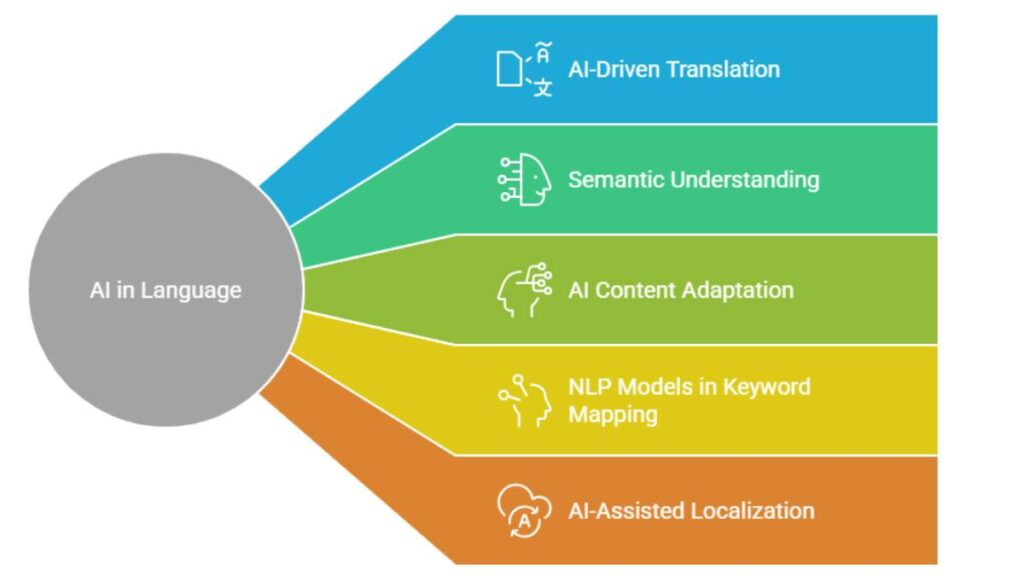
A few key shifts are driving this:
Translation is becoming adaptation
Instead of line-by-line conversion, content is now often reshaped based on how users in each region naturally express the same idea. Sometimes sentences change structure completely. Sometimes examples are replaced because they don’t resonate locally.
Search intent is being mapped across languages
Rather than treating each language as a separate keyword set, modern systems try to understand intent clusters. One concept in English might expand into multiple expressions in another language, depending on how people search in that region.
Keyword mapping is less literal now
Direct translation of keywords is becoming less reliable. What works in one language often has no search volume in another, even if it looks like a perfect equivalent on paper. So keyword strategy has started leaning more on behavior than language equivalence.
Cultural context is influencing ranking signals indirectly
Search engines don’t explicitly “score culture,” but they do reward content that keeps users engaged. And engagement is strongly tied to how natural the content feels in that language. Slight awkwardness, even if technically correct, tends to reduce performance.
NLP systems are improving cross-language understanding
Modern language models can connect related concepts across languages more effectively than older systems. That helps in identifying topic relevance beyond simple translation, which is quietly reshaping how multilingual content gets indexed and ranked.
That said, the system isn’t flawless. There are still gaps, especially with idioms, emotional tone, and regional phrasing that don’t have clean equivalents. Some content ends up technically accurate but slightly off in feel, which users pick up on immediately, even if they can’t explain why.
So while AI is improving multilingual SEO workflows, it’s also raising the expectation bar. Content needs to feel native, not just be correct.
Benefits and Challenges of AI-Powered Multilingual SEO
There’s a tendency to assume that once automation enters the picture, everything becomes easier. In reality, it becomes faster, yes, but also a bit more delicate. Small mistakes scale quickly. So do good decisions.
That’s really the trade-off here.
Benefits
Faster content localization at scale
What used to take weeks across multiple markets can now be done in a much shorter cycle. Not just translation, but full rollout of ideas across regions. That speed changes how teams think about expansion. Instead of “one market at a time,” it becomes more like parallel movement.
Better keyword alignment across languages
This is where things start to feel more structured. Instead of guessing equivalents, keyword patterns can be mapped based on how people actually search in each region. Sometimes the result is surprising. The “obvious” translation often isn’t the one people use.
Stronger alignment with search intent
When content is built around intent instead of literal phrasing, performance tends to stabilize across regions. It reduces the gap between what a page says and what a user actually expects to find.
Wider global reach without proportional effort
Scaling doesn’t feel linear anymore. One solid content system can branch into multiple languages without rebuilding everything from scratch each time.
Lower production overhead
Not just in writing, but in coordination. Fewer fragmented workflows, fewer disconnected versions of the same content floating around.
Challenges
Meaning gets slightly lost in translation
Even when everything is technically correct, tone can shift. A sentence that feels natural in one language can feel oddly flat or slightly off in another. Users notice that quickly, even if they don’t consciously point it out.
Cultural mismatch is still common
This is probably the most underestimated issue. Language is only part of communication. Context, tone, and cultural expectations carry just as much weight. When those don’t align, content feels generic.
Keyword dilution across markets
Expanding into multiple languages sometimes spreads focus too thin. Instead of building authority in a clear topic area, the content ends up scattered across variations that don’t fully reinforce each other.
Duplicate content confusion
Even with translations in place, search engines can struggle with understanding relationships between pages if the structure isn’t clean. It doesn’t always penalize, but it can blur visibility.
Technical setup still matters a lot
Hreflang tags, URL structures, and indexing rules… none of this disappears. In fact, with multilingual expansion, these technical elements become even more sensitive. Small errors can quietly limit reach in entire regions.
So the balance is fairly clear. Scaling is easier, but precision matters more than ever. The brands that do well here aren’t necessarily the ones producing the most content. They’re the ones keeping alignment tight across language, intent, and structure.
Understanding Multilingual SEO
Before anything else, it helps to step back and define what multilingual SEO actually means in practice, because it’s often confused with simple translation work. They are related, but not the same thing.
Multilingual SEO is essentially about making sure content is discoverable, relevant, and correctly interpreted across different languages and regions. Not just visible, but meaningful in each context.
That distinction matters more than it sounds.
Multilingual SEO vs International SEO
These two often get used interchangeably, but there’s a subtle difference:
- Multilingual SEO focuses on language variations
(English, Spanish, French, Hindi, etc.) - International SEO focuses more on regional targeting
(US, UK, India, UAE, etc.)
In real-world setups, they overlap heavily. A single website might need both layers working together. Language alone doesn’t define audience behavior. Region does too.
Hreflang Tags and Why They Still Matter
Hreflang is one of those technical elements that doesn’t get much attention until something breaks.
At its core, it tells search engines:
“This page is meant for this language and this region.”
Without it, things can get messy. Users might land on the wrong version of a page, or search engines might treat multiple versions as duplicates.
It doesn’t directly boost rankings, but it helps prevent confusion, which indirectly affects visibility.
URL Structures: Subdomain vs Subfolder vs ccTLD
This is one of those decisions that looks minor at first but has a long-term impact.
- Subfolder structure
example: /en/, /fr/, /es/- Easier to manage
- Consolidates authority
- Common choice for most global sites
- Subdomain structure
example: en.site.com, fr.site.com- Separates regions more clearly
- Slightly more complex to manage authority flow
- Country code domains (ccTLD)
example: site.fr, site.de- Strong regional signal
- Higher maintenance cost
- Often used by large enterprises or country-specific brands
There isn’t a universal “best” option. It depends more on scale, resources, and how independently each market operates.
How Search Engines Interpret Language and Region Signals
Search engines don’t rely on a single factor to decide which version of content to show. It’s a mix of signals:
- Language of the content
- Location of the user
- Domain structure
- Hreflang signals
- Engagement patterns in that region
And increasingly, content relevance is based on intent rather than just language matching.
This is where things get more fluid. A page doesn’t rank just because it exists in the right language. It ranks because it fits what users in that region actually expect to see when they search.
That expectation layer is becoming more important than pure technical setup.
Why Multilingual SEO is Critical for Google SGE & AI Overviews
Search is no longer just about listing pages. A growing part of it is about summarizing answers directly. That changes how multilingual content is evaluated and selected.
Instead of simply indexing pages, search systems now try to understand which content best answers a query in context. And that context often includes language, region, and intent all at once.
How AI Overviews Pull Multilingual Sources
AI-generated summaries don’t always rely on a single language source. They can pull from multiple pages, sometimes across different languages, and combine them into one response.
But there’s a catch.
Only content that is clearly structured and contextually strong tends to get picked up. Weak translations or loosely adapted pages usually get ignored, even if they technically exist.
Why Context Matters More Than Translation
A direct translation might be accurate but still fail to appear in AI summaries. The reason is simple: clarity of meaning matters more than linguistic accuracy alone.
Search systems are looking for:
- Clear explanations
- Well-structured ideas
- Context that can stand alone
- Minimal ambiguity
If a page feels like it was “translated” rather than written for that audience, it often gets deprioritized.
Entity-Based Understanding in Multilingual Ranking
There’s a noticeable shift toward entity understanding, where search systems focus more on concepts and relationships rather than exact keywords.
In multilingual contexts, this becomes even more important.
For example:
- A concept described in English may still be understood in another language version if the underlying idea is strong
- Pages that clearly define topics tend to perform better across regions
- Weak or vague content loses visibility faster
It’s less about matching words now and more about matching meaning.
How AI Selects Language-Specific Answers
When a query is made in a specific language, the system doesn’t just look for content in that language. It evaluates:
- Which content best answers the intent
- Whether the language feels natural
- Whether the information is complete enough to stand alone
- Whether it aligns with regional expectations
Sometimes, content from another language is even referenced if it better matches the intent, although it’s usually adapted or summarized.
Importance of Structured Data in Multilingual Content
Structured content plays a quiet but important role here. When information is clearly organized, it becomes easier for systems to extract meaning across languages.
Things like:
- Clear headings
- Logical content flow
- Consistent metadata across language versions
- Proper internal linking between equivalents
All of this helps content stay usable in AI-generated responses.
In a way, multilingual content is no longer just about reaching different audiences. It’s about making sure the content is understandable even when it gets broken apart, reassembled, and summarized by systems that don’t always rely on full pages anymore.
How AI Multilingual SEO Works
Multilingual content at scale doesn’t really work as a straight pipeline anymore. It’s more like a loop that keeps adjusting based on performance, intent shifts, and regional behavior. The process looks structured on paper, but in practice, it’s a bit more fluid.
Still, there is a clear sequence that usually holds up.
AI content generation + localization workflow
It typically starts with a core piece of content in a primary language. But instead of treating it as a “master version,” it’s more like a reference point.
From there:
- Content is broken into intent blocks (not just sections)
- Each block is evaluated for meaning rather than wording
- Localized versions are shaped based on how that idea is expressed in different regions
Sometimes entire paragraphs don’t survive the process. Not because they’re wrong, but because they don’t fit how users in another language would naturally think about the topic.
Language detection and intent classification
Before anything gets localized, systems need to understand two things:
- What language is the content in
- What the content is actually trying to solve for
This is where intent classification becomes important. A single topic might shift depending on the region. What reads as informational in one language might be interpreted as transactional in another.
That mismatch is often where multilingual performance breaks down.
Keyword mapping across languages
This step is often misunderstood. It’s not about translating keywords. It’s about rebuilding them.
A keyword cluster in one language might split into:
- Multiple variations in another language
- Different phrasing styles based on search behavior
- Entirely new terms that don’t exist in the source language
So instead of matching words, the focus shifts to matching intent clusters.
Semantic alignment using NLP models
Once content and keywords are mapped, the next step is aligning meaning.
This is where systems try to ensure:
- The same concept is being expressed consistently
- Context is preserved across languages
- No key idea gets diluted or lost in translation
It’s not always perfect. Some concepts simply don’t carry the same weight everywhere. But semantic alignment reduces the gap.
Content optimization for search systems
Finally, content is structured in a way that makes it easier to interpret:
- Clear sections
- Consistent phrasing for key ideas
- Logical flow between topics
- Reduced ambiguity in explanations
At this stage, multilingual content stops being “translated pages” and starts behaving more like independently written assets that just happen to share the same core intent.
AI Translation Methods for SEO
Translation used to be treated as a finishing step. Now it sits much earlier in the workflow, and more importantly, it’s no longer treated as a single method.
There are multiple layers involved, and each one serves a slightly different purpose.
Neural Machine Translation (NMT) in real workflows
Neural machine translation has become the default baseline for most multilingual systems. It doesn’t just convert words; it predicts how sentences should flow in another language.
But even with that, raw output isn’t usually enough for publishing.
What works better is:
- Using NMT for first-pass conversion
- Then, refining the structure based on intent
- Adjusting tone where needed
It’s efficient, but not final.
Context-aware translation models
This is where things get more nuanced. Context-aware systems try to understand meaning across full paragraphs, not isolated sentences.
That helps with:
- Maintaining consistency across sections
- Reducing awkward phrasing shifts
- Preserving intent even when structure changes
Still, context doesn’t always carry perfectly across languages. Especially when cultural references or implied meanings are involved.
Limitations of literal translation
Literal translation is where most multilingual content problems start.
Common issues include:
- Keywords that sound correct but aren’t used in real searches
- Sentences that feel grammatically right but unnatural
- Loss of emotional tone or urgency
- Overly formal or overly simplified phrasing
This is usually where content starts to feel “off,” even if it looks fine at first glance.
AI post-editing for refinement
Post-editing is where translation starts becoming usable for real audiences.
This stage usually focuses on:
- Adjusting phrasing to match local search behavior
- Fixing tone mismatches
- Rewriting unclear sections
- Aligning terminology across pages
It’s less about correcting errors and more about making content feel native.
Hybrid model: AI + human editorial refinement
Pure automation tends to fall short in edge cases. So most effective setups rely on a hybrid approach.
Typically:
- AI handles scale and first drafts
- Humans refine nuance, tone, and context
- Final output is adjusted based on how users actually engage with it
Not perfect, and sometimes slower than expected, but it tends to produce more stable performance across regions.
Keyword Research for AI Multilingual SEO
Keyword research changes quite a bit when dealing with multiple languages. It stops being a list-building exercise and becomes more of a mapping process between how people think and how they search in different regions.
Understanding Multilingual Keyword Intent
The same topic can behave very differently depending on language and culture.
A few patterns usually show up:
- Some languages prefer direct, short queries
- Others naturally use longer, question-based searches
- Transactional intent might be expressed more subtly in some regions
- Informational intent can overlap heavily with commercial intent
This means keyword intent cannot be assumed to stay consistent across translations.
Even small phrasing differences can completely shift meaning.
Step 1: Analyze Seed Keywords in Source Language
Everything starts with a core set of keywords in the primary language. But instead of treating them as fixed terms, they’re better seen as intent anchors.
From there:
- Identify the core topic clusters
- Group related search intents together
- Separate informational, transactional, and comparative queries
- Look at how users naturally frame problems, not just keywords
At this stage, the goal isn’t expansion yet. It’s clarity.
Because if the base structure is weak, everything built on top of it becomes inconsistent later.
Step 2: Generate Keywords in Target Language
This is where most strategies go wrong if handled too literally.
Direct translation rarely works well.
Instead, the process usually involves:
- Identifying how users in that region actually phrase the same intent
- Checking how competitors localize similar topics
- Observing SERP behavior to see what language patterns appear repeatedly
- Adjusting keyword clusters based on real usage, not linguistic similarity
Sometimes the translated version of a keyword has almost no search demand, while a completely different phrase carries the real volume.
That’s normal.
Step 3: Validate Keyword List
Once keyword clusters are built, validation becomes necessary. Not everything that looks relevant actually performs.
Typical checks include:
- Whether the keyword actually has meaningful search volume in that region
- Whether the competition level makes sense for the site’s authority
- Whether SERPs match the intended content type
- Whether the keyword aligns with local intent patterns
This step often filters out a large portion of “technically correct but practically useless” keywords.
Which is usually a good thing.
AI Tools for Multilingual Keyword Research
Modern keyword research for multiple languages relies heavily on layered tooling rather than a single platform.
Common categories include:
- Keyword generation systems
Used to expand seed topics into structured clusters across languages - SEO auditing tools
Helpful for identifying gaps in multilingual site structure and indexing behavior - Translation + clustering systems
These help group keywords based on meaning instead of direct language matching - SERP analysis tools
Used to observe how different regions actually structure search results for the same topic
The key point here is not the tools themselves, but how they are combined. Keyword research becomes less about extraction and more about interpretation across markets.
AI Multilingual SEO Strategy: Step-by-Step Framework
Scaling across languages without a clear strategy usually leads to scattered results. Some pages perform well, others never gain traction, and it’s often hard to understand why.
A structured approach helps reduce that randomness.
Market Understanding Before Expansion
Before creating content in new languages, it helps to understand where effort should actually go.
Key considerations:
- Which regions show real demand, not just potential interest
- How strong the competition already is in each market
- Whether the content needs to be deeply adapted or lightly localized
- What level of investment each region realistically requires
Not every market deserves the same level of depth at the same time.
Understanding Search Behavior in Each Market
Search behavior varies more than most teams expect.
Some important differences:
- Mobile-first vs desktop-heavy usage patterns
- Differences in query length and structure
- Local platforms influencing discovery habits
- Variations in how users evaluate trust in content
Even small behavioral differences can shift how content should be written and structured.
Search Intent Mapping Across Languages
This is where strategy becomes more precise.
Instead of translating keywords, the focus is on mapping intent equivalence.
For example:
- One language might express a problem directly
- Another might frame it as a comparison
- Another might start from a solution-first approach
All three can represent the same underlying intent, but the content structure needs to reflect those differences.
Avoiding direct translation traps is critical here. It often leads to content that feels correct but is slightly disconnected from how users actually search.
Language Shapes Perception
Language isn’t just a communication layer. It shapes how people think about problems.
That shows up in search behavior through:
- Emotional tone differences in queries
- Variations in urgency or specificity
- Cultural framing of the same concept
- Different expectations for content depth
A single topic might need to be positioned differently in each language, even if the core idea stays the same.
Shift from Volume to Relevance
High search volume doesn’t always translate into performance in multilingual markets.
In many cases:
- Lower-volume keywords can perform better due to stronger intent alignment
- Highly generic keywords may attract traffic, but not engagement
- Contextually specific queries tend to convert better, even if smaller in scale
Relevance often outweighs volume when dealing with multiple languages.
And this is where strategy becomes less about chasing keywords and more about understanding behavior patterns in each market.

Enroll Now: Advanced Digital Marketing Course
On-Page Optimization for AI Multilingual SEO
On-page structure becomes a lot more important when content exists in multiple languages. Not because search systems can’t read it otherwise, but because clarity helps everything align properly across versions.
When pages start multiplying across languages, small inconsistencies tend to snowball. A slight mismatch in titles here, a missing internal link there, and suddenly the relationship between versions becomes unclear.
So the focus shifts to consistency, but not rigidity.
Title tag localization strategies
Titles can’t just be translated. They need to reflect how people actually search in that language.
What usually works better:
- Keeping the intent intact, not the wording
- Adjusting phrasing to match local search habits
- Avoiding overly literal conversions that feel unnatural
Sometimes, a shorter title in one language performs better than a longer translated version. Not because of length itself, but because that’s how users in that region scan results.
Meta descriptions tuned for regional behavior
Meta descriptions behave differently across markets.
In some regions:
- Direct, benefit-driven descriptions perform better
- In others, slightly descriptive or contextual phrasing works better
- Emotional tone can influence click behavior more than expected
It’s less about “writing a perfect description” and more about matching how users decide what to click.
Hreflang implementation (without overcomplication)
Hreflang often gets over-engineered. At its core, it’s just about telling systems which version belongs to which audience.
What matters most:
- Consistency across all language versions
- No missing return tags
- Clear mapping between equivalent pages
Even small errors here can cause versions to compete with each other instead of complementing each other.
Internal linking across language versions
This is often overlooked, but it plays a quiet role in structure clarity.
Good practices include:
- Linking equivalent pages across languages where relevant
- Avoiding broken language loops (users stuck in wrong versions)
- Keeping navigation intuitive rather than overly automated
It’s not just technical hygiene. It helps users actually move between versions when needed.
Structured data for multilingual content
Structured data helps define meaning beyond visible text. In multilingual setups, it becomes even more useful.
Key focus areas:
- Keeping schema consistent across language versions
- Ensuring translated fields still match the original intent
- Avoiding partial or mismatched structured data
When done well, it helps systems understand content relationships more clearly across languages.
Technical SEO for Multilingual Websites
Technical setup tends to become more sensitive as language versions increase. What works for a single-language site often starts to break or behave unpredictably once multiple regions are added.
Not dramatically, but enough to impact visibility.
Site architecture choices
There are three common approaches, each with trade-offs:
- Subfolder structure
Keeps everything under one domain
Easier to manage authority flow
Usually more stable for long-term scaling - Subdomain structure
Separates language sections more clearly
Useful when teams or regions operate independently
Slightly more fragmented authority signals - Country-specific domains (ccTLDs)
Strong regional targeting
Higher trust in local markets
But requires a separate SEO effort for each domain
The choice usually depends more on operational complexity than technical superiority.
Crawlability for search systems
Multilingual sites need to be easy to navigate not just for users, but for crawlers as well.
Common issues include:
- Orphaned language pages
- Broken internal linking between versions
- Inconsistent navigation across regions
When crawl paths get messy, indexing becomes uneven. Some languages get full coverage, others get partially ignored.
Duplicate content handling
Duplicate content isn’t always a penalty issue. More often, it’s a clarity issue.
Search systems may struggle when:
- Multiple versions look too similar without clear signals
- Language targeting is unclear
- Canonical signals are inconsistent
The goal isn’t to eliminate similarity, but to make relationships between pages obvious.
Canonical tags in multilingual environments
Canonical tags help define primary relationships between pages, but in multilingual setups, they need careful handling.
Common mistakes include:
- Pointing all language versions to one canonical page
- Ignoring equivalent page relationships
- Mixing canonical and hreflang logic incorrectly
When aligned properly, canonical and hreflang work together rather than against each other.
Indexing strategies for multi-region visibility
Indexing behavior can vary significantly across languages and regions.
What usually improves consistency:
- Clean URL structure
- Clear language signals
- Proper internal linking
- Avoiding thin or partially translated pages
Indexing isn’t just about discovery anymore. It’s about whether systems trust the content enough to include it consistently across regions.
Content Optimization for AI Search
Content structure has started to matter just as much as content quality. Not in a mechanical way, but in how easily ideas can be extracted and reused in summaries.
When content is spread across languages, this becomes even more noticeable.
Writing content that is easy to summarize
The most effective content tends to be:
- Clearly structured
- Focused on one idea per section
- Free from unnecessary complexity in explanations
Not overly simplified, just clean in how ideas are presented.
If a section feels hard to break into a summary, it usually needs restructuring.
Structured sections for better extraction
Long blocks of text don’t perform as well in multilingual environments where systems need to interpret meaning quickly.
What tends to work better:
- Short, focused sections
- Logical progression of ideas
- Clear separation between concepts
This doesn’t mean rigid formatting. It just means reducing ambiguity in flow.
Entity-based content alignment
Instead of focusing only on keywords, content now benefits from stronger conceptual clarity.
That means:
- Clearly defining key topics
- Maintaining consistent terminology across languages
- Avoiding unnecessary variation in naming the same concept
When concepts are clearly defined, they tend to translate and adapt more reliably across markets.
Conversational formatting for better readability
Content that reads naturally tends to perform better across languages. Not because it’s casual, but because it mirrors how users think when searching.
Useful patterns include:
- Direct explanations instead of overly complex phrasing
- Occasional clarifications in brackets or short phrases
- Slightly varied sentence structures to avoid monotony
It doesn’t need to sound polished. It just needs to sound natural.
FAQ-style structuring for clarity
FAQ sections often perform well because they mirror real search behavior.
But the key is not just adding questions. It’s about:
- Answering directly without unnecessary buildup
- Keeping responses focused on one intent per question
- Avoiding repetitive phrasing across languages
When done well, FAQ sections become easy reference points for both users and systems.
Benefits of Implementing AI Multilingual SEO
The value of multilingual expansion isn’t just about reach. It’s about how efficiently global visibility can now be built when systems are structured properly from the start.
There’s a noticeable shift happening: brands that treat multilingual content as a core system, not an afterthought, tend to scale more predictably.
Increased efficiency in global content production
Once the structure is in place, content production becomes less fragmented.
Instead of rebuilding content for every region:
- Core ideas can be reused
- Adaptation becomes more systematic
- Repetition is reduced across teams
It’s not about doing less work, but about doing more with fewer redundant steps.
Improved user experience across languages
When content is properly aligned across languages, users don’t feel like they’re on a “translated version” of a site.
They experience:
- More natural phrasing
- Clearer explanations
- Better alignment with their expectations
That subtle sense of familiarity often improves engagement without needing major design changes.
Expanded global visibility
The obvious benefit is reach, but the more important part is consistency.
Instead of performing well in one market and poorly in others, structured multilingual systems tend to:
- Stabilize visibility across regions
- Reduce performance gaps between languages
- Improve long-term discoverability
It becomes less about spikes and more about a steady presence.
Competitive advantage in international markets
Most competitors still treat multilingual content as a secondary layer. That creates an opportunity gap.
Brands that invest in proper structure tend to:
- Enter new markets faster
- Build topical authority more evenly
- Avoid rebuilding content systems later
It’s not always visible immediately, but it compounds over time.
Faster indexing in evolving search systems
Well-structured multilingual content tends to get processed more smoothly.
Not because it’s “optimized,” but because:
- Relationships between pages are clearer
- Language signals are consistent
- Content is easier to interpret across regions
That clarity often leads to faster and more stable indexing patterns.
Overall, the biggest benefit isn’t just scale. It’s control. Once multilingual systems are structured properly, global expansion starts feeling less chaotic and more predictable, even if each market still behaves differently.
Common Challenges in AI Multilingual SEO
Scaling content across languages sounds smooth in theory. In reality, this is where most strategies start to show friction. Not because the idea is flawed, but because small inconsistencies multiply quickly once multiple languages are involved.
And the tricky part is, the issues don’t always show up immediately. They surface slowly through uneven performance across regions.
Over-reliance on automated translation systems
One of the most common pitfalls is trusting automated translation too far.
It usually starts fine. The content looks correct, reads okay, and technically covers the topic. But then performance data tells a different story.
What tends to go wrong:
- Sentences feel technically accurate but slightly unnatural
- Key phrases don’t match how people actually search locally
- Emotional tone gets flattened or lost
- Content starts feeling “generic” across languages
The problem isn’t automation itself. It’s when automation replaces interpretation instead of supporting it.
Loss of cultural relevance
Language is only part of communication. Cultural context carries just as much weight, sometimes more.
Where things often break:
- Examples that don’t resonate in certain regions
- Tone that feels too formal or too casual for the audience
- References that don’t translate well across markets
Even when content is linguistically correct, it can still feel distant if it doesn’t align with local expectations.
Keyword mismatch across languages
This is one of the quieter issues, but it has a big impact.
What happens often:
- Keywords that perform well in one language have no real equivalent elsewhere
- Direct translations lead to terms that nobody actually searches for
- Search intent shifts subtly between regions
So even if content is “fully localized,” it may still miss the actual search behavior entirely.
Technical misconfigurations
On the technical side, multilingual setups can get messy quickly.
Common issues include:
- Missing or incorrect language signals
- Broken relationships between equivalent pages
- Inconsistent URL structures across regions
- Improper handling of canonical and language tags
These don’t always break the site, but they quietly reduce clarity. An unclear structure tends to weaken visibility over time.
AI-generated inaccuracies in localized content
Another emerging issue is subtle content distortion.
Sometimes:
- Facts get slightly altered during adaptation
- Context shifts in ways that weren’t intended
- Content becomes too generalized across languages
These errors aren’t always obvious at first glance. They usually show up when users from different regions engage differently with the same topic.
Overall, the biggest challenge here isn’t producing multilingual content. It’s keeping it aligned. Once that alignment starts drifting, performance differences across languages become harder to explain and even harder to fix later.
Future of AI Multilingual SEO in the AI Search Era
The direction things are moving in is fairly clear, even if the timeline isn’t perfectly predictable. Search is shifting from static pages toward a more dynamic interpretation of content. And multilingual systems are evolving along with it.
What used to be a structured workflow is slowly becoming more adaptive and intent-driven.
Shift from keyword-based structure to entity-based understanding
Keywords are still relevant, but they’re no longer the center of gravity.
What matters more now:
- Clear definition of concepts
- Strong relationships between topics
- Consistent meaning across different expressions
Search systems are increasingly focusing on what something is, not just how it is described.
That shift becomes even more important when content spans multiple languages.
Rise of AI-generated multilingual search responses
Search results are becoming more synthesized. Instead of sending users to multiple pages, systems are starting to build direct answers.
In multilingual contexts, this means:
- Content may be pulled, summarized, and restructured across languages
- Different sources may contribute to a single response
- Language boundaries become less rigid in how information is used
Visibility now depends not just on ranking, but on being selected as a reliable source for summaries.
Increasing importance of semantic clarity
As systems get better at understanding meaning, unclear content tends to disappear quietly.
What performs better:
- Clearly structured explanations
- Consistent terminology across languages
- Reduced ambiguity in how ideas are presented
It’s less about writing “optimized” content and more about writing content that cannot be misunderstood easily.
Google SGE-style experiences shaping global behavior
Search experiences are becoming more conversational and answer-driven. That changes how users interact with multilingual content.
Instead of browsing multiple pages:
- Users expect direct answers
- They rely more on summarized information
- They trust systems to filter relevance for them
This reduces the importance of page-level visibility and increases the importance of being part of the answer layer itself.
Real-time adaptation is becoming more realistic
One of the more subtle shifts is toward content that can evolve faster across markets.
Not fully automated updates, but:
- Faster iteration across languages
- More responsive content updates based on behavior
- Continuous refinement instead of static publishing cycles
It’s not perfect yet, but the direction is clear. Content will behave less like fixed assets and more like living systems that adjust over time.
Overall, the multilingual strategy is moving away from static translation models toward something more fluid. Less about creating versions of content, more about maintaining meaning across different expressions of the same idea.
Conclusion
Multilingual growth has always been about reach, but the way that reach is achieved is changing quite a bit.
It’s no longer enough to simply publish content in multiple languages and expect consistent performance. The gap between “translated” and “truly localized” content is becoming more visible, especially as search systems get better at interpreting intent and context.
What stands out most across all of this:
- Content needs to carry meaning, not just words
- Structure matters as much as language
- Intent alignment is more important than literal accuracy
- Small inconsistencies scale quickly across markets
There’s also a quiet shift happening in how success is measured. It’s less about volume of pages across languages and more about how well each version actually connects with the audience it’s meant for.
Brands that treat multilingual content as a connected system rather than separate translations tend to build more stable global visibility. Not overnight, and not without iteration, but more consistently over time.
The direction is fairly clear now. Global content isn’t just being translated anymore. It’s being reinterpreted, reshaped, and restructured for how people actually search and understand information in their own language.
FAQs: AI Multilingual SEO
What is AI multilingual SEO?
It’s really just the practice of scaling content across languages using AI support, but not in a copy-paste translation way. The focus is more on meaning staying intact while the wording shifts based on how people in each region actually search. Different language, same intent underneath.
How does AI improve multilingual SEO?
Mostly by speeding up what used to be slow and messy work. It helps spot patterns in search behavior across languages and gives a starting structure for content in different regions. But the real improvement comes when those outputs are adjusted for how people actually talk and search locally.
Is AI translation good for SEO?
It’s useful, but only as a rough base. Raw translations tend to sound correct but slightly unnatural, especially in search contexts where phrasing matters a lot. In most cases, it needs cleanup afterward so it doesn’t feel like translated content but something written for that audience from the start.
What is the difference between multilingual SEO and international SEO?
Multilingual is about language; international is about geography. Simple distinction, but it matters. One deals with how content is expressed, the other with where and to whom it’s shown. A country can have multiple languages, and one language can span multiple countries, so they don’t always overlap neatly.
Why is multilingual SEO important for global websites?
Because users don’t think in one shared format across markets. Even when the topic is the same, the way people search changes a lot depending on language and region. Without adapting content properly, it might exist everywhere but actually perform well nowhere. That gap shows up quietly.
How does Google rank multilingual content?
It’s less mechanical than people assume. Matching language alone isn’t enough. What matters more is whether the content actually fits the intent behind the query in that region. Pages that feel naturally written for that audience usually do better than ones that feel translated or slightly off.
What are AI Overviews in Google search?
These are the summary blocks that show up directly in search results instead of just listing links. They pull together information from multiple sources and present a combined answer. Content that is structured clearly and easy to interpret tends to get picked up more often in these summaries.
How can multilingual SEO help in Google SGE?
It makes content easier to reuse in generated answers across different languages. When content is aligned properly with intent and structured cleanly, it becomes easier for systems to pull relevant parts into summaries. Without that alignment, even good content can stay invisible in those outputs.
What are hreflang tags in multilingual SEO?
They’re basically signals that tell search systems which version of a page belongs to which language or region. Sounds technical, but the idea is simple: avoid showing the wrong version to the wrong user. When set correctly, they stop different language pages from competing with each other.
What are the best AI tools for multilingual SEO?
There isn’t really one “best” tool. Most setups use a mix depending on the stage of work. Some tools help with keyword ideas, some with translation, others with technical checks. The outcome depends more on how the system is built than which single tool is used.
How do you do keyword research for multilingual SEO?
It starts with understanding how people search in one language, then checking how that same intent shows up in others. Direct translation usually fails here. Real search terms often look completely different once local phrasing, slang, or behavior is taken into account.
What are common mistakes in multilingual SEO?
The biggest one is assuming translation equals localization. That rarely works. Another issue is ignoring how intent changes across languages. On the technical side, messy structure or incorrect language signals can quietly break visibility without obvious warnings.
Can AI replace human SEO in multilingual optimization?
Not fully. AI handles speed and scale well, but it struggles with context and nuance. Language has too many small shifts in meaning for automation to get right every time. Human input still matters for tone, cultural fit, and making sure content actually feels right in each region.
How does AI help in content localization?
It helps identify patterns across languages and speeds up adaptation work. It can suggest structure and variations in phrasing, which saves time. But the real value comes when those suggestions are adjusted manually so the final content doesn’t feel generic or slightly disconnected.
What is semantic SEO in multilingual search?
It’s about focusing on meaning instead of exact wording. In multilingual settings, this becomes important because the same idea can be expressed in completely different ways. If the underlying meaning is strong and consistent, content tends to hold up better across languages.
How do you optimize content for AI search engines like SGE?
Content needs to be clear enough to be broken into summaries. Long, tangled explanations usually don’t perform well. Structured flow, direct answers, and consistent meaning matter more. Across languages, clarity becomes even more important than style or wording.
What are the challenges of AI multilingual SEO?
Things usually go wrong in small ways that add up. Translation can lose tone, keywords don’t always match across regions, and technical setups can easily become inconsistent. The hardest part is keeping everything aligned so each version still feels like part of the same system.
Does multilingual SEO increase website traffic?
It does, but only when done properly. Just translating pages won’t guarantee results. Traffic growth depends on how well each version matches how people actually search in that region. If that alignment is missing, the pages exist but don’t really perform.
What is the future of AI multilingual SEO?
It’s slowly moving toward intent-driven systems instead of keyword-focused ones. Content will likely be adapted more dynamically based on region and behavior. Translation alone won’t be enough anymore. Meaning, context, and how naturally content fits into each language will matter more than ever.