
Getting a business name right isn’t just a creative exercise; it tends to affect how people remember the brand, talk about it, and even trust it a little. This blog looks at where an AI Business Name Generator actually fits into that process. Not as a magic fix, more like a starting point that speeds things up… sometimes a lot. It covers how these tools work, what to expect from them, and where they fall short. There’s also a practical angle; how to sort through the noise, avoid obvious naming traps, and shape rough ideas into something usable. Naming can drag on if it’s not handled well. This makes it more manageable.
Table of Contents
Introduction
What is an AI Business Name Generator?
At its core, it’s a tool that turns a few inputs: keywords, industry hints, maybe a tone, into a list of possible business names. Sounds simple. But the output today feels very different from what these tools used to produce.
Earlier versions were clunky. You’d get awkward word mashups that didn’t quite sound like real brands. Now, the suggestions are cleaner, Shorter, and sometimes surprisingly sharp.
Think of it less like a “name creator” and more like a fast idea engine. You feed it direction, it throws back angles. Some obvious, some a bit unexpected. And that mix is where things get interesting.
Why AI-powered naming tools are revolutionizing branding
Naming used to drag on. Brainstorming sessions, back-and-forth debates, long lists that slowly got cut down to… almost nothing usable. And then, of course, the domain would already be taken.
What’s changed isn’t just speed. It’s the ability to explore multiple directions at once without getting stuck too early.
Instead of forcing one idea to work, you can:
- Try different tones side by side
- Shift from descriptive names to abstract ones quickly
- Test variations without overthinking each step
That freedom changes how decisions are made. There’s less pressure to “get it right” immediately, which ironically leads to better outcomes.
Importance of a memorable business name for startups and established companies
A name does more than identify a business. It frames it.
Before someone visits a website or sees a product, the name has already set a tone. It hints at whether the brand feels premium, playful, serious… or just forgettable.
For startups, this matters a lot. There’s no reputation yet, so the name carries more weight than people expect. It needs to land quickly.
A few things tend to hold up over time:
- Shorter names are easier to recall
- Clear pronunciation reduces friction
- Slight uniqueness beats generic clarity
Established brands play a slightly different game. They’re not always naming the company itself, but products, campaigns, or sub-brands. Still important. Just a different kind of pressure; more about fit than discovery.
How AI Name Generators save time and boost creativity
The biggest shift isn’t just saving time; it’s breaking mental loops.
When naming manually, ideas tend to repeat. Same words, same structures, just rearranged. It happens more than most people notice.
These tools interrupt that pattern.
They help by:
- Generating volume quickly (which matters more than it sounds)
- Introducing combinations that wouldn’t come up naturally
- Nudging the thinking in new directions
Not every suggestion is good. Far from it. But that’s not the point. The useful ones stand out faster when there’s contrast around them.
And sometimes, the best name isn’t even on the list; it’s the one that shows up right after scrolling through it.
How AI Business Name Generators Work
AI algorithms behind business name suggestions
Without getting too technical, these tools lean on patterns. Language patterns, brand patterns, even trends in how modern names are structured.
They’ve seen enough examples to understand what sounds like a brand versus what doesn’t.
So when a keyword goes in, the tool doesn’t just repeat it. It stretches it. Looks at related terms, breaks them apart, and rebuilds them in different forms. Adds prefixes, trims endings, sometimes invents entirely new combinations.
That’s why results can feel loosely connected, but still relevant.
Keyword analysis, industry relevance, and brand identity
The input matters more than most people think.
A single broad keyword usually leads to predictable names. Nothing wrong with that, but nothing memorable either. Add a bit more context, though, and the tone shifts.
For example:
- “Fitness” – generic, expected results
- “Luxury fitness for busy professionals” – sharper, more tailored suggestions
The tool is trying to interpret intent from limited signals. The clearer those signals, the better the output tends to get.
Still, it’s not perfect. Sometimes it leans too literal. Sometimes too abstract. That’s where filtering comes in.
Domain availability checks and extensions
This is where practicality steps in.
A name might look great on paper, but if the domain isn’t available, it creates friction right away. Most generators now check this in real time, or close to it, and that changes how people shortlist names.
Instead of falling in love with something unusable, you’re working with options that are at least possible.
Some tools also suggest variations when the exact match isn’t free. Not always ideal, but useful enough to keep the process moving.
AI vs traditional name brainstorming: pros and cons
There’s a tendency to treat this like a replacement. It’s not. More like a shift in roles.
AI handles:
- Speed
- Volume
- Early-stage exploration
Human input handles:
- Judgment
- Context
- Long-term brand fit
Traditional brainstorming still matters, but it works better after the initial idea pool is expanded. Starting from scratch with a blank page? That’s where things slow down.
Using both together tends to produce stronger results. One widens the field. The other sharpens it.
Benefits of Using AI Business Name Generators
Speed and efficiency: generate hundreds of names in minutes
Time adds pressure. Especially in early stages, where decisions stack up quickly.
Instead of spending hours debating a handful of ideas, these tools shift the process. You get a large set of options almost instantly. That alone changes how people evaluate names.
More options don’t always mean better decisions, but it does mean better comparisons.
Creativity enhancement: discover unique, brandable names
There’s a certain kind of idea that’s hard to reach through manual thinking alone. Slightly unusual, but still usable. Not obvious, but not confusing either.
These tools tend to surface those.
Often, the value isn’t in picking a name directly from the list. It’s in spotting patterns:
- A structure that works
- A sound that feels right
- A direction that wasn’t considered before
From there, refinement becomes easier.
Customization options: style, length, and tone of names
Not every business should sound the same, and most tools reflect that now.
Being able to adjust:
- Tone (formal, playful, modern)
- Length (short vs descriptive)
- Style (coined, compound, keyword-based)
…makes a noticeable difference in output quality.
Without that control, results can feel random. With it, they start to align more closely with the brand you’re trying to build.
Domain and social media handle suggestions
A name doesn’t exist in isolation anymore.
It needs to work across:
- A website domain
- Social platforms
- Sometimes, even app stores
Some generators include these checks or suggestions alongside the name. It’s a small feature, but it prevents future headaches.
Because changing a name later? Much harder than getting it right early.
Key Features to Look for in an AI Business Name Generator
User-friendly interface and ease of use
If the tool feels heavy or confusing, it slows everything down. And naming already has enough friction as it is.
The better platforms keep things simple. Enter keywords, adjust a few settings, and generate results. No learning curve, no extra steps.
That ease makes it easier to experiment, which is kind of the whole point.
Keyword targeting and AI creativity settings
Some tools stick too closely to the input. Others go too far off track.
The useful ones sit somewhere in the middle.
Being able to control how “creative” or how “literal” the results should be helps a lot. Especially when switching between exploration and refinement phases.
Brand style customization: modern, fun, professional, classic
Tone matters more than it seems at first glance.
A name for a legal firm shouldn’t sound like a gaming startup. And vice versa. Tools that allow tone adjustments, modern, classic, playful, and formal, tend to produce more usable results.
Even small shifts here can change the direction completely.
Domain name availability integration
This one’s straightforward. If domain availability isn’t built in, it becomes a separate task. Which slows things down.
Integrated checks keep everything in one place. You generate, filter, and shortlist all without breaking the flow.
It’s less about convenience and more about staying in momentum.
Multilingual support and global branding options
Names travel. Sometimes further than expected.
A word that works well in one language might feel awkward, or worse, misleading, in another. Not always obvious upfront.
Tools that consider multiple languages or offer broader linguistic variations help reduce that risk.
Even for businesses starting locally, it’s worth thinking ahead a bit. A name should scale without needing a rework later.
Top 10 AI Business Name Generators
1. Design.com – AI-generated names tied to a complete branding platform
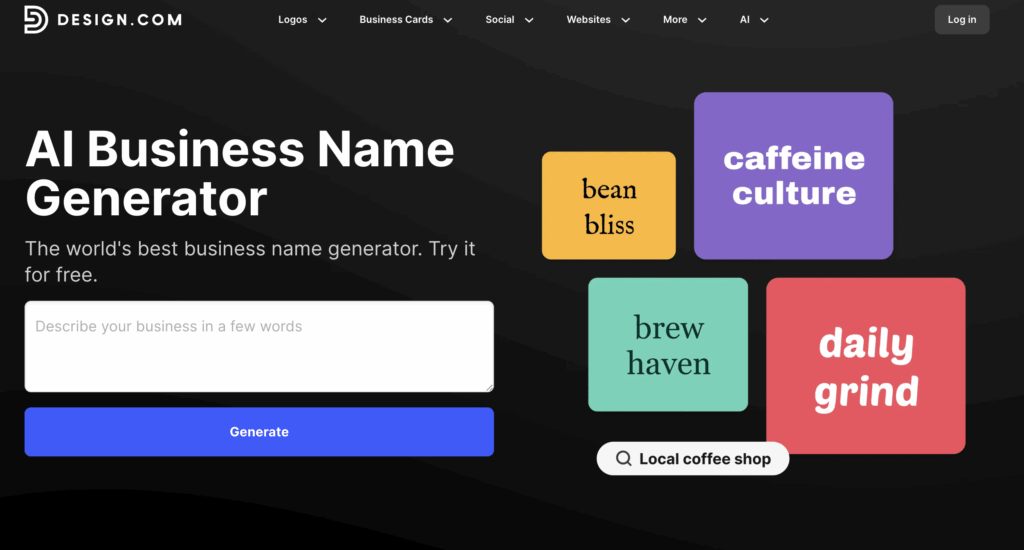
Design.com’s AI business name generator works based on your description, not just a list of preset keywords. Give it more context about your industry or style, and the suggestions become noticeably more relevant.
The real difference is what happens after you pick a name. Design.com can immediately generate a matching logo, then carry the same branding across business cards, social media, flyers, websites, and other marketing materials.
The trade-off is that the experience is designed around building a complete brand rather than exploring endless name variations.
- Works well for: entrepreneurs who want to turn a business name into a complete brand.
- Needs a bit of care with: the first batch of suggestions; more specific prompts usually lead to stronger results.
2. Namelix – AI-powered short and brandable names
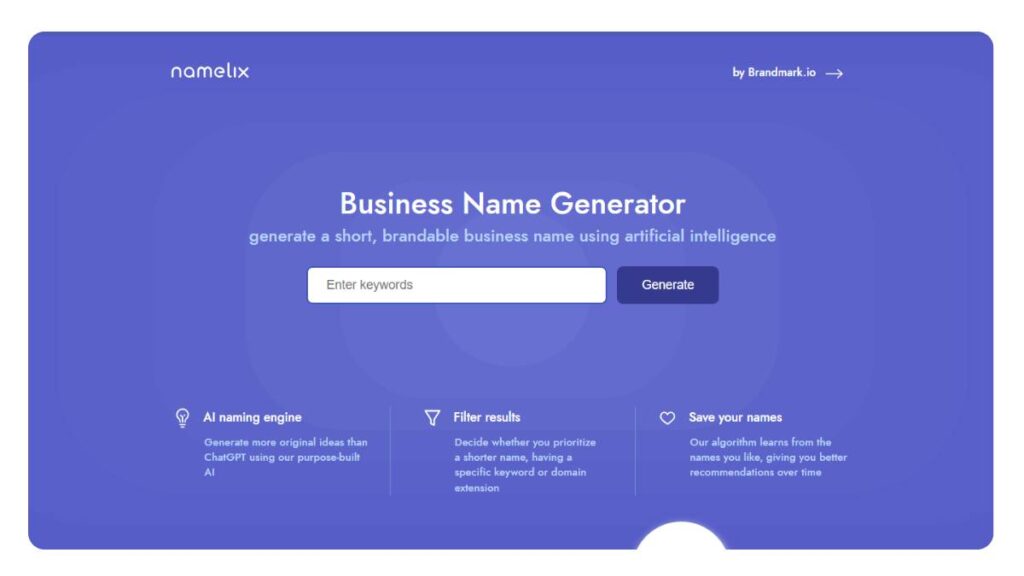
Namelix has a very clear bias: short, tight, brand-first names. Not descriptive. Not overly literal. More the kind of names that could sit on a homepage and feel “right” without explaining too much.
A lot of outputs lean toward made-up or slightly altered words. That can be a strength… or a problem, depending on what’s needed. For a modern brand, it works. For something that relies on clarity, maybe less so.
There’s also a pattern you’ll notice after a few searches. Clean names, minimal fluff, often two syllables or so. Easy to say. Easy to remember. That’s not accidental.
- Works well for: tech startups, SaaS, modern digital brands
- Needs a bit of care with: meaning; some names sound good but feel empty
3. Looka – Business names plus logo design suggestions
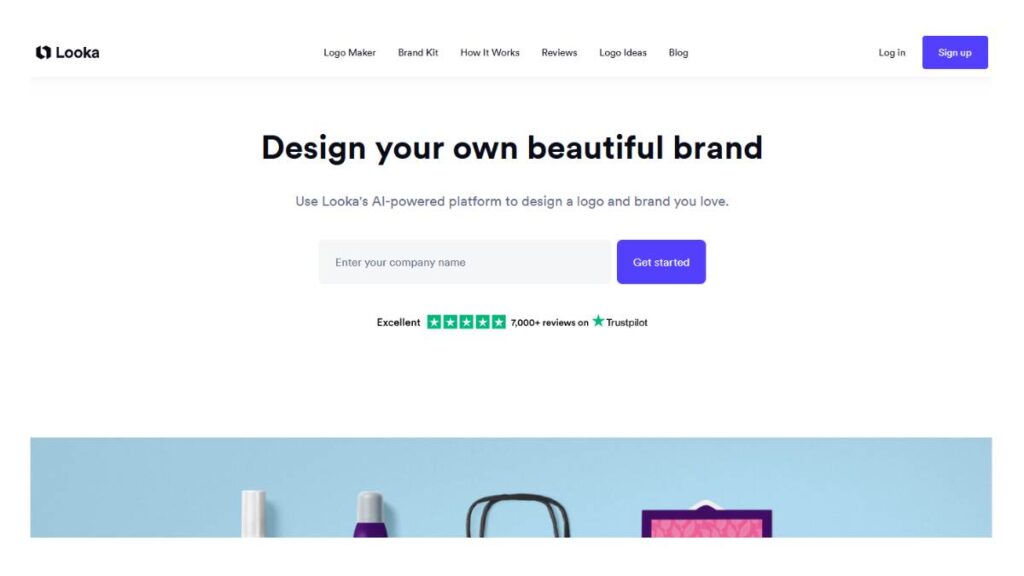
Looka doesn’t stop at the name. It immediately tries to show what that name could look like as a brand. Logo previews, colors, type; rough, but enough to react to.
That changes things. A name that feels average on its own might suddenly click when paired with a visual direction. Or the opposite happens; it looks off, even if it sounded fine.
It’s a different way of evaluating names. Less abstract, more practical.
- Works well for: early-stage founders trying to move fast
- Needs a bit of care with: not getting pulled in by visuals too early
4. BrandCrowd – Customizable AI name generator with professional styles
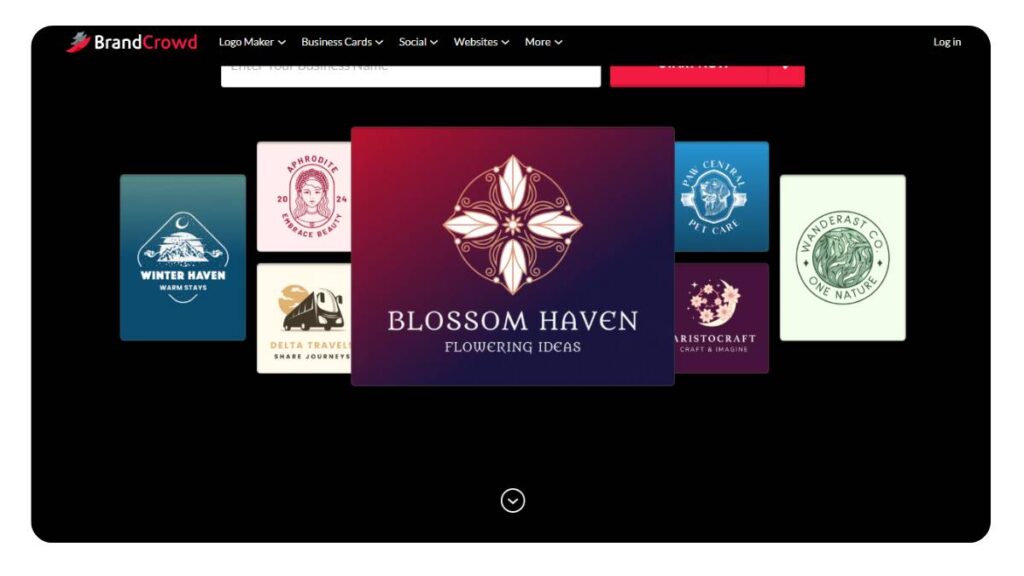
BrandCrowd sits on the safer side. The names feel structured, business-ready, and often a bit formal. Not much experimentation here, and that’s kind of the point.
If the goal is something polished and credible, it does the job. Especially for industries where trust matters more than creativity.
Still, there’s a trade-off. Safe names can blur together if not chosen carefully.
- Works well for: agencies, consulting firms, B2B services
- Needs a bit of care with: standing out; some suggestions feel familiar
5. Business Name Maker – Flexible options for one or two-word names
This one keeps things simple. No heavy styling, no complicated setup. Just straightforward combinations; mostly one or two words built around your input.
The results depend heavily on what goes in. Broad keywords? You’ll get broad names. More specific input? The quality improves quickly.
There’s something useful about that simplicity. It doesn’t try too hard.
- Works well for: small businesses, local brands
- Needs a bit of care with: generic outputs if inputs are vague
6. Namesnack – Free AI generator with industry-specific suggestions
Namesnack tends to stay close to the industry you’re working in. The suggestions feel relevant, sometimes a bit too on-the-nose, but still usable.
You’ll usually see a mix; some names are built directly from keywords, others that lean more toward branding. That variety helps, especially in the early stages.
Not every result lands. But enough to make it worth the time.
- Works well for: getting industry-aligned ideas quickly
- Needs a bit of care with: filtering; quality varies across results
7. SquadHelp – Crowd + AI hybrid business naming platform
SquadHelp takes a different route. It blends automated suggestions with input from real people. That combination shows up in the names; they often feel more considered, less mechanical.
There’s usually more personality in the suggestions. Sometimes more risk too, which isn’t a bad thing when trying to stand out.
It’s not as instant as other tools. But the trade-off is depth.
- Works well for: brands looking for something distinctive
- Needs a bit of care with: time; it’s not the fastest option
8. Oberlo Business Name Generator – Perfect for e-commerce startups
Oberlo clearly leans into e-commerce. The names often sound like they belong on product pages or online stores. There’s a certain style to them; direct, slightly branded, easy to plug into a storefront.
That focus helps if you’re building in that space. Less helpful if you’re not.
There’s also a tendency toward trend-based naming, which can age quickly if not handled carefully.
- Works well for: online stores, product-based brands
- Needs a bit of care with: long-term flexibility
9. Wordlab Business Name Generator – Offers hundreds of creative options
Wordlab is… a lot. You’ll get long lists, across different categories, with very little filtering upfront.
Some names feel sharp. Others feel random. That’s part of the experience. It’s less about precision and more about digging through and spotting something useful.
It can feel messy. But that mess sometimes leads to better ideas.
- Works well for: creative exploration
- Needs a bit of care with: time; you’ll need to sift through a lot
10. Shopify Business Name Generator – Domain-ready AI name tool
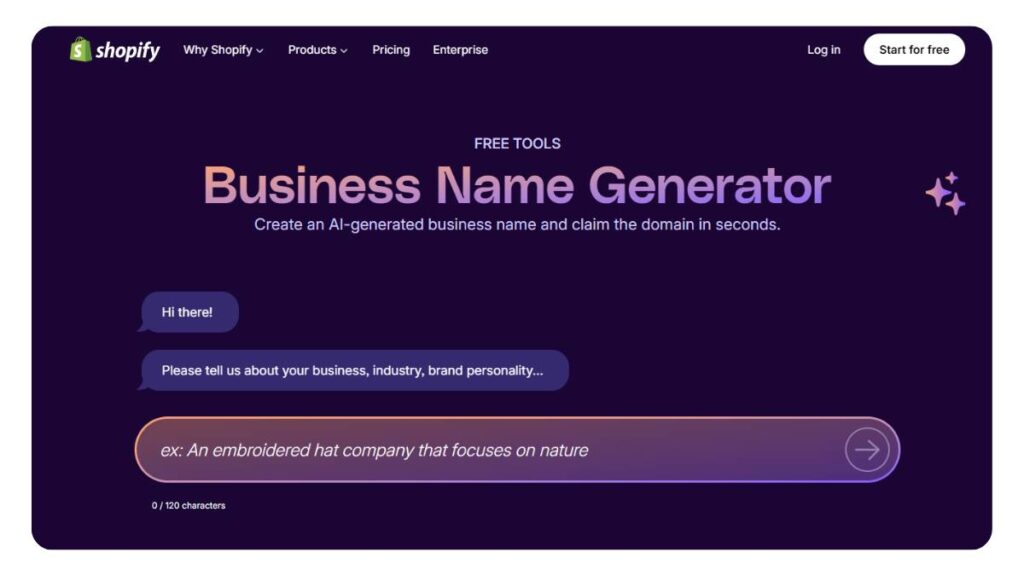
Shopify’s generator is practical. Almost aggressively so. It focuses on names that are available as domains, which keeps everything grounded.
You won’t see a lot of wild or experimental ideas here. But you will see names you can actually use right away. And that matters more than people admit.
Especially when timelines are tight.
- Works well for: launching quickly with a usable name
- Needs a bit of care with: creativity; options can feel limited
11. Panabee – Generates names with wordplay and domain checks
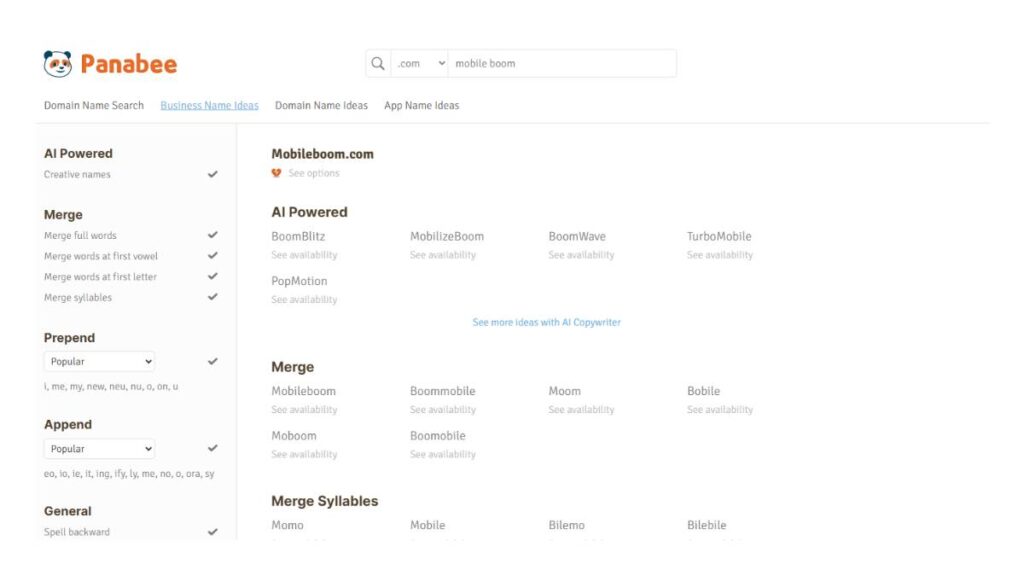
Panabee plays around with language a bit more. It twists words, combines them, and suggests variations that feel slightly offbeat.
Some of it works really well. Some of it feels forced. That’s the nature of wordplay.
Still, it’s useful when standard combinations start to feel repetitive. It pushes things just enough without going completely off track.
- Works well for: brands that want a bit of character
- Needs a bit of care with: clarity; clever names aren’t always easy to remember
12. ZenBusiness Business Name Generator – Names built around business type, audience, and tone
ZenBusiness offers a free business name generator that runs suggestions through an AI layer factoring in business type, target audience, preferred tone, keywords, and location instead of just remixing whatever keyword you type in. It also filters out anything that reads as generic or off-brand before it reaches you.
The tool sits inside a wider set of free business planning resources, so once a name is shortlisted, moving into logo or domain territory is a short hop rather than a separate search.
- Works well for: founders who want name suggestions shaped by audience and tone, not just keywords
- Needs a bit of care with: variety; the filtering keeps things on-brand but can narrow the range compared to more freewheeling generators
Enroll Now: AI Marketing Course
How to Use an AI Business Name Generator: Step-by-Step Guide
Choosing keywords and industry terms
Everything starts here. And this is where most people rush.
The instinct is to type one broad keyword and hit generate. Something like “fitness” or “marketing.” The result? Predictable names. Nothing wrong with them, but nothing that sticks either.
A better approach is to layer the input a bit. Think in terms of:
- What the business does
- Who it serves
- How it wants to be perceived
So instead of “fitness,” something like “premium home fitness,” or “quick workouts for busy professionals.” That extra detail shapes the output more than expected.
Not about overthinking it. Just giving the tool enough direction to work with.
Adjusting style, randomness, and length
Once the first set of names shows up, this is where things start to open up.
Most tools allow some level of control: style, tone, sometimes even how “creative” the results should be. It’s worth playing with that.
- Lower creativity – more direct, keyword-heavy names
- Higher creativity – more abstract, brand-style names
Neither is better. Just different use cases.
Same with length. Short names are easier to remember, but slightly longer ones can carry more meaning. It’s usually a trade-off, not a clear win.
The key is not to settle on the first set. Run a few variations. Small tweaks in input can lead to very different directions.
Filtering unwanted words with negative keyword options
This part often gets ignored, but it makes a difference.
Sometimes certain words keep showing up; words that don’t fit, or feel off-brand. Instead of working around them, it’s better to block them entirely if the tool allows it.
Removing noise sharpens the results. Less clutter, more relevant options.
It’s a bit like editing before writing. The output improves when constraints are clear.
Checking domain availability and social media handles
This is where practicality kicks in.
A name might look perfect… until the domain is gone. Or the social handles are taken everywhere. That gap between idea and execution can slow things down fast.
So it helps to check early. Not after finalizing, but during the process.
- Look for clean domain availability (not just variations)
- Check if social handles are consistent across platforms
- Avoid names that require too many workarounds
A good name that’s usable beats a great name that isn’t.
Finalizing and testing the brand name
Shortlisting is one thing. Deciding is another.
At this stage, it’s less about generating and more about pressure-testing:
- Say the name out loud; does it flow naturally?
- Write it down; does it look clean?
- Imagine it in different contexts: website, packaging, ads
Some names hold up. Others start to feel awkward the more they’re used to it.
And that’s usually the signal.
There’s no perfect formula here. Just a bit of repetition, a bit of instinct. The right name tends to feel steady across different situations.
Common Mistakes to Avoid When Using AI Business Name Generators
Relying solely on AI without human input
It’s tempting to treat the output as final. After all, the tool gives plenty of options; some of them are quite good.
But names don’t exist in isolation. They carry meaning, context, and long-term implications. That layer still needs human judgment.
Without it, the risk is ending up with something that sounds fine… but doesn’t quite fit.
Use the tool for exploration. Not for the final call.
Ignoring domain or trademark checks
This one shows up more often than it should.
A name gets shortlisted, maybe even finalized, and only then does someone check availability. By that point, changing direction feels frustrating.
Same with trademarks. Overlooking this step can create bigger issues later: rebranding, legal complications, and unnecessary delays.
It’s not the most exciting part of the process. But it’s one of the most important.
Overcomplicating the name: short and memorable is better
There’s a tendency to add more: extra words, extra meaning, extra detail.
But most strong brand names are simple. Not always obvious, but simple enough to recall without effort.
Long or complex names:
- Are harder to pronounce
- Get shortened anyway
- Lose impact over time
Clarity beats cleverness more often than expected.
Using overly generic keywords
Broad inputs lead to broad outputs. That’s just how it works.
If the starting point is too generic, the names will be too. They’ll blend in, sound familiar, and be easy to forget.
A bit of specificity changes everything. Even small details; target audience, tone, and positioning, can push the results in a better direction.
It doesn’t need to be perfect. Just more intentional.
Real-World Examples of Successful AI-Generated Business Names
Case studies of startups using AI for branding
There’s been a quiet shift over the past few years. More startups are using naming tools early in the process, not as a final solution, but as a starting point.
In many cases, the final name isn’t a direct output. It’s a refinement. A variation. Something that came from scanning dozens of suggestions and noticing patterns.
A few common scenarios tend to show up:
- Founders start with a broad idea, generate options, then narrow down to a specific style (short, abstract, or compound names)
- A slightly unusual or invented word stands out, gets tweaked, and becomes the final brand
- Multiple generated names get combined or reworked into something more original
The process isn’t linear. It moves back and forth a bit. But the end result often feels more intentional than starting from a blank page.
Insights on what makes a generated name work
Not every generated name is usable. Far from it. But the ones that do work tend to share a few traits.
They’re:
- Easy to say without hesitation
- Distinct enough to stand out, but not confusing
- Flexible; able to grow beyond the initial product or idea
There’s also a balance between meaning and abstraction. Some of the strongest names don’t describe the business directly, but still feel connected to it over time.
And maybe the most overlooked point: good names don’t try too hard. They settle in quickly. No friction, no second-guessing.
That’s usually the sign.
AI Business Name Generator vs Human Creativity
Strengths and limitations of AI naming tools
There’s a lot these tools do well. Speed is obvious, but it goes a bit deeper than that.
They’re good at spotting patterns. Good at remixing ideas. Good at pushing out variations that would take hours to come up with manually. And sometimes, they land on combinations that feel fresh simply because they’re not following the usual mental shortcuts.
But there are limits. Clear ones.
They don’t really understand context the way a person does. They don’t know the backstory of a brand, the long-term vision, or the subtle tone a business is trying to hit. So while the names might sound right, they don’t always feel right when looked at more closely.
A few things to keep in mind:
- Strong at volume, weaker at depth
- Good at structure, less reliable on nuance
- Useful for direction, not always for final decisions
That gap is where human thinking still matters.
How AI can enhance but not replace strategic brand thinking
Naming isn’t just about finding a word that looks good. It’s tied to positioning, audience, future growth; things that aren’t always visible on the surface.
That’s where strategy comes in. And that part doesn’t really get automated.
These tools can:
- Suggest directions
- Surface patterns
- Speed up exploration
But they can’t decide:
- Whether a name aligns with the brand’s long-term vision
- If it resonates with a specific audience
- How it might age over time
That layer still needs judgment. And sometimes, a bit of restraint.
Because not every clever name is a good one. And not every simple name is weak.
Combining AI suggestions with creative brainstorming
This is where things tend to work best: some structure, some instinct, a bit of back and forth.
A practical way to approach it:
- Start with generated names to widen the field
- Shortlist a handful that feel close
- Step away from the tool and refine manually
- Come back and test variations again
It’s not a straight line. More like a loop.
Sometimes the final name comes directly from the list. Other times, it’s a small tweak; a change in spelling, a shortened version, or a combination of two ideas.
And occasionally, the best option shows up after the tool is closed. That happens more often than expected.
Conclusion
Why every startup and small business should consider AI name generators
Naming used to be one of those slow, drawn-out tasks. Easy to delay, harder to finish.
These tools change that. Not by replacing the thinking, but by removing the blank page problem. They give a starting point. Actually, they give dozens.
For startups, especially, that matters. Time is limited, decisions stack up quickly, and getting stuck on a name can hold everything else back.
Even for small businesses or side projects, there’s value in exploring more options early on. It leads to better choices, or at least fewer regrets later.
Encouragement to experiment with multiple tools
No single tool gets it right every time. Each one has its own patterns, its own way of generating names.
Trying just one usually gives a narrow view. Trying a few open things up.
- One tool might lean toward short, brandable names
- Another might stay close to keywords
- Another might push more creative combinations
That variety helps. It makes it easier to spot what feels right and what doesn’t.
There’s no need to overthink it. Just explore, compare, and move on.
Final tips on choosing the most memorable and relevant name
At some point, the search needs to stop. That’s usually the hardest part.
A few things tend to help when narrowing it down:
- Say the name out loud more than once
- Check how it looks in simple text; no design, no styling
- Imagine explaining it to someone quickly
If it feels natural across those small tests, that’s a good sign.
And if there’s hesitation, something slightly off, it usually doesn’t go away later.
A strong name doesn’t need constant justification. It settles in. Feels usable. Easy to come back to.
That’s usually enough.
FAQ:
Can AI guarantee a perfect business name?
Short answer: no. It can get you close, sometimes very close, but “perfect” is a moving target. A name might sound great in isolation and still feel off once you place it inside a real brand. Audience, positioning, future plans… all of that matters. The tool suggests options. The final call still needs a bit of human sense-checking.
Are AI-generated names unique?
Some will be. Many won’t. There’s a lot of pattern reuse happening; common words, familiar structures, slight variations. That’s why a name might feel oddly familiar even if it’s technically new. The more distinctive results usually come after tweaking: combining parts, adjusting spelling, or just pushing the idea a step further.
How much do AI business name generators cost?
There’s a wide range. Plenty of tools are free for basic name generation, which is enough for most early-stage work. Costs usually come in later, when you want logos, branding kits, or premium suggestions. So, naming itself? Often free. Turning that name into a full brand, that’s where some investment starts to show up.
Can AI also suggest logos and branding?
Yes, and that’s becoming standard now. You’ll often see quick logo mockups, color ideas, maybe even font pairings. Helpful, especially when trying to visualize things early. But they’re rough directions, not finished work. Most brands outgrow those initial visuals pretty quickly once they start taking things more seriously.
Do I need technical skills to use an AI business name generator?
Not really. The tools are designed to be simple; type in a few words, adjust a setting or two, and go. The harder part isn’t using the tool. It’s knowing which names are worth keeping. That filtering instinct matters more than anything technical here.
Can AI business name generators check domain availability automatically?
In many cases, yes. And honestly, that’s one of the more practical features. It saves time and avoids that moment where a “perfect” name turns out to be unusable. It’s not always 100% accurate, though. A quick double-check never hurts, especially before making a final decision.
Are AI-generated names suitable for international markets?
Sometimes. But it’s not something to assume. A name that works in one language might sound strange, or mean something entirely different; in another. These tools don’t always catch that. If there’s any chance of going global, it’s worth pausing and checking how the name travels.
Can AI generate names for multiple industries at once?
It can, but the results tend to lose clarity. When inputs are too broad, the names come out vague. Not quite right for anything specific. It usually works better to run separate searches, one direction at a time. Keeps things cleaner, easier to evaluate.
How accurate are AI suggestions for brand identity and tone?
They can be surprisingly close, especially with clear inputs. But there’s often a surface-level accuracy; it sounds right, but doesn’t fully hold up. Tone is subtle. It’s shaped by more than just words. So the suggestions help, but they still need a bit of interpretation before committing.
Can I customize AI-generated names for length, style, or wordplay?
Yes, most tools give some control there. You can push for shorter names, more playful ones, or something more formal. It helps guide the direction. Still, the real refinement usually happens after adjusting, trimming, and reshaping until it feels right.
Do AI business name generators offer social media handle suggestions?
Some do, and it’s a useful addition. Seeing whether a name is available across platforms early on avoids friction later. Consistency matters more than it seems at first. It’s easier to lock that in upfront than fix it once accounts are already scattered.
Can AI help create SEO-friendly business names?
It can lean toward keyword-heavy names, sure. But that’s not always the goal. Names that try too hard to describe everything tend to feel flat. What usually works better is something memorable first, with just enough relevance to hint at what the business does.
How often are AI naming algorithms updated with new trends?
Fairly often, though it’s not always obvious. Naming trends shift; shorter names, new patterns, different tones; and the outputs gradually reflect that. You’ll notice it more over time than in a single session. Especially in fast-moving industries, the style of names does evolve.
Is it better to rely solely on AI or combine it with human brainstorming?
A mix tends to work best. The tool opens up possibilities quickly. Human input narrows things down with context and judgment. Rely on just one, and something gets missed. Together, it’s a bit more balanced and usually leads to stronger choices.
Can AI suggest names in multiple languages?
Some tools can handle that, yes. They’ll generate names based on different language patterns or let you switch between languages. Still, it’s not foolproof. Meanings can shift, and pronunciation can get tricky. A quick check with native speakers or basic research goes a long way.
How do AI generators handle common words or generic terms?
They reuse them a lot. Often with small tweaks, added prefixes, or combined forms. That’s why generic inputs lead to familiar-sounding results. To break out of that, the input needs more specificity. Otherwise, the names tend to blur together.
Can I save and compare multiple AI-generated name lists?
Most tools allow some form of saving or shortlisting, though it varies. Even if they don’t, it’s worth keeping a separate list. Comparing names side by side helps spot patterns; what’s working, what feels repetitive, what actually stands out after a second look.
Are AI-generated names more likely to be available as domains?
Sometimes, yes. Especially when the tool is designed with domain availability in mind. But it’s not guaranteed. Good names get picked up quickly. Availability should always be checked as part of the process, not assumed.
Can AI suggest catchy or rhyming names?
It can, and it does quite often. Rhymes, alliteration, playful structures; they show up easily. Some of them stick. Others feel a bit forced. Catchy helps, no doubt. But only if the name still feels natural when said out loud. That part matters more than the cleverness.