

A salary lands in a Dubai account. RSUs vest in a US brokerage. Rent goes out in rupees, the coworking desk bills in euros, and a client in London pays whenever their finance team gets around to it. Then return season arrives and the tax form wants all of it, in rupees, at prescribed exchange rates, split across a financial year and a calendar year that never line up.
That’s usually when people realise nobody ever taught them how to track expenses and taxes across multiple countries. The cost of winging it is real.
A missed foreign-asset disclosure carries a flat ₹10 lakh penalty for each year. A tax credit can vanish because one form went in late. A bank can quietly collect 20% TCS on a transfer you thought was routine.
This guide builds one working system for tracking expenses and taxes across countries. It covers who gets to tax you, what to record, how to convert currencies the way Indian rules expect and which deadlines are still live as of 30 September 2026. Every figure comes from 2026 sources. Each section is written so you can act on it this week.
Table of Contents
Why Does Managing Money Across Borders Get So Messy?
Because every country runs its own tax year, its own currency and its own residency test, and none of them coordinate. One paycheque can be taxed twice, reported on two different calendars and converted at three different exchange rates. The mess isn’t your fault, but the paperwork still is.
Different tax years, different currencies, different rules
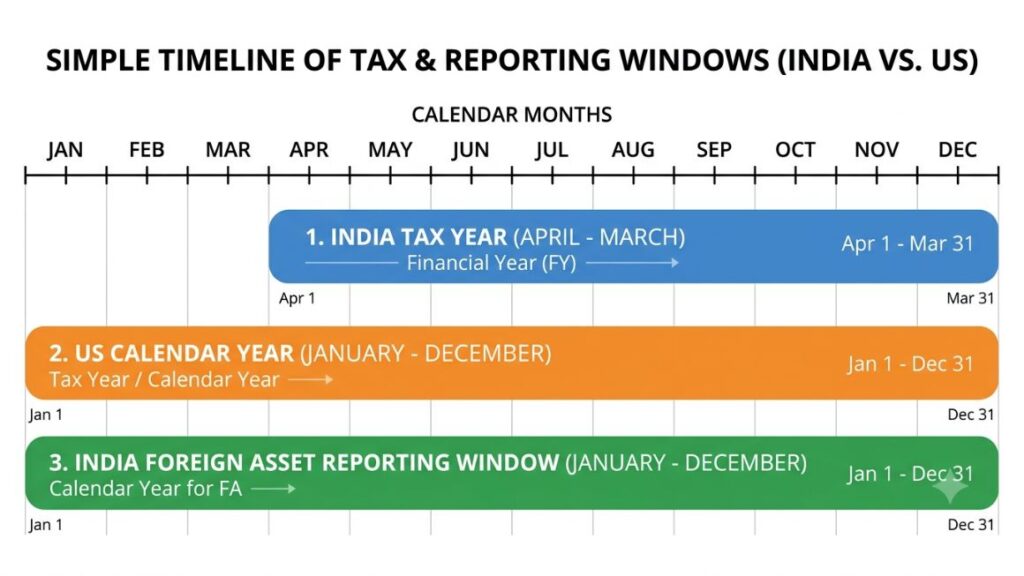
India’s tax year runs from 1 April to 31 March. The US taxes individuals on a calendar year. And India’s own foreign-asset disclosure ignores its own financial year and follows January to December instead, which trips up almost everyone the first time.
Currency adds a second layer. Your bank might show a dollar amount, your employer’s payslip shows another, and the Income Tax Department wants a rupee figure at a specific SBI rate on a specific date. Three sources, three numbers, one return. Any plan to track expenses and taxes across multiple countries has to start by admitting those calendars exist.
Scale matters here too. According to RBI data reported by Business Standard in December 2025, Indians remitted $17.2 billion overseas between April and October of FY26 alone. That’s a lot of households now holding money, assets or income in more than one place.
Who this actually affects
If you think this only concerns people who have emigrated, think again. Four groups get caught most often.
Remote workers
You might live in India and draw a salary from an overseas company, or live abroad on an Indian payroll. Either way, two countries may be counting your days at once, and tracking expenses and taxes across countries gets harder when the payslip and the desk sit in different places. Anyone searching for digital nomad taxes ends up in the same place: no country lets you skip the day count.
Also Read: Top Digital Marketing Jobs for freshers & Salary
Freelancers
A cross-border freelancer bills in dollars or pounds, gets paid through a platform that takes a cut, and often has no idea which of those numbers the tax office wants. The invoice value, the fees and the amount that finally lands in your account are three different figures. All three need a home in your records.
Returning NRIs
Coming back to India doesn’t switch your foreign life off. Old brokerage accounts, foreign bank balances and pension plans usually stay open. Your status in the first few years back decides how much of that India can tax.
ESOP and RSU holders
Employees of India-based teams at US-listed companies often receive shares in the parent. Those shares are foreign assets the moment they vest. They need reporting even if you never sell a single one.
Which Country Gets to Tax You? Residency Rules Explained
Your tax residency decides which income a country can tax. India taxes a resident on worldwide income. A non-resident pays Indian tax only on income earned or received in India. For most people, the number of days spent in the country settles it.
India’s residency tests (182 days, the 60/120-day rule, RNOR)
Here’s the good news for 2026: the rules didn’t change. The Income Tax Department’s own FAQ confirms that the day-count tests carry over unchanged into the Income-tax Act, 2025. Residential status for FY 2026-27 is decided under the new Act using days spent from 1 April 2026.
You’re a resident in India for a tax year if either of these is true:
- You spent 182 days or more in India during that tax year.
- You spent at least 60 days in India that year and 365 days or more across the four years before it.
The 60-day limit stretches to 120 days for an Indian citizen or person of Indian origin whose Indian income (leaving out foreign income) is above ₹15 lakh. Land in that band, 120 to 181 days, and you become a resident but not ordinarily resident, or RNOR.
There’s a third door that catches people who thought they’d escaped. An Indian citizen with Indian income above ₹15 lakh who isn’t liable to tax in any other country is treated as a deemed resident, and lands in RNOR too. Living in a zero-tax country doesn’t automatically make you a non-resident.
RNOR itself is the friendlier status. According to the analysis published by SKLA, you fall here if you were non-resident in nine of the previous ten years, or spent 729 days or fewer in India across the previous seven. Foreign income that has no link to a business or profession controlled from India generally stays outside Indian tax.
One catch worth flagging: the day count follows India’s April to March year, not the calendar year. Count on the wrong calendar and you can be wrong by weeks. Getting the day count right is step zero if you want to track expenses and taxes across multiple countries.
Tie-breaker rules under tax treaties
When two countries both call you a resident, the treaty between them picks one. It works down a fixed order: where you have a permanent home available, then where your personal and economic ties are closer (your centre of vital interests), then where you habitually live, and finally your nationality. If none of that settles it, the two tax authorities decide between themselves.
The order isn’t theoretical. In Sameer Malhotra v ACIT, the Delhi Income Tax Appellate Tribunal treated a taxpayer as a resident of Singapore under the India-Singapore treaty for part of a year. According to Nishith Desai Associates’ summary, three facts carried weight: his Indian home was rented out, so it wasn’t “available” to him, his family had moved with him, and he held a residence certificate from Singapore’s tax authority.
Notice what won that case. Documents did. Keep the rental agreement, the school admission letters, the residence permit and the certificate of residence together in one folder.
Days-in-country log
Keep a plain log with one row per day: date, country, city, and proof. Proof can be a boarding pass, a hotel invoice or a passport stamp. Some people also export their phone’s location history at the end of each quarter as a backup.
Update it weekly, not yearly. Residency comes first when you track your expenses and taxes across multiple countries. Get the status wrong and every number after it is built on sand. Reconstructing 365 days from memory in March is exactly how people end up at 184 days without knowing it.
India decides residential status by counting days in the April-March tax year: 182 days makes you a resident. 60 days plus 365 days over four years does the same, with the 60 stretching to 120 for citizens with Indian income above ₹15 lakh. The Income Tax Department confirms these tests carry over unchanged into the Income-tax Act, 2025. When two countries both claim you, the tax treaty tie-breaker looks at permanent home first. So rental agreements and residency certificates matter.
How Do You Track Expenses and Taxes Across Multiple Countries in One System?
Use one home currency, one folder structure and one calendar. Then log every transaction in its original currency with a date and a purpose tag. That single habit lets you track expenses and taxes across multiple countries without rebuilding your year from bank statements every March.
Step-by-step setup
Set this up once and you can track your expenses and taxes across multiple countries in about twenty minutes a month.
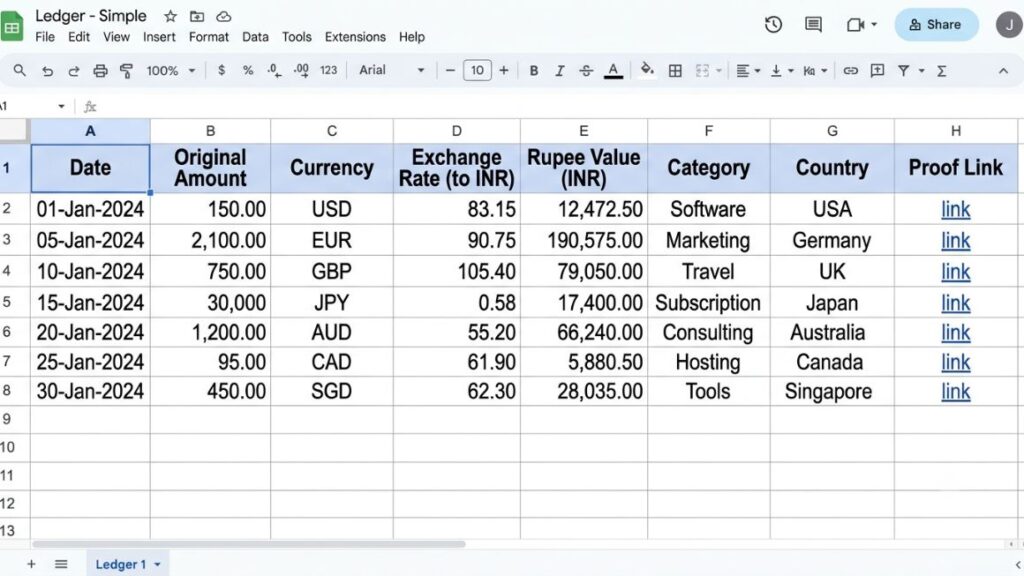
- Pick rupees as your reporting currency. Record every transaction in the currency it happened in, then add the rupee value in a separate column.
- Build one folder tree. Use Year, then Country, then four subfolders: Income, Tax Paid, Expenses and Assets. Mirror it to a second cloud drive.
- Keep one calendar. Put your day-count log and every filing deadline on the same calendar, with reminders two weeks ahead.
- Tag each expense on entry. Use personal, business, reimbursed by employer or shared. Doing it later never happens.
- Capture the receipt within 24 hours. A phone photo is fine. A pile of paper in a jacket pocket is not a system.
- Reconcile monthly. Match your ledger against bank and card statements, and note any income that has foreign tax withheld.
- Snapshot your foreign balances on 31 December. Also note the highest balance each account touched during the year. Indian reporting asks for both.
Choosing a tool stack
The best way to track expenses and taxes across multiple countries with software is to combine three layers. Most people need just these: an account or card that keeps original currencies intact, a receipt capture tool, and one master ledger. You don’t need all the paid options. A spreadsheet plus a decent scanner handles most cases.
For multi-currency expense tracking, the account layer matters most. Wise, according to a March 2026 comparison by Finny, holds 40+ currencies and preserves the original currency on every card transaction. The limit is the same for Wise and Revolut: they only see their own transactions, so cash or another card stays invisible.
On the capture side, a receipt management app saves you from photographing and renaming files by hand. Ramp’s August 2026 roundup notes that Zoho Expense has a free plan for up to three users with 20 scans a month, and that Expensify is free for individuals.
| Tool type | Examples | Best for | Watch out for |
| Multi-currency account or card | Wise, Airwallex | Keeping original currency on every spend | Only records its own transactions |
| Receipt and expense apps | Expensify, Zoho Expense | Scanning receipts, converting to home currency | Free tiers cap scans and users |
| Personal budgeting apps | Monarch, YNAB | Household budgets in one currency | Airwallex’s 2026 review says the personal apps it tested track a single currency |
| Spreadsheet | Google Sheets, Excel | Full control, tax-ready columns | Works only if you update it monthly |
Whichever tools you pick, the goal is the same: track expenses and taxes across countries in one place. Prices and limits shift often. Several of these sources come from vendors, so check each product’s page before you commit. If you already run a business, Airwallex’s own review says its free Explore plan covers up to 10 spend users and its business account holds 20+ currencies, which is worth a look for small teams.
Also Read: Freelancer Tools Stack: What You Actually Need vs What’s Overkill
Handling exchange rates correctly
Currency conversion is where tracking expenses and taxes across countries breaks most often. Indian rules don’t accept the rate you saw on Google. They want the SBI telegraphic transfer buying rate, or TTBR, for a date that depends on the type of income.
Under Rule 115 of the Income-tax Rules, 1962, salary is converted at the TTBR on the last day of the month before the month it falls due. Capital gains use the last day of the month before the transfer, and dividends use the last day of the month before they’re declared or paid. Foreign tax paid gets converted under Rule 128 the same way, on the last day of the month before the tax was paid or deducted, according to a TaxTMI expert reply.
For the closing value of foreign holdings in your return, BestTaxInfo says to use the TTBR as on 31 December of the year reported. So add a TTBR column to your ledger, and fill it in as you go.
One more thing to check. The Income-tax Act, 2025 came into force on 1 April 2026. It rules for tax years starting from that date sit under the new Income-tax Rules, 2026. Confirm the rule numbering with your chartered accountant. The exchange-rate logic is unlikely to change but the citations will.
The simplest way to track expenses and taxes across multiple countries is one home currency, one folder structure and one calendar. Record each transaction in its original currency, then convert to rupees using the SBI TTBR on the date Rule 115 prescribes, not a Google rate. Reconcile monthly and snapshot every foreign balance on 31 December.
What Records Should You Keep, and For How Long?
Keep proof of every income, every tax paid and every foreign asset for at least seven years, and longer for property and overseas holdings. The tax department can generally reopen a case up to three years after the assessment year ends, and up to ten years where the alleged escaped income is above ₹50 lakh.
Good records are what let you track expenses and taxes across multiple countries years after the fact. That’s the standard set out by advocate Amitraj Kaushal in Outlook Money. The same piece suggests a seven-year storage habit as a practical buffer for basic tax records, and says to hold documents until any assessment, appeal or dispute is fully closed.
Foreign assets deserve extra caution. The reopening window for income linked to overseas assets was extended to 16 years by an earlier amendment to Section 149, so a decade-old brokerage statement can still matter. Whether that limit still applies to a given year depends on the law in force for that assessment year, so ask a CA before you shred anything.
Income, tax-paid and proof documents
Build your folder around what a tax officer would ask for. In practice that’s this list:
- Payslips, invoices and contracts, showing gross amounts and currency
- Foreign tax certificates or withholding statements, such as Form 1042-S for US-source income
- Proof of payment for every foreign tax
- Certificates of residence from any country that has issued one
- Bank, card and brokerage statements, with year-end balances
- ESOP or RSU grant letters and vesting statements
- Remittance advices and, for exporters, your LUT acknowledgement
Business vs. personal expense tagging
Tagging is the cheapest way to track expenses and taxes across countries. Do it at the moment of spending, not at year end. A personal, business, reimbursed or shared label takes two seconds on entry and hours to guess later.
Reimbursed expenses are the classic trap. If your employer paid it back, it’s not your deduction, and claiming it twice is how a tidy ledger becomes an awkward notice. Separate cards for business and personal spending do more for your record-keeping than any app.
How Does India Tax Foreign Income and Give You Credit for Tax Already Paid?
A resident and ordinarily resident pays Indian tax on global income, then claims credit for tax already paid abroad under a tax treaty or, where there’s no treaty, under Section 91. The credit is capped at the lower of the foreign tax paid and the Indian tax on that same income, worked out country by country and source by source.
DTAA and foreign tax credit basics
A double taxation avoidance agreement (DTAA) is a bilateral treaty that stops the same income being taxed in full by both countries. A foreign tax credit is the relief that lets you subtract tax paid abroad from your Indian tax bill on that income. India has treaties with more than 90 countries, according to TaxFetch.
Here’s a worked example with assumed numbers. You earn $1,000 in dividends from a US stock, and $250 is withheld at source. Assume the TTBR converts to ₹90 per dollar. Your income is ₹90,000 and the foreign tax is ₹22,500.
If your slab rate is 30%, Indian tax on that income is about ₹27,000 before cess. The credit is the lower of ₹22,500 and ₹27,000, so it’s ₹22,500. You pay the remaining ₹4,500 or so in India.
The credit isn’t automatic, and it only works if your records let you track foreign tax paid country by country. It needs a separate filing, and foreign tax deducted at source doesn’t count for anything until you claim it.
Form 67 today, Form 44 under the Income-tax Act, 2025, and the current deadlines
Which form you use depends on the year the income belongs to. Form 67 continues for income up to FY 2025-26 (assessment year 2026-27), even if you file it after 1 April 2026, according to myITreturn’s guide. For income earned in tax year 2026-27 and after, Form 44 takes over under Rule 76 of the Income-tax Rules, 2026.
Now the deadline, where sources disagree. Rule 128(9) allows Form 67 up to the end of the assessment year, so 31 March 2027 for AY 2026-27, provided your return itself was filed on time or as a belated return, per AskCASanjay. ClearTax and TaxFetch both tell readers to file before 31 December 2026, which is the belated-return cut-off. The safer rule is simple: file the form first, then the return, and don’t wait for March.
Order matters when you track expenses and taxes across multiple countries, and the credit form always goes ahead of the return.
Miss the window and you can lose the credit for that year altogether, as Skydo warns. Tribunals have allowed late claims in some cases, but building a plan on that is a gamble.
Common mistakes
Five errors show up again and again when people track expenses and taxes across countries.
- Using the wrong exchange rate. Foreign tax converts at the TTBR for the month before it was paid.
- Treating any tax as creditable. VAT, GST and sales tax aren’t income tax, so they don’t qualify.
- Mismatched numbers. Country, income, foreign tax and credit figures should reconcile across Form 67 and the return schedules, myITreturn notes.
- Claiming tax deducted, not tax due. Foreign tax can’t be claimed merely because it was withheld.
- No proof. Keep the certificate and the payment proof, because the form asks for both as attachments.
India lets a resident claim credit for foreign income tax paid, limited to the lower of the foreign tax and the Indian tax on that same income. Form 67 applies up to FY 2025-26 and Form 44 applies from tax year 2026-27 under the Income-tax Act, 2025. File the form before the return, since the outer limit of 31 March 2027 for AY 2026-27 is not the date to aim for.
What Do You Have to Report Abroad? Schedule FA, FBAR and Foreign Accounts
Indian residents report foreign assets in their ITR whether or not those assets earned anything, and US persons file a separate FinCEN report once accounts cross $10,000. Both are about disclosure, not tax owed, and both carry penalties far larger than the sums usually involved.
Schedule FA (calendar-year rule) and the Black Money Act penalties
Schedule FA is the part of ITR-2 and ITR-3 where resident and ordinarily resident taxpayers list foreign bank accounts, shares, RSUs, property and signing authority. ITR-1 and ITR-4 don’t have it, so anyone with foreign assets has to move to a different form.
The trap is the calendar. For the AY 2026-27 return, you report assets held between 1 January and 31 December 2025, per Vested’s guide, not the April to March year. Reporting the balance on 31 March is one of the most common errors, Business Standard has noted.
The penalty is blunt. Under the Black Money Act, 2015, failing to disclose a foreign asset, or filing inaccurate details, attracts a flat ₹10 lakh penalty for each year. There’s a carve-out: where your non-immovable foreign assets total ₹20 lakh or less, that penalty doesn’t apply, according to CA Dinesh Bhalkikar, though the duty to disclose remains. Tax2win adds that Budget 2026 introduced relief from prosecution for the same small holdings, and ClearTax reports it applies from 1 October 2026.
Then there’s visibility. Under a CBDT order dated 8 July 2026, foreign account data received from other countries is being loaded into your AIS, and calendar-year 2025 data is expected after India receives it in September or October 2026, as TaxUpdate India reports. Check your AIS before you file, because the department may already know about that Singapore account.
FAST-DS 2026 disclosure window (open until 31 December 2026)
If an old foreign asset or income slipped through, the Foreign Assets of Small Taxpayers Disclosure Scheme is the off-ramp. It came into force on 16 August 2026 and stays open until 31 December 2026, according to the Income Tax Department’s FAQ, with declarations filed in Form 1 on the e-filing portal.
It has two routes:
- Category 1: undisclosed foreign income or assets, where the total value stays at or below ₹1 crore as of 31 March 2026. The effective cost is about 60%. The department’s own example: a ₹60 lakh undisclosed account plus ₹20 lakh of undisclosed income comes to ₹48 lakh payable.
- Category 2: foreign assets that were already funded from taxed income (or acquired while non-resident) but never reported, up to ₹5 crore. The fee is a flat ₹1 lakh.
Two cautions. The valuation date is 31 March 2026, so the exchange rate can decide which category you fall into. And the scheme excludes assets linked to proceeds of crime or years where a Black Money Act assessment is already complete. With three months left, it’s worth a proper conversation with a CA rather than a guess.
US and other countries’ reporting, briefly
If you’re a US citizen, green card holder or otherwise a US person, the Report of Foreign Bank and Financial Accounts, known as FBAR, applies once the combined value of your foreign accounts passes $10,000 at any point in the year. It goes to FinCEN, not the IRS, through the BSA E-Filing System.
The date is 15 April, with an automatic extension to 15 October and no form needed. For calendar-2025 accounts, that puts the extended deadline on 15 October 2026, two weeks from now. According to SDO CPA, 2026 penalties reach $16,536 for a non-willful miss and the greater of $165,353 or 50% of the balance for a willful one.
A separate US form, Form 8938, has higher thresholds and goes with your tax return. Other countries run their own disclosure regimes. If you hold accounts in a third country, look up its rules before assuming India and the US cover everything.
How Do You Send Money Abroad Without Overpaying TCS?
From 1 April 2026, banks collect no TCS on the first ₹10 lakh you remit in a financial year, then 2% on education and medical remittances above that and 20% on most other purposes. Overseas tour packages attract 2% from the first rupee, and education funded by a specified loan carries none.
Tax collected at source, or TCS, is an advance tax your bank collects when you send money out under the Liberalised Remittance Scheme (LRS). The scheme lets a resident individual remit up to $250,000 a financial year, according to Business Standard. Standard Chartered India’s notice and RBL Bank’s page both confirm the tour-package rate, while PKC India and Matrix Forex lay out the 2% and 20% bands above ₹10 lakh.
Remittance cost is the part of tracking expenses and taxes across countries that people forget until the bank has already collected it. Here’s what it means in rupees, for a year with no earlier remittances:
| Purpose | Amount sent | TCS calculation | TCS collected |
| Investment in a US brokerage | ₹25 lakh | 20% of ₹15 lakh above the threshold | ₹3,00,000 |
| Self-funded tuition | ₹25 lakh | 2% of ₹15 lakh above the threshold | ₹30,000 |
| Overseas tour package | ₹6 lakh | 2% from the first rupee, no threshold | ₹12,000 |
| Tuition paid from a specified education loan | ₹25 lakh | Nil | ₹0 |
RBL Bank notes that the ₹10 lakh limit is shared across purposes, excluding tour packages and education loans. Because it’s shared, the order of your transfers can change the bill, so ask the bank to run the numbers before a big transfer.
TCS isn’t an extra tax. It’s credited against your liability when you file, and any excess can be claimed as a refund, as BookMyForex explains. Some advisers warn that a PAN not linked to Aadhaar can double the rate, so link them before you remit.
What Changes If You Freelance or Run a Small Business Across Borders?
Exports of services are zero-rated under GST, so a freelancer billing a foreign client in foreign currency charges no GST when five conditions are met, and a yearly Letter of Undertaking keeps it that way. Everything else, from platform fees to the income itself, still needs tracking.
The five conditions in Section 2(6) of the IGST Act, as summarised by IncorpX, are that the supplier is in India, the recipient is outside India, the place of supply is outside India, payment arrives in convertible foreign exchange, and you’re not merely an intermediary. Get classed as an intermediary and 18% GST applies with no zero-rating. That one word decides a lot of invoices.
A Letter of Undertaking, or LUT, is filed on the GST portal in Form RFD-11 and must be renewed every financial year. The one for FY 2026-27 covers 1 April 2026 to 31 March 2027, and the next needs filing in April 2027. Without it, you’d pay IGST upfront and chase a refund for months.
Registration thresholds help smaller freelancers. GST becomes mandatory at ₹20 lakh of turnover (₹10 lakh in special category states), and a freelancer with only foreign clients charges 0% either way, according to Xflow. Many register voluntarily anyway, just to file the LUT and claim refunds on inputs.
Three habits keep the books clean when you track expenses and taxes across countries as a freelancer:
- Invoice in the client’s currency and show the export status on the invoice.
- Record three amounts per payment: invoice value, platform and conversion fees, and net rupees received.
- Report exports in your GST returns, in GSTR-1 (Table 6A) and GSTR-3B, even though the tax is nil.
For a freelancer, the way to track expenses and taxes across multiple countries is to keep every invoice, fee and conversion in one sheet. Remember that zero-rated doesn’t mean unreported. GST also applies to the currency conversion charge, not to the inward payment itself, Skydo points out. Whether the fees reduce your taxable income depends on how you’re taxed, so a CA should confirm before you deduct anything.
Also Read: Diversifying Income as a Freelancer: Beyond Just Client Work
A Monthly and Yearly Tax Calendar You Can Copy
Copy the table below into your calendar to track expenses and taxes across multiple countries on a schedule, and adjust it for your own situation. Dates are for the 2026-27 cycle and reflect sources checked in September 2026.
| When | What to do | Who it applies to |
| Last day of every month | Reconcile the ledger, update the day-count log, note the month-end SBI TTBR | Everyone |
| 15 October 2026 | Extended deadline for the US foreign-account report covering calendar-2025 accounts | US persons |
| October 2026 onward | Check your AIS for foreign account data received from other countries | Resident taxpayers with overseas assets |
| 15 December 2026 | Third advance tax instalment, if you owe advance tax | Freelancers and anyone with tax not fully deducted |
| 31 December 2026 | Last day for FAST-DS declarations and for a belated FY 2025-26 return. Snapshot foreign balances | Anyone with unreported foreign assets or a late return |
| 31 March 2027 | Outer limit for Form 67 for AY 2026-27. Collect foreign tax certificates | Anyone claiming credit for foreign tax |
| 1 April 2027 | File a fresh LUT for FY 2027-28 | GST-registered exporters |
| 15 April 2027 | US foreign-account report due for calendar-2026 accounts (auto-extends to 15 October) | US persons |
| July or August 2027 | File the FY 2026-27 return, with Form 44 first. Confirm the date for your ITR form | Everyone with foreign income |
Anyone who keeps to this schedule will track expenses and taxes across multiple countries with far fewer surprises. Belated returns come with a late fee of up to ₹5,000 and 1% monthly interest on unpaid tax, according to Tax2win. The revised-return date is reported as 31 March 2027 by some outlets and 31 December 2026 by others, so check the portal.
Mistakes That Cost People the Most
Honestly, most trouble when people track expenses and taxes across multiple countries comes from a handful of repeat errors. None of them are clever. They’re just easy to make when three countries send you paperwork at once.
- Counting days on the wrong calendar. Residency runs April to March. Foreign-asset disclosure runs January to December. Mixing them is the fastest way to get either wrong.
- Assuming zero income means zero reporting. A dormant foreign account still needs disclosure, and the ₹10 lakh penalty doesn’t care that it earned nothing.
- Using Google’s exchange rate. It’s convenient, and it’s not what the rules say.
- Filing the credit form last. Do it first. Treat the March deadline as the cliff, not the target.
- Charging GST on export invoices. It confuses foreign clients and misstates your books.
- Mixing personal and business spending on one card. Nobody has ever untangled that cleanly in March.
- Skipping the certificate of residence. A treaty position without a certificate is an argument, not a claim.
None of this is legal or tax advice. Rules change, and your facts are your own, so confirm your position with a chartered accountant before you file.
Conclusion
Three ideas are worth carrying out of this guide if you want to track expenses and taxes across multiple countries with less stress. Pick one home currency and log the original amount every time. Know which calendar governs each report: April to March for residency, January to December for foreign assets. And put the live deadlines on your calendar now, because 15 October, 31 December and 31 March are all close.
Start this weekend. Block two hours, build the folder tree, set up the ledger and back-fill your day count from your flight bookings. It’s dull work, and it’s how you track expenses and taxes across multiple countries without a panic every March.
If you like having a clear map for your own career decisions, the Crystal Clear Newsletter does that for marketers and digital professionals. It’s short, practical and built to help you plan your next move, whether that’s a job abroad, a remote role or a client base in another country. Subscribe to the Crystal Clear Newsletter and get the next edition in your inbox.
Frequently Asked Questions
What does it mean to be a tax resident of two countries at once?
It means both countries’ domestic tests say you’re a resident in the same period. That’s common in a year you move. The tax treaty between the two then decides which country wins, using permanent home, closer personal and economic ties, habitual abode and nationality in that order.
How many days in India make someone a tax resident?
182 days in the April to March tax year makes you a resident. So do 60 days plus 365 days across the four previous years. If you’re an Indian citizen with Indian income above ₹15 lakh, the 60 becomes 120 and you’re classed as RNOR, as the Income Tax Department’s FAQ explains.
Is a tax credit the same as a treaty exemption?
No. A credit lets you subtract foreign tax from your Indian tax on the same income, capped at the lower of the two. An exemption removes certain income from tax in one country altogether. Which one applies depends on the article of the treaty for that income type.
How is foreign income converted to rupees for the return?
Use the SBI TTBR for the date Rule 115 prescribes. For salary, that’s the last day of the month before the salary is due, and for capital gains it’s the last day of the month before the transfer. Convert foreign tax paid at the TTBR from the month before it was paid. That’s the step people most often get wrong when they try to track expenses and taxes across multiple countries by hand.
Do foreign assets that earned nothing still have to be reported?
Yes, for a resident and ordinarily resident taxpayer. Reporting depends on holding the asset, not on earning from it. A dormant account, or vested RSUs you never sold, still goes into your return on the calendar-year basis. Miss it and the ₹10 lakh penalty can apply.
Is it really worth tracking every small expense?
For personal coffee, no. For anything tied to income, foreign tax or business use, yes, because tracking expenses and taxes across countries only works when the records are complete. The small expenses are rarely the problem. The problem is having no record of which currency, which country and which purpose applied when someone asks.
Why was a claim for foreign tax rejected?
The usual reasons are a late Form 67, a missing tax certificate, the wrong exchange rate or figures that don’t match your return. Foreign tax also can’t be claimed just because it was deducted. Clean records make it easier to track expenses and taxes across countries and to prove a claim. Fix the mismatch and, if the deadline has passed, ask a CA about a rectification request.
Is US remote job salary taxable in India?
If the person is a resident in India, yes. India taxes residents on worldwide income, so the salary counts wherever the employer sits. If foreign tax was actually paid on that income, credit under the treaty is possible, but only through a separate filing.
Can old foreign assets still be disclosed if they were never reported?
Possibly. FAST-DS 2026 is open until 31 December 2026 for eligible taxpayers, with limits of ₹1 crore for undisclosed income and assets and ₹5 crore for already-taxed assets missed in disclosure. Get a CA to check eligibility before filing Form 1.
Do invoices to foreign clients need GST?
Usually not. Exports of services are zero-rated when you’re in India, the client and place of supply are outside India, payment comes in convertible foreign exchange and you aren’t an intermediary. File a Letter of Undertaking each financial year so you don’t pay IGST upfront.
How much TCS applies to a 20 lakh transfer abroad?
It depends on the purpose and what you’ve already sent this year. On a first ₹20 lakh remittance, the first ₹10 lakh has no TCS. TCS on the other ₹10 lakh would be 2% (₹20,000) for education or medical costs, or 20% (₹2,00,000) for investments.