

Most product teams don’t fail because of a bad roadmap. They fail because the roadmap lives in one tool, the backlog lives in another, and the conversation about priorities happens in Slack threads nobody can find three weeks later. By the time engineering starts a sprint, half the context is gone.
That gap between strategy and execution is exactly what the right software closes. A good platform gives your product managers, designers, and engineers one shared view of what’s planned, what’s in progress, and what’s blocked, so nobody has to reconstruct the story from memory. This guide breaks down 15 tools that handle roadmapping, backlog management, or cross-functional collaboration well, with real pricing, honest trade-offs, and who each one actually fits.
Not every tool here does everything. Some are built purely for visual roadmaps. Others are backlog and sprint machines. A few are collaboration layers that make the other two work better. Pick based on what your team is missing today, not what looks impressive in a demo.
Table of Contents
What to Look for Before You Buy a Roadmap or Backlog Tool
The right pick depends less on brand recognition and more on where your team’s process actually breaks down.
Start by naming the specific gap. Is it that stakeholders can’t see the roadmap without pinging you? That backlog grooming eats an hour every sprint because priorities live in a spreadsheet? That design and engineering work in separate tools and nothing syncs? Each of those points to a different category of tool.
Then check these four things before you commit budget:
- Roadmap visualization. Can you build a timeline, Now/Next/Later view, or Gantt chart that a non-technical stakeholder can read in ten seconds?
- Backlog and sprint support. Does it handle story points, sprint velocity, and dependencies, or is that a different tool entirely?
- Collaboration surface. Can PMs, designers, and engineers comment, tag, and resolve threads inside the tool instead of in a separate chat app?
- Integration depth. Does it talk to your existing stack (GitHub, Figma, Slack) natively, or will you be exporting CSVs by hand?
One more thing worth saying plainly: cost per seat adds up fast on tools with per-maker or per-editor pricing. A platform that looks cheap at five users can double or triple in price once your team hits twenty. Model that before you sign an annual contract.
Read More: Product Manager Interview Questions: What Actually Gets Asked in 2026
1. Jira Software
Jira is a backlog and sprint execution tool built by Atlassian for agile software teams that need to plan, track, and ship work across sprints. It’s the closest thing the industry has to a default for engineering-led product teams, and for good reason: it connects directly to the code your developers are actually writing.
What makes Jira worth the learning curve is the depth of its Scrum and Kanban boards. You can build custom workflows, run sprint retrospectives with built-in velocity charts, and use Advanced Roadmaps to visualize cross-team dependencies pulled from live sprint data instead of a static slide deck. When priorities shift mid-sprint, you drag the card and the whole team sees the change immediately.
The trade-off is that Jira was designed for engineers first. Product managers who just want a clean visual roadmap often find the interface cluttered, which is why Atlassian now sells Jira Product Discovery as a separate front end for the strategy side of the work (more on that next).
Best for: Engineering-led teams already using Atlassian tools who need serious sprint and backlog management.
Pricing: Free for up to 10 users. Standard runs around <span>$6</span> per user per month, Premium around <span>$12.50</span> per user per month, both billed annually. Enterprise is custom.
2. Jira Product Discovery
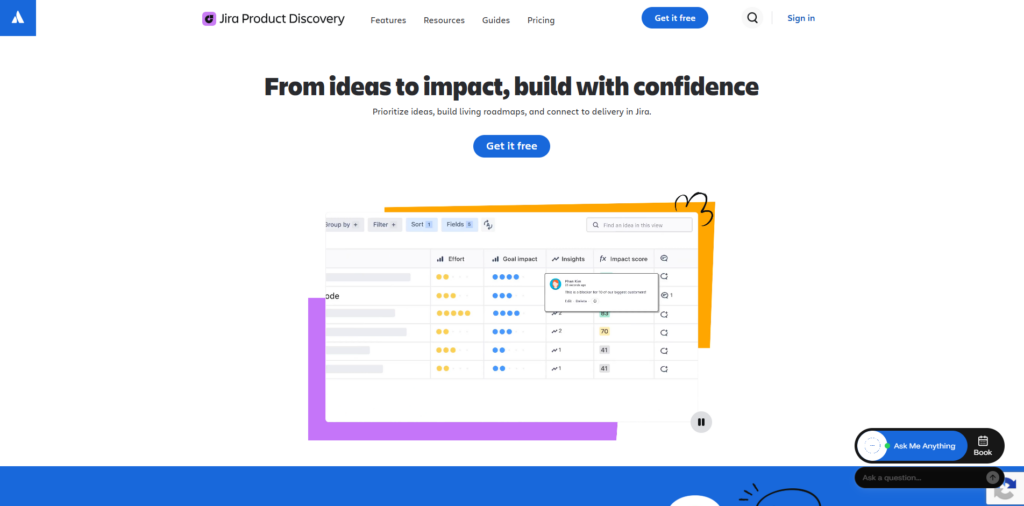
Jira Product Discovery, or JPD, is a separate Atlassian product built specifically for the ideation and prioritization phase that happens before work ever reaches a sprint board. Where Jira Software handles delivery, JPD is where you capture ideas from support tickets, sales calls, and customer interviews, score them against a prioritization framework you define, and build Now/Next/Later roadmap views.
The reason JPD earns its own spot on this list rather than being folded into Jira Software is the workflow it unlocks for teams already in the Atlassian ecosystem. When an idea graduates from discovery to development, it flows directly into your Jira Software backlog with no manual re-entry. A product org running two-week sprints can use this pairing to keep strategy conversations in JPD and execution details in Jira, without maintaining two disconnected systems.
It’s not a fit if your team doesn’t already use Jira Software, since JPD’s biggest value is the native handoff between the two.
Best for: Product teams inside the Atlassian ecosystem who want discovery and prioritization separated from delivery.
Pricing: Free for small teams; paid tiers are bundled with Jira Software licensing, so check current Atlassian pricing for your seat count.
Jira Product Discovery is Atlassian’s dedicated tool for capturing and scoring product ideas before they become development work. It connects natively to Jira Software so approved ideas flow straight into the engineering backlog, which makes it a strong fit for teams that already run sprints in Jira and want their discovery process in the same ecosystem.
Read More: Technical Product Manager vs Generalist Product Manager: Which Path Should You Choose
3. Productboard
Productboard centers the whole roadmapping process around customer insight instead of gut feel. Every feature request from support tickets, sales notes, and NPS comments lands in a shared insights repository, and you link each one to the feature it supports before scoring priority.
Productboard is a customer-driven product management platform that connects feedback directly to roadmap decisions, so prioritization is backed by evidence rather than whoever argued loudest in the planning meeting. That link between “here’s what customers are asking for” and “here’s why this is on the roadmap” is the single biggest reason mid-market and enterprise product teams choose it over a generic project tool.
The catch is cost and completeness. Productboard’s 2026 pricing moved to a single Spark plan billed per “maker,” and it doesn’t include a built-in knowledge base or changelog tool, so many teams end up paying for Intercom or Notion alongside it just to close those gaps. If your team is under ten people, that stacking cost is worth running the numbers on before you commit.
Best for: Mid-market and enterprise teams that need feedback-driven prioritization and can absorb per-maker pricing.
Pricing: Free plan available. Plus runs around <span>$19</span> per maker/month, Business around <span>$59</span> per maker/month, both billed annually. Enterprise is custom. AI usage runs on a separate credit system.
4. Aha! Roadmaps
Aha! is one of the oldest names in dedicated roadmap software, and it shows in how deep the strategy features go. You can map company-level goals down to individual initiatives and features, score ideas against a custom value framework, and generate presentation-ready roadmaps for board meetings without touching PowerPoint.
Honestly, this is the tool that gets recommended most often for teams that need to justify a roadmap to executives, not just track it internally. The strategy-to-feature linkage is genuinely strong. Every feature on the roadmap can trace back to the business goal it serves, which makes prioritization conversations less political.
That depth comes at a real cost, though. Aha! sells its product as separate “hubs” (Roadmaps, Ideas, Develop, Knowledge) rather than simple tiers, and stacking a few of them together gets expensive fast for smaller teams. It’s also overkill if your day-to-day problem is sprint or backlog management rather than strategic planning.
Best for: Enterprise product teams with dedicated product ops who need to connect strategy to roadmap execution.
Pricing: Aha! Roadmaps starts around <span>$59</span> per user/month; Aha! Ideas starts around <span>$39</span> per user/month, both billed annually. Enterprise-tier pricing with SSO runs significantly higher.
Read More: How to Become a Product Manager Without a Technical Background
5. Asana
Asana built its reputation on making structured project work approachable. Subtasks, dependencies, milestones, and task templates all work as first-class citizens, and the interface nudges teams toward good process without forcing rigid rules on them.
For product teams, Asana’s Timeline view functions as a lightweight roadmap, and Portfolios give leadership a cross-project view without needing a separate reporting tool. It’s not a purpose-built product roadmap platform the way Aha! or Product board is, but for teams that want one tool covering both product initiatives and general project work, it’s a genuinely solid middle ground.
The features that matter most for product teams (Goals, Portfolios, Workload, custom Forms) all sit behind the Advanced tier, and there’s no way to buy just one of them individually. If your team needs even a single Advanced feature, you’re paying full Advanced pricing for the whole set.
Best for: Cross-functional teams that want one tool for both product roadmaps and everyday project execution.
Pricing: Free Personal plan for very small teams. Starter runs around <span>$10.99</span> per user/month, Advanced around <span>$24.99</span> per user/month, both billed annually. Enterprise is custom.
Read More: Product Manager vs Product Owner: What’s the Actually Difference
6. Monday.com
Monday.com started life as a general work management tool and has since built out genuinely capable roadmap features on top of that foundation. You can toggle between Timeline, Gantt, Kanban, and Table views on the same board, which means your roadmap layer and your sprint tracking layer live in the same workspace instead of two separate apps.
What sells most teams on Monday.com is the visual polish. Color-coded status columns make progress readable to anyone at a glance, which matters a lot when your roadmap audience includes non-technical stakeholders like sales or customer success leads.
Watch the seat structure carefully. Every paid plan requires a three-seat minimum, so a two-person product team still pays for three seats even if only two people log in. It’s a small detail that quietly inflates the real starting cost past the advertised per-seat price.
Best for: Cross-functional teams that want roadmap visibility built into the same tool they use for day-to-day task tracking.
Pricing: Free for up to 2 seats. Basic runs around <span>$9</span> per seat/month, Standard around <span>$12</span>, Pro around <span>$19</span>, all billed annually with a 3-seat minimum. Enterprise is custom.
7. ClickUp
ClickUp’s pitch is simple: replace five separate tools with one. Docs instead of Notion, spreadsheets instead of Airtable, time tracking instead of Toggl, goal tracking built in. For product teams on a budget, that consolidation is genuinely appealing.
The roadmap and backlog tooling here isn’t as purpose-built as Aha! or Jira, but it’s flexible enough to build a working system: custom statuses, multiple view types (List, Board, Gantt, Workload), and an automation engine that handles a lot of the manual busywork other tools leave to you.
Most marketers skip evaluating the learning curve when comparing prices. It shows. ClickUp’s flexibility is also its biggest complaint in reviews: the sheer number of configuration options means new users spend real time deciding how to set things up before they can start working. Teams that want fewer decisions and faster onboarding may find that trade-off frustrating.
Best for: Budget-conscious teams that want one platform to replace docs, backlog tracking, and light roadmapping together.
Pricing: Free Forever plan. Unlimited runs around <span>$7</span> per member/month, Business around <span>$12</span>, both billed annually. Enterprise is custom. AI is a separate add-on starting around <span>$5</span> per member/month.
Read More: Product Prioritization Frameworks Every PM Should Know: RICE, MoSCoW, and When to Use Which
8. Trello
Trello is the simplest tool on this list, and that simplicity is the entire point. Boards, lists, and cards map directly onto how most teams already think about a backlog: a column for ideas, a column for in progress, a column for done.
For small product teams or early-stage startups, Trello’s low ceiling on complexity is actually an advantage. A growth team tracking a quarterly feature launch can set up four columns (Backlog, In Progress, In Review, Shipped) and share the board with marketing and customer success as a live status page, with no onboarding required for anyone who joins.
The trade-off shows up the moment your team scales past a handful of people or needs real sprint reporting. Trello doesn’t have native velocity tracking, capacity planning, or the kind of roadmap timeline view that larger product orgs eventually need. Atlassian has been adding AI-assisted card descriptions and smart suggestions, but the underlying structure stays intentionally lightweight.
Best for: Small teams and startups that need a simple, visual backlog without a steep setup process.
Pricing: Free tier available. Standard runs around <span>$6</span> per user/month, Premium around <span>$12.50</span>, billed annually.
9. Airtable
Airtable sits in a category of its own: part spreadsheet, part relational database, part project tool. For product teams, that flexibility means you can build a custom roadmap view, a feature request tracker, and a release calendar, all linked to the same underlying records, without writing a line of code.
Where Airtable pulls ahead of a tool like Notion is automation depth and relational structure. If your roadmap needs to reference customer accounts, engineering tickets, and marketing launch dates as connected tables rather than isolated lists, Airtable’s database model handles that far more elegantly.
That said, only editors count as paid seats, which helps keep costs down for teams with a lot of read-only stakeholders. But record limits and attachment caps on lower tiers catch active teams off guard faster than they expect, especially once a roadmap base starts tracking hundreds of feature requests.
Best for: Product ops and teams that need a roadmap connected to relational data, not just a flat task list.
Pricing: Free plan (up to 5 editors, 1,000 records per base). Team runs around <span>$20</span> per user/month, Business around <span>$45</span>, both billed annually. Enterprise Scale is custom.
Read More: How to Write a Product Requirements Document (PRD) Engineers Actually Use
10. Notion
Notion’s blank-canvas approach means a product team can build a roadmap, a spec repository, and a meeting-notes wiki all inside the same connected workspace. Pages, databases, and linked views combine into something closer to a custom internal tool than a fixed-template app.
That’s exactly why it’s more than just a notes app, even though people still discover it that way. A product team can spin up a database of feature requests, filter it into a roadmap view, and link every feature card to its spec document, all without leaving the page.
The flexibility cuts both ways. New users often spend more time designing their own page structure and templates than they spend actually planning the product, which is the most common complaint against Notion in comparison reviews. It also has fewer native integrations and no built-in automations, which pushes teams toward pairing it with a task-execution tool like Asana or ClickUp for anything beyond planning and documentation.
Best for: Teams that want a single connected workspace for roadmaps, specs, and documentation, and don’t mind building their own structure.
Pricing: Free plan with no time limit. Plus runs around <span>$10</span> per member/month, Business around <span>$20</span>, both billed annually. Enterprise is custom.
11. Linear
Linear was built by people who were frustrated with how slow and cluttered other issue trackers had become, and it shows in the speed of the interface. Keyboard shortcuts handle nearly every action, and the whole app feels closer to a code editor than a project management tool.
Linear’s roadmap feature lets you build timeline and list views tied directly to the same issues your engineers are working, so there’s no separate system to keep in sync. Its AI-powered triage automatically categorizes and routes incoming issues, which cuts down on the manual grooming work that eats into every sprint planning session.
What Linear doesn’t do is intelligent feature prioritization the way Productboard or Aha! do. It’s primarily an issue and sprint tracking tool that has grown a roadmap layer on top, not a strategic planning platform. Teams that need scoring frameworks or customer-feedback-linked prioritization will outgrow it.
Best for: Engineering-heavy product teams that want fast, keyboard-driven issue tracking with a lightweight roadmap on top.
Pricing: Free plan (unlimited members, capped at 250 issues and 2 teams). Basic runs around <span>$10</span> per user/month, Business around <span>$16</span>, both billed annually. Enterprise is custom.
Linear pairs a fast, keyboard-first issue tracker with a lightweight roadmap view built directly from live sprint data, which keeps engineering and planning in the same system. It’s a strong fit for software teams that find heavier tools like Jira slow, though it lacks the customer-feedback-driven prioritization scoring that dedicated product management software like Aha! or Productboard provides.
12. Confluence
Confluence is Atlassian’s team wiki, and for product teams it fills a gap none of the pure roadmap or backlog tools solve well: a shared home for specs, meeting notes, and decision records that everyone can find later.
The reason it’s worth including alongside roadmap tools rather than treating it as a nice-to-have is how tightly it integrates with Jira. A product manager can link a Confluence spec page directly to the Jira epic it describes, so engineers reading the ticket are one click away from the full requirements document instead of hunting through Slack history.
Confluence’s own roadmap and planning features are thinner than a dedicated tool. It’s a documentation and collaboration layer, not a place to build a visual product roadmap from scratch. Most teams pair it with Jira Software or Jira Product Discovery rather than using it standalone.
Best for: Teams already in the Atlassian ecosystem that need a connected documentation layer for specs and decisions.
Pricing: Free for up to 10 users. Standard runs around <span>$6</span> per user/month, Premium around <span>$12</span>, both billed annually. Enterprise is custom.
13. Miro
Miro is a visual whiteboard, and that makes it an unusual entry on a list about roadmaps and backlogs. But the reason it belongs here is real-time collaborative planning. Before a roadmap ever gets formalized in Jira or Aha!, most product teams sketch it out together on a whiteboard: sprint retros, story mapping sessions, and initial roadmap brainstorms all happen better with everyone drawing on the same canvas at once.
Miro’s integrations with Figma, Jira, and Confluence mean a rough whiteboard sketch of a roadmap can get exported or linked directly into the tool where the formal version lives. That handoff from ideation to execution is where Miro earns its place in a product team’s stack rather than existing as a separate, disconnected app.
It’s not a system of record. Nobody should be tracking sprint status or backlog priority permanently on a Miro board. Treat it as the room where planning conversations happen, not where the roadmap lives long-term.
Best for: Teams that run collaborative planning sessions, story mapping, or roadmap brainstorms before formalizing decisions elsewhere.
Pricing: Free plan (up to 3 editable boards). Paid plans start around <span>$8</span> per member/month, billed annually.
14. Craft.io
Craft.io positions itself as a product manager’s tool built by product managers, and the feature set backs that up: roadmapping, backlog management, requirements documentation, and release planning all live in one workspace, with Gantt, Kanban, and sprint views built in.
What sets Craft.io apart from a general project tool is its “Guru” layer, which surfaces best-practice templates and AI-assisted suggestions as you build out a roadmap or spec. For product teams without a lot of process maturity, that built-in guidance can shortcut a lot of trial and error.
The pricing structure charges per editor while making contributors and dev-team viewers free, which helps if your product team is small but your stakeholder list is long. Even so, jumping from Starter to Pro is a steep price increase, and teams report the UI isn’t always as intuitive as the feature list suggests.
Best for: Dedicated product teams that want an all-in-one strategy-to-execution workspace built specifically for PMs.
Pricing: Starter runs around <span>$19</span> per editor/month, Pro around <span>$79</span> per editor/month, both billed annually. Enterprise is custom.
15. Wrike
Wrike is an enterprise work management platform built for teams juggling complex workflows across departments, not just a single product org. Custom project views (Board, Table, Gantt, Calendar, Chart) let different teams work the way they prefer while still reporting into the same account.
For product teams, Wrike’s Scrum boards handle backlog prioritization and sprint tracking with real-time collaboration, and its resource booking feature lets you reserve specific team members or roles against upcoming roadmap work before committing to a timeline. That capacity-planning layer is something a lot of lighter tools on this list simply don’t offer.
Wrike is built more for project execution than for pure product strategy, so if your primary need is customer-feedback-driven prioritization, you’ll likely pair it with a tool like Productboard rather than relying on Wrike alone.
Best for: Large product and marketing teams that need advanced permissions, resource planning, and custom workflows across departments.
Pricing: Free plan available. Team runs around <span>$9.80</span> per user/month, Business around <span>$24.80</span>, both billed annually. Enterprise and Pinnacle tiers are custom.
Quick Comparison Table
| Tool | Best For | Starting Paid Price |
|---|---|---|
| Jira Software | Agile sprint & backlog execution | ~$6/user/mo |
| Jira Product Discovery | Discovery inside the Atlassian stack | Bundled with Jira |
| Productboard | Feedback-driven prioritization | ~$19/maker/mo |
| Aha! Roadmaps | Strategic, executive-facing roadmaps | ~$59/user/mo |
| Asana | Cross-functional project + roadmap work | ~$11/user/mo |
| Monday.com | Visual, non-technical stakeholder roadmaps | ~$9/seat/mo |
| ClickUp | All-in-one budget replacement | ~$7/member/mo |
| Trello | Simple visual backlog | ~$6/user/mo |
| Airtable | Relational, database-driven roadmaps | ~$20/user/mo |
| Notion | Connected docs + roadmap workspace | ~$10/member/mo |
| Linear | Fast engineering-led issue tracking | ~$10/user/mo |
| Confluence | Specs and decision documentation | ~$6/user/mo |
| Miro | Visual collaborative planning | ~$8/member/mo |
| Craft.io | All-in-one PM-built workspace | ~$19/editor/mo |
| Wrike | Enterprise cross-department execution | ~$9.80/user/mo |
Pricing reflects annual billing and is approximate as of 2026. Confirm current rates on each vendor’s pricing page before purchasing, since plans and seat rules change often.
Final Thoughts
The right product management software isn’t the one with the longest feature list. It’s the one that closes the specific gap your team is actually feeling right now, whether that’s stakeholders who can’t see the roadmap, a backlog that’s impossible to groom, or planning conversations that never make it out of Slack.
Start with one clear problem, test two or three tools against it directly with your own data, and resist the urge to buy for a team size you don’t have yet. Most of the platforms on this list offer free trials specifically so you can find that out before committing to an annual contract.
If you’re building out your product management skill set alongside choosing the right tools, that’s where a structured foundation helps as much as the software itself. YUP’s Product Management course walks through roadmap frameworks, prioritization models, and stakeholder communication that make any tool on this list work better in your hands.
FAQs
What is product management software?
Product management software is a platform that helps product teams plan roadmaps, manage backlogs, and coordinate cross-functional work between design, engineering, and stakeholders in one shared system. It typically replaces a mix of spreadsheets, slide decks, and disconnected task lists with a single source of truth.
What’s the difference between a roadmap tool and a backlog tool?
A roadmap tool focuses on strategic, high-level planning, like Aha! or Productboard, showing what’s coming over the next few quarters. A backlog tool, like Jira or Linear, tracks the granular tickets, story points, and sprint work that actually build those roadmap items. Many teams end up using one of each, connected together.
Do I need a dedicated PM tool, or can I use a general project tool like Asana?
It depends on team size and process maturity. Small teams or startups often do fine with a general tool like Asana, Trello, or ClickUp for both roadmap and backlog work. Teams past 20-30 people, or those doing heavy customer-feedback-driven prioritization, usually get more value from a dedicated tool like Aha! or Productboard.
Which tool is best for a small startup product team?
Trello or ClickUp are the most budget-friendly starting points for a small team, since both have generous free tiers and don’t require a steep learning curve. Notion works well too if documentation matters as much as task tracking. Save the enterprise-grade tools like Aha! or Craft.io for when your team and budget actually need that depth.
Is Jira overkill for a non-technical product team?
It can be. Jira was built for engineers running sprints, and product managers who don’t need that level of granularity often find it cluttered. If your team’s main need is a clean visual roadmap rather than sprint mechanics, Productboard, Aha!, or even Monday.com will feel more natural.
How much does product roadmap software typically cost per user?
Most tools on this list run somewhere between $6 and $20 per user per month on entry-level paid plans, with dedicated strategic tools like Aha! and Productboard starting closer to $19-$59 per user. Free tiers exist across almost every category, but they usually cap out fast once your team grows past 5-10 people.
Can these tools connect to each other, or do I have to pick just one?
Most teams end up running two or three connected tools rather than one. A common pairing is Jira Product Discovery for strategy plus Jira Software for delivery, or Productboard for feedback plus Linear for execution. Miro often sits alongside any of these as the whiteboard where early planning conversations happen.
What should I check before switching product management software?
Map out your existing roadmap, backlog items, and any custom fields before migrating, since most tools support CSV or API-based imports but rarely a perfect one-click transfer. Also check seat pricing at your actual team size, not just the advertised starting price, since minimums and per-maker rates can change the real cost significantly.
Is a free plan ever enough for a real product team?
For very small teams (2-5 people) doing simple task tracking, yes. Trello, ClickUp, Notion, and Airtable all have functional free tiers. Once you need sprint reporting, advanced permissions, or roadmap timeline views, you’ll typically hit the free tier’s ceiling within a few months.
How do I know if I need a separate tool for customer feedback and prioritization?
If your team is regularly debating priorities based on opinion rather than evidence, or if feature requests are scattered across support tickets, sales notes, and Slack messages, a feedback-centered tool like Productboard is worth the investment. If prioritization conversations are already grounded in solid data you track elsewhere, you likely don’t need to add another tool just for that.