
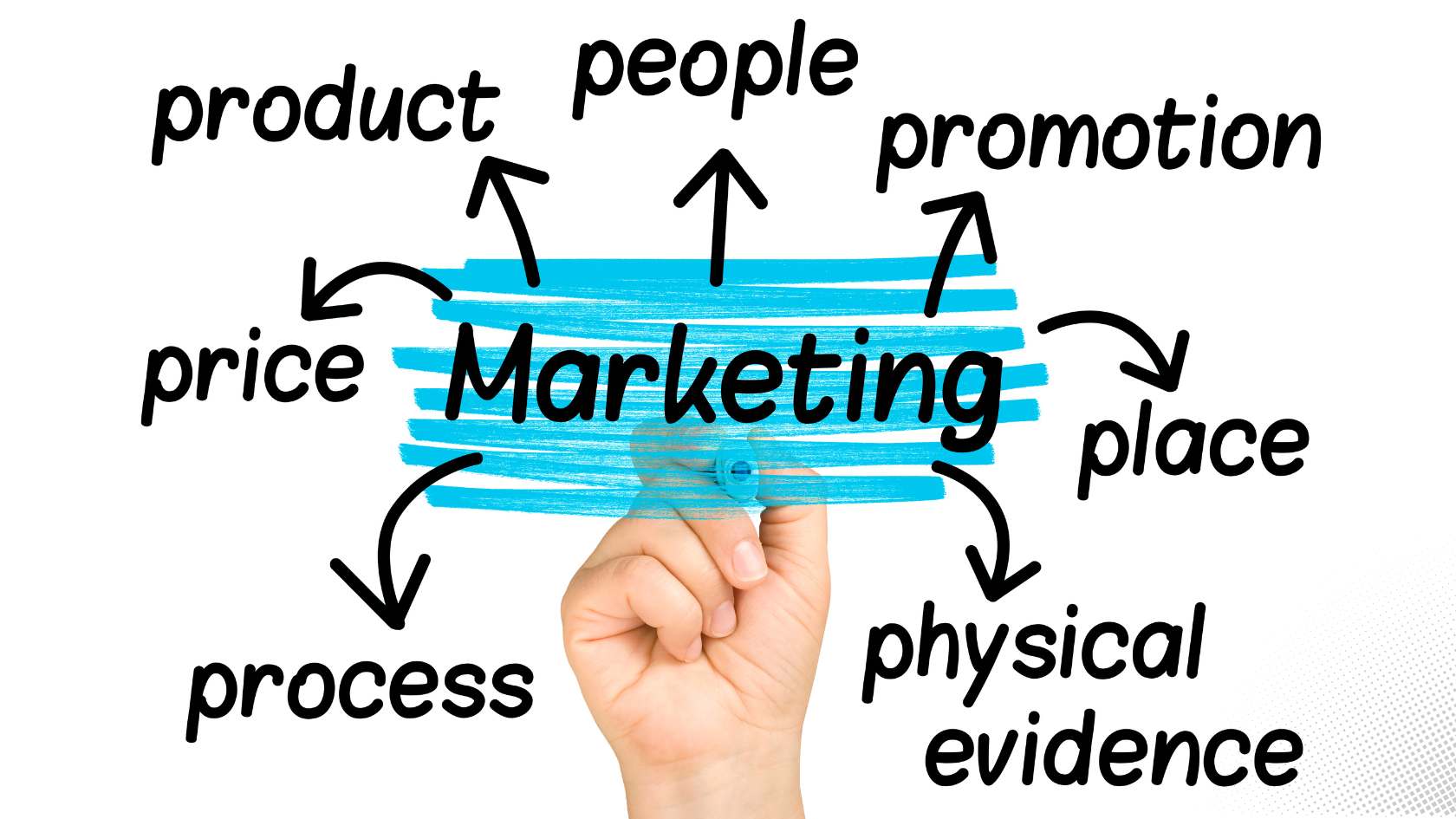
Most marketing textbooks hand you the 4Ps and call it a day. But if you’re marketing a service a consulting firm, a SaaS product, a hospital, a hotel the 4Ps leave you with a pretty big gap. They were designed for physical products in the 1960s. They have nothing to say about the people delivering your service or the process they follow.
Table of Contents
That’s the whole reason the 7Ps of service marketing exist. The framework adds three elements People, Process, and Physical Evidence that the original mix completely ignored. Together, all seven tell you where customer experience actually gets made or broken.
This article breaks down every P, shows you how real brands use it, and tells you what most marketers get wrong about each one.
What is Service Marketing?
Service marketing refers to the techniques and strategies businesses use to market intangible products—services. Service marketing is different from product marketing. Product marketing primarily focuses on physical items (except for digital products) that can be touched and seen, service marketing focuses on the customer experience and the overall service quality delivered.
Unlike other types of marketing, the unique challenge in service marketing is that you cannot touch or test a service in the same way you can with a product. This is why service marketing often involves a deep focus on emotional engagement, trust-building, and creating a compelling customer experience.
The 7Ps of service marketing play a crucial role in shaping this experience. These elements guide businesses in aligning their services with the expectations of their target audience, leading to higher satisfaction and better customer retention.
The 7Ps of service marketing extend McCarthy’s original 4Ps by adding People, Process, and Physical Evidence — three elements that directly shape how customers experience and evaluate a service. The framework was formalised by Booms and Bitner in 1981 and remains the standard strategic model for service-based businesses today.
What Does the 7Ps of Service Marketing Mean?
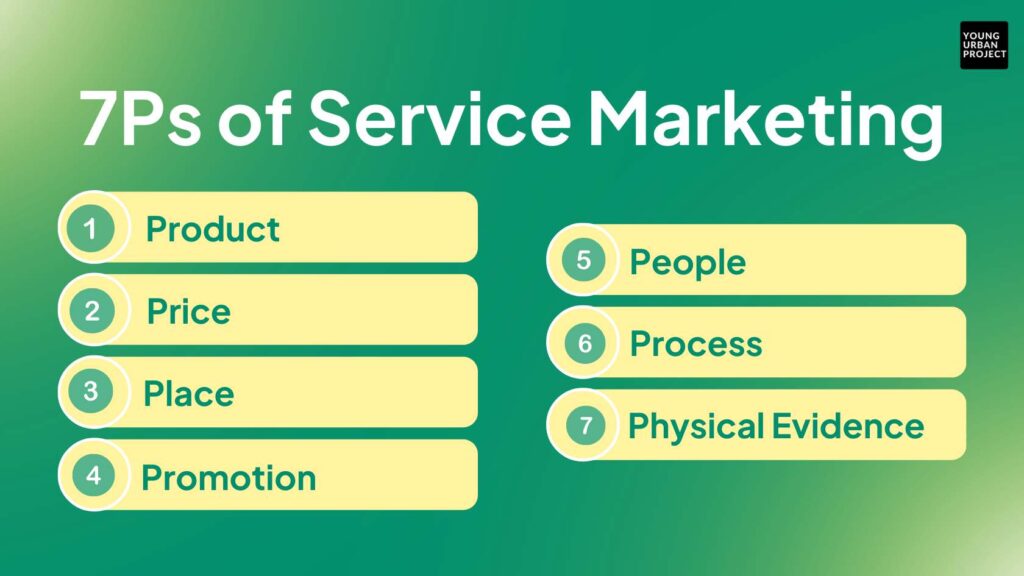
The 7Ps of service marketing is a framework designed to help businesses develop a comprehensive and balanced marketing strategy. These 7Ps—Product, Price, Place, Promotion, People, Process, and Physical Evidence—cover every aspect of how a service is developed, communicated, delivered, and perceived by customers.
Each element contributes to the overall service delivery experience and is tailored to the needs of the service industry. Unlike traditional 4Ps (Product, Price, Place, and Promotion), which are more applicable to product marketing, the 7Ps of service marketing take into account the intangible nature of services and the complex customer interactions that often accompany them.
Also Read: Difference between Goods and Services
Who Proposed the 7Ps of Marketing?
The concept of the marketing mix began with the 4 Ps of marketing, introduced by E. Jerome McCarthy in 1960. An American marketing professor, McCarthy unveiled these fundamental pillars—Product, Price, Place, and Promotion—in his book, Basic Marketing: A Managerial Approach. Later in 1981, Booms and Bitner, two marketing scholars, recognized the unique needs of service-based businesses and expanded this framework to create the 7Ps of service marketing. By adding People, Process, and Physical Evidence, they tailored the model to better suit industries where customer interaction, customer relationship, and service quality play a crucial role.
The 7Ps of Service Marketing
Let’s break down each of the 7Ps of service marketing in detail and explore how they impact the success of a service-based business.
Product (Service)
In service marketing, “product” refers to the core service being offered the experience, outcome, or transformation a customer pays for.
Since you can’t hand a customer the product before they buy it, the marketing job is to make the intangible feel concrete. What outcome does the customer get? What problem disappears? That’s what your service product is really about.
What makes a strong service product?
The service product is defined by three layers. The core benefit is the fundamental problem you solve. Zepto’s core service product isn’t “grocery delivery” it’s saving you 20 minutes on a busy evening. The augmented product is everything wrapped around that: app experience, packaging, communication. And the brand is the trust layer that makes someone choose you over an identical competitor.
Take Swiggy. Their core product is food delivery. But what they actually sell through speed guarantees, real-time tracking, and late-night availability is convenience without anxiety. That framing shapes every other marketing decision.
Most service businesses spend too much time describing features and not enough time articulating outcomes. “24/7 customer support” is a feature. “You’ll never be stuck mid-project on a Friday evening” is an outcome.
In service marketing, the product is the experience and outcome the customer receives, not a physical object. Because services are intangible, marketing must make the result visible through guarantees, testimonials, outcome-focused language, and trust signals before the customer can evaluate what they’re buying.
Price
Price in service marketing is more complex than sticking a number on a product. It signals quality, manages expectations, and competes on dimensions that have nothing to do with cost.
How should you price a service?
Service pricing follows several models depending on the business type. Time-based pricing charges by the hour (consultants, lawyers, designers). Outcome-based pricing charges for a result (performance marketing agencies that take a percentage of ad spend). Subscription pricing creates recurring revenue with predictable delivery (SaaS, Netflix, gym memberships). Value-based pricing anchors the price to the perceived outcome, not the cost to deliver.
Premium pricing builds trust in services where quality is hard to assess upfront. A first-time buyer choosing between a ₹500/hour and a ₹5,000/hour consultant has limited information — price becomes a proxy for competence.
Nykaa PRO’s tiered membership pricing is a useful example. Their free, standard, and paid tiers create a natural upgrade path where customers experience the service before committing to higher tiers. That’s smart pricing design for services: let customers build trust incrementally.
One thing that breaks service pricing fast: discounting too early. It sets a reference price that’s hard to recover from. If your service is genuinely premium, price it like one from day one.
Place
Place in service marketing is about where and how the customer accesses the service. With physical products, “place” means distribution channels. With services, it means touchpoints.
A hospital’s “place” is its location, but also its booking app, telemedicine option, and whether the waiting area makes you feel calm or anxious. A D2C brand’s service layer exists through WhatsApp, Instagram DMs, email, and the returns portal.
How has digital changed the Place P?
Digital channels have fundamentally expanded what “place” means for services. According to a 2024 Deloitte Digital Consumer Survey, 67% of Indian consumers prefer to access customer service through a mobile app or chat interface rather than phone or in-person. That’s a place decision that needs to be made deliberately.
Byju’s built its entire early growth on accessibility students in tier-2 and tier-3 cities who couldn’t access quality coaching institutes could access the service on a phone. Place was a competitive advantage, not just a logistical consideration.
For most service businesses today, “place” means: Is the service available where the customer already is, or does the customer have to come to you?
Promotion
Promotion is how you communicate your service’s value, build awareness, and create the trust that makes someone pay for something they can’t see yet.
For product companies, promotion often showcases the product itself. For service companies, you’re almost always promoting proof testimonials, case studies, credentials, ratings, before-and-after results.
What works in service promotion?
Content marketing works well for services because it lets the brand demonstrate expertise before asking for money. YUP’s own blog does this: articles like this one let practitioners experience the quality of teaching before enrolling in a course. That’s promotion through demonstration.
Referral programs matter more in services because word-of-mouth carries extra weight when the product is hard to evaluate from the outside. Urban Company’s double-sided referral incentive for both customer and professional is a textbook example of using promotion to reduce the trust gap in service buying.
Social proof is non-negotiable. A 2023 BrightLocal Local Consumer Review Survey found that 98% of consumers read online reviews for local businesses before making a purchase. For services with no physical product to judge, reviews are often the only tangible evaluation tool a buyer has.
Promotional messages for services should address the three things that hold buyers back: “Will this work?” (prove it), “Will it work for someone like me?” (show relevant examples), and “Is the risk worth it?” (reduce perceived risk with guarantees or trials).
Service promotion is primarily about building trust through proof — case studies, reviews, ratings, expert content, and guarantees. Because customers can’t evaluate a service before purchase, every promotional touchpoint must reduce perceived risk and demonstrate credibility rather than simply create awareness.
People
This is where service marketing gets personal. Literally.
People refers to every human being involved in delivering or experiencing the service your frontline staff, your support team, your sales team, and often your existing customers who interact with prospects.
In a product business, a factory worker rarely meets the end customer. In a service business, the person on the other end of the phone, the consultant in the meeting, or the instructor in the class is the product. Their attitude, knowledge, and communication style shape the entire experience.
Why People is often the most important P
A 2023 PwC Future of Customer Experience Survey found that 32% of customers would stop doing business with a brand they loved after just one bad experience. In services, that bad experience almost always involves a person.
Mamaearth’s customer service team is trained specifically around the brand’s “clean beauty” ethos. When customers call with questions about ingredients, they get knowledgeable, on-brand responses not a script. That consistency is a deliberate People investment.
For businesses like HDFC Bank or Axis Bank, frontline staff training is a massive competitive differentiator. Two banks can offer identical interest rates, identical apps, and identical products the relationship manager is often what keeps a customer from switching.
Hiring for attitude, training for skill, and building service standards that your team can actually meet are all People decisions. Most marketing teams don’t own this P. They probably should be involved in it.
Process
Process is the series of steps the system through which a service is delivered. It’s what happens between “yes, I want this” and “the job is done.”
A bad process shows up as confusion, delays, repeated questions, inconsistency between team members, and customer frustration. A good process is nearly invisible. The customer just feels like everything went smoothly.
What does a good service process look like?
The best service processes share a few properties. They’re standardised enough to be consistent across customers, but flexible enough to handle edge cases. They remove unnecessary friction without removing necessary human judgment. And they’re designed around the customer’s journey, not internal convenience.
Zomato’s delivery process is a useful model. From the moment an order is placed, the customer gets real-time visibility at each stage: restaurant confirmed, order prepared, rider picked up, rider X minutes away. That’s a process designed to manage anxiety, which is the dominant customer emotion in any service with a wait time.
In professional services like consulting or legal work, process clarity often replaces price sensitivity. Clients who understand exactly what they’re paying for, what happens when, and who is responsible for each stage are far less likely to question the fee.
Documenting your process, making it visible to customers, and reviewing it quarterly for friction points is process management. Most service businesses document their process once and forget it.
In service marketing, Process refers to the end-to-end system through which a service is delivered. A well-designed process reduces customer uncertainty, ensures consistency across delivery touchpoints, and scales quality without depending on individual performance. Process failures are one of the top drivers of service churn.
Physical Evidence
Physical Evidence is the tangible cues that help customers judge an intangible service. You can’t hold a consulting engagement. But you can see the consultant’s office, read their published work, and notice how quickly their team responds to your emails.
These cues aren’t decoration. They’re information signals that customers use to make quality assessments before and during the service.
What counts as physical evidence?
Physical evidence covers a wide range. Office design and environment a well-organised, modern workspace signals professionalism. Uniforms and staff appearance consistent, appropriate dress builds trust and brand recognition. Digital presence website speed, design quality, and content depth all signal competence. Documentation proposals, reports, invoices, and contracts that look polished tell the customer they’re working with a serious organisation.
For a service business like a fitness chain like Cult.fit, physical evidence is the studio design, the instructor certifications on the wall, the app’s workout tracking interface, and even the playlist. Every tangible element is managed to signal that this is a premium, results-oriented service.
Hospitals are perhaps the most studied example of physical evidence management. A 2021 study published in BMC Health Services Research found that patients’ perceptions of hospital quality were significantly shaped by facility cleanliness, signage, and staff presentation often before any medical interaction occurred.
For digital-first service businesses, physical evidence lives almost entirely in the digital environment. Your website’s load time, your email formatting, your brand consistency across touchpoints, the quality of your onboarding PDF all physical evidence.

Also read: Importance of Service Marketing
What makes the 7Ps of service marketing important?
The 7Ps framework plays a critical role in shaping the success of service-based businesses. Unlike tangible products, services are intangible and involve a higher degree of customer interaction. As such, businesses in the service industry must adopt a more nuanced approach to marketing that addresses not only the product itself but also the experience, delivery, and overall value perceived by the customer.
Here are 10 key reasons why the 7Ps are important for businesses, especially those offering services:
1. Holistic Marketing Approach
The 7Ps provide a comprehensive framework for service marketing by incorporating all aspects that influence a customer’s decision-making process. From the service quality (Product) to how the service is delivered (Process), businesses can craft a well-rounded marketing plan that appeals to the rational and emotional needs of the customer.
Also Read: What is the importance of Marketing
2. Enhanced Customer Experience
Each of the 7Ps plays a pivotal role in shaping the customer experience. For example, People refers to the customer-facing team, which directly impacts how customers feel about the service. Ensuring that every aspect of the service process is aligned helps to create an experience that delights customers, building trust and loyalty over time.
3. Better Alignment with Customer Needs
By carefully considering each of the 7Ps, businesses can better align their offerings with the needs of their target audience. For instance, the Price should reflect the value that customers perceive in the service, while the Product must fulfill their expectations. This alignment strengthens customer satisfaction and increases the likelihood of repeat business.
4. Stronger Brand Positioning
The 7Ps allow businesses to carve out a unique position in the market. By optimizing Promotion and crafting effective messaging, brands can differentiate themselves from competitors, making their services stand out in the minds of customers. This differentiation is vital for attracting new customers and retaining existing ones.
5. Consistent Service Delivery
Consistency in service delivery is one of the greatest challenges for service-based businesses, particularly those that interact directly with customers. The 7Ps framework ensures that businesses establish clear processes (Process) and maintain high service quality (Product) consistently, which is essential for building trust and delivering a seamless customer experience.
6. Increased Customer Retention
Effective use of the 7Ps can significantly improve customer retention. By ensuring a high-quality service experience and personalizing interactions through the People and Process elements, businesses can foster long-term relationships. Customers who feel valued and well-served are more likely to return and recommend the service to others.
7. Adaptation to Market Changes
The 7Ps framework is dynamic and can help businesses stay adaptable in a constantly changing market. As new marketing strategies emerge or customer expectations evolve, the framework allows businesses to quickly assess which elements need adjustment. This flexibility is especially crucial in industries influenced by digital transformation and shifting consumer preferences.
8. Improved Decision-Making
The 7Ps provide a structured approach to decision-making in marketing and service delivery. By breaking down each element—Price, Promotion, People, and so on—businesses can assess where to invest resources and where improvements are needed. This makes the process of refining or scaling a business more strategic and data-driven.
9. Increased Competitive Advantage
In competitive industries, differentiating your service offering can be challenging. The 7Ps allow businesses to not only meet customer expectations but exceed them by paying attention to smaller yet critical details. For example, enhancing Physical Evidence—like professional branding or a clean, inviting atmosphere—can make a significant difference in how a customer perceives the brand, giving a competitive edge.
10. Effective Marketing Communications
Marketing communication is a key component of success in any service-based industry. The 7Ps ensure that businesses develop a promotion strategy that speaks directly to their audience, using the right channels and messaging to engage potential customers. Whether through social media, email marketing, or face-to-face interactions, the framework helps businesses craft communication that resonates and converts.
Also Read: Understanding the Scope of Marketing
| Element | 7Ps of Product Marketing | 7Ps of Service Marketing |
| Product | Tangible, physical items that are produced, sold, and consumed. | Tangible goods or intangible services that are consumed. |
| Price | Price is set based on product value, competition, and cost. | Price still reflects value but can vary based on service customization and delivery. |
| Promotion | Focuses on advertising, sales, and other promotional activities for the product. | Includes marketing and communication strategies to highlight service benefits. |
| Place | Refers to where the product is sold and how it reaches consumers (e.g., retail, online). | Where the service is offered and how it’s delivered (e.g., in-store, online, or on-site). |
| People | Customers, salespeople, and stakeholders are involved in marketing the product. | Key element in service marketing, as service quality often depends on the people delivering the service (e.g., employees, customer service). |
| Packaging | Physical packaging used to protect and present the product. | Physical Evidence (e.g., the environment, brochures, uniforms) provides tangible proof of service quality. |
| Process | Process refers to the production and distribution of the product. | Process is customer-centric and involves service delivery methods, customization, and consistency. |
| Physical Evidence | Not a focus on product marketing. | Focuses on the tangible elements that give customers clues about the quality of the service (e.g., clean facilities, branding). |
Also read: What Is the Service Marketing Triangle and How Does It Work?
Examples of 7Ps of service marketing in action
1. Zomato

- Product: Zomato provides a platform for food delivery, restaurant discovery, and reviews. The variety and quality of food offerings are the core product.
- Price: Zomato offers competitive pricing with various discounts, offers, and subscription models like Zomato Gold.
- Place: The service is available on mobile apps and websites, providing convenience for users to order food from local restaurants.
- Promotion: Zomato uses targeted digital marketing campaigns, social media, influencer collaborations, and email promotions to engage customers.
- People: Customer service agents, delivery personnel, and restaurant partners play a significant role in delivering a seamless experience.
- Process: The process of ordering food is streamlined through the app, ensuring quick order placement, payment, and tracking.
- Physical Evidence: Zomato’s website, app design, customer reviews, and restaurant listings serve as physical evidence of the service’s quality and credibility.
2. Ola

- Product: Ola provides cab services and ride-hailing solutions for customers, with different categories like Ola Mini, Ola Prime, and Ola Rentals.
- Price: Ola’s pricing strategy includes competitive fare models and offers discounts and ride promotions to attract users.
- Place: The service is available across many cities in India and can be accessed through the mobile app, making it accessible wherever customers need it.
- Promotion: Ola uses social media campaigns, advertisements, and special discounts to promote its rides and attract new users.
- People: Drivers and customer support staff are crucial in ensuring a great ride experience and timely assistance for riders.
- Process: The ride booking process is easy and quick through the app, from booking to payment, ensuring a smooth customer experience.
- Physical Evidence: Ola’s branded cars, the app interface, and uniformed drivers provide tangible evidence of the brand’s professionalism and service quality.
3. Swiggy

- Product: Swiggy offers food delivery services from local restaurants, along with other services like Swiggy Genie for deliveries of non-food items.
- Price: The pricing strategy is affordable and dynamic, based on location, restaurant choice, and delivery charges.
- Place: The app and website enable customers to order food conveniently from a wide range of restaurants across different cities in India.
- Promotion: Swiggy uses targeted promotions, deals, and advertising through digital platforms, TV commercials, and partnerships to maintain visibility.
- People: The company’s delivery executives and customer support teams ensure timely service and customer satisfaction.
- Process: Swiggy’s well-optimized app process makes ordering simple and provides features like live tracking and in-app payment options.
- Physical Evidence: Swiggy’s branded packaging, delivery uniforms, and app design all contribute to the tangible aspects of the service that enhance customer trust.
4. Tata Consultancy Services (TCS)

- Product: TCS offers IT services and consulting, including digital transformation, enterprise solutions, and business process outsourcing.
- Price: Pricing is value-driven, reflecting the expertise and scope of services provided to businesses.
- Place: TCS operates globally, with offices in multiple countries, serving clients through physical locations and digital platforms.
- Promotion: TCS promotes its services through global events, thought leadership content, case studies, and strategic partnerships with other tech giants.
- People: TCS places significant emphasis on its skilled workforce, with experts and consultants working closely with clients to provide customized solutions.
- Process: The service delivery process is highly structured and involves stages like consultation, development, implementation, and post-project support.
- Physical Evidence: TCS uses branded presentations, reports, and professional communication as physical evidence of its services. Their office buildings and collaborative spaces also reflect their expertise and brand value.
5. MakeMyTrip
- Product: MakeMyTrip is a travel service provider offering flight bookings, hotel reservations, holiday packages, and more.
- Price: The platform offers competitive pricing with discounts, seasonal offers, and personalized pricing options for users.
- Place: MakeMyTrip’s services are accessible via its website and mobile app, providing convenience for users to plan their travel anytime, anywhere.
- Promotion: MakeMyTrip uses digital marketing campaigns, social media advertising, TV ads, and email promotions to attract and retain customers.
- People: Travel agents, customer service representatives, and support staff ensure high-quality service and assist customers with bookings and inquiries.
- Process: The booking process is smooth, from searching for travel options to payment and post-booking services, ensuring an efficient and hassle-free experience.
- Physical Evidence: The company’s app, website, confirmation emails, and customer testimonials serve as physical evidence of the brand’s credibility and the quality of its services.
Also Read: Difference between Marketing vs Advertising
Conclusion
Mastering the 7Ps of service marketing can make a significant impact on how you design and execute your service marketing strategy. By addressing the key elements—Product, Price, Place, Promotion, People, Process, and Physical Evidence—you ensure that every aspect of your service is tailored to meet customer expectations and exceed them. Whether you’re refining your pricing strategies, building a strong brand presence, or improving service quality, the 7Ps framework provides a comprehensive approach to marketing services in a competitive landscape.
With the right focus on these 7Ps of service marketing, businesses can enhance service delivery, improve customer experience, and build long-lasting relationships with customers. Keep these elements in mind as you develop your marketing strategies, and watch your service business thrive.