
You can’t hand a customer a gym membership the way you hand them a product off a shelf. You can’t let them try a business consulting engagement before they pay for it. And if an airline seat goes unsold at departure, that revenue is gone forever.
Table of Contents
That’s the core challenge service marketing solves. When you’re selling something intangible, the traditional playbook doesn’t apply. You need a different set of tools, different signals of quality, and a completely different relationship with your customer.
Service marketing is the practice of promoting and delivering intangible offerings from healthcare and banking to SaaS platforms and restaurant experiences in a way that builds enough trust for someone to buy something they can’t see, touch, or test in advance.
This guide breaks down what service marketing actually is, how it differs from product marketing, what the 7 Ps mean in practice, and which strategies work for businesses in India and globally.
What is Service Marketing?
Service marketing is the set of strategies businesses use to promote and sell intangible services. Unlike a product, a service has no physical form. You can’t inspect it before purchase. You can’t return it if it doesn’t meet expectations in the same way you’d return a broken appliance. And in most cases, it’s produced and consumed at exactly the same moment.
Because of these differences, service marketing relies heavily on trust signals, customer experience, and relationship-building not product features or packaging.
Service marketing is the strategic practice of promoting intangible offerings by building trust, managing customer experience, and communicating value before, during, and after the service interaction. Unlike product marketing, which centres on physical attributes, service marketing must compensate for the absence of tangibility through reputation, social proof, and consistent service quality.
The simplest way to understand it: when you choose a doctor, you don’t inspect their medical knowledge before your appointment. You look at reviews, hospital reputation, credentials, and what friends have said. That entire process of influence and trust-building is service marketing at work.
The 4 Core Characteristics That Make Services Different
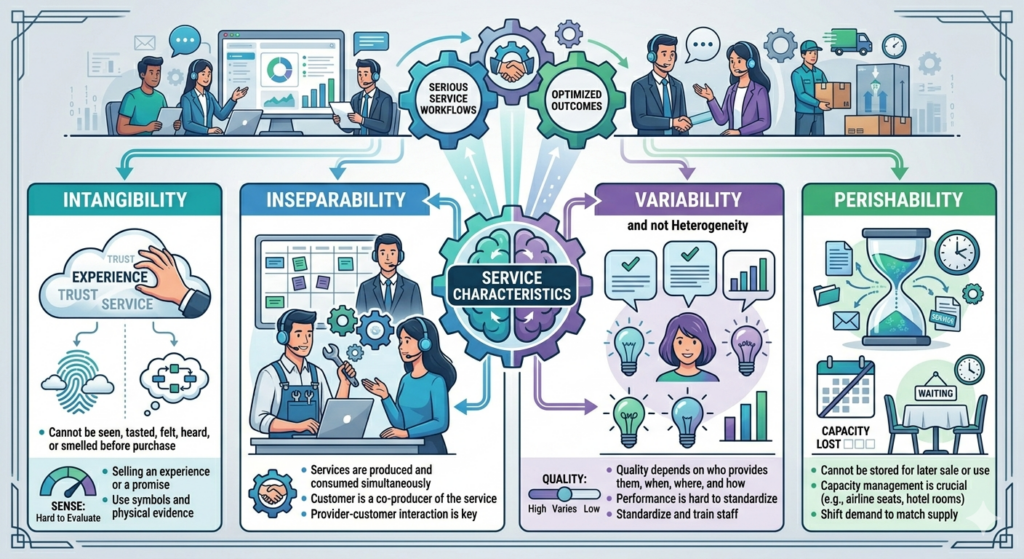
These aren’t just theory. Each characteristic directly changes how you market.
Intangibility
Services can’t be seen, touched, or stored. A potential customer has to trust the promise before experiencing the reality. This is why credibility signals certifications, reviews, testimonials, brand reputation carry so much weight in service industries.
Inseparability
A service is produced and consumed at the same time. A haircut, a legal consultation, a flight these happen in real time, with the customer present. That means the service provider IS the product. How your people show up directly shapes what the customer gets.
Variability
Services vary. The same restaurant can deliver an exceptional meal on Monday and a mediocre one on Thursday, depending on who’s cooking, how busy it is, and a dozen other factors. Standardising quality is one of the biggest operational challenges in service marketing, and it’s one of the hardest things to communicate in advance.
Perishability
Services can’t be inventoried. An empty seat on an IndiGo flight at 18:30 doesn’t roll over to the next day. That revenue disappears the moment the flight takes off. This is why dynamic pricing, advance booking incentives, and demand management are so central to service businesses.
The four characteristics of services intangibility, inseparability, variability, and perishability are what make service marketing fundamentally different from product marketing. Each one creates a specific challenge that requires a tailored strategy, from building credibility without physical evidence to managing demand when capacity cannot be stored.
Industry Use Cases and Examples of Service Marketing
Service marketing plays a crucial role across a variety of industries in India, helping brands build customer trust, enhance their offerings, and create lasting relationships. Let’s explore how different sectors use service marketing in India, highlighting one example for each.
1. Telecommunications
The telecommunications industry in India is highly competitive, with brands using service marketing to distinguish themselves through customer service and network reliability.
Jio is a prime example of a telecommunications company that uses service marketing effectively. It has positioned itself as a brand that provides not just affordable data plans, but also reliable connectivity, strong customer support, and added services like JioFiber and JioCinema. This holistic approach to service has helped Jio dominate the market.
2. Health and Wellness
The healthcare sector in India has also embraced service marketing, focusing on trust, personalized care, and patient satisfaction.
HealthifyMe is a popular wellness app that uses service marketing to promote personalized fitness plans and nutrition advice, focusing on customer engagement and continuous service updates.
3. Financial Services
Financial services in India rely on service marketing to build credibility and customer trust, particularly because these services deal with people’s money and financial well-being.
HDFC Bank is a leading example in this sector, leveraging service marketing to promote not just its financial products but also its strong customer service and digital banking solutions. The bank places a significant focus on personalized banking, customer care, and innovative financial solutions.
4. Tourism, Leisure, and Entertainment
In the tourism and leisure industry, service marketing helps brands provide unique travel experiences that stand out.
MakeMyTrip is one of the biggest names in India’s online travel space. The platform has built its success on service marketing by offering personalized travel packages, hassle-free booking processes, and an engaging customer experience, aiming to provide customers with seamless travel solutions.
5. Transportation
In the transportation industry, service marketing emphasizes convenience, accessibility, and customer comfort.
Ola uses service marketing to differentiate itself in a crowded market by offering an easy-to-use app, multiple ride options, and a focus on customer safety and satisfaction. Through personalized customer service and promotions, Ola works to maintain loyalty and encourage repeat business.
6. Hospitality
The hospitality industry in India thrives on exceptional customer service, creating memorable experiences for guests.
The Lalit is known for its high standard of service, offering personalized care, luxury accommodations, and fine dining experiences. The brand’s service marketing focuses heavily on creating bespoke experiences for guests, ensuring they feel valued and well-cared-for during their stays.
7. Consulting
Consulting firms use service marketing to emphasize their expertise, customer service, and ability to deliver solutions that help clients achieve success.
McKinsey & Company is a global consulting firm that uses service marketing to showcase its in-depth knowledge, client success stories, and expertise in strategy, operations, and technology consulting. The company highlights its value through case studies and whitepapers that demonstrate its ability to solve complex business problems.
8. Design, Marketing, and Sales
Design and marketing agencies use service marketing to highlight their creativity, innovation, and the value they bring to their clients.
Ogilvy India, a leading advertising and marketing agency, employs service marketing strategies that focus on delivering creative and tailored solutions to its clients. By showcasing successful campaigns and emphasizing the agency’s customer-first approach, Ogilvy positions itself as a leader in the design and marketing space.
9. Education
Education services in India are heavily influenced by service marketing, especially as more students look for quality learning experiences.
Unacademy, India’s leading ed-tech platform, attracts students by offering personalized learning experiences through interactive videos and coaching. It markets its services by showcasing the success of its students, testimonials, and the long-term value of its courses.
10. Restaurants
Restaurants use service marketing to enhance the dining experience, focusing on everything from the ambiance to the quality of service.
Domino’s India exemplifies service marketing in the food delivery sector, emphasizing fast delivery, customer engagement, and quality service. By offering personalized offers, app-based ordering, and consistent delivery times, Domino’s works to ensure customer satisfaction and brand loyalty.
Note: Want to learn marketing for Products and Services using Digital marketing channels? Check out our Advanced Digital Marketing Course (with Generative AI) 👇
Importance of service marketing
The importance of Service marketing is massive because it focuses on managing and promoting intangible services that play a pivotal role in consumer satisfaction. Here are key reasons why service marketing is essential:
Intangible Nature of Services: Unlike physical products, services are intangible and cannot be touched or seen before purchase. Effective service marketing bridges this gap by creating trust, providing testimonials, and highlighting service quality through customer experiences.
Customer-Centric Approach: Services are deeply dependent on customer satisfaction and loyalty. By focusing on customer needs and experiences, service marketing helps businesses create long-term relationships, making it easier to retain customers and increase lifetime value.
Building Customer Relationships: Service marketing fosters continuous interaction with customers. Brands like Zomato and Uber use feedback-driven strategies to maintain customer relationships and improve their services based on user input, enhancing their loyalty programs and user engagement.
Differentiation in Competitive Markets: Many industries, such as telecommunications or banking, offer similar services. Service marketing helps businesses differentiate by focusing on personalized services, customer care, and unique value propositions, as seen with Airbnb and its localized experiences.
Word-of-Mouth and Social Proof: Service marketing heavily relies on word-of-mouth, reviews, and social proof. Positive customer experiences often lead to organic referrals and social media sharing, helping to build brand credibility. Brands like Ola thrive on user reviews and ratings to create trust in the service.
Managing Service Quality: Service quality is crucial to retaining customers. Consistent service standards are key to marketing success, with companies like Taj Hotels ensuring that every guest receives top-tier service, regardless of location.
Leveraging Technology: Technology is integrated into service marketing strategies to improve customer experience and personalize offerings. Services like Amazon and Netflix use customer data to tailor recommendations and improve satisfaction.
Social Responsibility: Service marketing also helps position brands as socially responsible entities. Brands that promote values like sustainability and community welfare, such as Patanjali Ayurveda, can build stronger emotional connections with customers.
Types of Service Marketing
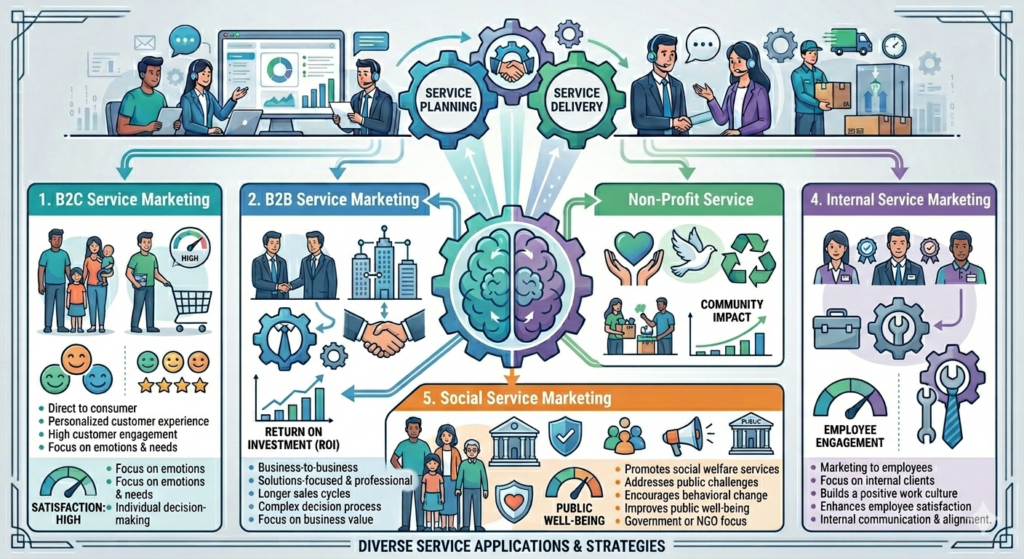
Types of marketing for services encompass various approaches depending on the target audience, goals, and organizational structure. Here’s an in-depth look at the five primary types:
1. B2C Service Marketing
Business-to-Consumer (B2C) service marketing focuses on providing services directly to individual customers. The goal is to attract, engage, and retain consumers by creating a positive service experience.
Characteristics:
- High emphasis on customer experience and satisfaction.
- Emotional appeals are often used in marketing messages.
- Services range from daily conveniences like food delivery to luxury experiences like spa treatments.
Example:
Swiggy, a leading food delivery service in India, employs B2C marketing strategies by promoting convenience, speed, and variety through targeted campaigns and offers.
Marketing Strategies:
- Highlighting benefits such as ease of use or affordability.
- Using social media platforms for engagement and brand visibility.
- Providing offers, loyalty programs, and personalized recommendations.
2. B2B Service Marketing
Business-to-Business (B2B) service marketing involves promoting services to other businesses rather than individual consumers. These services often include software solutions, consulting, and logistics.
Characteristics:
- Decision-making cycles are longer and more collaborative.
- Focuses on demonstrating value and Return on Investment (ROI).
- Services are usually tailored to client-specific needs.
Example:
TCS (Tata Consultancy Services) markets its IT and consulting services to businesses globally, offering customized solutions to enhance operational efficiency.
Marketing Strategies:
- Providing detailed case studies and whitepapers to showcase expertise.
- Building long-term relationships through personalized account management.
- Participating in industry events and webinars for networking and visibility.
Also Read: Difference between Marketing and Advertising
3. Non-Profit Service Marketing
Non-profit organizations use service marketing to raise awareness, attract donors, and promote causes. The objective is not profit but fulfilling a mission or addressing societal needs.
Characteristics:
- Focuses on emotional connection and purpose-driven messages.
- Often involves volunteer recruitment and community engagement.
- Combines traditional marketing with grassroots efforts.
Example:
Goonj, an Indian NGO, promotes donating clothes and other essentials to underprivileged communities.
Marketing Strategies:
- Storytelling to create emotional resonance with donors.
- Leveraging social media for fundraising campaigns.
- Collaborating with influencers or celebrities for greater reach.
4. Internal Service Marketing
Internal marketing focuses on promoting the organization’s values, services, and goals to employees and internal stakeholders. The idea is to ensure employees are engaged, aligned, and motivated to deliver exceptional service.
Characteristics:
- Treats employees as the first customers of the organization.
- Aims to enhance job satisfaction and service delivery quality.
- Builds a service-oriented culture.
Example:
Infosys, a global IT services leader, uses internal marketing by providing employees with robust training programs, career growth opportunities, and an inspiring work environment.
Marketing Strategies:
- Conducting workshops and training sessions.
- Encouraging feedback and fostering open communication.
- Recognizing and rewarding exceptional employee contributions.
5. Social Service Marketing
Social service marketing involves promoting ideas or behaviors that benefit society. Unlike other forms, the focus is on influencing public attitudes or behaviors for the greater good rather than driving profit.
Characteristics:
- Campaigns are often backed by governments, NGOs, or social organizations.
- Addresses societal challenges like public health, education, or environmental sustainability.
- Messaging is educational and aims to evoke a sense of responsibility.
Example:
The Swachh Bharat Abhiyan (Clean India Mission) is a government-led initiative in India that uses social service marketing to promote cleanliness and hygiene.
Marketing Strategies:
- Creating impactful campaigns with relatable narratives.
- Using mass media like television and radio for wider outreach.
- Engaging communities through local events and initiatives.
Difference Between Service Marketing and Product Marketing
Service marketing differs from product marketing in several key ways:
| Aspect | Product Marketing | Service Marketing |
| Focus of Marketing | Highlights tangible features, benefits, and performance of the product. | Emphasizes the experience, quality, and trustworthiness of the service. |
| Customer Decision-Making | Decisions are based on comparisons like price, features, and reviews. | Influenced by trust, reputation, and perceived service quality. |
| Marketing Mix (4 Ps) | Product, Price, Place, and Promotion focus on product features, pricing strategies, availability, and advertisements. | Focuses on Service quality, flexible pricing, accessibility, and relationship-building promotions. |
| Brand Positioning | Centers around unique selling points (USPs) like features and performance. | Positions the brand based on trust, quality, and consistency of service delivery. |
| Communication Strategy | Direct and feature-focused, highlighting the product’s benefits and technical details. | Builds trust with educational content, storytelling, and testimonials to set expectations. |
| Sales Process | Transactional, aiming to convince and close the sale quickly. | Relational, involving trust-building and tailored solutions for the customer. |
| Customer Experience | Linked to the product’s performance and post-purchase support. | Central to the service; interaction and delivery quality shape satisfaction. |
| Customization | Limited customization; core product remains consistent across customers. | Highly customizable to individual customer needs and preferences. |
| Customer Feedback Loop | Collected post-purchase to improve future product iterations. | Continuous feedback during service delivery allows real-time adjustments. |
| Marketing Challenges | Competing in a crowded market, managing product lifecycle, and driving innovation. | Maintaining service quality, ensuring consistency, and overcoming intangibility challenges. |
Also Read: What is Service Marketing Triangle
How to Create Effective Service Marketing Strategies
1. Understand Your Target Audience
Effective service marketing begins with a deep understanding of your audience’s needs, preferences, and pain points.
- Steps:
- Conduct market research through surveys, focus groups, and customer interviews.
- Develop customer personas to visualize your audience.
- Segment your audience based on demographics, psychographics, or behavioral traits.
- Example: Ola Cabs targets urban commuters by offering services tailored to their convenience and price sensitivity.
2. Define a Clear Value Proposition
Communicate what makes your service unique and why customers should choose it over competitors.
- Key Actions:
- Highlight the benefits of your service, not just features.
- Emphasize trust, reliability, and customer experience.
- Example: Urban Company emphasizes its professional, background-verified service providers to build trust.
3. Leverage the 7 Ps of Service Marketing
Use the extended marketing mix (Product, Price, Place, Promotion, People, Process, Physical Evidence) to create a balanced strategy.
- Focus Areas:
- Ensure seamless service delivery (Process).
- Train employees to embody your brand values (People).
- Create tangible elements like branded materials (Physical Evidence).
- Example: Air India uses branded interiors and premium services to align with its reputation.
4. Build a Strong Digital Presence
With services increasingly accessed online, a robust digital strategy is essential.
- Actions:
- Develop a user-friendly website that clearly explains your offerings.
- Optimize for local SEO to capture nearby audiences.
- Use social media to engage with customers and share testimonials.
- Example: Practo uses a mobile app and website to connect patients with healthcare professionals.
5. Use Storytelling and Case Studies
Given the intangible nature of services, storytelling can create an emotional connection and build trust.
- Strategies:
- Share customer success stories and testimonials.
- Use video marketing to showcase real-life service experiences.
- Example: Unacademy highlights student achievements to showcase the efficacy of its learning platform.
6. Provide Exceptional Customer Service
Customer satisfaction drives loyalty and word-of-mouth referrals, critical for service businesses.
- Steps:
- Train staff to handle customer inquiries and complaints effectively.
- Collect feedback and use it to improve service quality.
- Example: Taj Hotels’ personalized guest services have become a benchmark in the hospitality industry.
7. Focus on Relationship Marketing
Building long-term relationships with customers increases lifetime value and reduces churn.
- Tactics:
- Implement loyalty programs to reward repeat customers.
- Engage through personalized email campaigns or exclusive offers.
- Example: Paytm uses cashback offers and discounts to retain customers and encourage frequent use.
8. Leverage Data and Analytics
Use data anaytics to refine your marketing strategies and personalize customer experiences.
- Applications:
- Analyze customer behavior and preferences to tailor campaigns.
- Use CRM tools to track and manage customer interactions.
- Example: Swiggy uses data analytics to recommend restaurants and dishes based on user history.
9. Harness the Power of Reviews and Testimonials
Positive reviews and testimonials build credibility and influence purchase decisions.
- Steps:
- Encourage satisfied customers to leave reviews.
- Feature testimonials on your website and social media platforms.
- Example: Zomato prominently showcases user ratings and reviews to help customers make informed decisions.
10. Adapt and Innovate Continuously
The service industry is dynamic, requiring regular updates to stay relevant.
- Approach:
- Monitor industry trends and competitor strategies.
- Innovate based on customer feedback and technological advancements.
- Example: Uber introduced Uber Eats and subscription-based services like Uber Pass to diversify its offerings.
11. Integrate Omnichannel Marketing
Offer a seamless experience across multiple touchpoints, whether online or offline.
- Steps:
- Ensure consistent messaging across all platforms.
- Use tools like chatbots and 24/7 customer support to provide round-the-clock assistance.
- Example: Amazon integrates website, app, and physical stores to provide a unified customer experience.
The 7 Ps of Service Marketing
The traditional 4 Ps Product, Price, Place, Promotion were built for physical goods. Services need three more.
1. Product (the Service Itself)
What are you actually delivering, and what promise does it carry? For a service, quality consistency IS the product. HealthifyMe’s product isn’t an app it’s a coaching relationship that delivers measurable fitness results.
2. Price
Service pricing is more flexible and often more complex than product pricing. Netflix uses tiered subscription pricing (Basic, Standard, Premium) based on features and screen count. Urban Company uses transparent, fixed-rate pricing for home services specifically because price uncertainty is a barrier to purchase in that category.
3. Place (Accessibility and Delivery)
Where and how customers access your service matters enormously. Zomato’s expansion into 500+ Indian cities wasn’t just a logistics decision it was a service marketing decision. Accessibility is a key part of the value proposition.
4. Promotion
Promotion in service marketing leans heavily on social proof, storytelling, and content that makes the invisible tangible. Unacademy’s use of educator-led content on YouTube is both a promotional channel and a product sample watch the free lesson, see the quality, enrol.
5. People
The service IS the person delivering it, in most cases. Taj Hotels invests intensively in staff training not because it’s nice to do, but because every guest interaction is a brand experience. A poorly trained front desk team doesn’t just create a bad day it damages brand equity.
6. Process
How a service is delivered is as important as what is delivered. Swiggy’s app UX, real-time tracking, and order communication aren’t frills they’re core to why customers prefer it over competitors. A smooth process reduces friction and reduces post-purchase anxiety.
7. Physical Evidence
Since you can’t touch a service, physical cues signal quality. A well-designed website. Branded uniforms. A clean, professional office. The IndiGo aircraft livery and cabin cleanliness aren’t just operational standards they’re physical evidence that this airline takes quality seriously.
The 7 Ps of service marketing Product, Price, Place, Promotion, People, Process, and Physical Evidence extend the traditional 4 Ps framework to address the unique challenges of marketing intangible services. People, Process, and Physical Evidence are the elements that make service quality visible and consistent to customers who cannot evaluate a service before purchasing it.
Conclusion
Crafting effective service marketing strategies is essential for standing out in a competitive and dynamic marketplace. By focusing on understanding customer needs, building trust through consistent value delivery, and leveraging the power of digital tools, businesses can effectively promote their services. Strategies like implementing the 7 Ps, fostering relationships through loyalty programs, and continuously innovating ensure long-term success. Ultimately, a customer-centric approach coupled with actionable insights and adaptability will help service-based businesses not only attract but retain a loyal customer base in an ever-evolving market.
FAQs: What is Service Marketing?
What is the meaning of service marketing?
The meaning of Service marketing involves strategies and practices designed to promote and sell services rather than tangible products. It focuses on aspects such as customer service, experience, and relationship management.
Why is service marketing different from product marketing?
Service marketing is distinct because services are intangible, perishable, and often involve direct customer interaction. This makes factors like customer experience and relationship management even more critical compared to product marketing.
How do I create a successful service marketing strategy?
A successful service marketing strategy should focus on understanding your target customers, building strong customer relationships, and ensuring high-quality service delivery. Incorporating elements like personalized customer service and leveraging technology for better communication are key components.
What are some key elements of a service marketing mix?
The 7Ps—Product, Price, Place, Promotion, People, Process, and Physical Evidence—are the key elements of the service marketing mix. These components help businesses deliver a well-rounded customer experience.
How can technology improve service marketing?
The scope of Service Marketing is widening thanks to technology. Technology can enhance service marketing by providing tools for personalized customer engagement, streamlining service delivery, and gathering data for improved decision-making. Tools like CRM systems, chatbots, and AI can optimize customer experiences.
What is the example of Service Marketing?
One example of service marketing would be an airline company (like Emirates) promoting its comfortable seating, in-flight entertainment, and premium CX (customer experience) through print ads, digital ads and loyalty programs to attract travelers. Below are some more examples:
Banking Services: Banks market their savings accounts, loan offers, and mobile banking apps to enhance customer convenience.
Healthcare Services: Hospitals and clinics advertise advanced treatments, state-of-the-art equipment, super-specialized doctors, and emergency care to build trust.
Education Services: Universities and e-learning platforms promote their courses, expert faculty, and career support to attract students.
Hospitality Services: Hotels and resorts highlight luxurious amenities, fine dining, and concierge services to encourage room bookings.
Telecom Services: Internet and mobile service providers showcase their high-speed data plans, network coverage, and seamless customer support to gain more subscribers.