

Most products don’t die because they’re bad. They die because nobody finds out they exist, and the few who do find them never stick around long enough to feel the value. That’s the gap growth marketing strategies are supposed to close, and most founders attack it backwards. They throw budget at acquisition before they’ve figured out whether the people they’re acquiring actually stay.
The product companies that go from zero to a real user base, not a vanity-metric one, do something different. They treat growth as a property of the product itself, not a campaign that runs alongside it. According to a 2025 ProductLed Benchmark Report covering more than 600 B2B SaaS companies, 58% now identify as product-led, and 91% of those plan to increase that investment further. That’s not a trend. That’s the operating model.
This guide walks through 11 growth marketing strategies that actually build a user base, the kind of strategies you’ll see behind Notion, Figma, Dropbox, Calendly, and, closer to home, Zepto and CRED. You’ll also get the framework that ties them together, the mistakes that keep products stuck at zero, and answers to the questions teams ask most often when they’re starting from nothing.
Table of Contents
What Makes Growth Marketing Different for Product Companies?
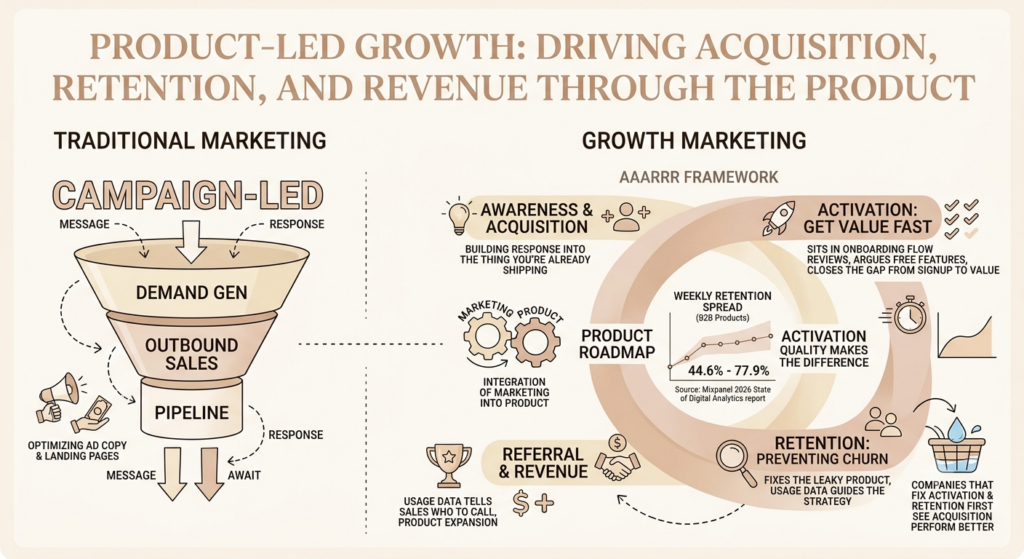
Growth marketing for product companies means using the product itself, not just campaigns, to drive acquisition, activation, retention, referral, and revenue. Traditional marketing pushes a message out and waits for people to respond. Growth marketing builds the response into the thing you’re already shipping.
That’s a real shift in where the work happens. A traditional marketer optimizes ad copy and landing pages. A growth marketer at a product company sits in onboarding flow reviews, argues about which feature should be free, and obsesses over the gap between signup and the moment someone actually gets value. The work moves from the campaign calendar into the product roadmap.
Product-Led Growth vs Traditional Marketing
Product-led growth treats the product as the primary driver of customer acquisition, conversion, and expansion. Traditional marketing treats the product as something you sell after marketing creates demand. The practical difference shows up in the budget. Traditional SaaS companies spend heavily on outbound sales and demand gen to drive pipeline. PLG companies spend on product, onboarding, and in-app experience, then let usage data tell sales who to call.
This isn’t about marketing disappearing. It’s about marketing’s job changing from “convince people to try this” to “make sure the right people find this and get value fast.” Honestly, that’s a harder job in some ways, because you can’t paper over a weak product with a clever campaign anymore.
The AAARRR Growth Framework
AAARRR (sometimes written AARRR, sometimes with the extra A for Awareness) stands for Awareness, Acquisition, Activation, Retention, Referral, and Revenue. Dave McClure popularized this pirate metrics model years ago, and it still holds up because it forces you to look past top-of-funnel numbers. A founder obsessed with signups but blind to activation is optimizing the wrong stage.
Most teams are decent at measuring the first two letters. Awareness and acquisition show up in every dashboard by default. Where companies fall apart is activation, the stage where a signup either becomes a real user or quietly disappears. That’s the stage this whole guide keeps circling back to, because it’s the stage that decides whether everything else works.
Why User Retention Matters More Than Acquisition
Retention matters more than acquisition because a leaky product makes every acquisition channel look worse than it actually is. If you’re losing 80% of new users in the first month, doubling your ad spend just means losing twice as many people, faster, at a higher cost. Competitor research across product-led growth case studies consistently shows the same pattern: companies that fix activation and retention first see acquisition channels (paid, organic, referral) perform better almost automatically, because the users who do show up actually stick.
According to Mixpanel’s 2026 State of Digital Analytics report, weekly retention for B2B products ranges from 44.6% to 77.9% globally. That’s a massive spread, and the gap between the top and bottom of that range usually comes down to activation quality, not raw product quality. Two companies can build comparably good software and end up with wildly different retention because one nailed the first session and the other didn’t.
Retention varies enormously even among comparable B2B products, with weekly retention ranging from roughly 45% to nearly 80% according to Mixpanel’s 2026 State of Digital Analytics report. The gap between top and bottom performers usually traces back to activation quality in the first session, not differences in core product quality.
1. Start With Product-Led Growth (PLG)
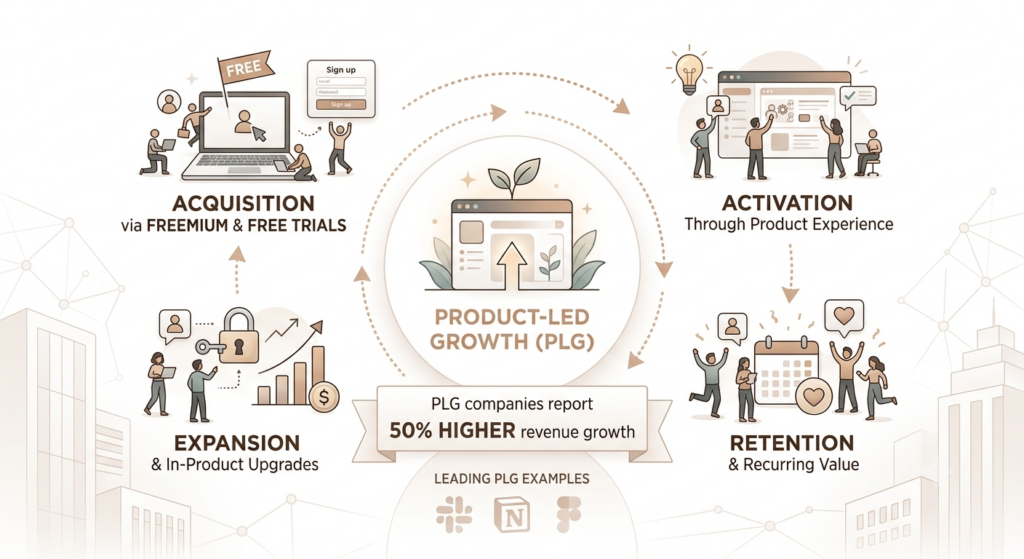
If there’s one growth marketing strategy product companies keep coming back to, it’s letting the product close the deal before a salesperson ever gets involved. Product-led growth (PLG) is a go-to-market motion where the product itself drives acquisition, activation, retention, and expansion, instead of relying on outbound sales to do that work. Blake Bartlett at OpenView coined the term back in 2016, but the underlying mechanics, freemium tiers, self-serve signup, in-product upgrade prompts, existed long before the label did.
The numbers behind PLG adoption are no longer a curiosity. 91% of B2B SaaS companies with over $50 million in ARR have implemented PLG strategies, and almost all of them plan to keep increasing that investment. PLG companies also report 50% higher revenue growth rates than sales-led competitors, while spending close to 40% less on sales and marketing to get there. That’s not a small efficiency gain. That’s a different cost structure for growth entirely.
Why the Product Becomes the Acquisition Channel
The product becomes the acquisition channel when using it is itself a form of discovery for other people. Think about how that plays out day to day: someone shares a Loom recording, a colleague clicks the link, watches it, and within thirty seconds understands what Loom does without reading a single landing page. No ad spend touched that interaction. The product did the selling.
This works because B2B buyers no longer want to talk to sales before they understand a product. Forrester reported that B2B buyers complete nearly 83% of their journey before ever speaking to a sales rep. If your product can’t explain itself during that self-serve window, you’ve already lost the buyer to a competitor who can.
Freemium vs Free Trial Models
Freemium gives users permanent free access to a limited version of the product, while a free trial gives full access for a fixed period before requiring payment. The choice between them isn’t cosmetic. Freemium converts more visitors into signups (a median 12% visitor-to-signup rate, 140% higher than free trials), but free trials, especially opt-out trials that require a card upfront, convert signups to paying customers at far higher rates, sometimes near 50%.
Which one fits depends on your product’s value curve. If someone needs weeks of usage to feel the value (a project management tool, say), freemium gives them room to get there. If the value is obvious within minutes (an AI writing tool, a converter, a quick utility), a time-boxed trial creates urgency without scaring off the curious.
Examples from Slack, Notion, and Figma
Slack’s free tier lets entire teams adopt the product without anyone signing a purchase order, and the experience of using Slack at one company became the reason people asked for it at the next one. Notion took a similar path but leaned harder into flexibility, letting users build wildly different workflows on the same base product, which made it useful to almost anyone with almost any job. Figma went further still by making collaboration the product itself: a single shared file with a link is the whole pitch, no install required for viewers, no sales call needed to see the value.
None of these companies treated growth as a separate department bolted onto the product. The product was the growth department.
Product-led growth has shifted from a startup tactic to the default operating model for scaled B2B SaaS, with 91% of companies over $50 million ARR running PLG strategies and reporting 50% higher revenue growth than sales-led peers while spending roughly 39% less on sales and marketing.
2. Reduce Time-to-Value Aggressively
How fast does a new user need to feel value before they give up on your product? In 2026, the honest answer from most PLG benchmark reports is somewhere under sixty seconds for self-serve products with low switching costs. That sounds aggressive until you remember how many tabs the average person has open while evaluating five competing tools at once.
Time-to-value (TTV) is the amount of time between a user signing up and experiencing the core value your product promises. The shorter the window, the higher your activation rate tends to be, and activation is the metric that predicts almost everything downstream. Top-performing PLG companies target 40-60% activation rates, with the best-in-class crossing 70%, yet a striking number of teams, only about a third according to recent PLG research, actually track activation as a formal metric. You can’t fix what you don’t measure.
The “Aha Moment” Strategy
The aha moment is the specific point in a product experience where a user understands, viscerally, why the product matters to them. For Slack, it’s sending and receiving a message in a real channel. For Dropbox, it’s syncing a file across two devices and seeing it appear automatically. For a project management tool, it might be assigning the first task to a teammate and watching it show up in their queue.
Finding your aha moment takes actual analysis, not guesswork. Pull retention curves segmented by which actions users took in their first session, and look for the action that correlates most strongly with users coming back a week later. That action, whatever it turns out to be, is your real onboarding target, not “complete the signup form.”
Designing Fast Onboarding Experiences
- Map the single fastest path from signup to the aha moment, and strip out every step that doesn’t serve that path directly.
- Pre-fill or auto-generate sample data so users see the product working before they’ve created anything themselves.
- Replace generic welcome tours with contextual prompts that appear exactly when a feature becomes relevant, not all at once on day one.
- Personalize the first session based on stated intent (role, use case, team size) so a marketer and a developer don’t see the identical walkthrough.
- Set a single, measurable activation event and design every onboarding screen around getting users to that event, nothing else.
In 2026, leading PLG companies are pushing this further with AI-driven personalization that adapts the onboarding sequence in real time based on early behavioral signals, like which feature someone explores first or whether they invite a teammate in that initial session.
Common Friction Points That Kill Activation
Email verification gates, mandatory long-form signup wizards, and feature-heavy dashboards that dump every option on a brand-new user are the usual culprits. So is asking for a credit card too early on products where trust hasn’t been established yet. Forty to sixty percent of free users in a typical PLG funnel never reach activation at all, and OpenView’s research labels these “zombie users,” people who signed up, poked around, and vanished without ever experiencing core value.
That said, this isn’t a call to remove every form of friction blindly. Some friction, like asking a B2B buyer to specify their company size, genuinely improves personalization downstream. The goal isn’t zero friction. It’s removing friction that doesn’t earn its place.
3. Build Viral Loops Into the Product
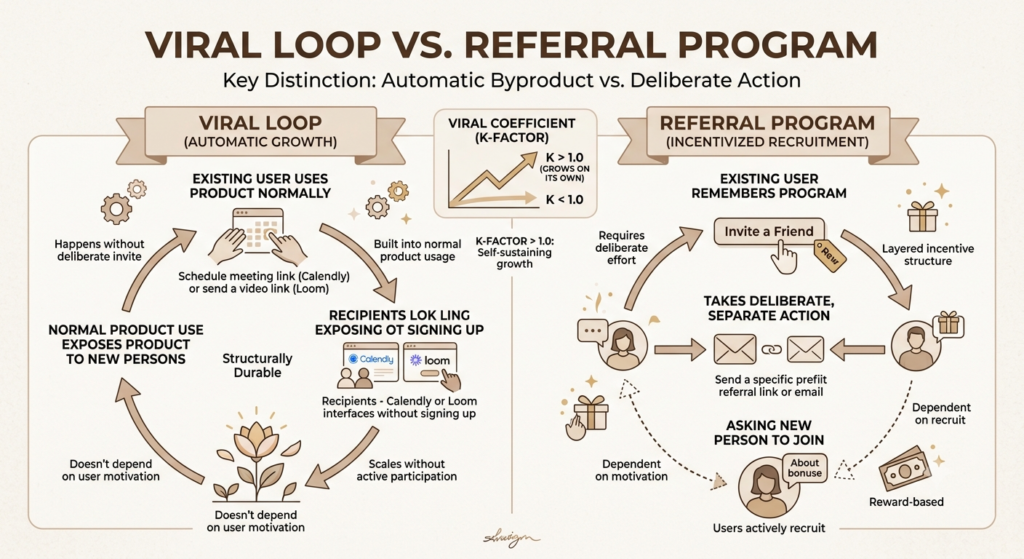
What separates a viral loop from a referral program? A viral loop happens automatically as a byproduct of normal product usage, while a referral program requires a user to take a deliberate, separate action to invite someone. That distinction matters more than it sounds, because viral loops scale without anyone remembering to participate.
What Makes a Viral Loop Different From a Referral Program
When someone uses Calendly to schedule a meeting, the person on the other end of that scheduling link sees Calendly’s interface without ever signing up. That’s a viral loop. Nobody clicked “invite a friend.” The product’s normal function exposed a new person to the product. A referral program, by contrast, is a deliberate incentive structure layered on top of the product, asking existing users to actively recruit others in exchange for a reward.
Both can work. But viral loops are structurally more durable because they don’t depend on motivation. A user doesn’t need to feel generous or incentivized to trigger one; they just need to use the product the way they normally would.
Product-Led Virality Examples
Loom is one of the cleanest examples in recent SaaS history. A user records a quick screen capture, shares the link instead of scheduling a meeting, and the recipient watches a polished, branded Loom player before ever hearing a sales pitch. That loop alone built enough momentum that Loom went from roughly 3,000 Product Hunt signups to a $975 million acquisition.
Cursor offers a more recent, more dramatic case. A developer downloads the AI code editor and starts typing, with zero onboarding wizard, no trial countdown, and the product’s value (AI-powered code completions) appears immediately. That frictionless entry point fed revenue growth from $500 million in ARR in May 2025 to $2 billion by February 2026, with corporate adoption climbing from roughly a quarter of revenue in late 2024 to around 60% by the $2 billion mark, as individual developers pulled the tool into their companies organically.
Measuring Viral Coefficient
The viral coefficient (often written as K-factor) is the average number of new users each existing user brings in through sharing. A K-factor above 1.0 means your user base grows on its own, without any paid acquisition, purely from existing users inviting new ones. Below 1.0, viral mechanics still help; they just need to combine with other channels rather than carry growth alone.
Dropbox’s viral coefficient during its referral program’s peak years has been estimated at roughly 0.35 by some analyses and considerably higher by others, depending on methodology and which channels get counted as “viral.” The honest takeaway, regardless of which estimate you trust, is that Dropbox never relied on virality in isolation. It stacked viral product mechanics on top of referrals, word of mouth, and PR, and the combination is what produced the explosive growth, not any single lever.
A viral loop differs from a referral program because it triggers automatically during normal product use rather than requiring a deliberate invite action. Products like Calendly and Loom generate new signups simply by being used as intended, which makes viral loops more durable growth engines than incentive-based referral campaigns alone.
4. Create a Referral Program That Rewards Both Sides
Why does referral marketing still work in a world full of paid acquisition tools and AI-targeted ads? Because a recommendation from someone you trust still beats an ad from a brand you don’t. That hasn’t changed in a decade of marketing technology, and it’s not going to change because of better targeting algorithms.
Why Referral Marketing Still Works
Referral programs work because they convert existing user trust into new user trust, transferring credibility that a brand could never buy directly. The filtering effect is underrated here, too. People who join because a friend recommended a product tend to activate faster, stay longer, and upgrade more often than users acquired through ads, because the referral already pre-qualified their interest and intent.
Incentive Structures That Drive Adoption
The strongest referral programs use double-sided rewards, meaning both the person who refers and the person who gets referred receive something of value. One-sided rewards (where only the referrer benefits) tend to underperform because the new user has no reason to act quickly, while the referrer has every reason to spam the invite to as many people as possible, regardless of fit. To set up double-sided rewards, you can use referral tools like ReferralCandy.
Zepto’s referral program in India is a clear modern example of this mechanic at work. Users earn a discount on their next order, capped at around ₹200, or accumulate credits worth up to ₹2,000 across ten successful referrals, with both the referrer and the new user benefiting. The reward currency is “Zepto Cash,” usable only within the app, which keeps the cost contained to actual platform usage rather than handing out cash that could be redeemed anywhere.
Lessons From Dropbox’s Growth Engine
Dropbox’s referral program offered both the referrer and the referred friend 500MB of extra storage, capping out at 16GB total for heavy referrers. That program drove the company from 100,000 to 4 million users in fifteen months, a 3,900% increase, and Dropbox has said internally that it saved roughly $48 million compared to what equivalent growth through paid acquisition would have cost, given that AdWords campaigns were running $233 to $388 per customer for a product priced at $99 a year.
The lesson that gets missed in most retellings: Dropbox didn’t invent word of mouth with this program. Around a third of their users were already arriving through informal referrals before the program existed. What the program did was capture energy that already existed and give it a structured place to go, with tracking, automation, and a reward worth sharing about.
5. Turn Existing Users Into Distribution Channels
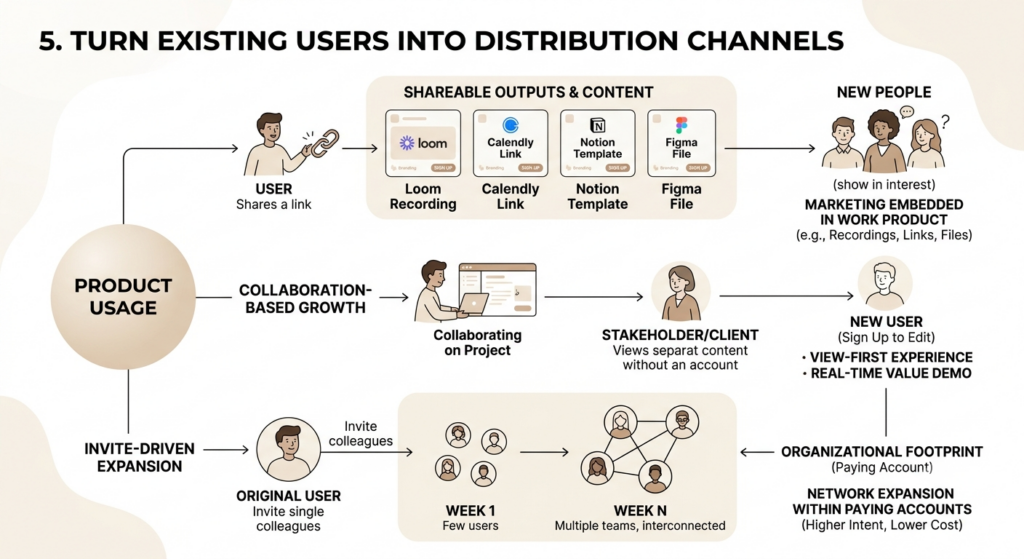
Companies like Calendly, Loom, and collaborative tools grow because every interaction with the product introduces new people to it. This is a step beyond viral loops in the narrow sense. It’s about designing the actual outputs of product usage, the documents, recordings, links, and shared workspaces, so that each one functions as a small piece of marketing.
Shareable Content and Outputs
Notion’s templates, Loom’s recordings, Calendly’s scheduling links, and Figma’s shared design files all share one trait: they’re things people would create and share anyway, as a normal part of doing their job, and each one happens to carry the product’s branding and a path to sign up. The marketing isn’t separate from the work. It’s embedded inside the work product itself.
Collaboration-Based Growth
Figma’s entire growth story runs through this mechanic. A design file shared with a stakeholder, a client, or another team member doesn’t require that person to install anything or create an account to view it. They see the product working in real time, often before they’ve ever heard a pitch about why Figma is different from other design tools. By the time they need to edit something themselves, they’ve already decided Figma is worth signing up for.
Invite-Driven Expansion
Invite-driven expansion happens when a single user pulls colleagues into the product because the product is more useful with more people in it. Slack, Notion, and Figma all lean on this. One person starts a workspace, invites two teammates to collaborate on something specific, and within weeks, the whole team is using the tool, often without anyone from sales ever getting involved in that expansion.
This is worth distinguishing from cold-start virality. It’s not a stranger discovering your product through a shared link. It’s an existing customer’s network expanding the footprint inside an organization that’s already paying. That’s usually a far higher-intent, lower-cost growth motion than acquiring a brand-new logo.
Products that turn their everyday outputs, shared documents, recordings, design files, scheduling links, into distribution channels grow without a dedicated acquisition budget, because every use of the product becomes a small demonstration of its value to someone who hasn’t signed up yet.
6. Build a Community Before You Need One
Most founders wait to build a community until they already have thousands of users, by which point the community feels like an afterthought instead of a foundation. The companies that get the most out of community-led growth started earlier, often while the product was still rough around the edges.
User Communities as Growth Assets
A user community functions as a growth asset when it does acquisition, retention, and product feedback work simultaneously, without requiring a proportional increase in marketing spend. Community-led growth reduces customer acquisition cost by an estimated 30-60% compared to traditional paid and sales-driven channels, according to recent SaaS research. That’s a meaningful number for any early-stage product company watching its runway closely.
It’s worth being honest about the limits here, too. Community measurement remains genuinely hard. Only 24% of companies running active community programs in 2025 could confidently quantify the financial impact of that community, up from 16% the year before. A SaaStr survey found 58% of SaaS community programs can’t attribute revenue to community engagement at all, largely because someone who lurks in a community for months before booking a demo shows up in the CRM as a fresh lead, not a warmed one.
Creating Customer-Led Advocacy
Notion didn’t build a forum and wait. The company showed up where designers, productivity enthusiasts, and builders were already gathering, on Twitter, YouTube, and Reddit, and gave its most engaged users a reason to create and share. The result was a template ecosystem that today functions as one of Notion’s largest acquisition engines, all built by users, for users, with Notion mostly getting out of the way.
Figma took a more product-embedded approach. Figma Community lives directly inside the product, letting designers publish templates, UI kits, and plugins that double as portfolio pieces for the creators themselves. Someone searching for a specific wireframe template stumbles into a Figma file, creates an account to duplicate it, and becomes a user without ever seeing a traditional ad. Figma’s community now includes more than 4 million user-created resources.
Community-Led Growth Examples
Duolingo built its community around shared progress, leaderboards, and clubs that turn language learning, normally a solitary and easy-to-quit activity, into something social and accountable. HubSpot took the education route instead, building HubSpot Academy to train an entire generation of marketers on inbound methodology, many of whom became advocates for the platform years before they ever became paying customers. Both approaches work, but neither one happened by accident. Each required deciding, early, what the community’s reason to exist would be beyond simply “talk about our product here.”
Community-led growth can reduce customer acquisition cost by 30-60% compared to paid channels, but it works best as a deliberate strategy with a clear purpose beyond the product itself, not a Slack group spun up after growth has already stalled.
7. Use Content Marketing to Capture Existing Demand
Content marketing remains one of the most scalable acquisition channels for products with a longer buying journey, but the rules of what works have shifted meaningfully since 2024. AI Overviews and chat-based answer engines now intercept a large share of searches before anyone clicks through to a website, which means content built purely to rank is fighting a smaller battle than it used to.
Educational Content That Solves Problems
The product companies winning at content marketing in 2026 aren’t writing about their feature list. They’re writing about the problem their buyer is trying to solve, with the product showing up as one part of a genuinely useful answer. Razorpay, Zerodha, and Finshots in the Indian market built exactly this kind of trust through blogs, explainers, and newsletters that educate first, long before any pitch appears.
SEO for Product Companies
SEO for product companies increasingly means optimizing for two audiences at once: traditional search rankings and AI answer engines that summarize content directly on the results page. Over 65% of Google searches now end without a click, according to recent digital analytics research, because AI Overviews answer the query directly. That doesn’t mean SEO is dead. It means the goal has shifted from “rank first” to “be the source that gets cited,” which rewards clear, well-structured, factually precise content over content stuffed with keywords.
Product-Led Content Strategy
A product-led content strategy ties educational content directly to in-product moments, rather than treating content and product as separate departments. This might mean linking a help-center article from inside an onboarding flow at the exact moment a user gets stuck, or publishing comparison content that helps a prospect self-select into the right pricing tier before they ever talk to sales. The content does double duty: it ranks externally, and it reduces support load internally.
8. Launch on Existing Audiences Instead of Building Your Own
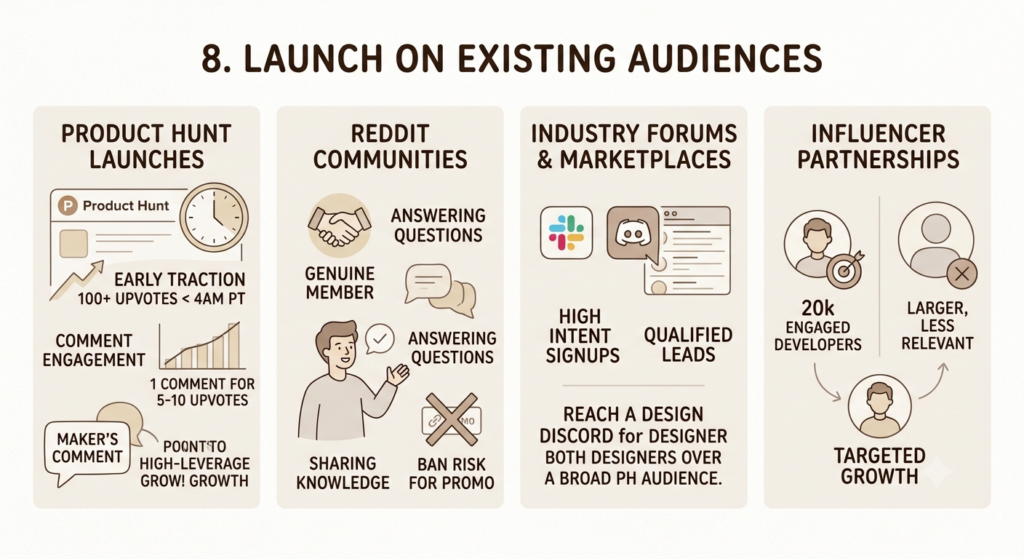
Early-stage companies often gain traction faster by borrowing existing audiences than by trying to build their own from a standing start. Building an audience from zero takes years. Borrowing access to one that already exists, if done with genuine value to offer, can take weeks.
Product Hunt Launches
A Product Hunt launch can still meaningfully jump-start a product’s first wave of users, but the platform has changed enough since its early days that the old playbook of mass-DMing strangers for upvotes no longer works, and arguably never should have. Product Hunt now runs a Featured versus All system, meaning unfeatured launches get almost no meaningful traffic regardless of how many upvotes they accumulate after the fact.
The data on what actually predicts a strong launch is fairly specific now. Analysis of recent Product Hunt launches found that products crossing 100 upvotes before 4 am PT had an 82% chance of finishing in the top 10. Comment engagement matters just as much as raw upvotes: launches with a healthy ratio of comments to upvotes (roughly 1 comment for every 5 to 10 upvotes) saw a 54% top-five finish rate, compared to just 8% for upvote-heavy launches with thin discussion. The single highest-leverage asset, more impactful than any graphic or video, was the maker’s own first comment, with detailed, non-salesy founder comments correlating with 166% more upvotes on average.
It’s also worth setting realistic expectations before launch day. One survey of founders found that 50% saw only a temporary spike in signups after their Product Hunt launch, and 16% saw no measurable increase at all. Loom is the standout exception that gets cited constantly, growing from roughly 3,000 Product Hunt signups into a product that sold for $975 million, but that outcome had as much to do with what Loom built after the launch as the launch itself.
Reddit Communities
Reddit communities work as a launch audience when a founder participates as a genuine member of the community first, answering questions and sharing knowledge, rather than showing up only to drop a link. Subreddits built around a specific profession or problem space tend to have sharp, fast detectors for promotional behavior, and the penalty for getting caught is usually a ban, not just a downvote.
Industry Forums and Marketplaces
Niche forums, Slack communities, and Discord servers built around a specific industry often have smaller audiences than Reddit or Product Hunt, but far higher intent. A founder building a tool for freelance designers will likely get more qualified signups from a well-targeted design Discord server than from a broad Product Hunt audience, simply because everyone in that smaller space already has the exact problem the product solves.
Influencer Partnerships
Influencer partnerships for product companies work best when the influencer’s audience overlaps tightly with the product’s actual use case, rather than chasing the largest possible follower count. A mid-sized creator with 20,000 highly engaged developers following their content will usually outperform a creator with ten times the audience but no specific relevance to the product category.
9. Use Product Usage Data to Drive Growth Decisions
Modern growth teams rely on product data rather than assumptions when optimizing the user journey, and that shift is probably the single biggest difference between growth marketing today and growth marketing a decade ago. Gut instinct still has a place, but it’s a starting hypothesis now, not a final answer.
Identifying Activation Events
An activation event is a specific, measurable action in the product that correlates strongly with a user staying long-term. Finding it requires looking at retention cohorts segmented by early behavior, not asking the team to guess based on what feels important. For a project management tool, that might be creating three or more projects in the first week. For a messaging tool, it might be sending messages in more than one channel within the first session.
Tracking Product-Qualified Leads (PQLs)
A product-qualified lead (PQL) is a user who has crossed a meaningful usage threshold in the product, like inviting a teammate or hitting a usage limit, that strongly correlates with willingness to pay. PQLs convert at 25-30%, compared to just 5-10% for traditional marketing-qualified leads, because the intent behind a PQL is demonstrated through real behavior rather than inferred from a content download or a webinar registration.
This is why the most efficient sales-assisted PLG companies don’t have reps doing cold outreach at all. Reps spend their time reaching out to PQLs with usage-aware messages that reference specific in-product behavior, positioning the next pricing tier as an obvious step rather than a hard sell.
Using Behavioral Analytics
Behavioral analytics tools track what users actually do inside a product (clicks, feature usage, session length, drop-off points) rather than relying solely on session counts or page views, the way traditional web analytics does. The distinction matters because two users can have identical session counts and wildly different outcomes; one might be deeply engaged with the core feature, while the other is clicking around aimlessly before churning. Traditional analytics can’t tell those two users apart. Behavioral analytics can.
A product-qualified lead converts at 25-30%, roughly three times the rate of a traditional marketing-qualified lead, because PQL status is earned through demonstrated product behavior rather than inferred from marketing engagement like content downloads or webinar signups.
10. Focus on Retention Before Scaling Acquisition
Why does churn kill growth faster than almost any other single problem? Because it compounds against you. Every dollar spent on acquisition that walks out the door within a month isn’t just wasted; it actively makes your next acquisition channel look worse, because the cohort data drags down every blended metric an investor or a board will eventually ask about.
Why Churn Kills Growth
A product with strong acquisition but weak retention is, to use the cliché that happens to be accurate here, a leaky bucket. Pouring more water (new users) into a bucket with a hole in the bottom doesn’t fix anything; it just means you’re pumping harder to maintain the same water level. According to a 2025 OpenView SaaS Benchmark Report, only 27% of self-described PLG companies report sustained year-over-year expansion, and the majority of the rest are struggling with exactly this pattern: acquiring free users faster than they can retain them, while calling the result “growth.”
Improving Product Stickiness
Product stickiness improves when a product becomes embedded in a user’s regular workflow rather than remaining an occasional, optional tool. This usually means building habit-forming touchpoints (notifications, recurring tasks, scheduled reports) tied to genuine value, not artificial engagement tricks designed to inflate daily active user counts without actually helping anyone.
That said, this approach has a real limitation worth naming honestly. Stickiness tactics that aren’t grounded in actual value tend to produce engagement numbers that look great in a board deck and terrible in churn data six months later. Users notice the difference between a notification that helps them and one that’s just trying to get them to open the app.
Retention Metrics That Matter
Net revenue retention (NRR) measures how much recurring revenue a company keeps and grows from its existing customer base over a given period, accounting for both churn and expansion. Companies identifying as product-led report 15-20% higher net revenue retention than sales-led competitors, according to a 2024 G2 study. A 2025 Forrester forecast also found that PLG companies prioritizing activation rate and NRR as primary KPIs see roughly twice the revenue growth of companies still optimizing primarily for marketing-qualified leads.
Net revenue retention, not new signups, is the metric that most reliably separates sustainable PLG companies from ones quietly losing the growth race. Product-led companies report 15-20% higher NRR than sales-led peers, and only about a quarter of self-described PLG companies achieve sustained year-over-year expansion, which suggests most teams still underweight retention relative to acquisition.
11. Build Expansion Loops, Not Just Acquisition Funnels
Many successful PLG companies generate a significant share of growth from existing customers upgrading, adding seats, and inviting teammates, not from acquiring brand-new logos. Expansion revenue typically costs roughly a third of what new customer acquisition costs, which makes it one of the most capital-efficient growth levers a product company has, and one of the most underused.
Land-and-Expand Strategy
Land-and-expand means winning a small initial footprint inside an account, often a single team or department, and growing the relationship from there rather than trying to sell the whole organization upfront. Datadog’s growth illustrates this well. The company’s motion typically starts with developers adopting a single monitoring product on a free or low-cost tier, then expanding into the broader observability platform as trust builds. By the third quarter of 2025, Datadog counted 603 customers generating more than $1 million in annual recurring revenue each, up from 462 a year earlier. The product opens the door. Sales, where it exists at all, widens it.
Seat-Based Growth
Seat-based growth happens when the value of a product increases as more people within an organization use it, which naturally pushes existing customers to add seats without any outbound sales motion required. Slack, Notion, and Figma all benefit from this dynamic. One team adopts the tool, finds it genuinely useful, and pulls in adjacent teams simply because collaboration tools work better with more collaborators inside them.
Usage-Based Pricing Models
Usage-based pricing ties what a customer pays directly to how much value they’re extracting from the product, rather than charging a flat fee regardless of usage intensity. This model aligns incentives cleanly: customers only pay more as they get more value, which removes a common objection in the sales process (“we’re not sure we’ll use it enough to justify the cost”) and lets growth scale naturally alongside actual usage, rather than requiring a separate upsell conversation.
Expansion revenue from existing customers, through seat growth, usage-based pricing, and land-and-expand motions, typically costs about a third of new customer acquisition, making it one of the highest-leverage growth strategies available to product companies that have already solved activation and retention.
The Growth Marketing Framework Product Companies Should Follow
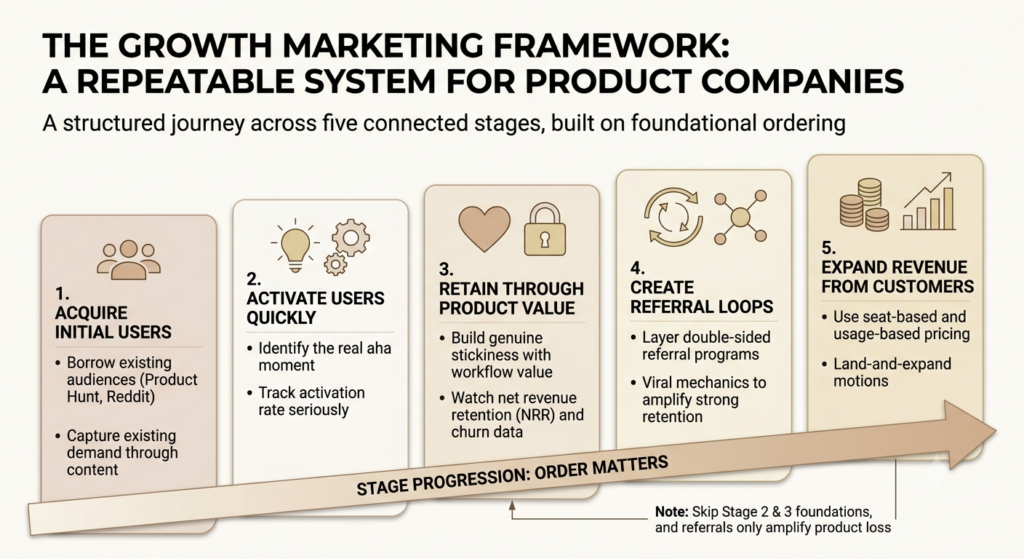
Pulling all eleven strategies together, here’s the repeatable system behind them, structured as five connected stages rather than eleven separate tactics competing for attention.
Stage 1: Acquire Initial Users. Borrow existing audiences (Product Hunt, Reddit, niche communities) and capture demand that already exists through content, rather than trying to create demand from nothing.
Stage 2: Activate Users Quickly. Identify the real aha moment through retention data, then strip every unnecessary step between signup and that moment. Track activation rate as seriously as you track signups.
Stage 3: Retain Through Product Value. Build genuine stickiness tied to real workflow value, watch net revenue retention as closely as new revenue, and treat churn data as the earliest warning system you have.
Stage 4: Create Referral Loops. Layer double-sided referral programs and viral product mechanics on top of a product that’s already retaining users well, since referral loops amplify whatever retention quality already exists, good or bad.
Stage 5: Expand Revenue Through Existing Customers. Use seat-based and usage-based pricing, plus land-and-expand motions, to grow revenue from the customer base you already have before chasing the next acquisition channel.
The order matters here, and it’s the part most teams get backwards. Skipping straight to Stage 4 (referrals) without solid Stage 2 and 3 foundations (activation and retention) just means referring people into a product that loses them anyway, faster.
Common Growth Marketing Mistakes That Keep Products Stuck at Zero
Scaling Ads Before Product-Market Fit
Spending heavily on paid acquisition before a product reliably retains users is one of the fastest ways to burn capital while learning nothing useful. The ads will generate signups. The signups will churn. And the resulting data won’t tell you whether your product is bad or your targeting is bad, because you never gave the product a fair shot to prove it could retain anyone in the first place.
Ignoring Activation Metrics
Only about a third of PLG companies track activation as a formal, defined metric, which means most teams are flying blind on the single number that predicts retention better than almost anything else. If you can’t answer “what percentage of signups reached real value last week,” you don’t yet have the information you need to make good growth decisions.
Chasing Too Many Acquisition Channels
Trying to run content marketing, paid ads, a referral program, community building, and influencer partnerships simultaneously, with a small team and limited budget, usually means doing all five badly instead of one or two well. Most successful zero-to-one growth stories trace back to disproportionate focus on a single channel that genuinely worked, not even the distribution of effort across everything available.
Building Features Instead of Growth Loops
Adding features can absolutely make a product better without making it grow faster. A growth loop, by contrast, is specifically designed so that using the product creates more usage of the product, either by bringing in new users or by deepening existing usage. Founder discussions across the PLG space repeatedly point to the same lesson: teams that build for engagement metrics without first understanding their growth loop tend to end up with a product that’s loved by a small group and invisible to everyone else.
The growth marketing mistakes that most reliably stall a product at zero, scaling acquisition before product-market fit, ignoring activation tracking, and spreading effort across too many channels, share a common root cause: treating growth as a marketing problem to solve with more spend, rather than a product problem to solve with better data.
Final Thoughts
Growth rarely comes from a single channel, and it almost never comes from the channel a founder originally bet on. The product companies that build a real user base from zero tend to share one trait above all others: they built acquisition, activation, retention, and referral directly into the product, instead of bolting growth marketing strategies onto a product that wasn’t ready for them yet.
Sustainable growth comes from systems and loops, not one-time campaigns that spike and fade. Before spending heavily on the next acquisition channel, it’s worth asking a harder question first: would the users you’re about to acquire actually want to tell someone else about this? If the honest answer is no, that’s where the real work needs to happen.
Frequently Asked Questions
What is growth marketing for product companies?
Growth marketing for product companies is the practice of using the product itself, not just campaigns or advertising, to drive customer acquisition, activation, retention, referral, and revenue. It treats onboarding flow, feature gating, and in-app prompts as marketing surfaces, not just engineering decisions.
Growth marketing vs traditional marketing: What’s the actual difference?
Traditional marketing focuses on generating awareness and demand outside the product, through ads, content, and outbound sales. Growth marketing focuses heavily on what happens after signup, optimizing activation, retention, and expansion inside the product itself, often using data and experimentation rather than brand campaigns.
How do I calculate my product’s viral coefficient?
Divide the number of new users generated through existing user invites by the total number of existing users who sent invites during that period. A result above 1.0 means your user base can grow purely through sharing, without paid acquisition. Below 1.0, viral mechanics still help growth, but they need to combine with other channels.
Who should use product-led growth as their primary motion?
Product-led growth works best for products with a relatively low average contract value, an intuitive interface that doesn’t require extensive training, and a value proposition users can experience within minutes rather than weeks. Complex enterprise products with multi-stakeholder buying committees and high contract values generally need a hybrid or sales-led motion instead.
Is a referral program actually worth building for an early-stage product?
It depends on whether you already have organic word of mouth happening. Dropbox’s referral program succeeded partly because roughly a third of its users were already arriving through informal referrals before the program existed. If nobody is currently recommending your product to anyone, a referral program won’t manufacture that enthusiasm from nothing; fix retention and product value first.
Why isn’t my product growing even though signups keep increasing?
This usually points to an activation or retention problem hiding behind a healthy top-of-funnel number. Check what percentage of new signups reach your core “aha moment,” and look at retention curves by signup cohort. Rising signups paired with flat or declining active users is one of the clearest signs that you’re acquiring users, but your product isn’t successfully activating.
What do most teams get wrong about product-led growth?
Most teams treat PLG as “remove the sales team and add a free tier,” without doing the harder work of identifying activation events, building data infrastructure to track PQLs, or designing onboarding around a specific aha moment. PLG without rigorous measurement usually just produces a lot of free users who never convert.
How long does it take to see results from growth marketing strategies like these?
Viral loops and referral programs can show a measurable signal within weeks if the underlying product retention is solid. Content marketing and SEO-driven strategies typically take three to six months to compound meaningfully. Community-led growth is the slowest to show attributable ROI, often six months to a year, because of how difficult community impact is to measure in standard attribution tools.
Do I need a dedicated growth team to run these strategies, or can a small startup do this alone?
A small team can absolutely run most of these strategies without a dedicated growth function, especially in the early stages. The strategies that matter most when you’re small, fast time-to-value, a clear activation event, and one well-executed distribution channel depend more on focus and good data than on headcount.