
You’ve built your email list. You’ve set up your platform. You hit send on a campaign and wait. Open rates hover somewhere between disappointing and embarrassing. Clicks are low. Revenue barely moves.
The list isn’t the problem. The message is. Specifically, you’re sending the same message to people who want completely different things from you. A first-time subscriber doesn’t need the loyalty rewards email. A customer who just bought your flagship product doesn’t need a welcome sequence. Email segmentation is how you fix this -by splitting your audience into groups that actually share something meaningful, and sending each group something relevant.
This guide covers every type of email segmentation worth knowing, how to build a strategy that works in practice, and what good segmentation looks like across real-world campaigns. By the end, you’ll know exactly how to stop treating your list as a monolith.
Table of Contents
What Is Email Segmentation?
Definition of Email Segmentation
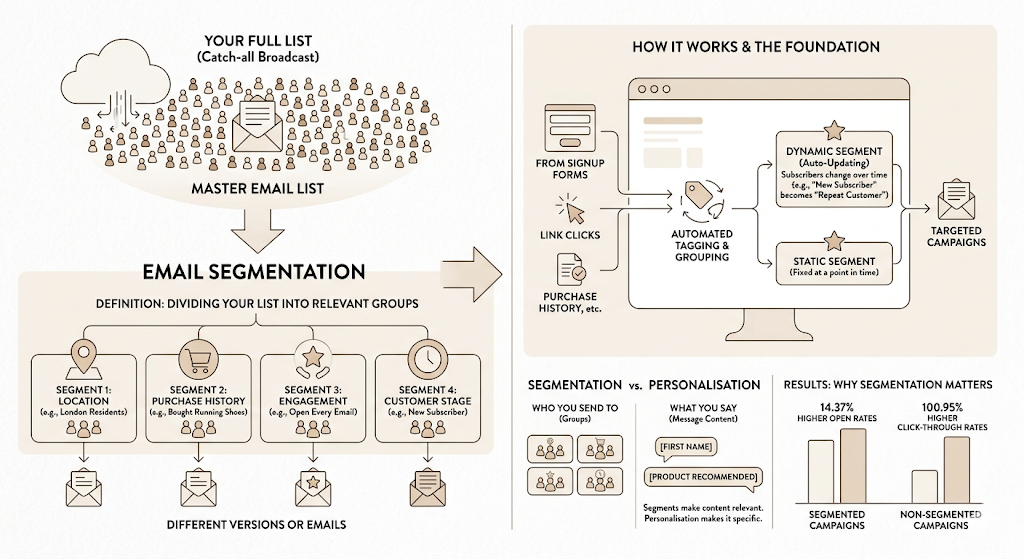
Email segmentation is the practice of dividing your email list into smaller groups based on shared characteristics, so you can send each group content that’s actually relevant to them. Instead of one campaign going to your entire list, segmentation lets you send a different version or a different email entirely to specific subsets of subscribers.
The “shared characteristic” can be almost anything: where someone lives, what they’ve purchased, how often they open your emails, or what stage they’re at in their customer journey. The point is that people within each segment have enough in common that one message serves them better than a catch-all broadcast.
How Email Segmentation Works
At its core, segmentation relies on data you already have. Your email platform collects information every time someone signs up, clicks a link, opens an email, or makes a purchase. You use those data points to tag subscribers and group them into segments. Then you build campaigns targeted at each segment instead of everyone at once.
Most modern email platforms let you set segments as either static (a fixed list at a point in time) or dynamic (auto-updating as subscriber data changes). Dynamic segments are generally more useful because your subscribers don’t stay the same forever. Someone who signed up last week and someone who’s been on your list for two years are in different places, even if they initially signed up for the same reason.
Email Segmentation vs Email Personalisation
People often use these terms interchangeably. They mean different things.
Segmentation is about who you send to. Personalisation is about what you say to them. Segmentation divides your audience into groups. Personalisation tailors the message within those groups, using things like first names, product recommendations, or location-specific content.
They work best together. Segmentation gets the right email to the right group. Personalisation makes the message feel like it was written for one person, not a group of five thousand.
Why Segmentation Is the Foundation of Successful Email Marketing
Batch-and-blast email was the norm a decade ago. It worked because email itself was still novel. Now your subscribers are getting dozens of emails a day. Generic messages get deleted before they’re read. Segmentation is how you earn the right to stay in someone’s inbox.
According to Mailchimp’s 2023 Email Marketing Benchmarks data, segmented email campaigns generate 14.37% higher open rates and 100.95% higher click-through rates than non-segmented campaigns. That gap only widens as your list grows and your audience becomes more diverse.
Why Email Segmentation Matters
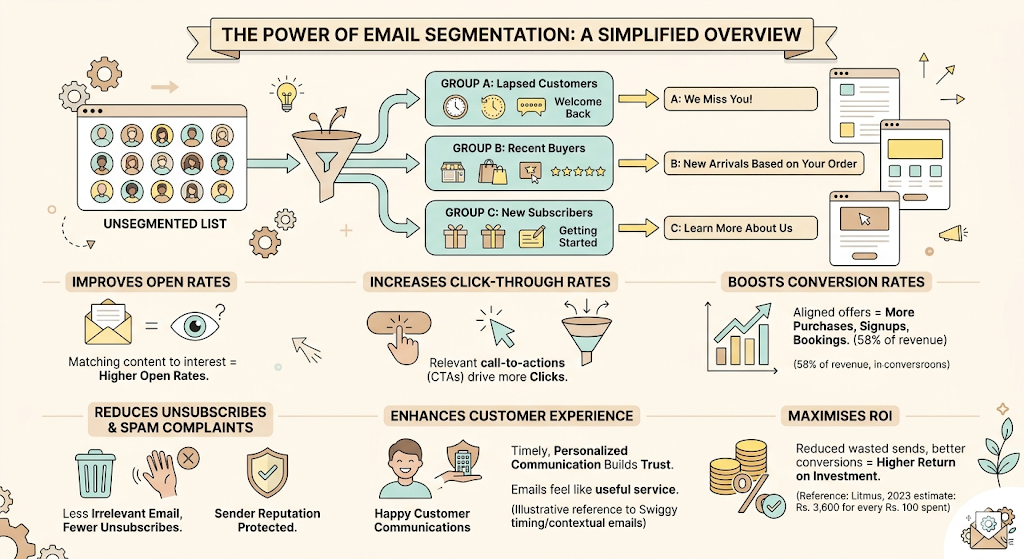
Open rates, click rates, revenue. Every metric that matters in email marketing improves when you send relevant messages to the right people. Here’s why each one moves.
Improves Open Rates
People open emails when the subject line matches what they care about. If you’re sending cart abandonment emails to people who’ve never added anything to their cart, or sending re-engagement campaigns to someone who bought three days ago, the mismatch shows. Subscribers develop pattern recognition fast. A few irrelevant emails and they stop opening anything from you.
Segmentation means your subject lines and preview text speak directly to what that specific group cares about at that moment. Open rates improve not because of better copywriting alone, but because the whole premise of the email actually fits the recipient.
Increases Click-Through Rates
Clicks happen when the content inside the email is relevant to the person reading it. That’s hard to pull off when one email needs to appeal to a subscriber who’s never bought from you, a loyal customer on their sixth order, and someone who hasn’t opened in three months.
When you segment, each email can focus entirely on what that group needs to see next. New subscribers get oriented. Active customers get product updates or loyalty offers. Lapsed subscribers get a reason to come back. Each scenario has a natural next action, and the click-through rate reflects that clarity.
Boosts Conversion Rates
Getting someone to take action, whether buying, signing up, or booking a call, is the hardest step in email marketing. It gets meaningfully easier when the offer aligns with where someone is in their relationship with your brand.
According to data from the Direct Marketing Association, segmented and targeted emails generate 58% of all email revenue. Most of that lift comes from sending purchase-stage emails only to people who are actually ready to buy, not to your entire list, including people who’ve never heard of your product line.
Reduces Unsubscribes and Spam Complaints
Irrelevant email is the number one reason people unsubscribe. It’s also a significant driver of spam complaints, which affect your deliverability across your entire list. One bad batch can lower your sender reputation enough to make even your best campaigns land in the promotions tab or junk folder.
Segmentation protects your deliverability by keeping your engagement signals strong. ISPs look at open and click rates as quality signals. When your metrics are healthy across segments, your emails land where they should.
Enhances Customer Experience
This one is undervalued. Email isn’t just a revenue channel. It’s also how people experience your brand between purchases. Relevant, timely emails build trust. They signal that you understand the person you’re talking to. Over time, that trust compounds into loyalty.
Swiggy does this well. Their transactional and marketing emails are timed and contextualised around order behaviour, location, and personal food preferences. They don’t send a generic “try our new feature” blast to their entire user base. They segment by behaviour and timing, and the result is emails that feel genuinely useful rather than automated noise.
Maximises Email Marketing ROI
Email already has one of the highest ROIs of any marketing channel, with industry estimates consistently placing it around Rs. 3,600 return for every Rs. 100 spent (Litmus, 2023). Segmentation multiplies that return by reducing wasted sends, protecting deliverability, and improving conversion rates across the funnel.
Email segmentation improves every core email metric by ensuring each subscriber receives content that matches their behaviour, lifecycle stage, or preferences. According to Mailchimp’s 2023 benchmarks, segmented campaigns outperform non-segmented ones by over 100% on click-through rates. Brands that segment consistently report higher email marketing ROI and lower unsubscribe rates across their lists.
When Should You Segment Your Email List?
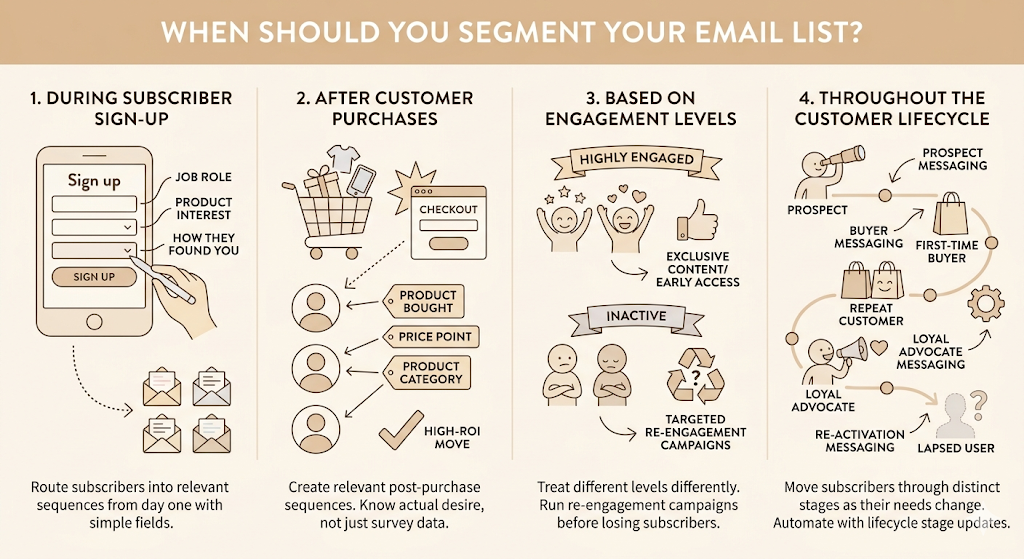
The short answer is: early and continuously. But there are specific moments where segmentation has the most immediate impact.
During Subscriber Sign-Up
The sign-up form is your first opportunity to collect segmentation data. A checkbox asking “What best describes you?” or a dropdown for interest categories costs you nothing and immediately tells you something useful. Many brands miss this entirely and import everyone into a single generic welcome sequence.
You don’t need a lengthy form. Even one well-chosen field, like job role, product interest, or how they found you, gives you enough to route new subscribers into relevant sequences from day one.
After Customer Purchases
A purchase tells you more about a customer than any survey. It tells you what they actually want. Post-purchase segmentation is one of the highest-ROI moves in email marketing: you know the product, the price point, and often the category. You can immediately tag this subscriber, remove them from any acquisition campaigns, and start a post-purchase sequence relevant to what they bought.
Based on Engagement Levels
Not everyone on your list engages at the same rate. Some subscribers open every email. Others haven’t opened in six months. Segmenting by engagement lets you treat these groups differently: rewarding highly engaged subscribers with exclusive content or early access, and running targeted re-engagement campaigns for inactive ones before you lose them entirely.
Throughout the Customer Lifecycle
The customer journey isn’t static. A subscriber moves from prospect to first-time buyer to repeat customer to loyal advocate (or to lapsed user). Each stage requires different messaging. Email platforms that let you automate lifecycle stage updates based on behaviour make this much easier to manage at scale.
Types of Email Segmentation Every Marketer Should Use
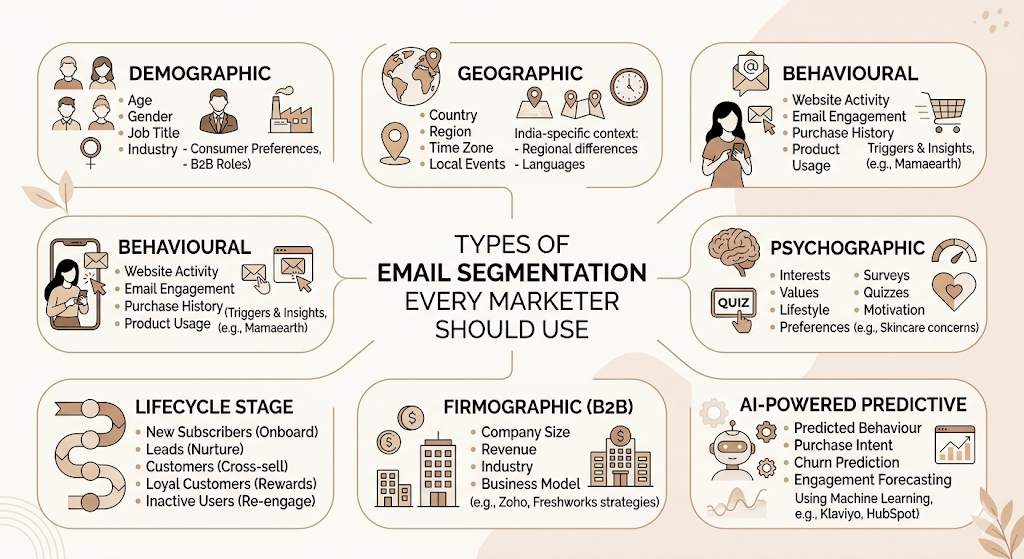
There are more ways to segment an email list than most marketers actually use. These are the types worth knowing.
Demographic Segmentation
Demographic segmentation uses characteristics like age, gender, job title, and industry to group subscribers. It’s often the first type marketers set up because the data is straightforward to collect.
Age and gender matter most for consumer brands where preferences genuinely differ by demographic. Job title and industry are more useful in B2B contexts where the message needs to match someone’s role and responsibilities. A marketing manager at a startup has very different needs than a CMO at an enterprise company, even if both signed up for the same newsletter.
The limitation here is that demographic data alone is shallow. Knowing someone’s age doesn’t tell you what they want from you today. Use demographics as a starting filter, then layer in behaviour for real precision.
Geographic Segmentation
Geographic segmentation targets subscribers by country, region, time zone, or proximity to local events. The time zone piece is often overlooked and disproportionately important: sending emails at 9 am your time to subscribers in a different time zone means they’re opening your email at midnight, if at all.
For brands operating across India, geographic segmentation matters in more ways than time zones. Consumer preferences, language nuances, and seasonality all vary by region. A sale relevant to subscribers in Bengaluru might not resonate in Delhi at the same time of year.
Behavioural Segmentation
Behavioural segmentation is the most powerful type, and also the most underused. It groups subscribers by what they actually do, including website activity, email engagement, purchase history, and product usage.
This is where the real insight lives. Someone who has visited your pricing page three times in the last week is in a very different headspace than someone who opened one email six months ago. Mamaearth uses behavioural triggers extensively across their email flows, matching product recommendation emails to browsing and purchase history rather than blasting the same offers to everyone.
Psychographic Segmentation
Psychographic segmentation groups people by interests, values, lifestyle, and preferences. It goes beyond what people do and tries to understand why they do it. This data usually comes from surveys, quiz funnels, or preference centres where subscribers self-select into categories.
A skincare brand might segment by skin concern (acne, ageing, sensitivity) and build entire email journeys around each. A financial education platform might segment by financial goal (saving, investing, debt payoff). The messaging becomes dramatically more relevant because it speaks to the subscriber’s actual motivation, not just their surface behaviour.
Lifecycle Stage Segmentation
Lifecycle stage segmentation maps your email strategy to where someone is in their relationship with your brand.
- New subscribers: Onboard them, establish value, set expectations
- Leads: Nurture toward first purchase with content and social proof
- Customers: Post-purchase sequences, cross-sell opportunities, satisfaction checks
- Loyal customers: Early access, rewards, referral programs
- Inactive users: Re-engagement campaigns with a reason to return
Each stage has a natural email strategy. The mistake is treating everyone on your list as though they’re at the same stage.
Firmographic Segmentation (For B2B)
For B2B email marketers, firmographic segmentation uses company-level data, including company size, revenue, industry, and business model, to group contacts. A solution that works for a 10-person startup needs to be positioned very differently to a 5,000-person enterprise, even if the core product is the same.
Zoho and Freshworks both do this well in their email marketing. Enterprise contacts receive content about security, integration, and compliance. SMB contacts get practical onboarding tips and quick-win use cases. Same product, completely different angles.
AI-Powered Predictive Segmentation
Predictive segmentation uses machine learning to group subscribers based on predicted future behaviour, not just past actions. Common applications include purchase intent scoring (who’s likely to buy in the next 7 days), churn prediction (who’s about to go inactive), and engagement forecasting (who’s most likely to respond to a re-engagement offer).
This type of segmentation doesn’t require you to build the models yourself. Most enterprise email platforms, including Klaviyo and HubSpot, now include predictive analytics that surface these scores automatically. The key is acting on them with relevant campaigns rather than just watching the data accumulate.
Email segmentation can be applied across seven dimensions: demographic, geographic, behavioural, psychographic, lifecycle stage, firmographic (for B2B), and AI-powered predictive. Behavioural and lifecycle stage segmentation typically delivers the highest ROI because they map to intent and readiness to act, rather than surface characteristics. Predictive segmentation, powered by machine learning, extends this by anticipating behaviour before it occurs.
How to Create an Effective Email Segmentation Strategy
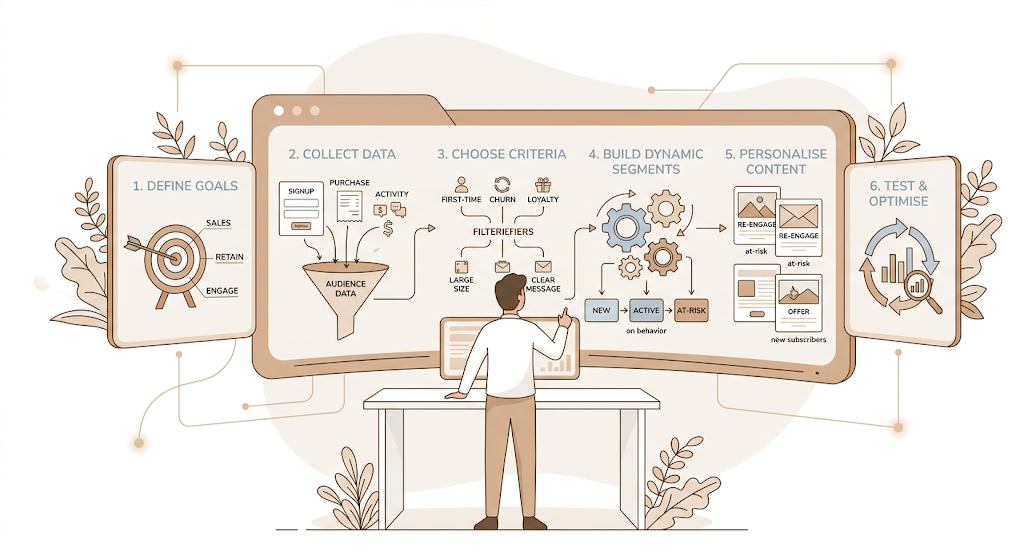
A segmentation strategy only works if it’s built around goals, not just around what data is available. Here’s how to build one that actually holds up in practice.
Define Your Marketing Goals
Start with the outcome you want. Are you trying to increase first-time purchases? Reduce churn among customers who’ve bought once? Improve engagement among subscribers who’ve been cold for 90 days? The goal determines the segment.
Jumping straight to “let’s segment by demographics” without a goal produces segments that generate reports but don’t drive action. Every segment you build should connect to a specific campaign with a specific objective.
Collect the Right Customer Data
You need data before you can segment. Map what you’re already collecting (signup form fields, purchase data, open/click history, browsing behaviour) against what you’d need for the segments you want to build.
Data gaps are normal. The fix is usually one of three things: update your signup form, set up event tracking on your website, or run a preferences survey to your existing list. Don’t try to fix all gaps at once. Prioritise the data that unlocks your highest-value segments first.
Choose Meaningful Segmentation Criteria
Not every segmentation axis is worth building. A segment is worth building if it’s large enough to justify a campaign, different enough from other segments to need different messaging, and stable enough to remain relevant for more than one email.
“Subscribers who opened the last email” sounds like a segment. But if the segment changes every week and the only messaging difference is the subject line, it’s not a meaningful segmentation. “Subscribers who’ve purchased twice but not three times” is a segment with a clear message and a clear goal.
Build Dynamic Audience Segments
Static lists go stale fast. A subscriber tagged as “new” in March shouldn’t still be getting new subscriber emails in August. Dynamic segments auto-update based on rules you set, so subscribers move through segments as their behaviour changes.
Most email platforms support this through tagging logic and automation triggers. Set up rules like: move to “active customer” segment after first purchase; move to “at-risk” segment after 60 days without opening; move to “re-engaged” segment after responding to a win-back campaign.
Personalise Email Content
Once your segments are defined, personalise the content within each one. This goes beyond using first names. Match the offer, the imagery, the product recommendations, and the language to what each segment actually cares about.
A loyalty segment doesn’t need a first-purchase incentive. An at-risk segment needs a reason to trust you again, not a product catalogue. Content personalisation within segments is where most of the conversion lift actually comes from.
Test and Optimise Continuously
Segments decay. Subscriber behaviour changes. What worked six months ago may not work today. Build in regular testing across segments: test subject lines, send times, offer types, and content formats. Track which segments respond to what, and adjust accordingly.
The brands with the best email programs treat segmentation as an ongoing discipline, not a one-time setup.
Real-World Email Segmentation Examples
Theory is useful. But segmentation makes more sense when you see it working in actual campaigns.
Welcome Email Series
A welcome sequence shouldn’t send the same three emails to every new subscriber. If you collected the subscriber’s interests at signup (as Nykaa does on their email preference page), your welcome series can show products from their stated categories rather than your best-sellers list. The subscriber’s first three interactions with your brand are already personalised. That’s the first impression you want to set.
Cart Abandonment Campaigns
Cart abandonment is the most obvious behavioural segment in ecommerce. Someone added items to their cart and didn’t buy. The segment is clear. But most brands send one generic “you left something behind” email. Smart brands add a layer: segment cart abandoners by the value of what they left, the category, or whether they’ve abandoned before. High-value cart abandoners might get a personalised email with a time-limited offer. First-time abandoners might just need a nudge with social proof.
Product Recommendation Emails
Zepto and Blinkit both use purchase history to drive product recommendation emails timed around repurchase windows. If you bought a product that typically runs out in 30 days, you get a replenishment email around day 25. That’s not generic email marketing. That’s segmented, behaviour-driven communication that feels useful rather than promotional.
Re-Engagement Campaigns
Subscribers who haven’t opened in 90 days are a distinct segment that needs a distinct approach. A re-engagement campaign shouldn’t look like your regular promotional emails. It needs to acknowledge the gap, offer something valuable, and give the subscriber a low-friction way to either re-engage or update their preferences. If they don’t re-engage after a win-back sequence, remove them. Keeping inactive subscribers inflates your list size but damages your deliverability metrics.
Customer Loyalty Campaigns
Loyal customers, those who’ve purchased four or more times, don’t need acquisition messaging. They need to feel recognised. Segment your high-frequency buyers and send them early access to new products, exclusive members-only content, or first dibs on sales. boAt does this with its loyalty program emails, treating repeat buyers to early access and personalised product drops before public launch.
Upselling and Cross-Selling Emails
If someone bought a DSLR camera, they probably need a camera bag, extra batteries, or a lens kit. That’s a natural upsell opportunity. Segment buyers by product category and build automated cross-sell sequences that trigger after purchase. The personalisation makes these emails feel like helpful recommendations rather than sales pressure.
Real-world email segmentation works best when campaigns map to specific subscriber actions and lifecycle stages. Cart abandonment, post-purchase cross-sells, re-engagement sequences, and loyalty programs each require distinct messaging that a general broadcast cannot deliver. Brands that build campaign-specific segments consistently outperform those relying on single-list email blasts.
Advanced Email Segmentation Techniques
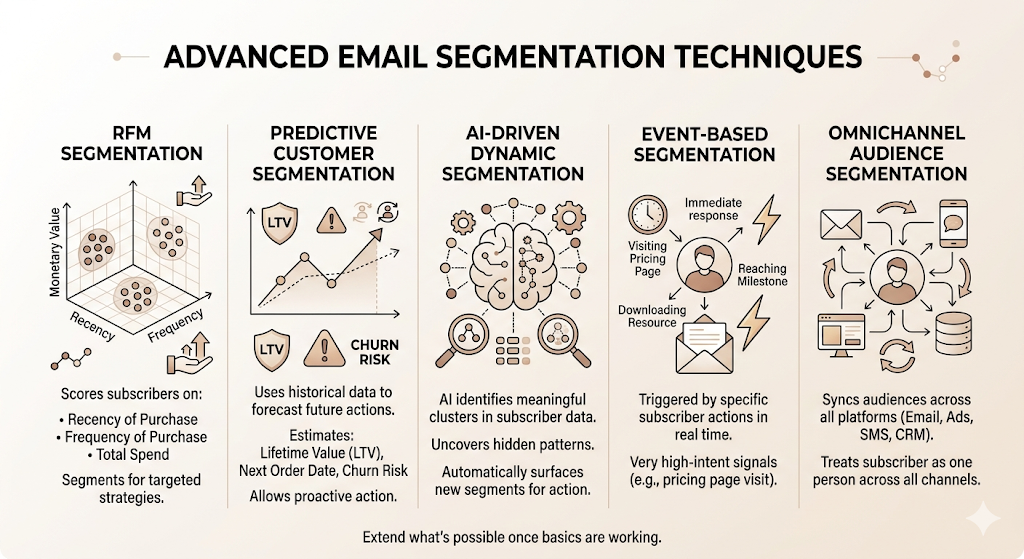
Once the basics are working, these techniques extend what’s possible.
RFM (Recency, Frequency, Monetary) Segmentation
RFM segmentation scores subscribers on three dimensions: how recently they purchased, how often they purchase, and how much they spend. Plotting your list on these three axes produces distinct customer groups with very different email strategies.
A customer who bought last week, buys monthly, and spends significantly is your best customer. They need appreciation and retention. A customer who bought once six months ago and spent very little is a different story. RFM makes this visible and makes your email strategy far more targeted than simple lifecycle stage segmentation alone.
Predictive Customer Segmentation
Beyond RFM, predictive segmentation uses historical behaviour data to forecast future actions. Klaviyo’s predictive analytics feature, for example, estimates each subscriber’s predicted lifetime value, next order date, and churn risk. These predictions let you act before behaviour happens: send a retention offer to someone predicted to churn, or send a VIP upgrade email to someone trending toward high LTV.
AI-Driven Dynamic Segmentation
Modern email platforms now offer AI-assisted segment building where the platform identifies meaningful clusters in your subscriber data that you might not have thought to look for manually. These are not segments you define upfront. The AI finds patterns (subscribers who consistently open on Sunday evenings, subscribers who always click on video content) and surfaces them for you to act on.
Event-Based Segmentation
Event-based segments trigger off specific subscriber actions in real time: visiting a pricing page, downloading a resource, reaching a milestone, or not logging in after signing up. These are extremely high-intent signals. A subscriber who visits your pricing page three times in five days is worth an immediate personalised email. Event-based segmentation makes that email possible.
Omnichannel Audience Segmentation
The best email segmentation doesn’t live in isolation. It syncs with your ad audiences, your SMS lists, and your CRM. If someone opts out of email, they shouldn’t keep seeing email-driven ads. If someone responds to an email offer, they should exit the retargeting audience for that offer. Omnichannel segmentation treats the subscriber as one person across all channels rather than separate contact records in separate platforms.
Best Practices for Email Segmentation
Keep Customer Data Updated
Stale data produces inaccurate segments. If someone changed their job title a year ago but you’re still sending them junior-level content, the relevance gap will show. Build regular data hygiene checks into your process: quarterly preference centre emails, post-purchase surveys, and automatic tag updates based on recent behaviour.
Avoid Over-Segmenting Your Audience
There’s a real risk of going too far. If you have 50 segments and each one has fewer than 200 subscribers, you’re creating operational complexity without proportional gain. Smaller segments are harder to test, harder to optimise, and harder to scale campaigns for. Start with 5-8 meaningful segments and expand deliberately as you have the data and bandwidth to manage more.
Combine Segmentation With Personalisation
Segmentation gets you to the right group. Personalisation makes the message feel individual. The most effective email programs do both: a loyalty segment gets loyalty-specific content, but within that email, the product recommendations are personalised to each subscriber’s purchase history. The combination is where the best results live.
Use Marketing Automation
Manual segment management doesn’t scale. Automation keeps subscribers moving through the right sequences as their behaviour changes without requiring someone to manually update lists every week. Set your rules once, test them thoroughly, and let the automation handle the segmentation logic.
Monitor Segment Performance Regularly
Segments need performance reviews, not just setup. A re-engagement segment that’s not converting after three email attempts is telling you something. A loyalty segment with unusually low open rates might be getting too many emails. Build a monthly or quarterly review cycle where you check each segment’s core metrics and adjust copy, frequency, or offer type based on what the data shows.
Common Email Segmentation Mistakes to Avoid
Relying Only on Demographics
Demographic data is easy to collect but shallow as a segmentation basis on its own. Two 28-year-old women in Mumbai who both work in marketing might have completely different purchase behaviours, engagement levels, and interests. Demographic segmentation is a starting point, not a complete strategy. Layer in behaviour to make it useful.
Using Outdated Customer Data
Segments built on data that’s six months or a year old are unreliable. Subscriber situations change. Job titles change. Purchase behaviour shifts. Interests evolve. If your segmentation data isn’t refreshed regularly, your segments will drift out of alignment with reality, and your emails will feel increasingly tone-deaf.
Creating Too Many Segments
More segments is not better. Each segment needs a distinct campaign, distinct content, and distinct measurement. If you can’t articulate what makes two segments different in terms of what you’d say to each one, they probably shouldn’t be separate segments. Start lean and expand based on evidence.
Ignoring Customer Behaviour
Behavioural data is the richest segmentation signal available, and it’s often the most ignored. Open history, click patterns, purchase timing, browsing behaviour, product views: all of this tells you far more than a demographic survey. If you’re segmenting on demographic data but not on behaviour, you’re leaving the most powerful variable on the table.
Failing to A/B Test Campaigns
Segmentation tells you who to send to. Testing tells you what to send. Brands that segment but don’t test end up optimising for list structure rather than for actual results. Run A/B tests on subject lines, content formats, and offer types within each segment. Let the data tell you what works.
Measuring the Success of Email Segmentation
You can’t improve what you don’t measure. Track these metrics at the segment level, not just at the campaign level.
Open Rate
Open rate tells you whether your subject lines are relevant to each segment. If one segment consistently underperforms on opens, the problem is either that the subject lines aren’t matching their interests or that your send frequency is too high and subscribers are experiencing fatigue.
Click-Through Rate (CTR)
CTR reflects content relevance. Strong open rates with poor CTR usually mean the subject line promised something the email body didn’t deliver, or the offer inside the email wasn’t right for this segment.
Conversion Rate
This is what matters most. A segment with great open and click rates that doesn’t convert is telling you the offer or the landing page isn’t matching subscriber intent. Conversion rate connects your email performance to actual revenue.
Revenue Per Email
Divide the revenue generated by a segment campaign by the number of emails sent. This metric lets you compare the value of different segments directly and helps you prioritise where to invest more time in optimisation.
Unsubscribe Rate
A rising unsubscribe rate in a specific segment is a signal that something is off: too many emails, wrong content, or misaligned offers. Monitor this at the segment level so you can catch problems before they affect deliverability.
Customer Lifetime Value (CLV)
Segmentation affects CLV over time. Loyal customers nurtured through relevant email journeys spend more and stay longer. Track CLV across segments to understand which subscriber groups are most valuable in the long run and invest accordingly in those relationships.
Email Segmentation Tools to Consider
Features to Look for in an Email Marketing Platform
Not every email platform handles segmentation equally. Look for these capabilities before committing: tag-based subscriber management, dynamic segment auto-updating, event-triggered automation, and the ability to sync with your CRM and ecommerce platform without a complex integration.
AI-Powered Segmentation Capabilities
Platforms like Klaviyo, ActiveCampaign, and Brevo now offer built-in predictive analytics and AI segment suggestions. Klaviyo’s predictive customer lifetime value and churn risk scores are particularly useful for ecommerce brands. HubSpot’s smart lists auto-update based on contact property changes in real time.
Automation and CRM Integration
Your email platform should talk to your CRM without friction. When a sales rep updates a contact’s stage in HubSpot or Salesforce, that update should automatically move the contact into the right email segment. Manual data transfer between systems creates lag and errors that undermine your segmentation logic.
Analytics and Reporting Features
Segment-level reporting is non-negotiable. You need to see open rates, CTRs, conversion rates, and revenue broken down by segment, not just by campaign. Platforms that only report at the campaign level make it impossible to diagnose which segment is underperforming and why.
The Future of Email Segmentation
AI and Machine Learning
AI is already changing how segments are built. Rather than marketers defining segment rules manually, machine learning algorithms can identify patterns in subscriber data that humans wouldn’t find or think to look for. The next generation of email segmentation is less “set up your rules” and more “here’s what your data is telling you.”
Predictive Personalisation
Predictive personalisation takes segmentation from reactive to proactive. Instead of responding to what subscribers have done, you’re anticipating what they’re about to do and sending the right message at the right moment. This is already available in enterprise tools. It’ll be standard across mid-market platforms within the next two to three years.
First-Party Data Strategies
As third-party cookies continue to decline in utility and regulators tighten data privacy rules across markets, including India (with the DPDP Act in effect), first-party data collected directly from subscribers becomes more valuable. Email programs that collect rich, consented preference data at signup will be better positioned than those relying on inferred or third-party segments.
Privacy-First Email Marketing
Privacy regulations are reshaping what data can be collected and how it can be used. The shift isn’t bad for segmentation, but it does change the data collection approach. Preference centres, explicit opt-ins for specific categories, and transparent data use policies will become the norm rather than an exception. Brands that build trust through transparency will retain higher-quality segments.
Hyper-Personalised Customer Journeys
The end state of advanced email segmentation is an email program where every subscriber is effectively a segment of one: receiving messages timed to their behaviour, personalised to their preferences, and advancing them along a journey that’s been dynamically adapted based on their responses. This isn’t science fiction. It’s where the leading ecommerce and SaaS email programs are already heading.
The future of email segmentation is predictive, privacy-first, and AI-driven. Machine learning is shifting the segmentation process from manual rule-building to AI-surfaced pattern recognition. As third-party data becomes less reliable, first-party data collected directly through preference centres and explicit opt-ins will become the foundation of effective segmentation strategies.
Conclusion
The problem with email marketing isn’t that it doesn’t work. The problem is that most brands are doing it in a way that stopped working years ago. One list. One message. Send and hope.
Email segmentation fixes the root cause. When you send the right message to the right group of people at the right moment in their relationship with your brand, everything changes: open rates, clicks, conversions, retention, and ultimately revenue. The lift is real and measurable, and it compounds over time as your segmentation gets sharper and your subscriber data gets richer.
Start with three to five meaningful segments based on the data you already have. Build campaigns specific to each. Track the right metrics at the segment level. And then expand from there, adding behavioural layers, predictive signals, and automation as your programme matures.
If you want to build the skills to run campaigns like this professionally, the YUP Crystal Clear Newsletter covers practical email and digital marketing tactics every week, with examples from brands that are actually doing this well.
Frequently Asked Questions (FAQs)
What is email segmentation?
Email segmentation is the process of dividing your email subscriber list into smaller groups based on shared characteristics, so you can send more relevant messages to each group. These characteristics can include demographics, purchase behaviour, engagement history, lifecycle stage, or subscriber preferences. The goal is to replace one-size-fits-all broadcasts with targeted campaigns that match what each group actually needs.
Why is email segmentation important?
Segmentation directly improves the metrics that determine email marketing success. According to Mailchimp’s 2023 benchmarks, segmented campaigns generate over 100% higher click-through rates than non-segmented ones. Beyond clicks, segmentation reduces unsubscribes, protects your sender reputation, and improves the customer experience between purchases.
What is the difference between email segmentation and personalisation?
Segmentation determines who receives which email by dividing your list into groups. Personalisation customises what’s inside the email using individual data points like the subscriber’s name, location, purchase history, or preferences. You need segmentation to make personalisation scalable: you personalise within segments, not just across your entire list.
What are the main types of email segmentation?
The main types are demographic (age, gender, job title), geographic (location, time zone), behavioural (email engagement, purchase history, website activity), psychographic (interests, values, lifestyle), lifecycle stage (new subscriber, active customer, lapsed user), firmographic (for B2B: company size, industry), and AI-powered predictive segmentation based on forecasted behaviour.
How often should you update your email segments?
Dynamic segments should update automatically as subscriber behaviour changes, which most modern email platforms handle through real-time tagging. Beyond that, a quarterly review of segment performance is good practice. If a segment hasn’t generated a meaningful campaign in three months, or if the subscriber data it’s based on is over six months old, it’s worth revisiting whether the segment still serves a purpose.
What data should you use for email segmentation?
Start with what you already collect: signup form fields, purchase history, open and click history, and website behaviour (if your platform tracks it). From there, you can add survey data, preference centre inputs, and CRM data for B2B contacts. Behavioural data tends to be more predictive of purchase intent than demographic data alone, so prioritise it.
Can small businesses benefit from email segmentation?
Yes, and you don’t need a large list or an enterprise email platform to start. Even a list of 500 subscribers can be meaningfully split into new subscribers, active buyers, and lapsed users. Those three segments alone justify three different campaigns with very different messages. Most platforms, including Mailchimp and Brevo, support basic segmentation on free or starter plans.
How does AI improve email segmentation?
AI improves segmentation in two ways. First, it automates pattern recognition, identifying subscriber clusters based on behaviour data that would take a human analyst hours to find manually. Second, it enables predictive segmentation, where subscribers are grouped based on their forecasted future behaviour (likely to churn, likely to buy, likely to upgrade) rather than just their past actions. Klaviyo and HubSpot are the most widely used platforms with built-in AI segmentation features.
What are the biggest email segmentation mistakes?
The most common mistakes are segmenting only by demographics (which is too shallow), using outdated subscriber data, creating too many narrow segments that can’t support meaningful campaigns, ignoring behavioural signals entirely, and failing to run A/B tests within segments to learn what messaging actually works.
Which metrics should you track to measure segmentation success?
Track open rate, click-through rate, conversion rate, revenue per email, and unsubscribe rate at the segment level, not just the campaign level. Customer lifetime value (CLV) is the long-term measure: segments that are well-targeted and well-nurtured should show higher CLV than subscribers who receive undifferentiated mass email.