

The brand pyramid model is one of those things that looks simple on paper but can really change how a brand is seen. This blog walks through it from the ground up, starting with what the product actually offers, moving through the practical benefits, the feelings it creates, the brand’s personality, and finally, the one line that sums it all up: the essence.
Along the way, it explains why businesses need it, how it can guide marketing, and how to measure if it’s actually working. Real examples from Apple, Nike, and Volvo show it in action, and there are tips and tools to make it useful, not just theoretical. When done right, the brand pyramid model keeps a brand consistent, memorable, and human.
Table of Contents
Introduction
The brand pyramid model is deceptively simple. A few layers stacked on top of each other, and yet it tells a lot about a brand. At the bottom, you’ve got the basic stuff; what the product is, what it does. At the top is the emotional core, the reason people actually care.
Brands are tricky. They’re not just logos, slogans, or the fancy ads you see online. They’re promises. They’re experiences. They’re the little things people feel when they interact with a company. The pyramid just lays it out, layer by layer, so it all makes sense.
Here’s the catch: the practical side has to be solid. If a product doesn’t deliver, the emotional stuff won’t save it. But when both sides line up, function and feeling, that’s when people start talking about your brand without you even asking.
Kevin Lane Keller’s thinking shaped a lot of this. He made it clear that a brand isn’t what the company says it is. It’s what people think it is. The pyramid helps spot gaps. Places where a message doesn’t land. Or where the product might promise one thing but deliver another.
Why Businesses Need a Brand Pyramid
A brand pyramid isn’t just for marketing slides. It’s actually useful; if you let it be. It gives clarity. It guides decisions. And it keeps a brand from wandering into “everything looks the same” territory.
- Clarifies purpose and differentiation: If a brand knows why it exists, that trickles down to everything. Messaging feels consistent. Products feel aligned. Customers pick up on it, even if they can’t put it into words.
- Helps product teams focus: Not every feature is worth it. The pyramid shows which benefits actually matter to the customer and which just add noise. Saves wasted effort.
- Aligns teams internally: Marketing, sales, support; everyone can be on the same page. Doesn’t mean parroting slogans, but at least the brand feels coherent to customers.
- Builds loyalty: People stick with brands that feel consistent and relatable. Not because the product is perfect, but because the brand feels “right” to them.
- Supports positioning: In crowded markets, clarity is the weapon. The pyramid helps articulate why the brand matters and how it’s different. Otherwise, it’s just noise.
Without it, a brand risks being messy. Features that don’t matter, messages that confuse. The pyramid gives a framework, imperfect, human, but practical, to make a brand actually stick in people’s minds.
Key Components of the Brand Pyramid Model
The brand pyramid isn’t just some fancy diagram. It’s more like a lens to look at your brand and see what actually matters. The layers stack on each other, but each has its own job. Skip one, and the whole thing feels off. Overdo one, and it overshadows everything else.
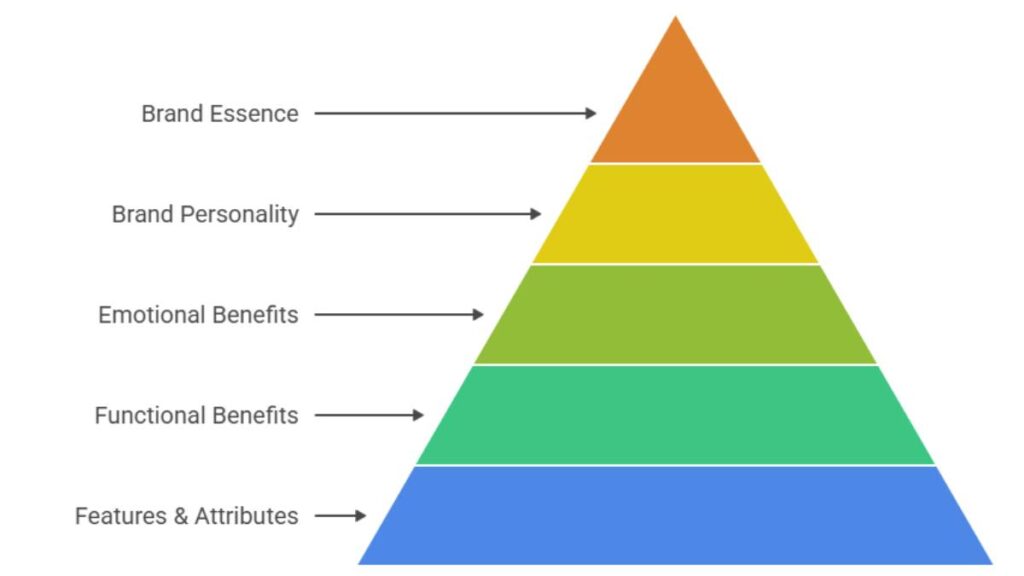
Features and Attributes
Start at the bottom. This is the stuff people can see or touch. The tangible things. The basics.
- What does the product do?
- What’s actually different from competitors?
- Anything physical or measurable that makes it stand out?
Take Volvo. Safety isn’t a tagline. It’s baked into the design, materials, and engineering. Dyson? Those little innovations in airflow or suction? That’s what makes the brand feel “premium” without shouting it. This layer gives the pyramid a foundation. Without it, everything above wobbles.
Functional Benefits
Next, functional benefits. This is the “so what?” of features. It’s practical, plain, and simple.
- Does it solve a problem?
- Does it make life easier or faster?
- Does it actually outperform alternatives?
It’s what gets someone to stop scrolling and consider your product. It’s the logic part; the “yeah, this actually works” part. Without functional benefits, people might like the look, but they won’t buy.
Emotional Benefits
Now things get interesting. Emotional benefits are what people feel.
- Pride, confidence, comfort, excitement; how does it land?
- Does it align with how someone sees themselves?
- Does it create a memory, a little moment that sticks?
A car, for example, might just get you from A to B, but the right brand makes it feel powerful, safe, or fun. This layer is sticky. It’s what people talk about to friends. It’s the start of loyalty.
Brand Personality / Values
Personality and values are the quirks, the traits, the “who the brand is.”
- Bold? Friendly? Serious? Playful?
- What does it stand for?
- How do those traits show up in campaigns, content, or customer interactions?
Ben & Jerry’s is playful but socially aware. Nike? Bold, inspirational, competitive. Without personality, brands feel hollow, like a product without a story.
Brand Essence
At the very top is the brand essence. The heart. The thing you’d tell someone if they asked, “What is this brand really about?”
- Can it be summed up in one line?
- Does it tie all the layers below together?
- Does it guide messaging, design, and customer experience?
Disney? “Making magic.” Volvo? “Safety.” Short, clear, and powerful. Everything else feeds into this. Skip it, and the brand feels like a stack of random pieces. Nail it, and the brand isn’t just seen; it sticks, resonates, and even influences decisions without anyone having to explain it.
Every layer matters, but it’s the combination that counts. Functional, emotional, personality, essence; all of it has to talk to each other. That’s what makes a brand more than a product. That’s what makes it something people actually remember.
Step-by-Step Guide to Building a Brand Pyramid
Building a brand pyramid isn’t something you do once and forget. It’s more like… sculpting slowly. You start at the bottom and keep shaping as you go up. It’s messy at first, and that’s okay. Don’t get hung up on perfection.
Start with features and attributes. This is the foundation. What does the product or service actually offer? Write it down. Every detail that matters. Think of things people can see, touch, or measure. The little things matter as much as the big. Miss them, and the whole pyramid feels shaky.
Next, work on functional benefits. Now you’re asking, “So what?” What does each feature actually do for the customer? Does it save time? Make life easier? Solve a real problem? Functional benefits are what people notice first; the logical reason they consider the brand. Skip this, and the emotional layer has nothing to cling to.
Then comes the tricky part: emotional benefits. This is how someone feels when they use the product. Pride. Confidence. Comfort. Excitement. Maybe even relief. These are the little things that make people remember a brand. It doesn’t have to be dramatic. Consistency is more important than flash.
After that, figure out brand personality and values. If your brand were a person, who would it be? Bold? Friendly? Playful? Thoughtful? This isn’t fluff. It guides messaging, campaigns, and even how the team talks about the brand internally. Personality makes a brand relatable. Without it, everything else just feels… flat.
Finally, define the brand essence. The single, simple idea that ties everything together. Disney calls it “making magic.” Volvo? “Safety.” Short, clear, and powerful. Everything below should point to this. Miss it, and the pyramid is just blocks stacked randomly. Nail it, and the brand sticks in people’s minds.
Expect back-and-forth. Lots of tweaks. Discussions about what really matters. That’s normal. The goal isn’t a perfect diagram on the first try. It’s clarity, alignment, and a map everyone can use.

Enroll Now: Advanced Digital Marketing Course
Brand Pyramid in Marketing Strategy
Once the pyramid is up, it’s more than a diagram. It becomes the lens for every marketing decision.
Positioning and rebranding are easier with a pyramid. It clarifies what the brand stands for and what it shouldn’t touch. In crowded markets, this clarity is gold. Without it, you end up sounding like everyone else.
Storytelling and content benefit, too. Functional benefits handle the logic, emotional benefits handle the feeling, personality gives it voice, and essence keeps it anchored. Campaigns feel natural when they reflect all layers. They don’t feel forced.
Customer engagement and loyalty are where it really pays off. Brands that deliver across all layers earn trust. People stick around not just because the product works, but because the brand feels right. They forgive small mistakes, they tell friends, they come back.
Competitive differentiation is another big one. Features alone don’t make a brand stand out. Emotional benefits alone don’t either. When all layers work together, the brand becomes unique and hard to copy. That’s when marketing stops being random and starts being strategic.
Basically, the pyramid is like a north star. Every campaign, every product decision, every message; it helps you check if it’s actually on brand. Without it, things drift. With it, everything aligns.
Examples of Effective Brand Pyramids
Seeing the pyramid in action makes it click. Big brands often nail it, and you can learn a lot from them.
Apple: Sleek design and intuitive software are the features. Functional benefits? Easy to use, reliable. Emotional benefits? Pride, belonging, creativity. Personality? Innovative, aspirational. Essence? “Think differently.” Every piece fits together.
Nike: Features like performance and durability. Functional benefits? Comfort, support, reliability. Emotional benefits? Empowerment, confidence, victory. Personality? Bold, inspiring. Essence? “Just do it.” Consistency across products and campaigns makes it stick.
Volvo: Safety is the feature and functional benefit. Emotional? Trust, peace of mind. Personality? Dependable, thoughtful. Essence? “Safety first.” Simple, clear, memorable.
The point isn’t just about big budgets. Small brands can do the same thing: clarity, consistency, alignment across layers. When done right, the pyramid turns a product into a brand people actually care about. Miss a layer or misalign it, and the brand feels hollow. Nail it, and it’s sticky, trusted, and memorable.
Tools and Templates to Optimize Your Brand Pyramid
Having a brand pyramid sketched out is one thing. Making it actually useful day to day? That’s a whole different story. Without some structure, things slip. Teams get inconsistent. Messages drift. So a few simple tools and templates go a long way.
- Brand positioning statement template: This is the quick “what the brand is” line. Not a tagline. Something your whole team can point to and say, “Yeah, that fits.” It’s like a mini compass; helps you know if campaigns or product ideas are on track.
- Customer personas: Don’t underestimate this. You need to know who the brand is actually for. Age, lifestyle, habits, annoyances, aspirations. Functional and emotional benefits only make sense when you have a person in mind. Without it, the pyramid is just a theory.
- Messaging matrix: Features, functional benefits, emotional benefits, personality; mapped across ads, social media, emails. Without this, messages get inconsistent. Different channels start saying slightly different things. Before long, the brand feels messy.
- Iteration templates: Even a simple spreadsheet with each layer listed works. Markets change. Products change. Customers’ expectations shift. If the pyramid isn’t alive, it gets outdated fast. These templates make tweaks less painful.
At the end of the day, these tools aren’t magic. They don’t make a brand. They just make it easier for people to use the pyramid without losing track of what actually matters. That’s the real win.
Measuring the Impact of Your Brand Pyramid
A brand pyramid is only worth the ink on paper if it actually changes anything. Otherwise, it’s decoration. Measurement is the only way to see if it works.
- Emotional impact: Hard to quantify, yes. But not impossible. Look at repeat purchases, NPS scores, reviews, and even social chatter. Do people feel what the brand promises? Pride? Comfort? Trust?
- Functional impact: Easier to track. Usage, adoption, customer success metrics. This is the proof that the bottom layers, features, and benefits are actually delivering.
- Awareness and loyalty: Are people recognizing the brand? Remembering it? Recommending it? These are signs that the pyramid isn’t just internal thinking, it’s actually landing with real humans.
- Iterate constantly: The pyramid isn’t static. Competitors move. Products evolve. Expectations shift. Check it, tweak it, don’t wait for something to break. Even small, regular reviews keep the brand aligned and prevent drift.
Think of metrics not as a report card. Think of them as a reality check. You see what’s working, what isn’t, and where the pyramid layers need tightening. It’s feedback, plain and simple.
Conclusion
A brand pyramid is more than a diagram. Done right, it’s a tool; one that helps make sense of a brand, guide decisions, and keep messaging consistent. But only if it’s used, not just admired.
Some takeaways:
- Build from the bottom up: features, functional benefits, emotional benefits, personality, essence. Skip layers, and the pyramid wobbles.
- Alignment is everything: every layer should talk to the others. Nothing should contradict, nothing should feel tacked on.
- Tools are helpers, not crutches: templates, matrices, personas; they keep the pyramid usable. But judgment, debate, and discussion shape it into something meaningful.
- Measure, tweak, repeat: the market changes. Customers evolve. Brands that adapt stay alive. The pyramid should grow with the brand, not gather dust.
At the end of the day, a strong brand pyramid makes a brand memorable, credible, and human. People feel it. They connect to it. They trust it. And that, really, is what makes a brand stick.
FAQs: About Brand Pyramid Model
1. What is a brand pyramid model, and why is it important?
Imagine stacking blocks. The bottom is what your product is. Above that, what it does. Then how does it make people feel? On top, the one line that captures it all. It’s important because without it, your messaging floats. Everyone ends up saying a little of everything, and nothing sticks.
2. How do I build a brand pyramid from scratch?
Start with the basics: features. List everything your product or service offers. Next, figure out the functional benefits; what problems does it actually solve? Then, dig into feelings. Pride, safety, confidence; whatever resonates. Layer in personality and values. Finally, condense the essence into a single line. Don’t expect perfection on the first try. This is messy work.
3. What are the main components of a brand pyramid?
Five main layers:
1. Features and attributes
2. Functional benefits
3. Emotional benefits
4. Brand personality/values
5. Brand essence
Everything builds on what’s beneath it. Skip one, and the pyramid wobbles.
4. How does the brand pyramid help with marketing strategy?
It’s a reference. Campaigns, social posts, product changes; you can check them against the pyramid. Keeps things consistent. Stops the brand from saying random stuff that confuses people. Without it, messaging drifts.
5. Can small businesses use a brand pyramid model effectively?
Yes. Often even more effectively than big brands. When resources are tight, clarity is gold. A small brand with a clear pyramid can punch way above its weight because every action is aligned.
6. What’s the difference between functional and emotional benefits in a brand pyramid?
Functional = practical. “It cleans faster, lasts longer, saves time.” Emotion = how it makes someone feel. “It makes me proud, confident, or secure.” Both matter. Features get attention. Emotions keep people coming back.
7. How often should I update my brand pyramid?
Not constantly. But keep an eye on it. Markets shift, customers evolve, competitors move. A quick check every few months, or at least a couple times a year, is enough. Make small tweaks before things start to feel stale.
8. Are there tools or templates to make building a brand pyramid easier?
Sure. Simple spreadsheets, whiteboards, even sticky notes. Templates just help organize thoughts and make discussions easier. They don’t do the thinking for you; no shortcut there.
9. How does the brand pyramid improve customer loyalty?
Consistency. When functional promises are delivered, and emotional connections hit the mark, people trust the brand. Trust drives repeat business. It’s not just about selling a product; it’s about being someone your customer feels good about sticking with.
10. Can a brand pyramid model help during rebranding or product launches?
Absolutely. It’s the map you check against when doing something new. Does this launch fit the brand’s personality and essence? Will it confuse existing customers? The pyramid keeps the messaging tight, even when things change.
The real point: the pyramid isn’t decoration. It’s a practical tool, a guide, a sanity check. When used well, it makes the brand coherent, human, and something people actually connect with. Not just notice, but remember.