

More than 50 countries now run some version of a remote-work residence permit. Every one of them will tell you theirs is the easy one. That isn’t a claim you can trust blindly. A digital nomad visa in 2026 that looks easy on income can turn brutal on paperwork, hand you a Schengen-blocking permit, or quietly tax you at 40% once you cross 183 days. Easy means something different depending on what you’re actually optimizing for.
This guide skips the “top 10 easiest” format. Instead, it breaks “easy” into the seven things that decide your actual experience: income threshold, paperwork, processing time, visa length, family rules, tax exposure, and whether the visa leads anywhere permanent. Then it walks the real country landscape for 2026, with verified income figures, fees, and the routes that get missold as digital nomad visas but aren’t.
Table of Contents
What Is a Digital Nomad Visa?
A digital nomad visa is a residence permit authorizing non-citizens to live in a country while working remotely for an employer or clients based outside that country. It differs from a tourist visa in one critical way: a tourist visa never authorizes work, remote or otherwise.
How does a digital nomad visa work? You apply, usually at a consulate or through an online portal, by proving remote income above the country’s threshold, holding valid health insurance, and showing you won’t compete for local jobs. Approval grants a residence permit, not a work permit for the host country’s own economy.
Digital nomad visa requirements generally include proof of remote employment or freelance income, roughly six months of bank statements, health insurance meeting a specified minimum, a clean criminal record and proof of accommodation. Exact documents vary. But this core set repeats almost everywhere.
Who is eligible for a digital nomad visa? Employees of foreign companies, freelancers with foreign clients and business owners running companies registered outside the host country. Most programs explicitly exclude anyone planning to work locally.
A digital nomad visa vs tourist visa distinction is straightforward: one permits remote work, the other doesn’t. A digital nomad visa vs work visa is murkier: a work visa ties you to a specific local employer; a nomad visa deliberately keeps you out of the local labor market. And a digital nomad visa vs remote-work or freelancer residence permit, like Czechia’s Zivno trade license or Germany’s freelance visa, is mostly a naming difference. Several country programs in this article aren’t called “digital nomad visa” at all but function the same way, and are flagged as alternative routes rather than treated as identical.
What Actually Makes a Digital Nomad Visa Easy?
A digital nomad visa is easy when its income threshold, paperwork, and renewal terms match your actual situation, not when a blog ranks it #1. Seven variables decide that fit, and they trade off constantly.
Income threshold relative to your actual earnings. A €2,849 monthly bar (Spain) is unremarkable for a senior consultant and out of reach for someone two years into freelancing. The number only means something next to your bank statements.
Application process and documentation. Some countries process everything online in a single portal (Estonia, Malaysia). Others still want apostilled degree certificates couriered to a consulate that answers email once a week.
Processing time. Croatia and Romania move in two to four weeks. Portugal’s AIMA backlog currently stretches the full residence-card journey to four to nine months, even after visa approval.
Visa duration and renewal. Croatia caps out at 18 months with zero renewal and a mandatory six-month gap before reapplying. Thailand’s DTV runs five years. Those aren’t the same product wearing different labels.
Family eligibility. Hungary’s White Card allows no family reunification at all. Malaysia’s DE Rantau lets you bring parents. Portugal builds family inclusion in from day one.
Tax rules. “Tax-free” gets thrown around loosely. Croatia genuinely exempts foreign remote income by law. Estonia and Greece measure your income requirement in net terms, which pushes their real bar 25 to 40% above what the headline number suggests.
Pathway to long-term residence. Croatia and Malta were built as temporary programs with no PR route by design. Spain and Portugal were built as bridges to permanent residency and citizenship.
Weigh these against your own priorities before comparing countries. A visa that’s easy on income but dead-ends after 18 months isn’t easy if you’re trying to build a life somewhere.
Also Read: Building a Secure Digital Marketing Workflow for Distributed Teams
The Digital Nomad Visa Landscape in 2026
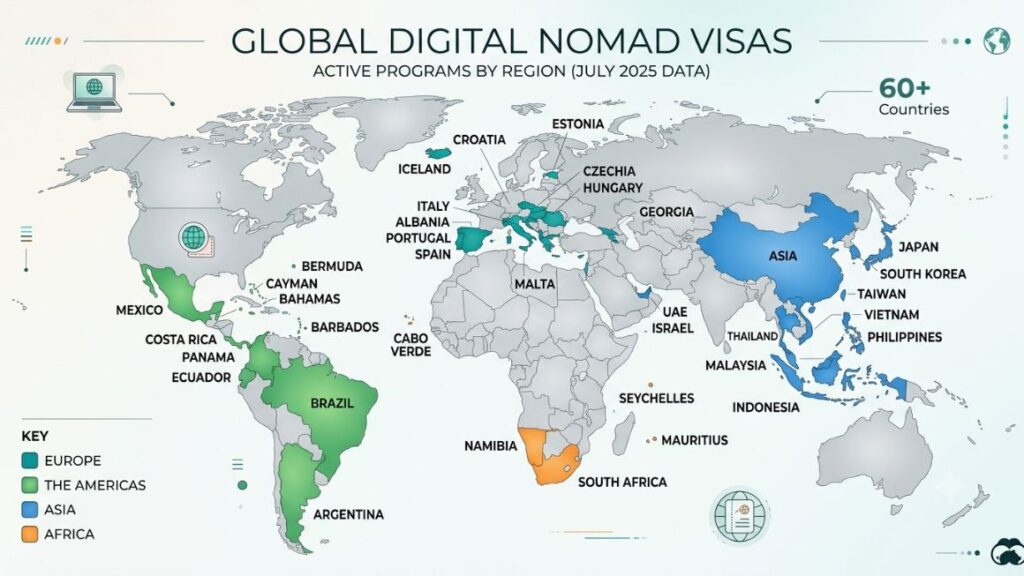
The global landscape has expanded fast. Freaking Nomads now tracks over 70 active programs which is up from a handful when Estonia and Barbados pioneered the category in 2020. That growth is exactly why older “best digital nomad visa” roundups mislead people. Croatia’s threshold jumped from €3,295 to €3,622.50 between March and August 2026 alone. Portugal’s D8 bar moved with January’s minimum-wage hike and Romania’s real number is now closer to €5,400 a month, not the €3,700 most 2023-era guides still quote.
Some programs have stalled entirely. The Philippines signed its digital nomad visa into law via Executive Order 86 in 2025, and as of mid-2026 the implementing rules still aren’t in force, so nobody can apply. Montenegro has announced intent for years without a live program. Different countries also use different names for similar routes: Portugal’s is the D8, Hungary’s is the White Card, Kazakhstan’s is Neo Nomad. This guide separates dedicated digital nomad visa programs from these alternative remote-work routes throughout, and flags a handful of Caribbean and African programs where current status needs direct verification.
Digital Nomad Visas in 2026: Country-by-Country Guide
Europe
- Spain. €2,849 a month (200% of the 2026 minimum wage), plus roughly €1,068 for a first family member and €356 for each additional one. Apply from a consulate for a one-year visa, or from inside Spain to the UGE fast-track unit for a three-year residence permit, renewable to five years, with permanent residency available after that. Processing runs about 20 working days through the UGE. Freelancers can earn up to 20% of income from Spanish clients, a flexibility almost no other European program offers.
- Portugal. The D8 requires €3,680 a month, four times Portugal’s 2026 minimum wage, plus €460 for a spouse and €276 per child, and €11,040 in savings. It’s a two-step process: a visa from the consulate, then a residence card from AIMA, currently taking four to nine months given the backlog. It grants a two-year permit renewable for three more, with permanent residency at five years. The big 2026 change: citizenship now requires 10 years of residence, not five, under the nationality law reform effective May.
- Italy. About €28,000 a year (roughly €2,333 a month), the lowest bar among major Western European programs, but it requires proving “highly qualified” status through a degree, a licensed profession, or five years of experience (three for ICT roles). Fee is €116, the permit runs one year and renews annually with no cap, and self-employed applicants often use Italy’s regime forfettario for an effective 5% rate on revenue under €85,000.
- Croatia. €3,622.50 a month as of the March 2026 update, reindexed every spring at 2.5 times the average net salary. Up to 18 months, not renewable, with a mandatory six-month gap before reapplying. In exchange, Croatia fully exempts digital nomad income from local tax.
- Greece. €3,500 a month, measured net after tax, which makes it a heavier lift than it appears. Since February 2026’s Law 5275/2026, you must apply at a Greek consulate before traveling; the old route of applying inside Greece as a tourist has closed. It runs as a 12-month visa converting to a two-year residence permit, renewable, with time counting toward the five-year EU long-term residence track.
- Estonia. €4,500 a month net, one of the higher income thresholds in Europe. Twelve months, not renewable, so you leave and reapply for more time.
- Malta. €42,000 a year (about €3,500 a month), raised from €32,400 in 2024. One year, renewable up to four total, with no path to permanent residency by design. Your first 12 months of foreign income are exempt, then a flat 10% applies, well under Malta’s standard 35% top rate. Qualifying authorised work is subject to a 10% tax rate under Malta’s nomad tax rules, with special treatment during the first 12 months subject to the conditions of those rules.
- Romania. Roughly €5,000-plus a month, based on three times Romania’s average gross monthly salary. Twelve months, renewable subject to continuing to meet the income requirement. Romanian tax residency depends on the country’s tax-residency rules and is not determined solely by a simple 183-day rule.
- Czech Republic. Not officially branded a digital nomad visa. The Zivno trade-license route asks around CZK 69,836 a month (about $3,200) for IT and marketing specialists, with a general freelance route requiring roughly $5,200 in savings or contracts. It’s a one-year permit with some of the lowest effective freelance tax rates in the EU.
- Hungary. The White Card needs €3,000 a month net, doubled from €2,000 in 2024, as an ongoing condition rather than a one-time check. One year, renewable once to two years total, with zero family reunification. A spouse must file a fully separate application meeting the same income bar.
- Cyprus. €3,500 a month net, plus 20% for a spouse and 15% per child, under a ceiling of 500 residence permits. One year, renewable to three. Cyprus is in the EU but not yet in Schengen, though accession looks likely in 2027.
- Slovenia. Live since November 21, 2025. Roughly €3,400 a month, twice the average net salary. One year, not renewable, but family reunification applies immediately, a rarity in Europe.
Alternative Remote-Work Routes in Europe
Germany has no dedicated nomad visa. Its freelance (Freiberufler) visa serves a similar function but was built for self-employed professionals generally. Georgia offers something unusual. Citizens of eligible countries can receive up to 365 visa-free days. But this does not apply to every nationality, including Indian passport holders. It isn’t a visa at all, and no dedicated Georgian digital nomad visa exists despite what some guides claim.
North and Central America
- Costa Rica. $3,000 a month for an individual, $4,000 for a family, codified under Law 10008. One year, extendable to two if you spend at least 180 days physically present in year one. Foreign income is explicitly tax-exempt.
- Panama launched a short-term remote-worker visa in May 2021, applied for through consulates or an immigration lawyer, with no tax on foreign-sourced income and a US-dollar economy.
- Mexico has no dedicated digital nomad visa, despite hosting one of the world’s largest nomad populations. The real route is the Temporary Resident Visa, applied for at a consulate abroad, requiring roughly $4,400 to $4,500 a month or about $75,000 to $80,000 in average savings, issued for a year and renewable to four, with permanent residency possible afterward.
Asia and the Middle East
- Indonesia. The E33G Remote Worker KITAS needs $60,000 a year, applied for entirely online. One year with no in-country extension, so staying longer means a fresh application.
- Thailand. The DTV is unusual: no income requirement, just savings of 500,000 THB (about €12,500). Five years of validity, 180 days per entry, extendable once per entry. Staying 180-plus days makes you a Thai tax resident.
- Japan. ¥10,000,000 a year (roughly €57,000), one of the steepest bars anywhere, open only to citizens of 49 visa-waiver countries with tax treaties. Six months, not extendable.
- United Arab Emirates. $3,500 a month, one-year renewable, and zero personal income tax on employment earnings. Requirements tightened through 2026, now asking six consecutive months of bank statements.
- South Korea. The F-1-D workation visa graduated from pilot to permanent status on June 30, 2026. The income threshold varies by age and location. Applicants aged 18 to 34 generally face a lower threshold than older applicants. Eligible applicants settling outside the Seoul Metropolitan Area can qualify at a lower GNI multiple.
- Malaysia. DE Rantau runs two tracks: tech and digital professionals need just $2,000 a month, non-tech professionals need $5,000. Three to 12 months initially, renewable to 24 months. Malaysia stands out on family eligibility, even parents can join. MDEC reported processing delays in September 2026 because of technical and integration issues.
- Taiwan. $40,000 a year for applicants 30 and older, just $20,000 for ages 20 to 29. Initially extended from six months to a two-year maximum in a 2026 update.
- Philippines. Signed into law but not open for applications as of mid-2026. The circulating $2,000-a-month figure is indicative, not confirmed. Until it launches, the practical route stays the 30-day visa-free tourist entry. It is extendable in-country to 36 months.
- Türkiye. Roughly €33,800 a year (about $3,000 a month), open to applicants aged 21 to 55 from a specific list including EU countries, the UK, the US, Canada and Russia, requiring a university degree.
- Sri Lanka. Launched in February 2026 after years of delay. About $2,000 a month plus $500 per dependent, for a one-year renewable visa, with a longer five-year option also available.
- Kazakhstan and Kyrgyzstan. Kazakhstan’s Neo Nomad visa (category B12-1) moved from announcement to actual processing in 2025, asking around $3,000 a month, issued for a year and renewable up to four years total. Kyrgyzstan has floated a similar concept, but current operational status needs direct verification.
South America
- Colombia. Three times the Colombian minimum wage, about COP 5,252,715 (roughly €1,300 a month), resetting every January. Up to two years. It is open to citizens of around 100 visa-exempt nationalities, with fees totaling about €150.
- Brazil. $1,500 a month, or $18,000 in savings as an alternative. This is a relatively low income bar of any major program worldwide. One year, renewable to two, open to any nationality.
- Argentina. No income requirement; you document the work itself through contracts and client letters instead. 180 days, extendable once to 360, but only for nationalities that can already enter Argentina visa-free.
Caribbean
Barbados. $50,000 a year, self-certified rather than bank-verified, for the 12-Month Welcome Stamp. Reapply annually rather than renew. Fee is $2,000 for an individual or $3,000 for a family, due only after approval, with foreign income fully tax-exempt.
The Bahamas, Dominica, Montserrat, Curaçao and the Cayman Islands are regularly listed in “best digital nomad visa” roundups, but their operational status, fees, and current 2026 thresholds varied enough between sources that they shouldn’t be treated as confirmed without checking each territory’s immigration authority directly.
Africa
- South Africa. R650,796 gross a year (about R54,200, or roughly €2,600, a month), straight from the Department of Home Affairs gazette. Up to three years on a visitor’s visa for remote work. Stay under six months in any 12-month period and you owe South Africa nothing; cross that line and SARS registration kicks in.
- Mauritius. $1,500 a month plus $500 per dependent, and remarkably, completely free, the only nomad visa anywhere with no government fee. One year, renewable.
- Namibia. $2,000 a month, designed as a single six-month stay rather than a renewable permit, with a spouse adding $1,000 and each child $500.
- Kenya has discussed a digital nomad visa concept publicly, but a confirmed, operational program with verified 2026 figures wasn’t available at the time of writing.
Also Read: Best Countries for Digital Nomads in 2026: Visas, Cost of Living, and Time Zones
Digital Nomad Visa Comparison: Income, Duration, Fees and Taxes
Spain, Portugal, and Croatia sit at the accessible end of Western Europe on paperwork, while Malta and Estonia carry the heaviest income bars on the continent. In Asia, Malaysia’s tech track and Sri Lanka’s new program undercut Japan and South Korea by a wide margin. Brazil and Colombia remain the lowest-friction entries in the Americas.
Digital Nomad Visas With Lower Income Requirements
Rather than crowning an “easiest” country, it’s more useful to see where the income bar sits lowest, then weigh what you give up for that.
Countries with relatively low income thresholds include Brazil ($1,500/month or $18,000 in savings), Colombia (around €1,300/month), Italy (€2,333/month), Taiwan ($1,667/month for under-30s), and Malaysia’s tech track ($2,000/month). Against a mid-career remote salary of $4,000 to $6,000 a month, all five clear comfortably, which is why they top every “best countries for digital nomads” list. The actual fit still depends on the applicant’s income, documentation, family situation and the programme’s other eligibility conditions.
Why a lower income requirement does not always mean an easier visa. Italy’s bar is low, but it demands “highly qualified” documentation many freelancers struggle to produce. Brazil’s threshold is the lowest of any major program, yet its insurance rules require US$30,000 in coverage that consulates check carefully. Colombia’s health policy must cover seven specific categories, including maternity, which standard travel insurance usually excludes. Family requirements, employment restrictions, and whether you apply by consulate or online all add friction a headline income number hides completely.
Digital Nomad Visas for Indian Passport Holders
Can Indians apply without an overseas job offer? Yes, in most programs. Freelance client contracts and invoices are generally treated the same as formal employment across European and Latin American programs.
Online applications vs embassy applications. Estonia, Malaysia, and Indonesia run fully online portals. Spain, Portugal, and most others still require an in-person consulate appointment, and Portugal specifically carries a multi-month AIMA backlog through 2026.
Income and bank documentation typically means six to twelve months of bank statements, ITR filings, and, for freelancers, client invoices and signed agreements, plus an Indian police clearance certificate.
Schengen rules and remote-work restrictions. A valid residence permit issued by a Schengen country generally allows short tourist visits to other Schengen countries being subject to to the 90 days in 180 days rule. It does not generally give you the right to work in those countries.
Countries with practical options for Indian remote workers in 2026 include Portugal, Spain, Croatia, Estonia, Georgia (visa-free, no application), Greece, Malta, Costa Rica, Indonesia, the UAE’s Virtual Working Programme, Malaysia, Colombia, and Barbados. Croatia, Hungary, and Spain sit at the accessible end on income; Portugal, Greece, and the UAE ask more but offer stronger long-term positioning. One reminder that matters more than the visa itself. For Indian applicants, tax residency depends on your days of stay in India and other conditions under Section 6 of the Income Tax Act. The basic test includes 182 days or more in India during the relevant tax year, with additional rules applying in certain cases. That triggers NRO/NRE account conversion under FEMA and changes which income India can still tax.
Also Read: How to Make Money Online in India [Without High Investment]?
Digital Nomad Visas With a Path to Long-Term Residence
What is permanent residency? A status letting you live in a country indefinitely without renewing a temporary visa, distinct from citizenship, which grants a passport and full political rights.
Can a digital nomad visa lead to permanent residency? Sometimes. Portugal’s D8 and Spain’s DNV were designed as genuine bridges toward settlement. Croatia and Malta were built with no PR route at all, by legal design.
Portugal. Time on the D8 counts toward permanent residency at five years and, since May 2026’s nationality law reform, toward citizenship at 10 years for most applicants (seven for EU and CPLP nationals), up from the five-year timeline that once made Portugal famous among nomads.
Spain. Permanent residency at five years of continuous residence, with a maximum of 10 months outside Spain across that period. Citizenship generally takes 10 years, except for Latin American citizens, who qualify in two, making Spain the fastest EU passport route for that group post-2026.
Why visa duration and permanent residency aren’t the same thing. A long visa doesn’t mean the time counts toward anything if the program wasn’t designed with residency in mind. Check whether a country’s digital nomad visa is a standalone product (Croatia, Malta and Hungary) or a genuine immigration pathway (Spain, Portugal) before assuming your years abroad are building toward something.
Digital Nomad Visa Taxes: What You Need to Know
Does a digital nomad visa make you tax-exempt? Not automatically. Some countries genuinely exempt nomad income (Croatia, Costa Rica, Romania under 183 days); most simply don’t tax you until you cross 183 days, at which point standard local rules apply in full.
Local income tax varies widely: the UAE charges zero, Romania sits at a flat 10%, Hungary at 15%, while Spain and Portugal run progressive systems reaching 47% and 48% for full tax residents without a special regime.
Tax residency generally follows the 183-day rule, though Spain’s Beckham Law, Malta’s post-year-one 10% flat regime, and Cyprus’s non-dom program all offer preferential treatment for qualifying newcomers.
Double taxation and tax treaties. Most digital nomad visa countries hold tax treaties with major economies, including India’s DTAAs, which prevent the same income being taxed twice, though claiming that relief requires filing correctly in both jurisdictions.
Your home-country tax obligations don’t disappear. For Indian applicants, NRI status after 182 days abroad means only India-sourced income stays taxable in India, not that Indian obligations end entirely.
A country advertising a digital nomad visa as tax-free usually means foreign remote income is exempt only up to the 183-day residency threshold, or under a specific carve-out like Croatia’s. It rarely means an applicant owes no tax anywhere; home-country obligations, in India’s case NRI status and DTAA claims, still apply on top.
What Do You Actually Need Before Applying?
- Proof of remote income: employment contracts, client agreements, or invoices spanning three to twelve months
- Minimum income and savings: bank statements matching the threshold, plus any separate savings requirement (Portugal’s €11,040, Thailand’s 500,000 THB)
- Passport and background checks: validity well beyond your stay, plus police clearance, often from every country lived in for six-plus months over five years
- Health insurance: from nothing formally required (Thailand’s DTV) to strict, no-co-payment policies (Spain)
- Accommodation: a rental agreement, property deed, or booking confirmation
- Employment or client documents: proof the income is genuinely foreign-sourced
- Family and dependant documents: marriage and birth certificates, often apostilled and translated
- Tax and residency considerations: how the destination’s 183-day rule interacts with your home country’s rules
How Much Does a Digital Nomad Visa Cost?
- Visa cost and cost of living are separate numbers, and conflating them is how people misjudge a move.
- Application fee ranges from free (Mauritius) to $2,000 (Barbados), with most European programs landing between €80 and €300.
- Minimum income is the biggest planning variable, from Brazil’s $1,500 a month to South Korea’s roughly $6,200 baseline.
- Health insurance typically runs a few hundred to a couple thousand dollars a year, with Spain and Colombia among the strictest on coverage.
- Accommodation, local taxes, renewal costs and cost of living sit outside the visa fee and vary by city as much as country: Zagreb costs meaningfully less than Lisbon, even under the same Schengen-adjacent visa category.
Countries Often Mistaken for Digital Nomad Visa Destinations
Not every route that lets you live abroad and work remotely is a dedicated digital nomad visa. Dedicated visas, like Spain’s, Portugal’s D8, and Croatia’s, have their own legal framework and income formula. Remote-work and freelancer permits, like Germany’s Freiberufler route or Czechia’s Zivno, achieve a similar outcome inside a broader self-employment framework. Self-employment and temporary residence permits, common across Latin America, often work for remote income even though “digital nomad” never appears in the legislation.
Tourist or extended-stay programmes, like Georgia’s 365 visa-free days or the Philippines’ tourist extension while its real nomad visa sits unlaunched, let you stay and quietly work but were never built as a nomad category. Lumping all four types into one “best digital nomad visa countries” list overstates how many genuine dedicated programs exist.
How to Apply for a Digital Nomad Visa?
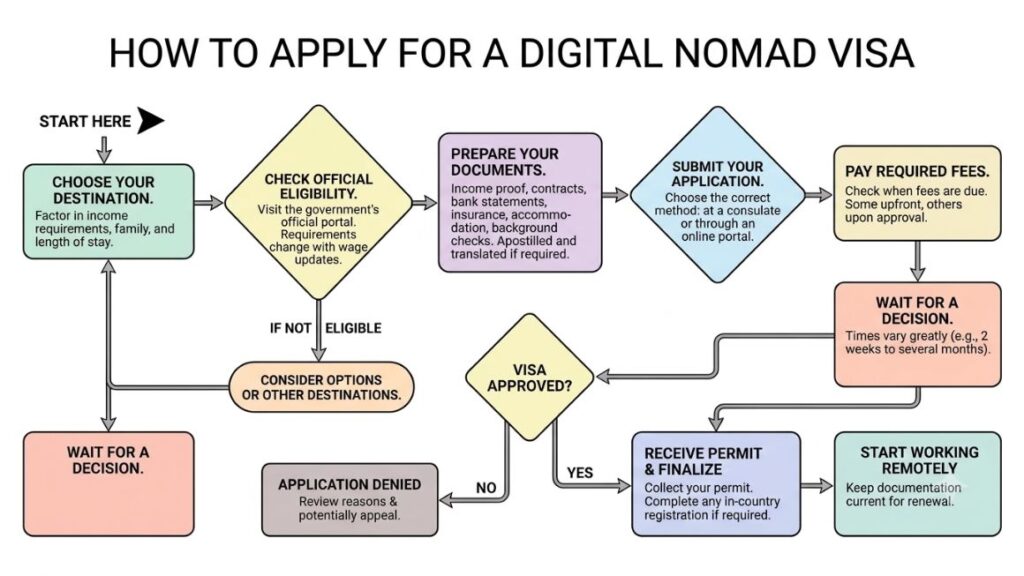
- Choose your destination based on income, family situation and length of stay, not reputation.
- Check official eligibility requirements on the government’s own portal, since figures shift with wage updates.
- Prepare your documents: income proof, contracts, bank statements, insurance, accommodation, background checks, apostilled and translated where required.
- Submit your application at a consulate or through an online portal, depending on the country.
- Pay the required fees, some due only on approval (Barbados), most upfront.
- Wait for a decision, from about two weeks (Croatia, Romania) to several months (Portugal’s AIMA queue).
- Receive your permit and complete any final in-country registration.
- Start working remotely, keeping documentation current for renewal.
Common Digital Nomad Visa Mistakes
- Applying before checking the current income figure, not a two-year-old blog post
- Assuming no local tax applies, when most programs only exempt income up to the 183-day residency line
- Working for local clients when the visa prohibits it, grounds for rejection or revocation in most programs
- Confusing tourist stays with remote-work permission, since a tourist visa never authorizes work
- Ignoring renewal conditions, like Malta’s presence test or Hungary’s ongoing income floor
- Assuming the visa leads to permanent residency, when Croatia and Malta were built with no PR pathway
- Using outdated visa information, risky in 2026 given how many thresholds moved mid-year
How to Choose the Right Digital Nomad Visa for Your Situation?
Lower income requirement: Brazil, Colombia, Italy, or Malaysia’s tech track.
Short-term trial: Croatia’s 18 months or Costa Rica’s extendable one-year option.
Long-term residence: Spain and Portugal, the two programs actually built for it.
Indian freelancers: prioritize online-portal countries (Estonia and Malaysia) or straightforward client-documentation rules (Spain and Colombia) over consulate-heavy routes with long backlogs.
Moving with family: Malaysia and Portugal offer the most generous dependant rules; skip Hungary’s White Card entirely if family is coming.
Tax-focused: weigh Croatia’s exemption, the UAE’s zero income tax and Malta’s post-year-one 10% rate against your own home-country residency and DTAA rules.
Conclusion
There’s no single country that wins “easiest digital nomad visa” across every criterion that matters. Income requirements swing from zero to $74,000 a year. Application processes range from a same-day online portal to a multi-month consulate queue. Tax treatment genuinely differs, not just in headline rate but in what “tax-free” is quietly excluding. And a digital nomad visa doesn’t automatically hand you a path to permanent residency, no matter how many times a listicle implies otherwise.
For Indian applicants, the practical filter comes down to documentation ease, family rules if you’re not traveling solo, and getting clear on your NRI tax status before booking a flight. Whatever country you land on, verify current figures directly with that country’s immigration authority before applying. Thresholds moved mid-year in Croatia, Portugal, and Romania in 2026 alone, and a number accurate in January can already be wrong by the time you file.
If you’d rather have current thresholds, tax rules, and application changes land in your inbox as they shift instead of chasing them down yourself, that’s exactly what the Crystal Clear Newsletter is built for: a regular, no-fluff read on the trends and numbers that actually affect how people like you work and live.
FAQs
What is a digital nomad visa?
A digital nomad visa is a residence permit that lets non-citizens legally live in a country while working remotely for an employer or clients based elsewhere. It is distinct from a tourist visa, which never authorizes work.
Which countries offer digital nomad visas in 2026?
Over 50 countries run active programs, including Spain, Portugal, Italy, Croatia, Greece, Estonia, Malta, Indonesia, Thailand, Japan, the UAE, South Korea, Malaysia, Colombia, Brazil, Costa Rica, South Africa and Mauritius, alongside newer entrants like Slovenia and Sri Lanka.
How much income do I need for a digital nomad visa?
It varies enormously, from no fixed requirement (Thailand’s DTV, Argentina) to roughly $74,000 a year (South Korea’s baseline tier). Most mid-tier European and Latin American programs fall between $1,500 and $5,000 a month.
Can Indians get a digital nomad visa?
Yes. Indian passport holders can apply for Portugal’s D8, Spain’s DNV, Croatia’s, Estonia’s, Malaysia’s DE Rantau, Colombia’s, Costa Rica’s, and the UAE’s Virtual Working Programme, among others. Eligibility and documentation differ by country.
Can I get a digital nomad visa without an overseas job offer?
Yes, in most programs. Freelance client contracts and invoices generally satisfy the income requirement just as well as a formal employer’s offer letter, as long as the income clearly originates outside the host country.
Can I bring my spouse or children on a digital nomad visa?
Most programs allow it with an added income requirement per dependant, though details vary: Malaysia even allows parents, Portugal builds family inclusion in from the start, and Hungary’s White Card doesn’t allow family reunification at all.
Do I have to pay tax in the country where I hold a digital nomad visa?
Usually only after crossing a residency threshold, most commonly 183 days in a 12-month period, though a handful of countries, Croatia included, exempt qualifying foreign remote income by law regardless of how long you stay.
Is a digital nomad visa the same as a tourist visa?
No. A tourist visa never authorizes remote work, even informally, while a digital nomad visa is specifically designed to permit it. Working remotely on a tourist visa technically violates its terms in nearly every country that also offers a dedicated nomad category.
Which digital nomad visas have lower eligibility requirements?
Brazil ($1,500/month or $18,000 in savings), Colombia (around €1,300/month), Italy (€2,333/month, subject to a “highly qualified” documentation bar), and Taiwan’s under-30 tier ($1,667/month) currently sit among the more accessible programs on income alone.
Can a digital nomad visa lead to permanent residency?
Sometimes. Spain and Portugal were designed as genuine bridges to permanent residency and eventual citizenship. Croatia and Malta, by contrast, were built as temporary programs with no PR route at all, regardless of renewals.
How do I apply for a digital nomad visa?
Choose a destination matching your income and family situation, confirm current eligibility on the government’s official immigration portal, gather income and insurance documentation, apply through a consulate or online portal, then convert to a residence permit once approved.