

For most of the last decade, loyalty programs were built around a simple assumption: a human being reads the offer, decides if it’s worth it, and clicks. That assumption is starting to fall apart. Google’s Universal Commerce Protocol, OpenAI’s Instant Checkout, and a growing list of shopping assistants mean a chunk of your future purchases will be decided by software acting on a customer’s behalf, not the customer scrolling your app at 9pm.
An AI agent for loyalty marketing is how brands are responding on their own side of that shift, using autonomous systems that can read member data, decide on an offer, and execute it without someone in marketing ops manually building the segment first.
This isn’t a trend piece. It’s a working guide for marketers who actually run loyalty programs and need to know what these agents do, how they’re built, what’s already live at real companies, and where the risk sits. We’ll get into platforms, deployment steps, ROI math, and where India’s data protection rules change the calculus. If you’re trying to figure out whether this belongs on your 2026 roadmap, by the end you’ll have a clear answer.
Table of Contents
What Is an AI Agent for Loyalty Marketing?
An AI agent for loyalty marketing is a software system that can independently analyze member data, decide on the next best action, and execute it, like sending a personalized offer or flagging a churn risk, without a human manually configuring each step. That’s the whole definition. Everything else is detail on how it gets there.
AI Agent vs AI Assistant
An assistant waits for you to ask something. You type a question into a chatbot, it answers, and it stops. An agent doesn’t wait. Give it a goal like “reduce churn among gold-tier members this quarter” and it goes and does the analysis, drafts the offers, and in more mature setups, launches the campaign itself. The distinction matters because most of what got called “AI in loyalty” through 2023 and 2024 was really assistant-shaped: dashboards, chat support, insight summaries. Agents are the layer above that.
AI Agent vs Traditional Loyalty Automation
Traditional automation runs on rules someone wrote: if a member hasn’t purchased in 60 days, send a 10% off email. It’s reliable but static. It doesn’t know that a 10% offer is wasted on someone who was going to buy anyway, or that a different member needs a different lever entirely. An AI agent evaluates that context per member and adjusts the action, which is closer to how a good CRM manager would think, just at a scale no human team can match.
AI Agent vs Predictive AI
Predictive AI tells you what’s likely to happen. It scores a member as “68% likely to churn in 30 days” and stops there. A human still has to decide what to do with that number. An AI agent takes the next step and acts on the prediction, choosing the intervention and, in autonomous setups, sending it. Predictive AI is the analysis. The agent is the execution.
Core Components of an AI Loyalty Agent
Strip away the vendor marketing and every AI loyalty agent has four parts: a data layer that feeds it member information, a reasoning layer (usually an LLM plus a decision model) that figures out what to do, a set of tools it’s allowed to use like a CRM or an email platform, and guardrails that cap what it can spend or how often it can contact someone. We’ll go deeper on architecture further down.
AI Loyalty vs Traditional Automation vs Predictive AI vs AI Agents
Here’s the comparison in one place, since these four terms get used interchangeably in vendor decks and shouldn’t be.
| Capability | Rules-Based Automation | Predictive AI | AI Agent |
| Decides the trigger | Human-defined rule | Model score | Model reasoning |
| Chooses the action | Fixed and pre-set | Human picks from suggestions | Agent selects and can adjust |
| Executes the action | Yes, but rigid | No (hands off to human) | Yes, autonomously or with approval |
| Personalization depth | Segment-level | Individual score | Individual and context-aware |
| Learns from outcomes | No | Periodically retrained | Continuously, in mature setups |
An AI agent for loyalty marketing differs from traditional automation and predictive AI in one key way: it can both decide the right action for an individual member and execute it, closing the loop without a human configuring every step in between.
Why AI Is Changing Loyalty Marketing in 2026
Three things are colliding at once, and none of them were true five years ago.
The Rise of Agentic Commerce
Google introduced the Universal Commerce Protocol (UCP) in partnership with Shopify, Walmart, and Target, an open standard that lets AI agents browse, compare, and purchase products directly, without a human clicking through a website.
That single announcement, per Chain Store Age’s February 2026 coverage, marked agentic commerce moving from theory to something retailers actually have to build for. Add in OpenAI’s Instant Checkout inside ChatGPT and Agent Payments Protocol (AP2) for secure agent-led transactions, and you’ve got a real, live stack that brands need to plug into.
AI Shopping Agents as a New Customer Interface
PYMNTS Intelligence put it bluntly in a March 2026 report: the most consequential customer a brand acquires this year may never open a promotional email or feel the pull of a rewards tier. It’ll be an AI agent, comparing subscription value and executing a purchase on a human’s behalf. That’s not a hypothetical. Prototypes like Meta’s Muse are already positioned as personal concierges that coordinate purchases across accounts.
The Limits of Static Loyalty Rules
Here’s the problem with the old model. A points-and-tiers program built on fixed rules can’t tell the difference between a member who’s about to leave and one who’s just quiet this month. Currency Alliance’s 2026 trends report describes today’s AI-empowered consumers as “light-footed and less patient,” switching brands more easily when loyalty value isn’t visible in the moment. Static rules simply can’t move fast enough to keep up.
The Move Toward Real-Time Personalisation
Capillary’s 2026 loyalty predictions note that over 90% of US online adults and nearly 9 in 10 European shoppers now belong to at least one loyalty program, and yet a separate finding cited in the same report shows 75% of customers would still switch brands for a single compelling discount. Participation is high. Loyalty is shaky. That gap is exactly what real-time, agent-driven personalization is meant to close.
The Two AI Agents Changing Customer Loyalty
There’s a distinction most articles on this topic skip entirely, and it’s the one that actually matters for your strategy.
Brand-Side Loyalty Agents
This is the agent your marketing team deploys: inside your CRM, your loyalty platform, your campaign tools. It works for you. It decides which offer to send, which member to flag for a retention call, which reward catalog to surface. This is what most of this article covers.
Consumer-Side Shopping Agents
This is the agent working for the customer. It compares your loyalty value against a competitor’s, in real time, and it doesn’t care about your brand story. It cares about whether the points are worth more here or there. Forbes’ September 2026 coverage of this shift quotes Jaclyn Wands, VP of product and AI at Phaedon, describing these as “the new gatekeepers” of customer loyalty.
Why Brands Need to Optimise for Both
You now have two audiences: the human and the agent shopping for them. Winning the human still requires storytelling and emotional connection. Winning the agent requires your loyalty value to be machine-legible, meaning structured, queryable, and honest about what it’s actually worth. Brands that only optimize for one side of this are going to lose ground fast.
What an AI Agent Can Automate Across the Loyalty Lifecycle
This is the practical part. Here’s what’s actually being automated today, not in five years.
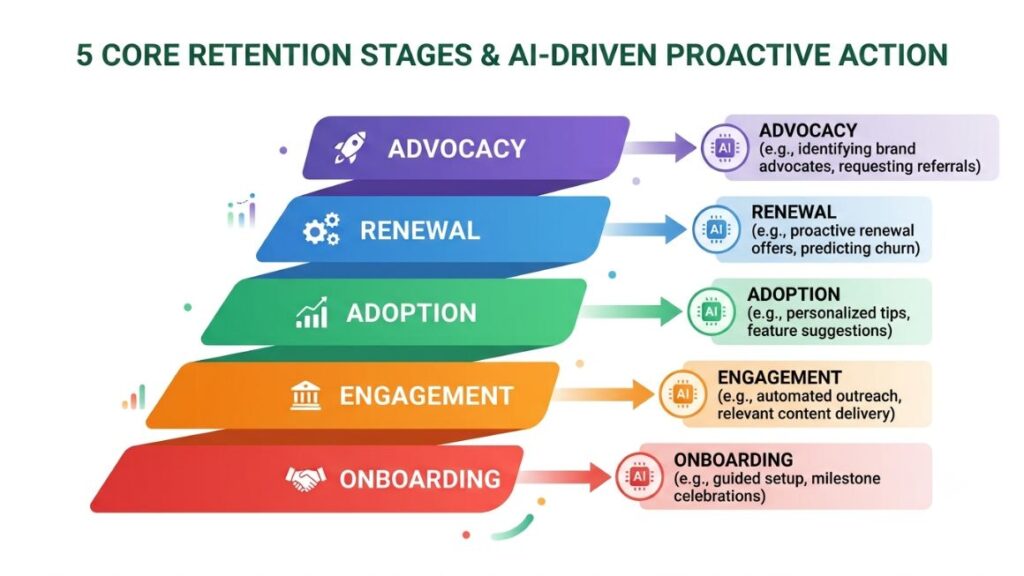
Customer Onboarding and Activation
Agents can build a welcome sequence that adapts to how someone joined, what their first purchase was, and any stated preferences, rather than sending everyone the same three emails.
Also Read: Lifecycle Marketing Guide: Strategy, Stages & Examples
Customer Segmentation
Instead of a marketer manually pulling lists, an agent can build and refresh audience segments on its own, using natural language prompts like “members who haven’t redeemed in 90 days but still browse weekly.”
Personalised Rewards and Offers
This is where personalized rewards AI earns its name. Rather than a blanket 15% off, the agent picks the specific incentive, be it bonus points, early access, or a discount, most likely to move that individual member.
Next-Best Action and Next-Best Offer
At any given moment, an agent can weigh dozens of possible actions for a member and pick the one with the highest expected value, factoring in margin, not just conversion.
Churn Prediction and Win-Back
A major airline used an AI agent to catch pre-churn signals like decreased search activity and slowing mileage accumulation, then automatically triggered offers such as lounge passes or status extensions, according to Digiqt’s 2025 review of AI agent deployments in loyalty. That’s churn prediction AI paired with automated intervention, not just a dashboard flag.
Cross-Sell and Upsell
Agents can recommend the next product a member is likely to want based on past purchases and similar-member behavior, timed to moments when they’re already engaged.
Loyalty Member Support
This is the most mature use case in production today. Finnair’s AI agent Sisu, built on Salesforce’s Agentforce platform, resolves 80% of customer service inquiries end-to-end, including loyalty tier questions like lounge access and baggage allowance, per Salesforce’s December 2025 customer story. That’s a real number from a live deployment, not a projection.
Fraud and Anomaly Detection
Agents flag unusual earning or redemption patterns, like a sudden spike in point transfers, and can auto-resolve minor cases or escalate serious ones with minimal friction for genuine members.
Campaign Optimisation
Instead of waiting for a marketer to review last month’s A/B test, an agent continuously tests offer variants and creative, shifting budget toward what’s working in near real time.
Also Read: 15+ Proven Audience Segmentation Strategies That Work
How an AI Loyalty Agent Works
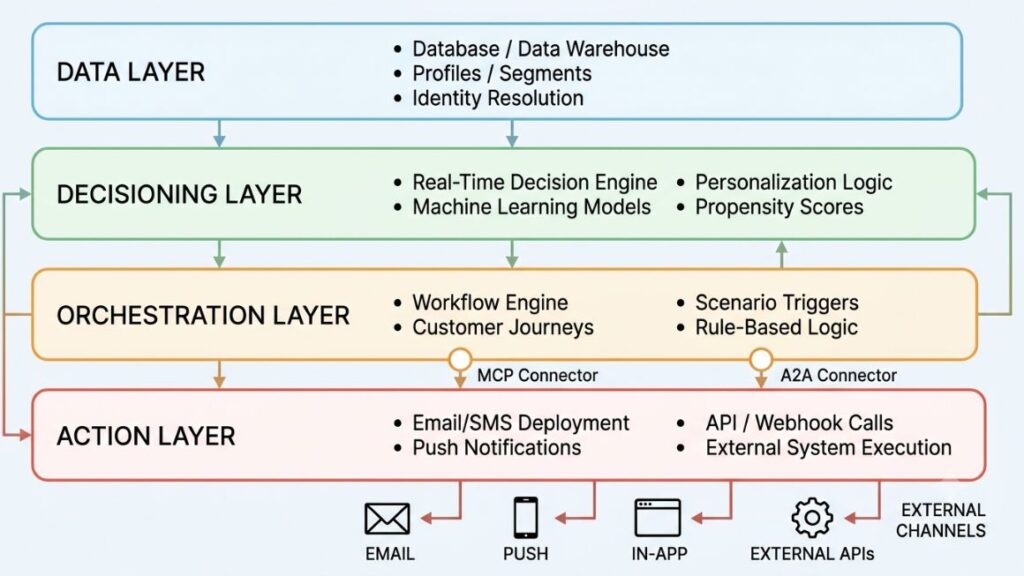
You don’t need to be technical to run a loyalty program, but you should understand the five layers underneath the agent you’re evaluating or building.
Customer and Loyalty Data Layer
This is the foundation: a unified customer profile pulling from your CRM, POS, app, and loyalty platform. If your data lives in five disconnected systems, the agent’s decisions will be only as good as the fragments it can see.
Intelligence and Decisioning Layer
This is where the LLM and predictive models sit, reasoning over the data to score propensity, predict churn, and generate next-best-action recommendations.
Agent Orchestration Layer
In more advanced setups, this isn’t one agent doing everything. It’s several specialized agents (one for offers, one for segmentation, one for fraud) coordinating through a framework, a pattern ThirdEye Data describes in its 2025 documentation of agentic loyalty assistants built on LangChain and LangGraph.
Action and Activation Layer
This is where the decision becomes a real-world action: an email sends, a push notification fires, a points balance updates, a support ticket resolves.
Feedback and Optimisation Loop
Mature agents don’t just execute and stop. They track what happened after the action and use that outcome to sharpen the next decision, which is the difference between a one-time automation and a system that actually improves.
Where LLMs, RAG, APIs, MCP and A2A Fit
Two open protocols are becoming the connective tissue here.
Model Context Protocol (MCP), introduced by Anthropic, standardizes how an agent connects to external data sources like your CRM or product catalog.
Agent2Agent (A2A), an open standard backed by Google and now hosted by the Linux Foundation, standardizes how one agent talks to another, so your loyalty agent can coordinate with a customer’s shopping agent or a payment agent without custom integration work for every pairing.
Together with UCP for transactions and AP2 for payments, these four protocols form what the industry is now calling the agentic commerce stack.
AI Loyalty Platforms and Agents to Know in 2026
You don’t need to build this from scratch. Here’s who’s actually shipping.
| Platform | Agent / Product | Known For |
| Capillary | aiRA | Conversational campaign setup, automated QA, agentic loyalty operator built on Loyalty+ |
| Antavo | Timi AI | AI Loyalty Cloud with a named AI persona for campaign planning |
| Exchange Solutions | Offer, Audience, Analytics and Insights Agents | Marketer-focused agent suite across personalization and competitive intelligence |
| Salesforce | Agentforce | Cross-functional service agents, proven in loyalty support at Finnair |
| Lyzr | Enterprise loyalty agents | Dynamic rewards and predictive churn re-engagement |
| Kognitiv | Pulse | AI-powered insights and lifecycle-change detection |
| NextBee | Smart Agents | Autonomous task execution layered onto loyalty engagement suites |
Capillary Technologies deserves a closer look if you’re building or buying in India. Headquartered in Bengaluru and listed on the NSE after a November 2025 IPO, Capillary serves over 410 brands across 47 countries and was named a Leader in Forrester’s Wave for Loyalty Platforms, Q4 2025.
Its agent, aiRA, handles conversational campaign configuration, automated testing before launch, and continuous optimization, and the company reports a 25% incremental ROI from what it calls “Generative Loyalty” along with a 70% acceleration in promotion execution time. Those are Capillary’s own reported figures, worth verifying against your own use case before you build a business case around them.

AI Loyalty in Practice: Real Examples and India Use Cases
Theory is easy. Here’s who’s actually running this in production.
Finnair and AI-Powered Loyalty Support
Finnair’s Sisu agent, live since April 2025 on Salesforce’s Agentforce, resolves 80% of chat-based service questions on its own, including loyalty-specific queries about gold-tier lounge access and baggage extras. The remaining 20% route to a human agent. Chief Digital Officer Antti Kleemola described it as a natural extension of a service team that already relied entirely on Salesforce, not a bolt-on chatbot.
Capillary’s aiRA in Enterprise Use
Capillary reports that one large conglomerate client now resolves 30% of its support queries end-to-end through aiRA, freeing human teams for higher-value retention work. The company also cites a 90% drop in production errors tied to automated QA before campaigns launch, which matters more than it sounds. Bad segment logic that used to slip into a live campaign now gets caught before it ships.
Exchange Solutions’ Loyalty Agents
Boston-based Exchange Solutions rolled out a second phase of AI agents in mid-2025 covering personalization, analytics, audience discovery and what it calls a Market Intelligence Agent. That monitors competitor loyalty moves and suggests positioning adjustments before a rival gains ground.
A Hypothetical AI Loyalty Workflow for an Indian D2C Brand
Picture a D2C skincare brand running a loyalty program mostly through WhatsApp, the way brands like Mamaearth and boAt already lean heavily on the channel for retention. An AI agent could monitor repurchase cycles by product category, flag a customer who’s two weeks past her typical reorder window, and trigger a WhatsApp nudge with a small points bonus timed to when she’s historically most responsive, all without a marketer manually pulling that list every Monday. This is hypothetical, not a documented case study. But it’s the exact shape of workflow the platforms above are already built to support.
Also Read: AI in eCommerce Marketing: Complete Guide to Growth, Personalization & ROI (2026)
Real-world deployments of an AI agent for loyalty marketing already show measurable results: Finnair resolves 80% of loyalty and service inquiries through its AI agent Sisu, and Capillary reports a 90% reduction in campaign QA errors and a 70% acceleration in promotion execution for enterprise clients using its aiRA agent.
How to Deploy an AI Agent for Loyalty Marketing?
Nine steps. Don’t skip the usual ones at the start, they’re the ones that determine whether this works.
Step 1: Define the Business Goal. Don’t start with “we want AI.” Start with “we want to cut 90-day churn by 15%” or “we want to reduce discount waste.” The goal shapes everything downstream.
Step 2: Audit Data Readiness. If your loyalty data, POS data and CRM data don’t talk to each other, fix that first. An agent built on fragmented data can make confidently wrong decisions.
Step 3: Choose One Use Case. Resist the urge to automate five things at once. Pick churn win-back or offer personalization, prove it works, then expand.
Step 4: Connect Your Existing Stack. Most platforms in the table above integrate through APIs with common CRM, CDP and loyalty systems. Confirm this before you sign a contract, not after.
Step 5: Define Guardrails. Set frequency caps, discount ceilings and eligibility rules the agent cannot cross, regardless of what it “thinks” is the right move.
Step 6: Add Human Approval for High-Stakes Actions. For your first few months, keep a human in the loop on anything above a certain discount threshold or reaching your highest-value members.
Step 7: Test Against a Control Group. Run the agent-driven cohort against a business-as-usual group. Without this, you’re guessing at incremental impact.
Step 8: Measure and Optimise. Review outcomes weekly at first, then monthly once the agent’s decisions stabilize and prove reliable.
Step 9: Scale to Additional Use Cases. Once one workflow is proven, expand into segmentation, cross-sell or fraud detection using the same guardrail-and-test discipline.
How to Measure the ROI of an AI Loyalty Agent?
Redemption rate alone won’t tell you if this is working. Track these four categories instead.
Retention and Churn Metrics
Track 90-day and 180-day churn rate for the agent-managed cohort against a control group. Netguru’s April 2026 analysis of AI-driven loyalty strategies reports churn reductions of up to 30% and customer lifetime value increases of up to 50% among brands running mature AI-driven loyalty programs. These figures vary widely by baseline maturity and shouldn’t be treated as a guaranteed benchmark for every implementation.
Revenue and Margin Metrics
Look at incremental revenue per member, not just total redemption volume, and watch margin per offer closely. An agent optimizing purely for engagement can quietly erode margin if you’re not watching this.
Reward Economics
Track breakage (unredeemed rewards) and liability on your books. An agent that’s too generous with points creates a financial exposure that shows up months later.
Agent Performance Metrics
Beyond business outcomes, measure the agent itself: decision accuracy against outcomes, false-positive churn flags, and how often human overrides were needed. This tells you whether to loosen or tighten your guardrails.
When You Don’t Need an AI Agent
Honestly, not every loyalty program needs this yet. That’s worth saying plainly.
When Rules-Based Automation Is Enough
If your member base is small, your offer catalog is simple, and a birthday email plus a tier-based discount covers your needs, a full agent is overkill. Save the investment.
When Predictive AI Is Enough
If you just need to know who’s likely to churn and you’re comfortable having a human decide the intervention, a predictive model without full agentic execution does the job, at a fraction of the complexity.
When Agentic AI Makes Sense
This makes sense once you’ve got member volume that makes manual personalization impossible, multiple channels to coordinate, and a team that’s bottlenecked on campaign ops rather than strategy. That’s the point where the “agentic AI marketing” investment starts paying for itself.
Risks, Privacy and Guardrails
None of this is risk-free, and any vendor pitching it as plug-and-play is skipping the hard parts.
Over-Personalisation
There’s a line between “this brand gets me” and “this brand knows too much.” Cross it and members disengage, or worse, they feel surveilled.
Margin Erosion
An agent optimizing purely for redemption or engagement, without a margin constraint built in, will happily discount its way to a great engagement chart and a terrible P&L. This is the single most common failure mode in early deployments.
Bad Data and Wrong Decisions
Garbage in, garbage out still applies. An agent making decisions on stale or fragmented data will make those decisions faster and at greater scale, which makes the mistake worse, not better.
Hallucinations and Incorrect Loyalty Information
LLM-based agents can generate confidently wrong answers, like telling a member their points expire on the wrong date. RAG (retrieval-augmented generation) and validation layers that check agent outputs against your actual system of record are non-negotiable here, not a nice-to-have.
Consent and Privacy
Stanford’s Digital Economy Lab and Consumer Reports launched a joint research initiative called Loyal Agents specifically because, as autonomy increases, agents risk being optimized for the vendor rather than the person they’re supposed to serve. That’s a real governance gap the industry is still working through.
Human Oversight and Auditability
Every serious platform in this space, from Exchange Solutions to Capillary, includes some form of explainability, meaning the agent can show why it made a decision, not just that it made one. If a vendor can’t show you this, ask harder questions.
Also Read: AI Personalization in Marketing: Strategies, Tools & Trends
India’s DPDP Framework and AI Loyalty
For Indian brands, this isn’t optional context. Under the Digital Personal Data Protection Act, 2023, the DPDP Rules were notified in November 2025, with the Consent Manager registration framework activating in November 2026 and full compliance with consent and notice obligations required by 13 May 2027, though the government has signaled the main compliance date could accelerate.
Consent has to be free, specific, informed and unambiguous, and it has to be provable if the Data Protection Board ever asks, per Section 6(10) of the Act. Practically, that means an AI agent using loyalty data for personalization needs to know exactly what each member consented to, and needs to honor a withdrawal instantly across every channel it touches. Build this into your data layer from day one. Retrofitting consent logic after your agent is already live is significantly harder.
India’s DPDP Act, 2023 requires free, specific, and provable consent for personal data processing, with full compliance obligations due by 13 May 2027. Any AI agent for loyalty marketing operating in India needs consent status built directly into its data layer, not bolted on afterward.
What AI Shopping Agents Mean for the Future of Loyalty
Loyalty Programs Becoming Agent-Readable
Expect loyalty terms, tier benefits, and point values to move toward structured, machine-readable formats so an AI shopping agent can evaluate them instantly, the same way a human scans a comparison table.
Offers Designed for Machine Decision-Making
Vague marketing language like “exclusive member perks” means nothing to an agent doing a value comparison. Expect offers to get more precise and quantifiable, because that’s what gets picked.
Multi-Agent Commerce
The near-term future looks like your loyalty agent negotiating directly with a customer’s shopping agent through A2A, checking eligibility, applying the right tier discount, and confirming the transaction, with no human on either side clicking anything.
The New Role of Human Loyalty Teams
None of this replaces loyalty marketers. It shifts the job from manually building segments and QA-ing campaigns toward strategy, creative direction, and deciding what the program should stand for in the first place. That part still needs a human.
Conclusion
Loyalty marketing is splitting into two audiences at once: the human member and the AI agent shopping on their behalf. An AI agent for loyalty marketing is how brands are handling the first half of that equation, automating the personalization, churn prevention, and campaign execution that used to eat up entire marketing ops teams. Start narrow. Pick one use case, get your data ready, and build guardrails before you build ambition.
The brands that get ahead here won’t be the ones with the flashiest agent demo. They’ll be the ones whose loyalty value is honest and legible enough that both a human and an algorithm choose them.
If you want to get hands-on with how these agents actually get built and deployed inside a real marketing stack, YUP’s AI Marketing course walks through the tools, prompting, and automation workflows marketers are using right now, including the Hotskill app for practicing these skills directly.
FAQ
What is an AI agent for loyalty marketing?
An AI agent for loyalty marketing is a software system that independently analyzes customer data and takes action. This involves sending a personalized offer or flagging churn risk, without a human configuring each individual step.
How is an AI loyalty agent different from a chatbot?
A chatbot answers questions when a customer or marketer asks something. An AI agent works proactively toward a goal while deciding and executing actions like campaign launches or churn interventions on its own.
How is AI different from traditional loyalty automation?
Traditional automation follows fixed and pre-set rules the same way for every member in a segment. An AI agent evaluates individual context and adjusts the action per person. It can learn from outcomes over time.
What data does an AI loyalty agent need?
It needs a unified view of customer purchase history, loyalty tier and points activity, engagement across channels and consent status. Fragmented or siloed data significantly weakens the quality of its decisions.
What can AI agents automate in loyalty marketing?
Onboarding sequences, segmentation, personalized offers, churn prediction and win-back, cross-sell recommendations, member support, fraud detection and campaign optimization are all live use cases today.
Can AI agents predict customer churn?
Yes. Predictive models score churn risk based on behavioral signals like reduced purchase frequency, and mature agents go a step further by automatically triggering a retention offer once that risk crosses a threshold.
Which platforms offer AI loyalty agents?
Capillary (aiRA), Antavo (Timi AI), Exchange Solutions, Salesforce (Agentforce), Lyzr, Kognitiv, and NextBee all offer AI agents built specifically for loyalty and engagement use cases as of 2026.
Are AI loyalty agents only for large enterprises?
Not exclusively, but most current deployments are enterprise-scale because that’s where the data volume and team bottlenecks justify the investment. Smaller D2C brands can start with a single and narrow use case on a lighter platform.
How much does an AI loyalty agent cost?
Pricing varies significantly by platform and scale, and most vendors in this space don’t publish flat rates publicly. Get a quote based on your member volume and the specific use case you’re starting with, rather than budgeting off a general estimate.
How do you measure AI loyalty ROI?
Track churn reduction and customer lifetime value against a control group, incremental revenue per member, reward breakage and liability, and the agent’s own decision accuracy, not just redemption rate alone.
Are AI loyalty agents safe for customer data?
They can be, if guardrails, consent tracking and human oversight are built in from the start. In India. This also means aligning with DPDP Act consent requirements before the agent ever touches personal data.
How will AI shopping agents affect loyalty programs?
As more purchases get brokered by AI agents acting for consumers, loyalty programs will need to make their value proposition machine-readable and precise, not just emotionally compelling to a human reading an email.