

Five years ago, a mid-sized marketing campaign needed a media buyer, a copywriter, a data analyst. Someone was needed to stitch their outputs together in a shared spreadsheet. Now a single agent reads the performance data, writes the ad copy and ships the campaign. That often happens before the marketer has finished their coffee. This shift is why so many teams are searching for the best AI agent for marketing right now, and why picking wrong is an expensive mistake.
The stakes are real. Teams that buy an agent because it demos well, rather than because it fits where their data already lives, tend to burn a quarter’s budget on a tool that never leaves the pilot stage. Gartner expects more than 40% of agentic AI projects to be shelved before 2027. That is mostly due to unclear value rather than broken technology. Choosing the right agent isn’t a nice-to-have. It’s the difference between a tool your team still uses in six months and another line item nobody wants to admit was a mistake.
This guide breaks down what an AI agent for marketing actually does. Discover why adoption has accelerated so fast in India and globally, what the best ones on the market look like side by side, and how to pick the one that fits your team instead of someone else’s case study.
Table of Contents
What Is an AI Agent for Marketing, and How Is It Different from a Chatbot or Automation Tool?
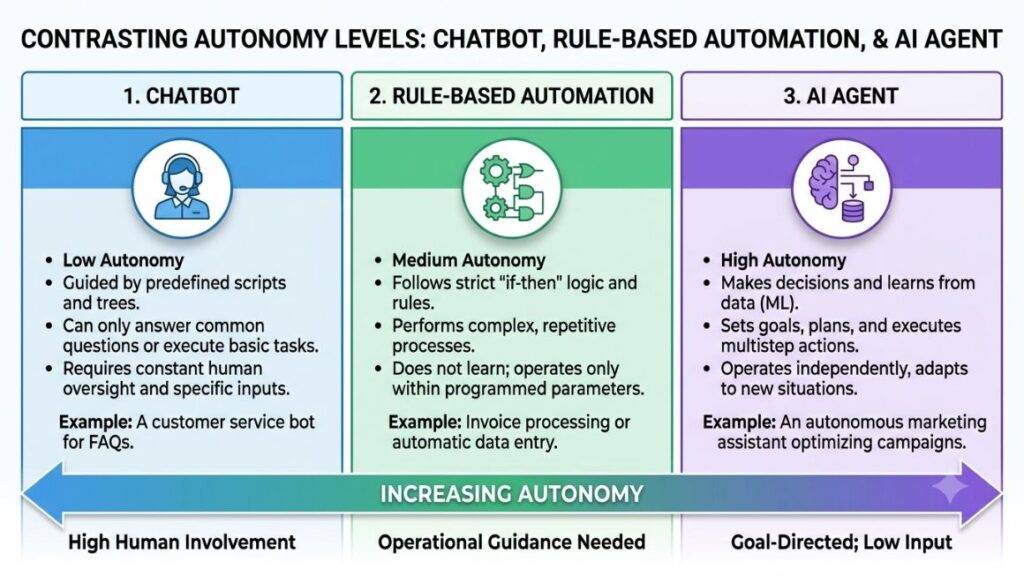
An AI agent for marketing is a system that plans a task, takes action across connected tools, and returns a finished result with minimal human input at each step. That’s the whole definition, and it’s worth sitting with, because most of what gets sold as “agentic” doesn’t clear that bar.
A chatbot answers a question and stops. Rule-based automation, the classic if-this-then-that setup most teams already run in their email platform, executes a fixed sequence and breaks the moment reality doesn’t match the rule. An agent does neither. It reasons about what to do next, calls on tools to do it, checks the result and adjusts. Ask a chatbot for last quarter’s paid social performance and it will describe what it can’t access. Ask an agent, and it pulls the numbers, builds the comparison, and flags the anomaly nobody had noticed yet.
Where this gets murky in practice is the marketing tool everyone already owns. Tofu HQ is one of the sharper voices writing on this distinction. It frames this as a spectrum rather than a hard line. Most “AI marketing” tools sit somewhere between assistant and agent. They’re offering suggestions a human still has to approve rather than completing the loop end to end. That’s a fair description of where the category was eighteen months ago. It’s less true now. The tools covered later in this guide increasingly close the loop themselves, from research through execution, which is exactly what separates this generation from the last.
An AI agent for marketing plans a task and takes action across connected tools. It delivers a finished result with minimal human input at each step. That sets it apart from a chatbot, which only answers, and from rule-based automation, which executes a fixed sequence and breaks when conditions change. The clearest sign a tool is genuinely agentic is whether it completes a workflow end to end rather than handing a draft back for a human to finish.
Why Marketing Teams Are Adopting AI Agents Right Now
Adoption of AI agents in marketing has gone from a curiosity to a default in under two years, and the numbers back that up from every direction: India, global enterprise, and marketing specifically.
In India, the shift has been unusually fast. According to an IDC InfoBrief commissioned by UiPath, around 40% of Indian organisations had already implemented agentic AI by mid-2025. More than 90% are expected to have deployed AI agents by the end of 2026. That puts India ahead of most Asia-Pacific markets on both intent and execution, not just intent. Globally, Gartner’s forecast is nearly as steep. 40% of enterprise applications will carry a task-specific AI agent by the end of 2026, up from under 5% in 2025, an eightfold jump in a single year.
Marketing specifically has moved from pilot to production faster than most other functions. Salesforce’s 2026 State of Marketing data shows that 34% of enterprise marketing teams now run at least one autonomous agent in production, more than double the 14% recorded in Q4 2025. That’s not a survey about intent to try AI. That’s a survey about agents already doing live work, unsupervised, inside real campaigns.
What’s driving the pace? Three pressures, mostly. Budget scrutiny means CMOs are asked to do more with flat or shrinking headcount, and 81% of them expect their AI tool spend to keep growing over the next year regardless. Always-on execution matters more when customers expect a response in minutes, not days, and an agent doesn’t sleep between shifts. And generative engine optimization, the practice of getting cited inside ChatGPT, Perplexity, and Google’s AI Overviews rather than just ranking on a results page, has become its own budget line as fewer searches send a click to any website at all.
Define the moment plainly: generative engine optimization, or GEO, is the practice of structuring content so AI answer engines cite it directly, rather than optimizing only for a ranked link a person has to click.
The Adoption Gap: Why 40%+ of Agentic Projects Still Get Cancelled
Here’s the honest counterweight to all that momentum. Gartner projects that more than 40% of agentic AI projects may be cancelled by the end of 2027. The reasons are consistent across every analysis: escalating costs, unclear business value and governance nobody built before launch. Only 21% of organisations have what Gartner calls a mature governance model for autonomous agents. 52% cite poor data quality as the biggest blocker to getting an agent into production at all.
That’s not a reason to wait. It’s a reason to be specific about what you’re buying and why, which is most of what the rest of this guide covers.
What the Best AI Agent for Marketing Should Actually Do
The best AI agent for marketing does five things well: it connects to the data you already have, it protects your brand voice while producing at volume, it scores and routes leads with enough precision that sales actually trusts the handoff, it reports on its own performance in language a budget meeting can use, and it’s built to be found and cited by the AI answer engines your customers are already asking instead of Google.
Most vendor pitches lead with autonomy. That’s the wrong first question. The right first question is integration depth. Does the agent read live data from the platforms your team already runs campaigns in, or does it need a fresh data pipeline built before it can do anything useful? An agent that reasons well but sees only half your channels will give you confident and incomplete answers. That is worse than no answer at all.
Brand-voice fidelity matters more as output volume climbs. A tool that writes fast but drifts from your tone by the fortieth piece of content isn’t saving you editing time, just moving it downstream. Lead-scoring accuracy is the same problem from the sales side: an agent that routes cold leads as hot ones erodes trust with your sales team faster than it builds pipeline. And reporting has to be something a marketer can hand to a CFO without translating it first, not a dashboard full of model confidence scores nobody outside the data team understands.
The fifth requirement is newer, and it’s the one most legacy tools weren’t built for. With over two in three U.S. Google searches now ending without a click, according to SparkToro’s clickstream research published in 2026, a marketing AI agent for digital marketing that only optimizes for search rankings is optimizing for a shrinking slice of how people actually find brands.
Read More: AI Agents for Content Marketing: How Autonomous Workflows Are Replacing Manual Content Ops in 2026
The 9 Best AI Agents for Marketing in 2026, Compared
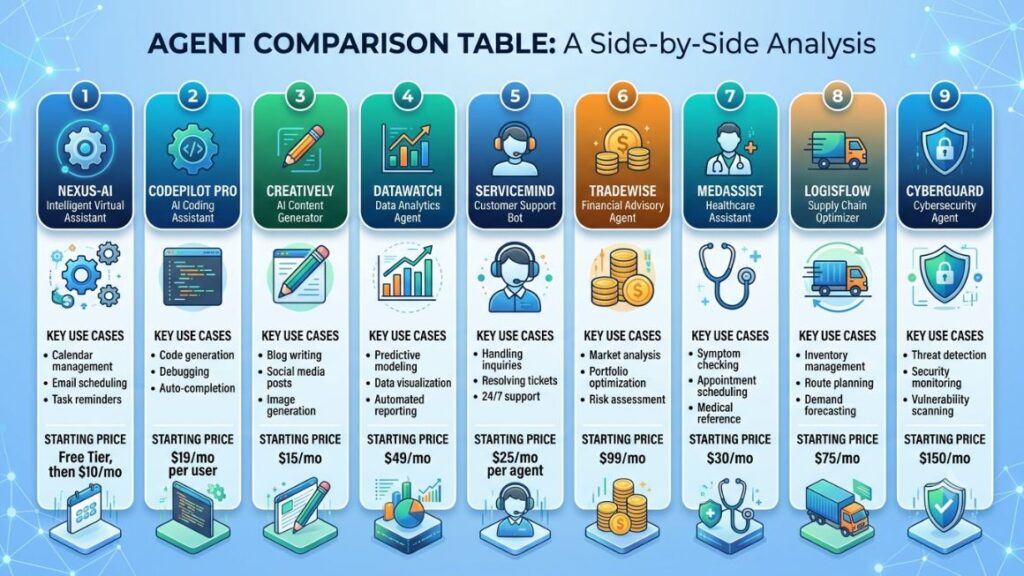
Nine platforms are worth a marketer’s serious attention in 2026, and the honest answer to “which is best” depends entirely on where your marketing data already lives. An agent built into a CRM reasons well about contacts and deals. An agent built on a unified marketing data layer reasons across paid, organic, email, and web performance at once. Those are different jobs, and no single platform does both equally well.
| Platform | Marketing use case | Best for | Starting price |
| Supermetrics AI | Cross-channel analysis, reporting, anomaly detection | Teams running paid, analytics, and CRM across multiple platforms | $44/mo billed annually |
| HubSpot Agent Hub | Support deflection, lead qualification, CRM answers | B2B teams already on HubSpot | Included with Pro/Enterprise; usage-based credits |
| Salesforce Agentforce | Campaign, loyalty, and checkout | Enterprise teams with data in Salesforce | ~$0.10/action or $2/conversation |
| Klaviyo AI | Campaign and flow creation, lifecycle service | Ecommerce and D2C brands on Klaviyo | $157/mo list for 16,000 Composer credits |
| Adobe Experience Platform Agents | Audience building, journey orchestration, experimentation | Enterprise teams on Adobe Experience Platform | Consumption-based; no public list price |
| Relevance AI | Custom agents and multi-agent workforces | Teams building agents for a specific workflow | Custom, not publicized |
| Copy.ai | GTM content and high-volume outbound workflows | Joint marketing and sales teams | Chat from $29/mo; workflows from ~$1,000/mo |
| Jasper | Brand-governed content, SEO and GEO | Content teams producing at volume under brand rules | $59/mo billed annually |
| Claygent | Company research, lead qualification, signal detection | B2B teams running account-based programs | Free tier; paid from $185/mo |
Pricing verified against vendor pages, August 2026.
Supermetrics AI
Supermetrics AI runs on data already unified from more than 170 marketing and sales sources, including Google Ads, Meta Ads, LinkedIn Ads, and GA4. That is why it’s a strong first stop for teams whose reporting questions span more than one platform. Three built-in agents handle most of the work. A Dashboard Agent that turns a plain-language question into a built report. An Insights Agent that explains what drove a performance change and flags anomalies before a human spots them. A Connector Agent that builds a new data integration in hours instead of the weeks an engineering ticket usually takes.
Example: The Economist used Supermetrics to centralize its online and offline marketing data, cutting collection and prep workload by 80%. That enabled faster budget reallocation off the back of more frequent analysis.
HubSpot Agent Hub
HubSpot Agent Hub is the console formerly known as Breeze Agents. It was launched in public beta in July 2026 for Professional and Enterprise customers. Its Customer Agent resolves 65% of inbound conversations across more than 8,000 customers. The Prospecting Agent researches accounts, scores leads and recommends outreach. The trade-off is the data foundation: Agent Hub reasons from HubSpot’s CRM record, so teams whose paid media performance lives elsewhere will still need a separate reporting layer alongside it.
Salesforce Agentforce
Agentforce’s marketing use cases center on customer experience personalization: campaign agents that brief and optimize against a marketer’s stated goals, loyalty agents that tailor offers to a member’s purchase history, and checkout agents that intervene to recover or expand a sale. Pricing runs on consumption rather than seats, roughly $0.10 per standard action through Flex Credits or around $2 per conversation on the legacy model, and the cost that catches most buyers off guard isn’t the agent itself but the Data Cloud layer it depends on to reason well.
Klaviyo AI
Klaviyo’s Composer agent audits live campaigns, flows, and segments, then returns a ranked list of revenue opportunities, an abandoned-cart flow nobody has revisited in months, say, and builds a launch-ready replacement staged for approval. Its Customer Agent completes returns and applies loyalty points across email, SMS and WhatsApp rather than just answering questions about them. The constraint worth flagging: Klaviyo’s predictions are built from ecommerce transaction data. So they’re far more accurate for D2C brands than for B2B or subscription businesses without that order history.
Adobe Experience Platform Agents
Adobe rebranded Experience Cloud as CX Enterprise at its April 2026 Summit. Agent Orchestrator has coordinated more than ten production agents across audience building, journey optimization, and experimentation. The Journey Agent, in particular, flags when multiple touchpoints are targeting the same customer. It catches the over-communication problem that most journey maps never surface on their own. Pricing runs entirely through consumption-based AI Credits with no public list price. So cost discovery goes through Adobe sales.
Relevance AI
Relevance AI is a build-your-own platform for teams whose workflow doesn’t match anything off the shelf. It is a reporting agent that pulls from three tools and posts a Slack summary, or a lead-qualification agent that checks a new form fill against ICP criteria before routing it. It supports human approval steps and offers more than 400 templates to start from. But reviewers consistently note that getting to a production-ready agent takes real setup time. Its dual-meter billing makes cost forecasting harder than a flat seat price would.
Copy.ai
Copy.ai has repositioned from a writing tool into a go-to-market platform. Its GTM agents research an account, draft the outreach, personalize it against CRM data and push the result back to Salesforce or HubSpot without a human triggering each step. Reviewers note that long-form output still needs substantial editing. T makes Copy.ai a stronger fit for short-form sequence work than for publish-ready long articles.
Jasper
Jasper’s agents target SEO and generative engine optimization specifically, holding brand voice and knowledge assets in what it calls Jasper IQ so output stays governed by brand rules rather than whatever a prompt happens to contain. It also measures how a brand shows up across AI answer engines, making it the clearest AI-search play among these nine, though its most useful agents sit behind a custom-priced Business tier.
Claygent
Claygent is deliberately narrow. It browses the public web to answer questions a database can’t, whether a target company runs a competing tool, or what a recent funding round implies about budget, and shows its sources for every answer it returns. It doesn’t send outreach or build campaigns. It’s the research layer that feeds a sequencer or CRM, which makes it a strong fit specifically for B2B teams running account-based programs at volume.
Read More: Agentic Marketing Platforms: The Complete Guide to AI Agents That Plan, Execute & Optimize Marketing
How a Fast-Growing Indian D2C Brand Would Realistically Use One of These
Picture a D2C skincare brand operating at roughly Mamaearth’s scale, running paid social, email, and a growing WhatsApp channel, with data scattered across Meta Ads Manager, Klaviyo, and a CRM nobody fully trusts. That team doesn’t start with an enterprise platform like Adobe or Salesforce. It starts with either Klaviyo AI, since lifecycle revenue is already the growth lever, or Supermetrics AI, to get one governed view across paid and email before deciding what to automate next. A quick-commerce operation at Zepto’s scale, by contrast, is optimizing for speed of decision over lifecycle depth, which points toward an agent layer built on live, cross-channel reporting rather than one built around a single customer record.
How to Choose the Right AI Agent for Your Marketing Team?
The right AI agent for marketing follows your data, not the other way around. Map where your marketing performance data already lives before comparing feature lists. Is it scattered across ad platforms and a CRM nobody trusts or already unified in one system of record? That single question eliminates half the shortlist before a demo call even happens.
Budget reality is the second filter, and it’s wider than most comparison charts show. Entry points range from free tiers, at Claygent and Relevance AI, through the $35 to $125 monthly range most SMB tools sit in, up to enterprise usage-based pricing that can run into six figures once the underlying data layer is included. Salesforce Agentforce’s $2-per-conversation model is the clearest example of how usage-based pricing can surprise a budget. It sounds simple until a single customer query triggers eight backend actions and the bill reflects that, not the conversation count a marketer expected.
Questions to Ask Before You Buy
Ask the vendor these five questions before signing anything. Treat a vague answer to any of them as information in itself.
- What data sources does this agent connect to natively, and what needs a custom build?
- Does pricing scale by seat, by action, or by completed outcome, and what does that look like at our actual volume?
- What happens when the agent is wrong, who reviews it, and how quickly can we intervene?
- Is this agent-washed, meaning does it actually take action, or does it draft something a human still has to execute?
- What’s the realistic time to first value, based on customers our size, not the best-case logo on the homepage?
Red Flags That Mean You’re Buying an “Agent-Washed” Assistant
Agent-washing is when a vendor markets an assistant, something that drafts and suggests, as though it were an agent that completes work end to end. The tell is usually in the demo: watch for language like “recommends” and “suggests” repeated more than “executes” and “resolves.” If every output still needs a human to copy, paste, and send it, you’ve bought a faster assistant, not an agent, and you should price it accordingly.
Read More: AI Agents for Agencies: Benefits, Use Cases & Best Tools (2026)
What Return Should You Actually Expect from an AI Marketing Agent?
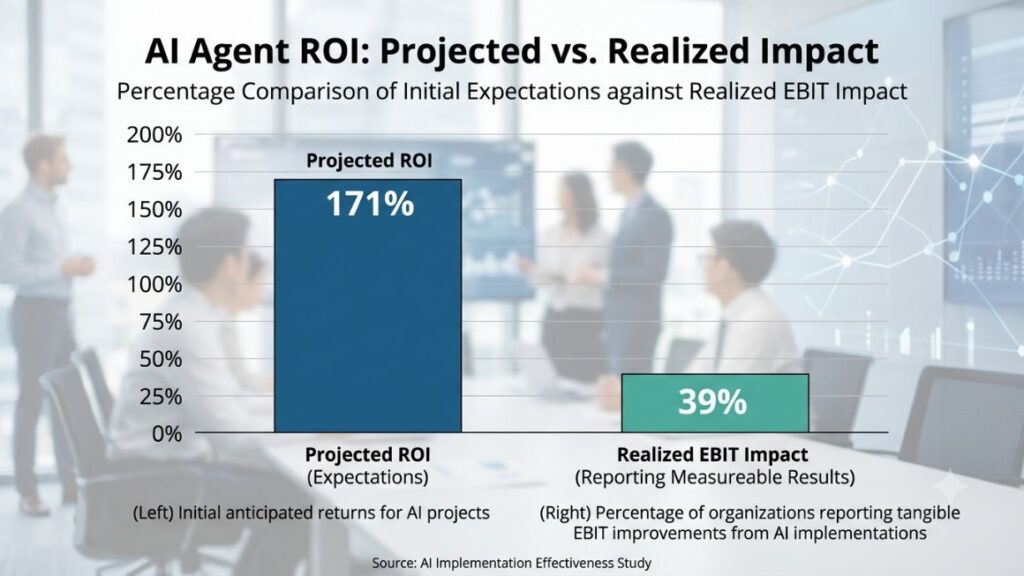
Organizations running agentic AI report an average ROI of 171%, with U.S. enterprises reporting closer to 192%, according to PagerDuty’s 2025 executive survey cited widely across 2026 market research. That’s the headline number every vendor deck will show you. The honest caveat matters more: McKinsey’s 2026 State of AI survey found that only 39% of organizations attribute any measurable EBIT impact to AI at all, and just 6% call that impact significant. The gap between projected and realized return is the real story of 2026, not the 171% average by itself.
Enterprises deploying agentic AI project an average return of 171%, rising to roughly 192% among U.S. enterprises, according to PagerDuty’s 2025 survey and McKinsey’s 2026 analysis. The catch is measurement discipline. Teams that set baseline metrics and a governance framework before deployment reach positive ROI roughly 2.4 times faster than teams that skip that step. That is a bigger predictor of realized return than the tool itself.
Timeline expectations need the same honesty. Gartner’s research shows roughly 29% of attempted agent deployments get abandoned within 90 days. That almost always happens because a pilot ran without a baseline measurement of the task it was meant to replace, or without anyone owning the outcome once the initial excitement faded. Teams that define what success looks like before the pilot starts, not after, are the ones still running their agent at day 180.
That’s the whole discipline, really: measure the manual process first, set the success threshold before deployment, and give one person accountability for the outcome. Skip any of those three and the 171% average is just a number in someone else’s case study.
How AI Agents Are Changing Marketing in India Specifically
India isn’t following the global AI agent story. In several respects, it’s ahead of it. Adobe’s 2026 AI and Digital Trends Report found that 60% of Indian consumers are interested in creating a personal AI agent, the highest figure recorded anywhere in Asia Pacific, and 55% said they’d already interact with a brand’s AI agent if one were offered to them. That consumer appetite is running well ahead of what Indian businesses currently expect from their own customers, which is an unusual gap in a market where consumer trust in new technology usually lags.
On the business side, Salesforce’s State of Sales India 2026 report found that 91% of Indian sales leaders who have deployed agents consider them business-critical, not experimental, and nine in ten sales teams are already using agents or plan to within two years. Indian sellers using agents expect research time to fall by roughly 34% and outreach drafting time by roughly 36%, freeing up exactly the hours that a lean Indian marketing or sales team usually doesn’t have.
Combine that with the IDC-UiPath finding that around 40% of Indian organisations had already implemented agentic AI by mid-2025, and the picture is consistent across every data source: India isn’t cautiously testing this category. It’s scaling it faster than most comparable markets, spending on AI technology in India projected to grow at an annualised 38% from 2023, reaching $10.4 billion by 2028.
What this means for an Indian marketing team is practical, not abstract. Global enterprise tools like Adobe Experience Platform and Salesforce Agentforce are built for organisations that already have a funded data layer underneath them, which is a real prerequisite most mid-sized Indian brands haven’t built yet. That’s exactly why a data-first agent like Supermetrics AI, or a platform-native one like HubSpot Agent Hub or Klaviyo AI, tends to be the more realistic starting point: less infrastructure to stand up before the agent does anything useful.
The Future of AI Agents in Marketing: What’s Next After 2026
Two shifts are already visible past the 2026 horizon, and both change what “best” means for the next wave of buyers.
The first is that generative engine optimization stops being an add-on and becomes a native requirement of every content and campaign workflow, not a separate project a team runs once a quarter. With over two in three searches now ending without a click, the agents that survive the next buying cycle will be the ones built to make a brand citable inside an AI answer, not just rankable on a results page that fewer people are scrolling through.
The second is the move from single-purpose tools toward what several 2026 industry reports are already calling multi-agent squads: a reporting agent handing context to a content agent, which hands a draft to a compliance agent, coordinated by an orchestrator rather than a human stitching outputs together by hand. Gartner’s own five-stage model for enterprise AI puts collaborative agents working inside applications by 2027 and agent ecosystems spanning platforms by 2028, which tracks with what the vendors covered in this guide are already previewing.
What should marketers build internal capability around now, ahead of that shift? Data hygiene, mostly. Every agent covered in this guide performs only as well as the data it’s grounded in, and the teams still stuck in pilot purgatory a year from now will overwhelmingly be the ones that never fixed fragmented, ungoverned marketing data before pointing an agent at it.
Conclusion
The best AI agent for marketing isn’t the one with the flashiest autonomy claims in its demo. It’s the one that already speaks the language of where your data lives, that your team will still be using in six month, and that you can defend in a budget review with a number, not a feeling. Start by mapping your data, not by shortlisting vendors and the right platform narrows itself down fast.
If you’re building the internal capability to make that choice well, and to actually run the tool once you’ve picked it, that’s exactly the gap YUP’s AI Marketing course and the Hotskill app are built to close. Both walk through the same evaluation discipline covered in this guide, applied to your own stack rather than a hypothetical one.
FAQ
What is the best AI agent for marketing right now?
There isn’t one universal answer. Supermetrics AI is the strongest pick for teams reporting across multiple platforms, HubSpot Agent Hub and Klaviyo AI suit teams already committed to those platforms, and Salesforce Agentforce or Adobe Experience Platform Agents fit enterprise teams with an existing, funded data foundation in that ecosystem.
Is an AI marketing agent the same as a chatbot?
No. A chatbot answers a question and stops. An AI agent plans a task, takes action across connected tools, and returns a completed result, like a built report or a launched campaign, with minimal human input along the way.
How much does an AI agent for marketing cost?
Entry points range from free, at Claygent and Relevance AI, to around $44 per month for Supermetrics AI’s Starter plan, up to enterprise usage-based pricing that can run into six figures once the underlying data layer is included. Always price the platform the agent depends on, not just the agent’s own subscription line.
Do I need an AI agent if I already use marketing automation software?
Probably, if your current automation is rule-based rather than reasoning-based. Traditional marketing automation software executes a fixed sequence that breaks when conditions change. An agent adapts to the specific situation it’s handling, which is the gap most teams are trying to close by adopting one now.
Can AI agents replace a marketing team?
Not the whole team, and not yet. What agents do reliably is remove repetitive research, reporting, and drafting work, freeing marketers for strategy, judgment calls, and relationship work an agent still can’t do well. Teams using agents are restructuring roles around that split, not eliminating the roles outright.
How long does it take to see ROI from an AI marketing agent?
It varies by how disciplined the rollout is. Teams that set a baseline metric and a clear success threshold before deployment reach positive ROI roughly 2.4 times faster than teams that skip that step. Without that discipline, Gartner’s research shows roughly 29% of deployments get abandoned within the first 90 days.
What’s the biggest risk in adopting an AI agent for marketing?
Buying an agent-washed assistant, a tool that drafts and suggests rather than completing work end to end, and paying agent-level pricing for it. The second-biggest risk is skipping baseline measurement, which makes it impossible to prove the agent’s value even when it’s genuinely working.
Which AI agent is best for small teams vs. enterprise?
Small teams generally get more value from platform-native agents already included in a tool they use, like Klaviyo AI or HubSpot Agent Hub, since there’s no separate data layer to fund. Enterprise teams with existing Salesforce or Adobe investments get more from the agents built into those ecosystems than from adding a new standalone vendor.
Do AI marketing agents work for Indian D2C and B2B brands?
Yes, and Indian adoption is currently outpacing several larger markets. Over 90% of Indian organisations are expected to have deployed AI agents by the end of 2026, and 91% of Indian sales leaders already using agents consider them business-critical rather than experimental.
What should I check before signing up for an AI marketing agent?
Confirm what data sources the agent connects to natively, how pricing actually scales at your volume, who reviews its output before anything goes live, and whether the vendor can name a customer your size who reached measurable ROI, not just a logo from a case study.